





Craft vs Industrial Spirits: What’s the Real Difference?
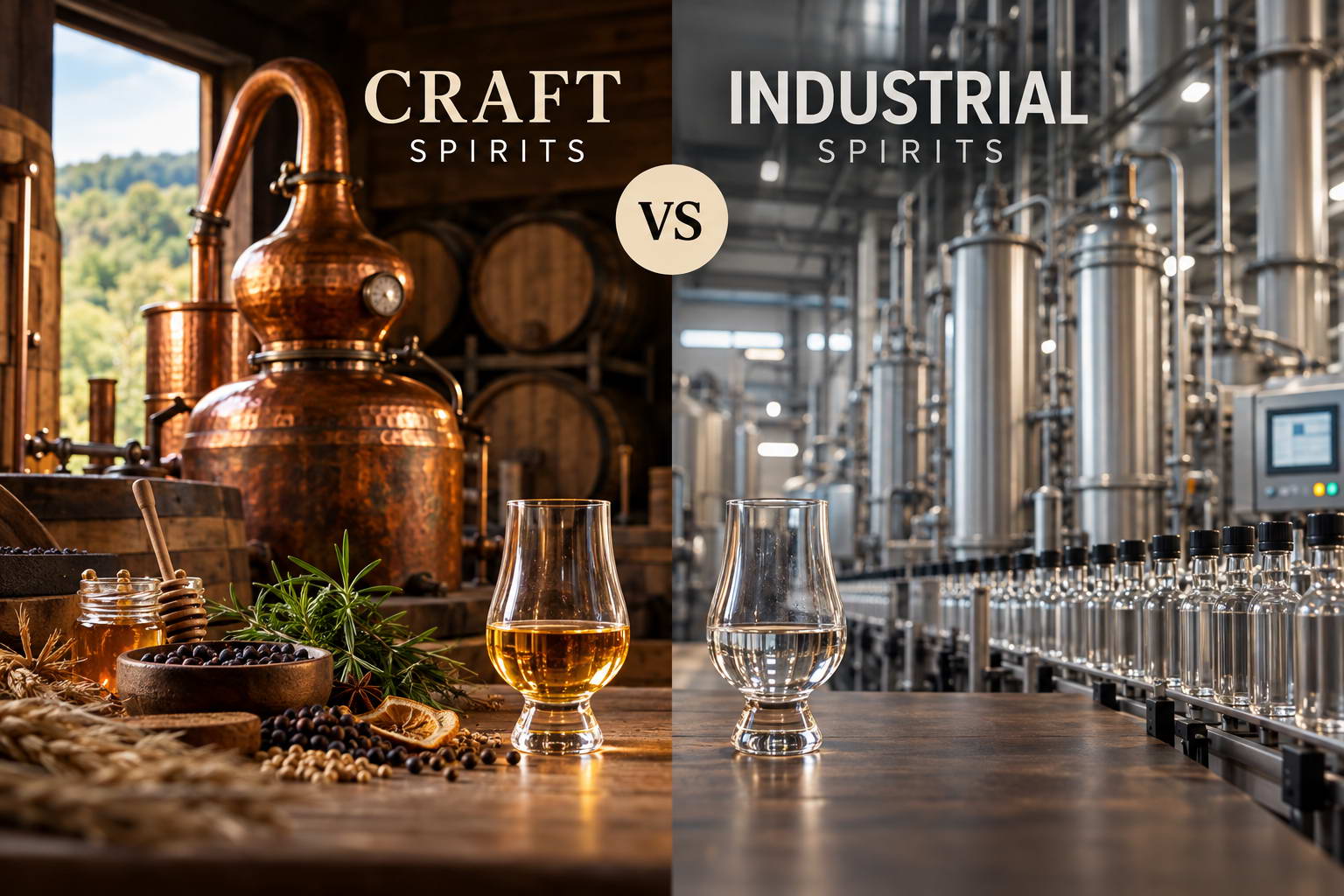
The word “craft” is everywhere today.
Craft beer.
Craft gin.
Craft distillate.
Craft liqueur.
Craft rum.
And it is very easy to start treating the word craft itself as a sign of higher quality.
At the same time, industrial production is often imagined as something faceless, cheap and heavily standardised.
But reality is much more complicated.
Craft alcohol is not automatically better, and industrial alcohol is not automatically worse.
The real differences are more often about production scale, flexibility, recipe freedom, batch consistency and the way the producer approaches the product.
What Does “Craft Alcohol” Actually Mean?
There is no single universal definition that works equally well in every country and every spirits category.
In everyday use, craft alcohol usually refers to products made:
- in relatively small batches;
- by a smaller producer;
- using an original or proprietary recipe;
- with closer control over individual production stages;
- with more freedom to adjust the process;
- without the need to produce millions of identical bottles.
So craft is primarily an approach to production, not a flavour and not a guarantee of quality.
What Is Industrial Alcohol?
Industrial production is focused on larger volumes and consistency.
For a major brand, it is extremely important that the customer receives a very similar product:
- today;
- next month;
- in another country;
- from another production batch.
This requires:
- standardised raw materials;
- precise production parameters;
- large-scale equipment;
- automation;
- systematic quality control;
- consistent blending.
None of this is a disadvantage by itself.
Is Scale the Main Difference?
Scale is one of the main differences, but not the only one.
Large-scale production has to solve very different problems.
For example, if a small distillery produces several hundred or several thousand bottles, it can change a recipe relatively easily.
If a brand sells millions of bottles, even a small recipe change becomes a major production decision.
So large scale naturally encourages standardisation.
Does a Small Batch Mean Better Control?
Potentially, yes.
With a smaller batch, a producer may be able to follow a specific production cycle more closely.
For example, they may:
- inspect raw materials more carefully;
- monitor fermentation closely;
- make more precise cut decisions;
- adjust the recipe;
- work separately with individual barrels.
But small scale itself does not guarantee that this control actually happens.
A small producer can also make technological mistakes.
Does Large-Scale Production Mean Less Control?
Not necessarily.
In fact, large producers often have:
- laboratory control;
- automated measuring systems;
- standardised procedures;
- temperature control;
- traceability systems;
- strict technical protocols.
So the level of control can be extremely high — it is simply organised differently.
How Does the Approach to Raw Materials Differ?
A craft producer often has more freedom to work with unusual, seasonal or local raw materials.
These may include:
- specific fruit varieties;
- local grain;
- different types of honey;
- seasonal berries;
- herbs;
- botanicals.
Because the batch size is smaller, the producer does not need to secure thousands of tonnes of perfectly identical raw material.
Why Is Unusual Raw Material Harder for a Large Producer?
Because of volume.
If a brand needs to produce hundreds of thousands of identical bottles, it needs raw materials in very large quantities.
Those materials must be:
- available;
- consistent;
- predictable in price;
- easy to source and transport.
That is why large producers often rely on more standardised ingredients.
Does Local Raw Material Automatically Taste Better?
No.
Local origin alone is not a sensory advantage.
But it can add individuality to a product.
For example, different types of honey can create different aromatic profiles in a distillate.
We discussed this separately in the article “Why Do Different Types of Honey Create Different Aromas in Distillates?”.
Why Does Craft Production Experiment More Often?
Because the cost of experimentation is lower.
A small batch can be:
- seasonal;
- experimental;
- limited;
- a test release.
If the result is interesting, the idea can be developed further.
If it does not work, the producer does not need to rebuild a huge production system.
What Kind of Experiments Are Possible?
For example:
- a new raw material;
- a different yeast strain;
- a different fermentation time;
- an unusual botanical combination;
- a different distillation regime;
- another type of oak;
- ageing in ex-wine casks;
- finishing;
- an unusual final ABV.
This is why small producers often create products that are harder to find in large international ranges.
Do Large Brands Experiment Too?
Yes.
Sometimes very actively.
Large companies may have enormous resources for research, laboratories, barrel programmes and test releases.
The difference is that bringing an experimental product into full-scale distribution usually requires much more preparation.
What Matters More: Handwork or Technology?
This is a false opposition.
High-quality alcohol can combine:
- manual control;
- mechanisation;
- automation;
- laboratory measurement;
- sensory evaluation.
Automation does not mean low quality.
And handwork does not automatically make a product better.
How Important Is Distillation?
Very important.
In distilled spirits, the distillation method strongly affects the character of the final drink.
Relevant factors include:
- type of still;
- distillation speed;
- number of distillations;
- cut selection;
- temperature regime;
- characteristics of the original raw material.
We discussed the difference between distillation and the production of a more neutral spirit in the article “How Is Distillation Different from Rectification?”.
Is Craft Alcohol Always Made in a Copper Alembic?
No.
Copper pot stills are strongly associated with traditional craft distillation, but they are only one type of equipment.
There are many possible configurations:
- pot stills;
- column stills;
- hybrid systems;
- different reflux configurations.
The final result depends not only on the equipment, but also on how the producer uses it.
Does Multiple Distillation Mean Better Quality?
Not automatically.
Additional distillation can make the spirit cleaner and lighter.
But at the same time, some of the aromatic character of the raw material may be lost.
So the important question is not how many times the spirit was distilled, but what style the producer wanted to create.
How Does a Craft Producer Work with Cuts?
In smaller production, the distiller may rely on a combination of measurements and sensory evaluation for each individual run.
The cut points may be adjusted slightly depending on:
- raw material;
- fermentation;
- temperature;
- the profile of the specific batch.
This can allow more flexibility.
How Does a Large Distillery Handle the Same Process?
The process is usually more strongly standardised.
The goal is predictable results at high volume.
That means using clearly defined production parameters and control points.
This reduces variation between batches.
Which Is Better: Consistency or Uniqueness?
That depends on what the buyer wants.
One person may want to open a new bottle and get exactly the same flavour they enjoyed last year.
Another may enjoy noticing small differences between batches.
The first preference aligns more closely with highly standardised production.
The second is more commonly associated with craft products.
Is It Normal for Craft Batches to Differ Slightly?
Yes, when the differences come from controlled natural variation.
For example, honey from one season may differ slightly from another.
Fruit also varies from harvest to harvest.
In small batches, these differences may remain more noticeable.
Some buyers see that as an advantage.
Others prefer greater consistency.
Does Consistent Flavour Mean a Product Is “Artificial”?
No.
Consistency can be the result of very sophisticated production work.
A producer may blend different batches in such a way that the final profile remains almost identical.
This is a difficult skill that requires experience and control.
What Is Blending?
Blending is the process of combining different components to create a desired final profile.
A producer may combine:
- different batches;
- different barrels;
- different ages;
- different types of maturation;
- different distillates.
Blending is not simply a way to “hide bad alcohol.”
In many categories, it is a separate craft in its own right.
Do Craft Producers Blend Too?
Of course.
The scale may simply be smaller.
For example, several barrels can be combined to create a more balanced result.
Or parts of the same distillate can be matured in different types of oak and later blended together.
Example: Honey Spirit Aged ENTUZIAST
With Honey Spirit Aged ENTUZIAST, the idea of the product is not based only on ageing time.
Different types of casks are involved: French oak previously used for Tempranillo/Garnacha, Ukrainian oak, and an Oloroso cask finishing stage.
This is an example of an approach where the producer works with several different components of the profile rather than relying on one standardised maturation scheme.
Is Craft Alcohol Always More Expensive?
Often, but not always.
Small-scale production has different economics.
Each bottle may carry higher costs for:
- raw materials;
- manual labour;
- equipment;
- packaging;
- logistics;
- certification;
- storage.
Large-scale producers benefit from economies of scale.
What Are Economies of Scale?
When a producer makes very large volumes, many costs are spread across a greater number of bottles.
For example:
- bulk purchasing of raw materials;
- automated bottling;
- large-scale logistics;
- mass-produced packaging;
- higher equipment productivity.
This means a large producer can sometimes offer a very high-quality product at a relatively accessible price.
Does a High Craft Price Guarantee Quality?
No.
The price may be high simply because production is small.
It may also include:
- expensive packaging;
- manual bottling;
- small production runs;
- expensive raw materials;
- marketing;
- brand positioning.
So price should always be evaluated together with the product itself.
Does the Word “Craft” on the Label Guarantee Anything?
Not by itself.
This is important to remember.
The word may honestly describe the producer’s approach.
Or it may simply be part of the marketing message.
So instead of focusing on the word, look for specifics:
- who the producer is;
- what raw materials are used;
- what production method is used;
- where distillation takes place;
- how maturation is handled;
- what the producer actually does in-house.
How Should You Read “Small Batch”?
As a description suggesting that the product is released in relatively small production runs.
But there is no universal number of bottles after which a batch stops being “small.”
For one producer, 500 bottles may be a large release.
For another, 10,000 bottles may still be small compared with its main production volumes.
What About “Handcrafted”?
The situation is similar.
It is better to treat the word as a reason to learn more.
For example:
- what exactly is done by hand;
- whether each distillation is individually controlled;
- how barrels are managed;
- how batches are assembled.
Without this context, the word does not tell you very much.
Is Craft Alcohol Less Filtered?
Sometimes.
Some small producers deliberately use minimal filtration to preserve more aromatic and textural components.
This can affect:
- aroma;
- oiliness;
- clarity;
- how the drink behaves when chilled.
But minimal filtration is not automatically an advantage.
Why Can Gin Turn Cloudy?
If a gin contains a lot of natural essential oils from botanicals, strong chilling or dilution can sometimes cause slight cloudiness.
This is not necessarily a defect.
We discussed this in the article “Why Does Gin Turn Cloudy After Chilling or Adding Ice?”.
Example: MeadGIN ENTUZIAST
MeadGIN ENTUZIAST is an example of a signature approach to gin where honey distillate is used instead of a completely neutral spirit base.
So the character comes not only from juniper and other botanicals, but also from the spirit base itself.
Decisions like this are easier to implement in smaller signature batches, where the producer does not have to adapt the recipe to enormous global volumes.
Does a Signature Recipe Mean Better Quality?
No.
It simply means the concept is more individual.
A signature recipe can be:
- excellent;
- bold;
- unusual;
- or simply unbalanced.
The final result still has to be judged on its own merits.
What Can Industrial Alcohol Do Better?
Often — consistency.
Large producers can be extremely good at reproducing the same profile again and again.
This is a major advantage when a buyer wants:
- predictable flavour;
- stable quality;
- broad availability;
- a clear and consistent price.
What Can Craft Alcohol Do Better?
Often — individuality.
A small producer may be able to use:
- narrow specialisation;
- local raw materials;
- rare botanicals;
- unusual barrels;
- experimental batches;
- more frequent recipe changes.
But again, this is a possibility, not a guarantee.
Which Is Better for Cocktails?
Both craft and industrial spirits can work very well in cocktails.
It depends on the recipe.
A bartender may sometimes need maximum consistency.
In another case, a distinctive signature distillate may be more interesting because it gives the cocktail its own character.
Which Is Better for Drinking Neat?
There is no universal answer here either.
For neat tasting, the important characteristics are:
- aroma;
- cleanliness;
- texture;
- balance;
- finish.
Production scale does not directly determine any of these qualities.
Can an Industrial Product Be Complex?
Yes.
Large scale does not prevent a producer from using:
- complex blends;
- long maturation;
- different barrel types;
- precise distillation control;
- an experienced production team.
So treating “mass-produced” as a synonym for “simple” is incorrect.
Can a Craft Product Be Simple?
Yes.
Sometimes simplicity is the goal.
A producer may deliberately create a clean distillate with minimal intervention in order to show the raw material clearly.
Complexity is not a requirement for a good product.
Is Craft Alcohol Worth Paying More For?
If you are interested in:
- unusual recipes;
- local raw materials;
- small batches;
- individual style;
- experiments with maturation,
a craft product may be more interesting to you.
But if your priority is a stable, familiar profile and strong value for money, a large producer can also be an excellent choice.
How Should You Choose Between Craft and Industrial Spirits?
Do not start with the word Craft.
Look at the product itself.
Ask:
- What is it made from?
- Who actually produces it?
- What technology is used?
- Does the producer make its own distillate?
- Does the producer explain the process?
- Is the product aged?
- What is the intended style?
- How do I plan to drink it?
Can You Tell Any of This from the Label?
Partly.
A label can tell you:
- the producer;
- ingredients;
- product type;
- ABV;
- country of origin;
- ageing information;
- sometimes details of the production method.
We explained how to interpret this information in the article “How to Read the Label on a Strong Alcoholic Drink”.
What About Age?
A craft product does not have to be older to be better.
And an industrial product does not become better simply because there is a large number on the label.
We discussed this in “Should You Choose Alcohol by Its Age?”.
What About ABV?
Strength does not tell you whether a product is craft or industrial, and it is not a direct measure of quality either.
For more detail, see “What Does 40% ABV Mean and Does It Indicate Quality?”.
Craft vs Industrial: Which Has More Marketing?
Marketing exists everywhere.
Large brands use large-scale advertising campaigns.
Craft brands often sell a story:
- small production;
- handwork;
- local raw materials;
- signature recipes;
- the founder’s story.
Both approaches are completely normal.
The important thing is to separate the brand story from the actual characteristics of the drink.
What Matters More Than the Word Craft?
Much more important are:
- quality of raw materials;
- clean fermentation;
- competent distillation;
- good cut selection;
- water quality;
- barrel management;
- balance;
- aroma;
- texture;
- finish.
In Short: What Is the Real Difference?
- Craft production usually works with smaller batches.
- It often has more freedom for experimentation.
- Small producers can more easily use local or unusual raw materials.
- Industrial production is more strongly focused on consistency and scale.
- Large producers often have very high levels of automated and laboratory control.
- A craft product is not automatically better.
- An industrial product is not automatically simpler or worse.
- Small Batch, Craft and Handcrafted are not quality scores by themselves.
- Small batches may naturally vary slightly from one another.
- The most important thing is to evaluate the product itself, not the size of the company that made it.
Conclusion
The real difference between craft and industrial spirits is not a simple opposition between “good” and “bad.”
They are two different approaches to production.
A large producer usually aims for consistency, repeatability and high volume.
A smaller producer may have more room for experimentation, local ingredients and individual decisions.
Both approaches can produce excellent spirits.
And both can produce mediocre ones.
So the word Craft on a label should be treated not as a mark of quality, but as a clue about the format of production.
In good spirits, what matters is not the size of the distillery, but how well the producer works with raw materials, fermentation, distillation, maturation and the final balance of the drink.