





Why do different types of honey give different aromas to the distillate?
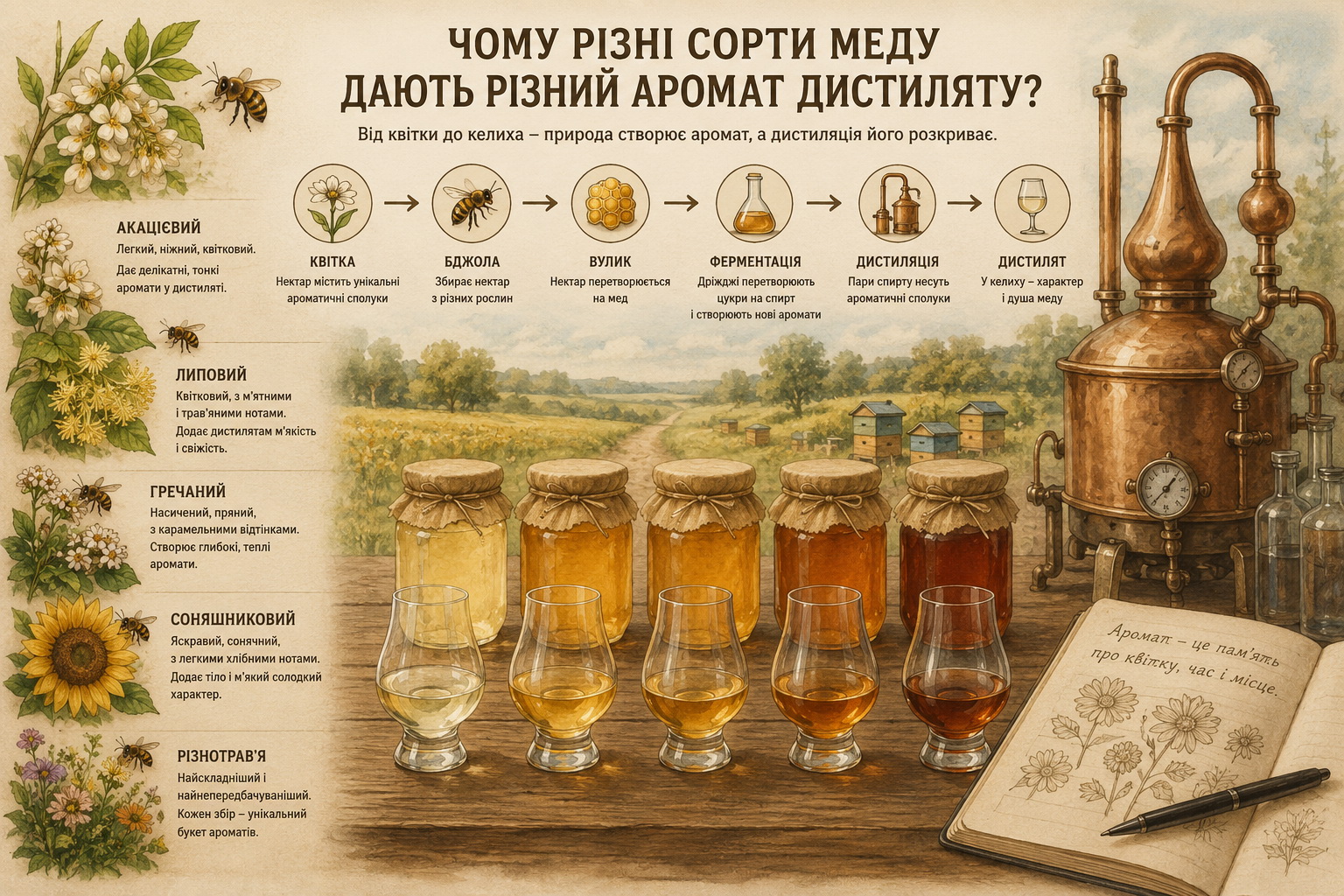
It all starts not in the distillery
Imagine two beekeepers. One works among white acacia groves, where in spring the air is filled with a delicate floral aroma. The other tends the apiary near endless buckwheat fields, which smell thick, tart and slightly spicy at the end of summer. Both collect natural honey, both take their work seriously, but the result of their work will be completely different even before the honey reaches the distillation cube.
This is one of the greatest features of honey distillates. Their character is not born only during fermentation or distillation. It begins much earlier - on the flower to which the bee has flown.
Bees collect more than just nectar
You can often hear that honey differs only in color or sweetness. In fact, it is a much more complex product. Along with nectar, bees carry dozens of natural aromatic substances, essential oils, organic acids, and other compounds specific to the plant from which the nectar was collected to the hive.
That is why acacia honey will never resemble buckwheat honey, and linden honey is easy to recognize even with your eyes closed. Each variety has its own aromatic “handwriting,” which becomes the basis of the future distillate.
Fermentation does not destroy the aroma — it changes it
There is a widespread belief that after fermentation, almost nothing remains of the honey aroma. This is not entirely true.
Yeast does not simply convert sugars into alcohol. During fermentation, they create dozens of new aromatic compounds — esters, aldehydes, and higher alcohols. They are responsible for the fruity, floral or even spicy shades of the future drink.
The master distiller does not work with the aroma of fresh honey, but with a new palette that nature itself created together with the fermentation process.
Distillation is the art of selection
Some imagine distillation as a simple process of obtaining alcohol. In fact, it is more like the work of a jeweler.
During distillation, the distiller carefully separates the fractions, leaving only the part where the purest and most pleasant aromatic components are concentrated. It is this decision that determines whether the future distillate will retain the light floral shades of acacia, the characteristic freshness of linden or the rich character of buckwheat honey.
Acacia - elegance and lightness
Acacia honey is considered one of the most delicate. It gives the distillate subtle floral notes, light sweetness and an extremely soft aroma. Such drinks seem airy and elegant, opening gradually, sip by sip.
Linden - the aroma of summer
Linden honey has a more expressive character. It can be found in shades of wild herbs, dried flowers, light menthol freshness and a warm honey aftertaste. Distillates from such honey often seem more rounded and multi-layered.
Buckwheat - a character that is impossible to confuse
Buckwheat honey does not try to please everyone. Its aroma is rich, spicy, sometimes even earthy. That is why distillates from it come out bold, complex and very recognizable.
For some it is love at first sip, for others it is a drink that you need to grow up to. But buckwheat honey leaves almost no one indifferent.
Even the same honey is never the same
Nature does not work according to a template. The aroma of honey is influenced by the weather, the amount of sun, humidity, region, soil composition and even the duration of plant flowering. Therefore, acacia honey collected this year may differ noticeably from last year.
That is why honey distillates are somewhat reminiscent of great wines. Each season leaves its own character in the drink, which cannot be completely repeated.
Why is this important for a connoisseur?
Understanding the origin of honey changes the very approach to tasting. You start to pay attention not only to the strength or aftertaste, but also to where the raw materials come from, what plants formed its basis, and how they manifested themselves after fermentation and distillation.
That's when the tasting turns into a journey - from the flowering field to the glass.
Conclusion
Honey distillate is the result of the cooperation of nature and man. Bees collect nectar, plants form the future aroma, yeast creates new shades of taste, and the master distiller carefully preserves them during distillation.
Each variety of honey tells its own story. Acacia - light and elegant, linden - warm and floral, buckwheat - rich and bold. That is why there are almost no two identical honey distillates. And perhaps this is the best reminder that great drinks are born not only thanks to technology, but also thanks to nature, which never repeats itself.