




How to Read the Label on a Strong Alcoholic Drink
A bottle of strong alcohol may contain dozens of words, numbers and designations.
Brand name, type of drink, strength, volume, country of origin, ingredients, age statement, batch number, serving recommendations — all of this can quickly turn into information overload.
Especially when the producer actively uses marketing terms such as:
- premium;
- craft;
- reserve;
- small batch;
- special edition;
- handcrafted;
- select.
Some information on the label can genuinely help you understand what is inside the bottle.
Other wording tells you more about brand positioning than about the drink itself.
That is why it is useful to learn how to separate technical information from marketing language.
Where Should You Start?
Not with the attractive name and not with the colour of the label.
First, look for several basic details:
- what type of drink it is;
- its alcohol strength;
- who produced it;
- where it was produced;
- the bottle volume;
- what is listed in the ingredients;
- whether there is information about ageing or production method.
This already tells you much more than a large logo on the front label.
The Most Important Wording Is the Type of Drink
First of all, you need to understand what you are actually buying.
The label may indicate categories such as:
- gin;
- whisky or whiskey;
- brandy;
- rum;
- vodka;
- liqueur;
- spirit drink;
- distilled spirit;
- infusion;
- spirit-based drink;
- distillate.
This is more important than a fantasy product name.
The brand name can be almost anything, while the category gives you at least a basic idea of the technology and style.
What Does ABV Mean?
ABV means Alcohol by Volume.
It is the proportion of ethyl alcohol in the drink by volume.
For example:
40% ABV means that approximately 40% of the drink’s volume is ethyl alcohol.
On some labels this may also be written simply as:
40% vol.
or:
alcohol 40%.
ABV tells you the strength of the drink, but it does not directly tell you anything about quality.
Two spirits at the same 40% ABV can feel completely different.
Is 40% ABV High or Low?
For strong spirits, it is a very common level.
But the number itself does not tell you how “harsh” the drink will feel.
The perception of alcohol is influenced by:
- the composition of aromatic compounds;
- the type of distillate;
- texture;
- temperature;
- the presence of sugar;
- ageing;
- aromatic balance.
That is why a 43% spirit can sometimes feel smoother than another drink at 40%.
We will look at this topic separately in the next article in this series.
Can You Judge Quality by Alcohol Strength?
No.
A higher ABV does not automatically mean higher quality.
And a lower ABV does not mean the drink is worse.
ABV is a technical characteristic.
It helps you understand alcohol concentration, but it does not measure:
- raw material quality;
- distillation quality;
- aroma;
- balance;
- finish;
- quality of ageing.
Why Should You Read More Than the Front Label?
The front label mainly sells an image.
The back of the bottle often contains much more useful information.
It may include:
- the full product category;
- ingredients;
- producer;
- production address;
- importer;
- country of origin;
- alcohol strength;
- volume;
- batch number;
- storage conditions.
That is why it is worth literally turning the bottle around before buying it.
What Can You Learn from the Ingredients?
The ingredients help you understand what the drink is built from.
For example, they may include:
- distillate;
- water;
- sugar;
- honey;
- infusions;
- juices;
- plant ingredients;
- aromatic components.
But ingredients should not be interpreted too simplistically.
For example, the word “honey” in the origin of a distillate does not mean the final spirit must be sweet.
During distillation, sugars do not normally pass into the distillate.
That is why a honey distillate can be completely dry.
We discussed this in more detail in the article “Why Aren’t Honey Distillates Sweet?”.
If It Says “Honey,” Does That Mean Sweet?
Not necessarily.
This is a good example of why a label should not be interpreted only through associations.
Honey can be used as a fermentation raw material.
After fermentation, the material is distilled.
Under normal distillation conditions, the sugar stays behind and does not pass into the distillate.
The final drink may retain honey-like aromatic associations, but that is not the same as actual sweetness.
What Does “Distillate” Mean?
A distillate is the product obtained by distilling fermented raw material.
The raw material may include:
- grapes;
- grain;
- fruit;
- honey;
- other fermented products.
The origin of the distillate can significantly influence the aroma and character of the final drink.
How Is Distillate Different from Rectified Spirit?
In simple terms, distillation can preserve much more of the character of the original raw material.
Rectification is aimed at producing a more neutral spirit with a high degree of purification.
That is why information about the base of a drink can be important.
We explained this difference in more detail in the article “How Is Distillation Different from Rectification?”.
Does the Producer Always List Every Raw Material?
Not always in as much detail as the buyer might want.
This is especially true for complex recipes, botanical blends and technical production nuances.
A producer may choose not to disclose exact proportions or the complete recipe.
That is normal.
For example, in gin, the full botanical composition may be part of a proprietary recipe.
So the absence of a complete formula on the label does not automatically mean the producer is hiding something.
What Does “Aged” Mean?
It means that the drink spent a certain amount of time in contact with an ageing medium — most commonly an oak barrel.
But it is important to understand:
the fact that a drink was aged does not tell you how successful that ageing was.
A barrel can contribute:
- vanilla;
- spices;
- caramel-like notes;
- wood tones;
- dried fruit;
- tannic structure.
But excessive oak influence can make a spirit rough and overly woody.
Does an Older Age Always Mean Better Quality?
No.
Age tells you how long the spirit was matured, but it does not guarantee good balance.
The result is influenced by:
- type of oak;
- barrel size;
- toast or char level;
- previous barrel use;
- storage conditions;
- initial strength;
- the distillate itself.
A younger spirit may be better balanced than a significantly older one.
We will also cover this topic separately in the “How to Choose Alcohol” series.
Why Can a Small Barrel Be Misleading?
In a small barrel, there is more wood surface area relative to the amount of liquid.
That means oak can influence the spirit much faster.
However, rapid colour development and a strong oak aroma do not mean the drink has acquired all the characteristics of long maturation in a large barrel.
More detail is available in the article “Why Do Small Barrels Mature Spirits Faster?”.
What Does “Barrel Aged” Mean?
Usually it indicates that the drink spent a certain period of time in a barrel.
But the wording alone does not tell you:
- what kind of barrel it was;
- how many times it had been used;
- how long the contact lasted;
- what type of oak was used;
- how intense the wood influence was.
If the producer provides this information, it is far more useful than the word “aged” by itself.
What Does “Finish” or “Finishing” Mean?
In the context of aged spirits, finishing means the final stage of maturation in a different barrel.
For example, a distillate may spend most of its ageing period in oak and then several months in a barrel that previously held another drink.
This can add new aromatic layers.
What Can a Wine Barrel Add?
A barrel that previously held wine already has its own history.
Some of the wood compounds have already been extracted, while aromatic traces of the previous wine may remain.
As a result, the distillate may develop notes associated with:
- berries;
- dried fruit;
- wine;
- nuts;
- spices.
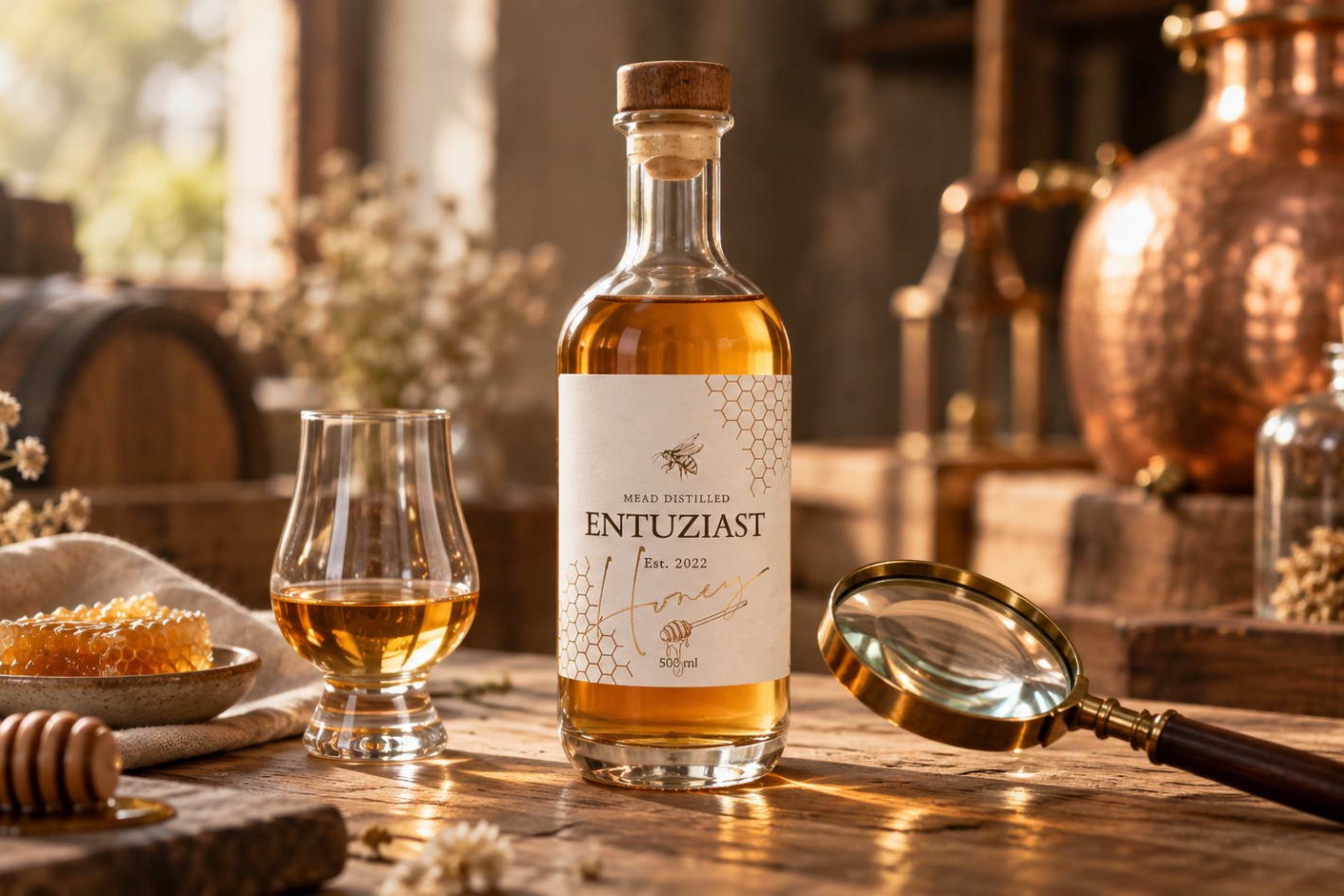
Example: Honey Spirit Aged ENTUZIAST
Honey Spirit Aged ENTUZIAST is a good example of why production details can be useful.
The spirit has an alcohol strength of 43% ABV and is aged for more than two years.
The main maturation takes place in French oak previously used for Tempranillo/Garnacha red wine, with part of the spirit aged in Ukrainian oak, followed by a finishing stage involving an Oloroso cask.
This information is much more useful than an abstract phrase such as “premium aged.”
It helps explain where wine-like, dried-fruit, spicy and oak-related notes may come from.
What Does “Reserve” Mean?
This word should be treated carefully.
In different categories and countries, it can have different meanings.
Sometimes it is primarily a marketing designation.
So the word Reserve by itself should not be the reason to choose one bottle over another.
Look for what the producer actually explains beyond the word itself.
What About “Premium”?
The word Premium by itself tells you almost nothing about production technology.
It is mainly a positioning term.
It can appear on an excellent product.
Or it can simply be part of the label design.
Instead of focusing on the word Premium, look for specific facts:
- raw materials;
- production method;
- type of distillate;
- ageing;
- ABV;
- origin.
What Does “Craft” Mean?
The word Craft is usually associated with smaller-scale production, original recipes and greater control over individual batches.
But it is not a universal guarantee of quality.
The word “craft” does not tell you whether the spirit was distilled well or whether it is sensorially balanced.
So it can provide useful context, but it is not a quality score.
What Does “Small Batch” Mean?
Literally, it means a small production batch.
This may indicate that the product is released in limited production runs.
But the exact meaning of “small” depends on the producer.
So Small Batch does not automatically mean handmade or higher quality.
What Does “Handcrafted” Mean?
This is another term that often has a descriptive or marketing role.
Modern production almost always combines manual and automated processes.
It is much more useful to learn what exactly the producer does by hand:
- raw material preparation;
- distillation;
- blending;
- batch control;
- bottling.
Does the Country of Origin Matter?
Yes, but not as a simple “better or worse” ranking.
The country can suggest:
- production traditions;
- typical raw materials;
- legal category;
- ageing climate;
- local stylistic characteristics.
But an excellent distillate can be produced in many different countries.
Are the Producer and the Brand Always the Same?
No.
A brand may belong to one company while the actual production is carried out by another.
Some brands produce their own distillate.
Others buy an existing spirit base and then blend, age or flavour it.
So the “producer” field can sometimes tell you more than the name on the front label.
What Does Bottle Volume Mean?
For example:
- 0.5 L;
- 500 ml;
- 0.7 L;
- 700 ml.
This is simply the amount of product in the bottle.
But when comparing prices, people often forget this parameter.
A bottle with a lower price may simply be smaller.
So it is often more useful to compare not only bottle price, but also price per litre.
What Is a Batch Number?
A batch number allows the producer to identify a specific production run.
This is important for quality control and traceability.
In craft spirits, different batches may sometimes show small natural variations.
This is especially possible when production uses natural raw materials and smaller volumes.
Is Sediment a Sign of Bad Alcohol?
Not always.
Some natural drinks may develop a small amount of sediment.
It can be related to natural components, minimal filtration or temperature changes.
That is why it is important to read the producer’s recommendations.
If the label specifically states that natural sediment is possible and does not affect quality, its presence alone is not a defect.
What Does “No Colouring” or “No Flavourings” Mean?
These statements describe specific features of the recipe.
But they should not be turned into a universal quality scale either.
A drink without added flavourings can be excellent or mediocre.
The same is true of a product that uses permitted aromatic ingredients.
What matters is understanding the category and technology of the specific drink.
Can You Trust the Tasting Description on the Label?
Yes, but treat it as a guide rather than an objective tasting result.
Descriptions such as:
- vanilla;
- caramel;
- citrus;
- juniper;
- spices;
- honey;
describe the expected sensory profile.
But different people can perceive the same aroma differently.
Why Can a Label Mention “Vanilla” When There Is No Vanilla in the Ingredients?
Because a tasting description and an ingredient list are two different things.
For example, an oak barrel can produce aromatic compounds that people associate with vanilla.
That does not mean vanilla was added to the drink.
Likewise, fruity aromas in a distillate do not always mean the corresponding fruit is present in the final product.
Should You Look for a Bottling Date?
For most strong distilled spirits, the bottling date matters less than it does for wine or beer.
Once bottled and properly sealed, strong alcohol largely stops developing in the same way it did in the barrel.
In other words, ten years in a bottle is not the same as ten years of oak maturation.
The Bottle Does Not Continue the Ageing Process
This is an important point.
If a label says the distillate was aged for three years, it does not become “13 years old” after spending another ten years in a sealed bottle.
The active interaction with wood stops after bottling.
So the stated age refers primarily to the period of maturation before bottling.
Does the Recommended Serving Temperature Matter?
Yes, but it is a recommendation rather than a strict rule.
Temperature strongly affects the perception of:
- aroma;
- alcohol warmth;
- texture;
- sweetness;
- bitterness.
Strong chilling can make a drink feel smoother, but it can also suppress aroma.
Why Shouldn’t You Blindly Follow “Serve Very Cold”?
If the goal is simply to make strong alcohol feel as easy as possible to drink, cold temperatures can help.
But if you want to evaluate the aroma and character of the spirit, very low temperatures can hide a significant amount of detail.
That is why tasting temperature and casual serving temperature may be different.
Should You Pay Attention to a Recommendation to Add Water?
For some strong distillates, a few drops of water can be very useful.
Water lowers the alcohol concentration and changes the behaviour of aromatic compounds.
Sometimes the aroma becomes easier to detect afterwards.
We explain why in the article “Should You Add Water to Strong Spirits?”.
What Information on the Label Really Matters?
If you ignore the design and marketing language, check:
- Type of drink.
- ABV.
- Volume.
- Producer.
- Country of origin.
- Ingredients.
- Type of raw material or distillate.
- Ageing information.
- Barrel type, if stated.
- Batch number.
And What Should You Treat More Carefully?
First of all, words that sound impressive but tell you very little without additional explanation:
- Premium;
- Reserve;
- Exclusive;
- Special;
- Select;
- Handcrafted;
- Small Batch;
- Luxury.
These terms may be completely appropriate.
They just should not replace specific information about the product.
How to Read a Spirits Label in 30 Seconds
If you are standing in front of a store shelf, you can use a simple checklist.
- What is it? Gin, brandy, distillate, liqueur and so on.
- What is the ABV?
- What is it made from?
- Who produced it?
- Where was it produced?
- Was it aged?
- If so, how exactly?
- Is there real information behind the marketing words?
This alone is enough to understand the bottle much better.
Is an Attractive Label a Bad Thing?
Of course not.
Design is an important part of the product.
A good bottle can be attractive, recognisable and suitable as a gift.
The problem only begins when design becomes the only meaningful information about the drink.
A good producer should be able to explain not only what the product looks like, but also how and from what it was made.
Can You Choose Good Alcohol by the Label Alone?
Not completely.
A label cannot communicate:
- the real aroma;
- texture;
- alcohol warmth;
- balance;
- finish.
But it can help you eliminate some options and understand what the producer is actually offering.
In Short: How Do You Read the Label on Strong Alcohol?
- First, identify the actual type of drink.
- Find the ABV — it tells you strength, not quality.
- Check the bottle volume.
- Read the ingredients and the origin of the distillate.
- Pay attention to the producer, not only the brand.
- If the drink is aged, look for specific information about time and barrels.
- Do not treat Premium, Reserve or Craft as automatic signs of quality.
- Do not confuse a tasting description with an ingredient list.
- Do not add years spent in the bottle to the ageing statement.
- The more specific production information the producer provides, the easier it is to understand the product.
Conclusion
A spirits label is more than just design.
If you know where to look, it can tell you a great deal before you ever open the bottle.
The most useful information is the product category, ABV, ingredients, origin of the distillate, producer and ageing details.
Words such as Premium, Reserve, Craft or Small Batch should only be evaluated together with specific facts.
And most importantly, do not look for one magical feature that automatically identifies a good bottle.
Neither high strength, nor a large age statement, nor elaborate packaging, nor the word Premium guarantees quality by itself.
A good label should not persuade you with impressive words — it should help you understand what is actually inside the bottle.