





Why are honey distillates not sweet?
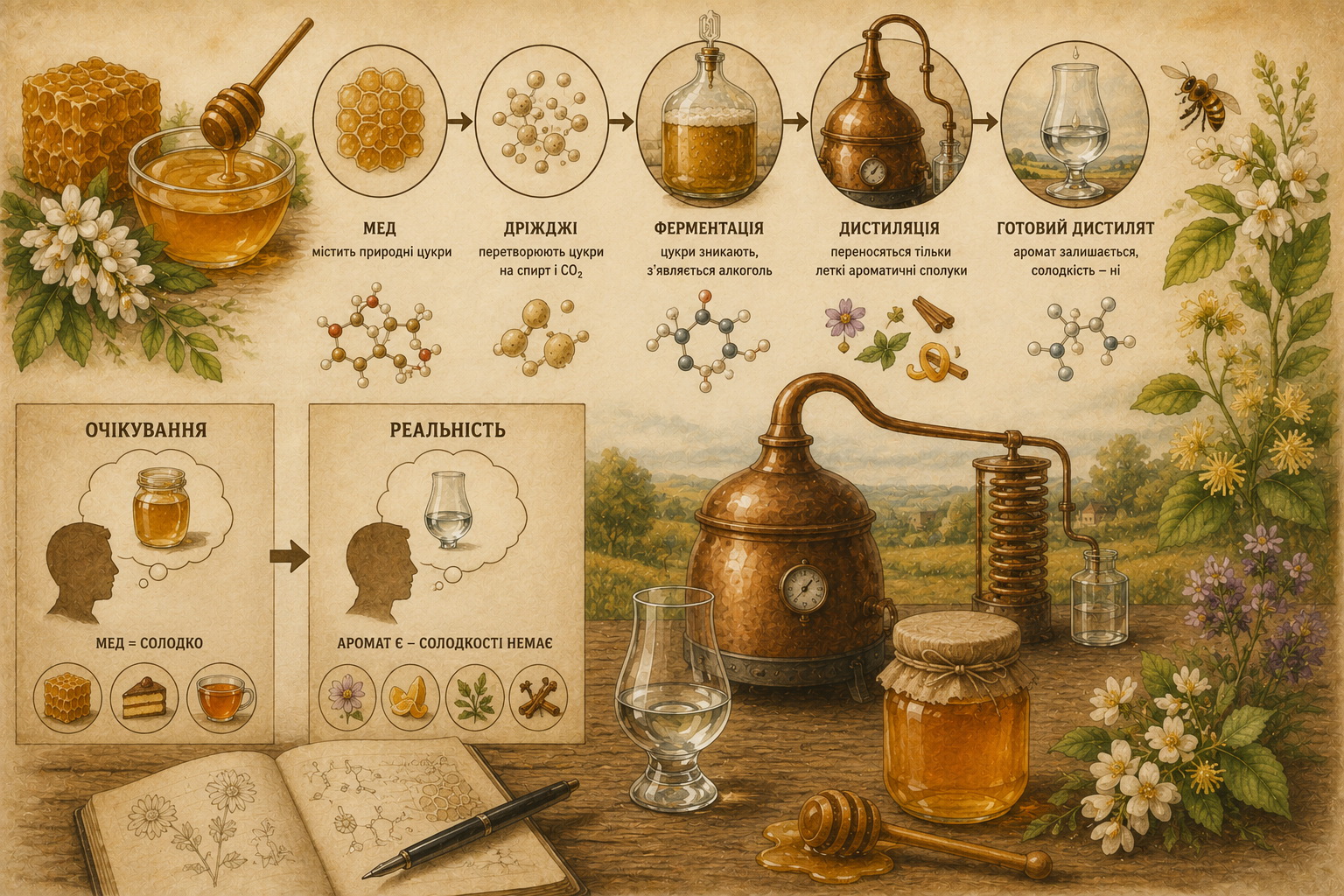
The biggest surprise during the first acquaintance
When a person hears the phrase "honey distillate" for the first time, they almost always imagine something sweet. This seems completely logical. Honey is associated with desserts, fragrant pastries, tea and natural sweetness. Therefore, the brain already creates a certain expectation before the first sip.
And that is why the first acquaintance with honey distillate is often surprising. The drink turns out to be completely different from what was imagined. It can be soft, floral, fruity, spicy or even a little dry, but not sweet at all.
Why does this happen?
Our brain is easily fooled
A person rarely evaluates taste "from scratch." We almost always compare a new experience with what we already know.
When we see the word “honey,” our brain automatically recalls familiar sensations: thick consistency, rich sweetness, warm floral aroma. That is why the first sip of honey distillate seems unexpected - expectations and reality do not coincide.
But this is not a defect of the drink. It is a feature of our perception.
Sweetness and aroma are different things
In everyday life, we often perceive them as one whole. In fact, they are completely different sensations.
We perceive sweetness with the taste buds of the tongue. Aroma - with the olfactory receptors. That is why the same product can smell very sweet, but remain completely dry to the taste.
A classic example is vanilla. Most people perceive its aroma as sweet, although it itself does not contain sugar. A similar effect can be observed in many wines, whiskeys or gins, where fruity or honey notes create the illusion of sweetness.
What happens to honey?
During fermentation, yeast uses the natural sugars in honey as a source of energy. They are the ones who convert them into alcohol and carbon dioxide.
When the process is complete, most of the sugars have already disappeared. And during distillation, only volatile aromatic components are transferred to the finished drink. The sugars are left behind.
That is why honey distillate cannot be sweet just because it is made from honey.
Why is the aroma of honey noticeable?
Natural honey is much more than just fructose and glucose. It contains hundreds of aromatic compounds derived from flower nectar.
During production, some of these substances change, some are reborn during fermentation, and the most valuable ones pass into the distillate. They are the ones that create the familiar floral, waxy, fruity or herbal shades.
Therefore, we can recognize the “honey character” of the drink, even if it no longer has any sweetness.
This is the art of distillation
The task of the master is not to make the alcohol sweet. On the contrary, his goal is to convey the natural aroma of the raw material as delicately as possible, without burdening the drink with residual sugars.
This is one of the main advantages of honey distillates. They allow you to experience the character of honey in a completely different form - light, pure and multifaceted.
Taste without prejudice
If you are tasting a honey distillate for the first time, try to forget the word "honey" for a moment. Do not look for a familiar sweetness. Instead, pay attention to the aroma, texture, aftertaste and those small nuances that are revealed gradually.
Very often it is the second or third sip that allows you to understand the drink much better than the first. When expectations disappear, there is room for real acquaintance.
Conclusion
Honey distillates are not sweet because they have "little honey". They are not sweet because the honey completely changes its nature during production. Sugars become alcohol, and the aroma transforms into a new, much more complex composition.
That is why honey distillate should not be compared to a spoonful of honey. It is a separate world of flavors and aromas, in which honey is no longer the main character, but a talented author, whose work can be recognized even when it no longer appears on the scene.