





How Is Distillation Different from Rectification?
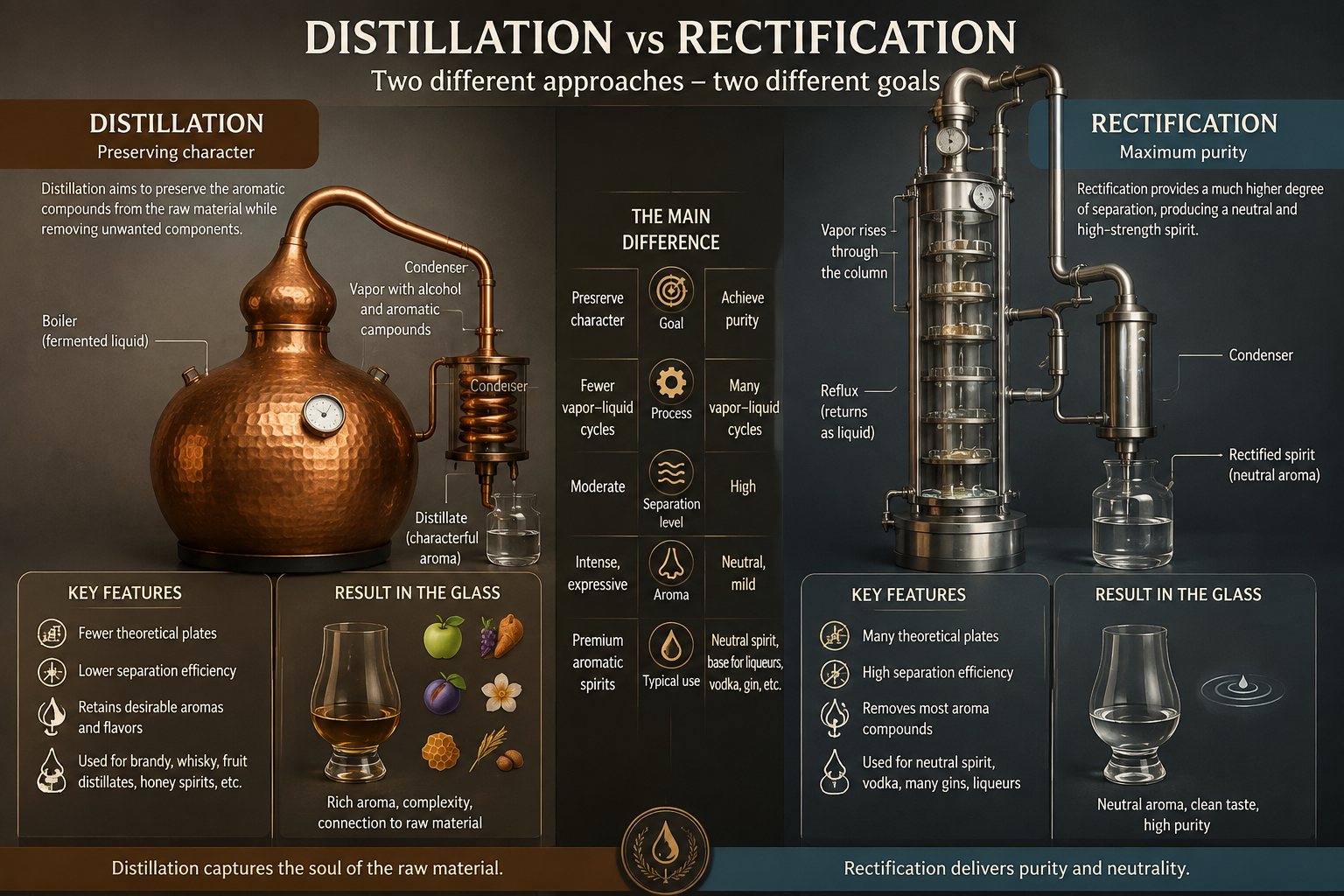
Distillation and rectification are often mentioned together, which makes it easy to assume that they are almost the same process. Both involve heating an alcoholic mixture, evaporation, condensation, and the separation of components according to their volatility.
But their technological goals are different.
Distillation is often used to preserve part of the character of the raw material, while rectification allows much deeper separation of components and can produce a more purified and neutral spirit.
This is why grape, fruit, grain, or honey distillates may retain noticeable characteristics of the original raw material, while highly rectified alcohol is generally much more neutral.
To understand the difference, it helps to look at what is actually happening inside the equipment.
What Is Distillation?
Distillation is a process used to separate a liquid mixture according to differences in the volatility of its components.
In spirit production, the starting material is usually a fermented liquid containing:
- water;
- ethyl alcohol;
- organic acids;
- esters;
- aldehydes;
- higher alcohols;
- aromatic compounds;
- other substances created by the raw material and fermentation.
When this liquid is heated, ethanol is not the only substance that enters the vapor phase. Water and many aromatic compounds evaporate as well.
These vapors leave the still, are cooled, and condense back into liquid.
That liquid becomes the distillate.
Why Isn’t Distillation Simply About Alcohol Boiling Before Water?
A common simplified explanation says that ethanol boils at around 78°C and water at 100°C, so the alcohol simply evaporates first.
In a real fermented mixture, things are much more complicated.
Water and ethanol form a mixture whose behavior is different from that of either pure substance. In addition, fermented liquid contains many other volatile compounds.
When heated, these components enter the vapor phase at the same time, although in different proportions.
A distiller is therefore not working with two isolated substances called “alcohol” and “water,” but with a complex multi-component system.
What Is the Main Goal of Distillation?
The purpose depends on the type of product being made, but when producing an aromatic distillate, the goal is not simply to increase alcohol concentration.
The producer must also:
- remove undesirable compounds;
- retain desirable aromatic substances;
- build a clean and balanced profile;
- reach the desired alcohol strength;
- preserve part of the character of the original raw material.
That is where the difficulty lies.
If separation is insufficient, unwanted harsh or heavy notes may remain. If separation becomes too aggressive, the distillate may lose much of its aroma and become overly neutral.
Good distillation is therefore about balance.
What Is Rectification?
Rectification is a more intensive separation process carried out in specialized column equipment.
If a simple distillation can be thought of as one broad cycle of “evaporation → condensation,” a rectification column allows many smaller versions of this process to occur repeatedly inside the same system.
Vapor rises through the column, partially condenses, evaporates again, comes into contact with liquid flowing in the opposite direction, and gradually separates according to volatility.
This allows column equipment to achieve a much higher degree of separation.
How Does a Rectification Column Work?
In simple terms, a rectification column can be imagined as a system in which distillation is repeated many times in succession.
Alcohol-rich vapor moves upward. Part of it cools and turns back into liquid. That liquid flows downward and comes into contact with rising hot vapor.
This continuous exchange between vapor and liquid gradually separates the components.
More volatile compounds tend to become concentrated higher in the system, while heavier compounds remain lower or return toward the boiler.
The process can repeat across many effective stages of separation.
What Are Theoretical Plates?
Technical discussions about rectification often mention “theoretical plates.”
A theoretical plate is not necessarily a literal metal plate inside the equipment. It is a conceptual way of describing separation efficiency.
Each theoretical plate represents one effective stage of vapor-liquid contact where the composition of the mixture moves closer to equilibrium.
The more effective stages a column provides, the more deeply it can separate components.
A simple copper pot still provides far fewer such stages, which is one reason it can preserve more accompanying aromatic compounds.
What Is Reflux?
Reflux is another important concept for understanding the difference between distillation and rectification.
Some vapor inside the system may cool and condense before reaching the final condenser.
That condensed liquid then flows back into the column.
This returning liquid is called reflux.
The greater the amount of reflux, the more repeated cycles of evaporation and condensation take place, and the stronger the separation becomes.
In rectification, reflux is one of the central mechanisms controlling purity and separation efficiency.
Why Does Rectified Spirit Become More Neutral?
The aroma of the original raw material is created by many different volatile compounds.
Some of these behave differently from ethanol. During repeated vapor-liquid contact, the rectification column gradually separates them.
The deeper the purification, the fewer accompanying aromatic compounds remain with the ethanol.
As a result, the spirit becomes:
- cleaner;
- more neutral;
- less strongly connected to the aroma of the starting material;
- more suitable for products where neutrality is desirable.
Why Can a Distillate Retain Aroma?
During distillation, the producer does not necessarily try to remove every accompanying compound.
Some of them are desirable.
Esters, organic acids, higher alcohols, and other aromatic compounds can contribute fruity, floral, herbal, grain-like, honeyed, nutty, or spicy notes.
The goal is not to retain everything, but to retain the right things.
That distinction is fundamental.
Is Distillation Just “Less Pure Alcohol”?
That description is misleading.
It creates the impression that rectification is the “proper” form of purification and distillation is simply an inferior version of it.
In reality, they are different technological approaches.
For an aromatic fruit, grape, grain, or honey distillate, complete neutrality would be undesirable because it would remove the very character the spirit is meant to express.
For a product requiring a neutral base, however, strong raw-material aroma may be unwanted.
So “more purified” does not automatically mean “better.”
What matters is whether the technology fits the intended product.
What Product Comes Out of Rectification?
Rectification can produce spirit at very high alcohol strength and with a high degree of purification.
That spirit can then be used as a base for many different beverages.
It may be diluted with prepared water or used for infusions, liqueurs, flavored spirits, certain gin styles, and other products depending on the process.
The main advantage of a neutral spirit is predictability: it contributes very little raw-material aroma of its own.
What Product Comes Out of Distillation?
The result depends on the raw material and the method used.
A distillate may be:
- grape-based;
- apple-based;
- pear-based;
- plum-based;
- grain-based;
- honey-based;
- sugarcane-based;
- agave-based;
- or based on another fermented raw material.
It may remain clear or be matured in oak.
It can also serve as a base for more complex spirits.
How Do Distillate and Rectified Spirit Differ in Aroma?
The difference is especially noticeable during tasting.
In a well-made aromatic distillate, characteristics of the raw material and fermentation may still be recognizable.
For example:
- apple distillate may show fresh or baked apple notes;
- grape distillate may reveal flowers, fruit, or dried-fruit aromas;
- grain distillate may suggest malt, bread, or cereal;
- honey distillate may show floral, herbal, fruity, waxy, or spicy nuances.
In highly rectified spirit, these raw-material associations are generally much weaker or absent.
Neutrality becomes the defining characteristic.
Why Can Neutrality Be an Advantage?
Neutral spirit is sometimes seen as less interesting, but in many products it is exactly the right technological choice.
If the producer wants herbs, berries, spices, or other ingredients to define the aroma, a strong raw-material character from the base spirit may interfere.
A neutral base allows the producer to build the aromatic profile almost from scratch.
That is why rectified spirit is widely used throughout the beverage industry.
Can Gin Be Made from Both Distillate and Neutral Spirit?
Yes, and this is where things become particularly interesting.
Many gin styles begin with neutral spirit, which is then redistilled with juniper and other botanicals.
In that approach, the base spirit is not supposed to compete strongly with the botanical composition.
But some producers deliberately use a more characterful base distillate, such as fruit, grape, or honey distillate.
That creates two aromatic layers:
- the character of the base distillate;
- the character of juniper and the other botanicals.
This gives the producer even more room to create a distinctive style.
Can a Distillate Be Rectified?
Yes.
A distillate can become the feedstock for further purification.
If it is processed through a rectification column, many of its aromatic compounds can be separated out, leaving a more neutral spirit behind.
This means that distillation and rectification do not belong to completely separate worlds.
They can be different stages within the same production chain.
Does a Rectification Column Always Have to Produce Neutral Spirit?
No, and this is an important nuance.
Column equipment does not always have to be operated at maximum separation efficiency.
Its working parameters can be adjusted.
Depending on the design and operating conditions, a producer can obtain spirits with different levels of purity and aromatic character.
This is why the boundary between “distillation” and “rectification” in real production can sometimes be less clear than simple diagrams suggest.
Pot Still vs Column: What Is the Difference?
A traditional copper pot still has a relatively simple design.
Its geometry often allows more aromatic compounds to pass into the distillate, although the exact level of separation depends heavily on the shape of the still and the way it is operated.
A rectification column contains many zones where vapor and liquid repeatedly interact.
This gives it much greater potential for precise separation.
In simplified terms:
- pot still — generally more raw-material character;
- rectification column — greater potential for deep purification.
But the final result always depends on the equipment, operating mode, and decisions made by the producer.
Why Does the Shape of the Still Affect Flavor?
Even among relatively simple stills, results can vary greatly.
Important factors include:
- the shape of the boiler;
- the height of the neck;
- the diameter of the vapor path;
- the angle of the lyne arm;
- the amount of copper contact;
- the presence of a dephlegmator or reflux condenser;
- the rate of heating;
- the intensity of cooling.
All of these parameters affect how much vapor returns to the still and how much reaches the condenser.
This is why two stills processing the same fermented wash can produce noticeably different spirits.
Why Is Copper Important in Distillation?
Copper serves more than an aesthetic or traditional purpose.
It conducts heat efficiently and can react with certain sulfur-containing compounds produced during fermentation.
This can help reduce undesirable harsh aromas.
Copper elements or packing may also be used inside column equipment when the producer wants the vapor to benefit from copper contact.
Can Distillation Be Done Only Once?
Yes.
In some production methods, a single distillation is enough, especially if the equipment already provides the desired degree of separation.
Other methods use double or triple distillation.
Each additional distillation gives the producer another opportunity to work with fractions, raise alcohol strength, and alter the aromatic profile.
But more distillations do not automatically mean higher quality.
They are simply another technological tool.
Why Can Distillation Preserve a Sense of Origin?
A distillate can carry part of the story of its raw material.
Fruit variety, grain type, honey variety, yeast strain, and fermentation conditions all help create the original set of aromatic compounds.
If the distillation process is designed to preserve some of those compounds, they remain noticeable in the finished product.
Deep rectification weakens that connection considerably.
This is one reason the origin and quality of raw material matter so much in many distillates.
Which Process Is More Difficult?
It would be inaccurate to say that one process is simple and the other complex.
Rectification requires precise control over the column, temperature zones, reflux ratio, operating stability, and many other technical parameters.
Aromatic distillation requires equally careful sensory decisions: where to make the cuts, how fast to run the still, and how much aromatic character to retain.
The complexity is simply different.
What Is the Reflux Ratio?
The reflux ratio describes the relationship between the amount of condensed liquid returned to the column and the amount of product that is collected.
The more liquid that is returned, the more intensive the internal exchange between vapor and liquid becomes.
This improves separation efficiency but reduces the speed at which finished product is collected.
Rectification is therefore a constant balance between speed and separation quality.
Can You Tell Whether a Spirit Is a Distillate or Rectified Spirit by Its ABV?
No.
Alcohol strength alone does not provide a reliable answer.
A distillate may leave the still at a relatively high strength. Rectified spirit, on the other hand, may later be diluted with water to 40% ABV or another bottling strength.
This means a bottle labeled 40% ABV may contain a spirit based on an aromatic distillate or one based on neutral alcohol.
You need to look at the category, composition, and production method.
Which Is Better: Distillation or Rectification?
That question is a little like asking whether a knife or a spoon is better.
It depends entirely on the task.
If the producer wants an extremely neutral alcoholic base, rectification is an excellent tool.
If the goal is to preserve the aroma and identity of the original raw material, distillation often offers more advantages.
In some spirits, both approaches may even be combined.
How Does This Difference Matter for Honey Distillates?
In honey distillates, the character of the raw material is especially important.
Different varieties of honey can have different floral, herbal, and fruity profiles. Fermentation transforms these characteristics, while distillation can preserve part of that transformed aromatic identity in the final spirit.
If that alcoholic base were subjected to deep rectification, many of those distinctions could disappear.
This is why producers who want to highlight the character of honey, fermentation, and origin must balance purification very carefully.
Why Does This Matter to the Consumer?
You do not need to understand every technical detail of production.
But knowing the difference between distillation and rectification makes it easier to read labels and understand why two strong spirits can taste so different.
If a producer emphasizes grape, grain, fruit, or honey distillate, the origin of the alcoholic base may be an important part of the drink’s character.
If a product is built on neutral spirit, its identity is more likely to come from other elements such as botanicals, infusions, flavoring ingredients, or later production stages.
In Short: The Main Differences
- Distillation can preserve more aromatic compounds from the raw material.
- Rectification allows much deeper separation of components.
- A distillate often has its own recognizable aromatic profile.
- Rectified spirit is generally intended to be much more neutral.
- Distillation is commonly used for characterful fruit, grain, grape, and honey spirits.
- Rectification is useful where a clean, predictable, neutral alcoholic base is required.
- Neither method is automatically better — the correct choice depends on the intended style.
Conclusion
Distillation and rectification rely on similar physical principles, but they solve different technological problems.
Distillation allows a producer to work not only with alcohol strength, but also with the character of the raw material. It can preserve some of the aromas created by fruit, grain, grapes, honey, and fermentation.
Rectification goes much further in separating components. Its strength lies in high purification, consistency, and the ability to create an extremely neutral alcoholic base.
The difference is therefore not that one method is “high quality” and the other is “low quality.”
The difference is in the intention.
When preserving raw-material character matters, distillation becomes a tool of creativity. When neutrality is the goal, rectification becomes a tool of precision.