





Why do small barrels age faster?
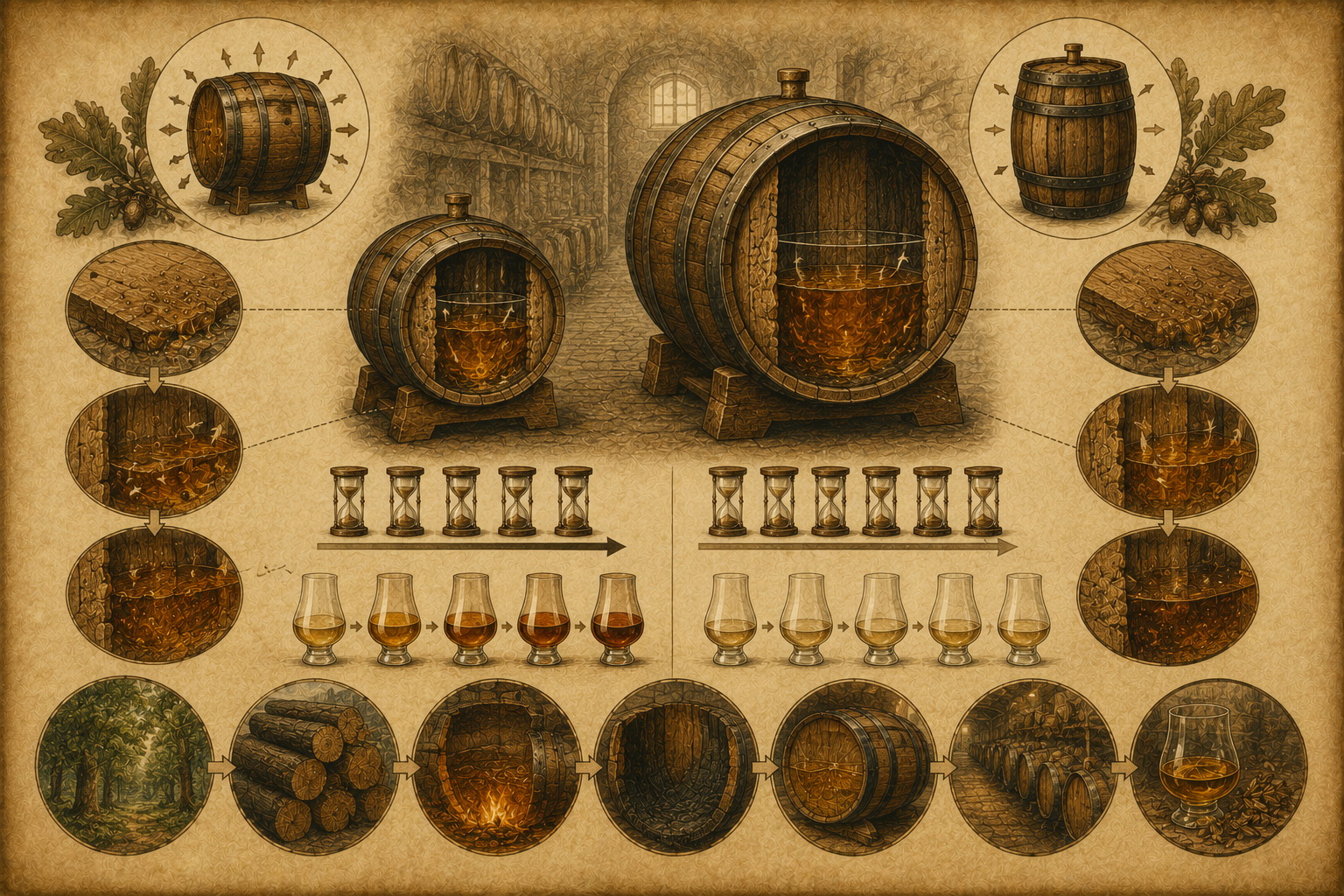
A small barrel makes a big difference
There is a common belief among home distillers that if a small barrel ages the distillate faster, it is automatically better.
At first glance, this seems obvious. If a drink acquires a beautiful color, vanilla aroma and oak tones after just a year, why wait five or ten years in a large barrel?
But then a logical question arises.
Why do the most famous distilleries in Scotland, Ireland, France or Japan still use mainly large barrels?
The answer is much more interesting than it seems.
It's not about liters. It's all about the area of the oak
Imagine two oak barrels.
One holds 30 liters.
The other holds 300 liters.
The amount of liquid differs by a factor of ten, but the area of the inner surface of the oak increases by far less than ten times. That is why each liter of distillate in a small barrel comes into contact with a much larger amount of wood.
If we compare not the barrels themselves, but the ratio of "oak area per liter of drink", it becomes clear why the processes occur faster.
Each drop of distillate interacts with the wood more often, receives aromatic substances faster and changes more intensively.
A barrel never stands still
From the outside, it may seem that aging is a stationary process. In fact, there is constant movement inside the barrel.
During the day, the temperature rises. The wood expands slightly, and the distillate penetrates deeper into its pores.
At night, the temperature drops. The wood contracts, and the liquid returns, carrying new aromatic compounds with it.
This cycle repeats itself day after day, month after month, year after year.
In a small barrel, the path to the wall is much shorter. Almost the entire volume of the distillate is constantly involved in this movement. That is why extraction occurs noticeably faster.
What exactly does oak give to the distillate?
Oak is not just wood. This is a complex natural structure that contains hundreds of organic compounds.
During aging, the distillate gradually acquires vanilla notes thanks to vanillin, light coconut shades - thanks to lactones, spice and structure - thanks to tannins, and caramel, toast and nutty nuances appear after the barrel is fired.
In a small barrel, all these substances are transferred to the drink faster.
And this is where the main danger lies.
Faster does not mean better
Imagine that you are brewing tea.
For the first few minutes, it becomes aromatic and pleasant. But if you leave the bag in the cup for too long, the drink will start to get bitter.
A similar process occurs with the barrel.
While the oak works delicately, it adds complexity, softness, and noble aromas.
But if the extraction becomes too intense, the wood begins to dominate. Instead of fruity, honeyed or floral notes, only oak, astringency and dryness remain in the glass.
That is why there is a saying among distillers:
“The barrel should not shout over the distillate itself.”
Why does the color appear so quickly?
Many people perceive a rich amber color as a sign of long aging.
In fact, a small barrel can color the distillate in golden shades in just a few months.
But color is only one part of the story.
The taste, aroma and structure mature much more difficult. The drink may look old, although its aroma has not yet reached harmony.
That is why experienced masters never judge aging by color alone.
Why do big distilleries love big barrels?
It would seem that if a small barrel saves years, everyone should use it.
However, most well-known producers choose barrels with a volume of about 180 to 500 liters.
The reason is simple.
A large barrel works slower, but much more delicately.
It is not in a hurry to give everything at once. The distillate gradually gains aroma, without losing its own character. The master has more time to observe its development and stop the aging just when the balance becomes perfect.
It is like slowly cooking a complex dish. High temperatures can speed up the process, but they don't always make the result better.
Does this mean that small barrels are a bad choice?
Not at all.
For small craft distilleries, experimental batches, or home aging, they can be a great solution.
They allow you to see the result faster, compare different degrees of oak roasting, test new recipes, and better understand how a particular distillate behaves.
However, they require much more attention.
While a large barrel can be tasted once every few months, a small one sometimes needs to be checked much more often. The line between great results and over-aging can be very thin.
So which barrel is better?
A different question would be more appropriate.
Not “which barrel is better,” but “for what purpose is it used.”
Small barrels provide speed, brightness, and the opportunity to experiment.
Large barrels provide patience, stability, and an extremely subtle development of flavor.
And that’s why they don’t compete with each other. They solve different problems.
Conclusion
A small oak barrel really does speed up aging. The reason is not magic or a special type of wood, but the fact that each liter of distillate comes into contact with a larger area of oak. This means faster extraction of aromatics, faster color change and more intense flavor development.
However, speed is only a tool. The skill lies not in forcing the barrel to work faster, but in stopping the process in time. After all, a truly great distillate is born when the wood emphasizes its character, rather than hiding it behind its own flavor.