




What Does 40% ABV Mean and Does It Indicate Quality?
On the label of a strong alcoholic drink, there is almost always one number people notice immediately.
40%.
43%.
46%.
50%.
And very often, that number starts to feel like the main characteristic of the drink.
Some people think 40% is the “standard.”
Some look for something stronger because it seems more serious or higher quality.
Others do the opposite and look for the lowest possible strength, expecting a smoother drink.
But in reality, ABV only tells you the concentration of alcohol by volume and is not a direct measure of quality.
What Is ABV?
ABV stands for Alcohol by Volume.
It indicates the proportion of ethyl alcohol in a drink by volume.
If the label says:
40% ABV
it means that approximately 40% of the drink’s volume is ethyl alcohol.
The rest is mainly water and other components of the drink.
Does 40% ABV Mean 40% Pure Alcohol?
Yes, but this needs to be understood correctly.
It does not mean the bottle contains “40% alcohol and 60% something else” as separate layers.
It is a physical measurement of ethanol concentration in the liquid.
For example, 500 ml of a drink at 40% ABV contains approximately 200 ml of ethanol by volume.
But ethanol and water form a uniform solution.
Why Is 40% So Common?
For many categories of strong spirits, 40% is a very common bottling strength.
It offers a practical balance between:
- aromatic expression;
- stability;
- alcohol sensation;
- familiar consumer expectations.
But it is not a universal “correct” number.
Different styles can be excellent at 38%, 43%, 46% or considerably higher.
Does 40% Mean Standard Quality?
No.
Two drinks at 40% ABV can be radically different.
One may be:
- clean;
- aromatic;
- balanced;
- smooth in perception;
- long in the finish.
Another at the same 40% can be:
- harsh;
- flat;
- overly alcoholic;
- unbalanced;
- short in the finish.
The number is the same, but the sensory result is completely different.
Why Can the Same ABV Feel Different?
Because we do not perceive ethanol alone.
The overall sensation is influenced by:
- aromatic compounds;
- texture;
- residual or added sugars;
- acidity;
- bitterness;
- tannins;
- temperature;
- the character of the distillate;
- ageing;
- serving method.
So alcohol concentration is only one part of the total sensory profile.
Why Can 43% Feel Smoother Than 40%?
At first, that sounds illogical.
But smoothness is not a simple mathematical function of ABV.
If a drink is well balanced, aromatic, rounded in texture and does not show harsh alcoholic notes, it can feel smoother even at a slightly higher strength.
And the opposite is also true: a weaker spirit can feel harsher if the alcohol is poorly integrated or the aromatic structure is weak.
What Is Alcoholic Harshness?
It is the degree to which alcohol dominates the sensory impression of a drink.
It can appear as:
- a sharp ethanol smell;
- burning sensation;
- aggressive heat;
- a “pure alcohol” impression;
- a short aromatic profile.
Importantly, alcoholic harshness does not always correspond directly to ABV.
A 40% spirit can feel very alcohol-forward, while a 46% one may feel far more harmonious.
Can Smoothness Be Measured by a Number?
No.
Smoothness is a complex sensory impression.
It is influenced by:
- temperature;
- texture;
- aroma;
- sweet aromatic associations;
- sugar content;
- ageing;
- sip size;
- individual sensitivity.
So the number “40%” cannot tell you how smooth the drink will feel to you personally.
Why Does Aroma Affect the Perception of Strength?
The brain does not perceive taste, aroma and texture as completely separate things.
They combine into one overall impression.
For example, aromas associated with vanilla, honey, ripe fruit or caramel can create a softer impression.
As a result, the same alcohol concentration may feel less aggressive.
Dry, herbal, bitter or especially sharp aromas can do the opposite and make the drink feel more intense.
Does Sugar Make Alcohol Feel Smoother?
Yes, sweetness can mask some of the alcoholic burn.
That is why a liqueur and a dry distillate at the same ABV can feel completely different.
But that does not mean the sweeter drink contains less alcohol.
The sensory balance is simply different.
Can Alcohol Strength Be “Hidden”?
To some extent, yes.
Alcohol warmth can be partly masked by:
- sweetness;
- aroma;
- low temperature;
- soft texture;
- ice;
- mixing in cocktails.
That is why some strong cocktails can taste much lighter than they actually are.
It is important to remember: sensory smoothness does not mean low alcohol concentration.
Why Does Cold Make Strong Alcohol Feel Smoother?
At lower temperatures, the volatility of aromatic compounds decreases.
At the same time, the intensity of some sensory sensations is reduced.
The drink may feel:
- less sharp;
- less alcohol-forward;
- denser;
- smoother.
But part of the aroma is also suppressed.
So strong chilling is a compromise between smoothness and aromatic expression.
Does Water Affect the Perception of ABV?
Yes.
Adding water genuinely lowers the alcohol concentration in the glass.
If you add a small amount of water to a strong distillate, the ABV becomes lower.
But the aromatic balance also changes.
In some spirits, a few drops of water can make certain aromas easier to detect.
We discussed this in more detail in the article “Should You Add Water to Strong Spirits?”.
Why Does Strong Alcohol Feel Warm?
The sensation of warmth does not mean the liquid itself is hot.
Ethanol interacts with receptors involved in heat and irritation perception.
That is why a room-temperature drink can create a strong warming sensation in the mouth, throat and chest.
This is another example of why our perception of strength is not just a number on the label.
Why Does the First Sip Often Feel the Strongest?
Because your senses have not yet adapted to the alcohol.
The first contact can produce pronounced:
- warmth;
- burning;
- ethanol aroma;
- irritation.
After a few minutes and a small first sip, the second sip may feel noticeably calmer.
But the ABV, of course, has not changed.
Can You Estimate ABV by Taste?
Roughly — sometimes.
Accurately — no.
An experienced taster may be able to estimate whether a drink is weaker or stronger.
But aroma, sugar, temperature and texture can easily distort perception.
So reliably distinguishing, for example, 40% from 43% by taste alone is difficult.
Can 40% Be “Too Strong”?
Yes, especially for someone who is not used to strong distillates or who has high sensory sensitivity.
That is perfectly normal.
Alcohol perception is highly individual.
The same drink may feel:
- very smooth to one person;
- moderately strong to another;
- too harsh to someone else.
So “smooth” is not an absolute characteristic.
Does Higher ABV Mean More Aroma?
Not always, but strength can influence aromatic concentration.
Ethanol is a good solvent for many aromatic compounds.
That is why some producers bottle at a slightly higher ABV to preserve a more intense profile.
But if the distillate itself is weak or poorly balanced, a few extra percentage points will not automatically make it better.
Why Are Some Gins Bottled at Higher ABV?
For gin, strength is especially important because ethanol carries essential oils from juniper and other botanicals.
A higher ABV can help preserve a more intense aromatic profile.
It can also help the gin remain more noticeable in cocktails or a Gin & Tonic.
But this does not mean the strongest gin is automatically the best.
We discussed gin selection in the article “How to Choose a Good Gin and What to Look For”.
Why Does a Producer Sometimes Reduce Strength Before Bottling?
After distillation or ageing, a spirit may have a much higher alcohol strength than the final bottled product.
Before bottling, it can be diluted with prepared water to reach the target ABV.
For example, a spirit may originally be significantly stronger and then be adjusted to 40%, 43% or another chosen level.
This is a normal production process.
Does Dilution with Water Reduce Quality?
No.
In many spirit categories, dilution is a standard part of production.
The real question is not whether water was added, but whether the final strength was chosen correctly for the specific drink.
Too much dilution can make the profile thin and watery.
Too little can leave the spirit overly aggressive.
So final ABV is often the result of sensory balancing.
Are There “Undiluted” Spirits?
Yes.
Some spirits are bottled at cask strength or close to it.
You may see terms such as:
- cask strength;
- barrel proof;
- full proof.
These drinks can be significantly stronger than the familiar 40% range.
That is a particular style, not an automatic sign of premium quality.
What Does Cask Strength Mean?
Usually, it means the spirit is bottled with minimal adjustment after the barrel or without major dilution.
Such spirits can be highly concentrated in aroma and flavour.
But they may also benefit from:
- small sips;
- time in the glass;
- adding water.
Some people find this more interesting; others find it too intense.
Does Higher Strength Mean Higher Quality?
No.
This is one of the most common misconceptions.
60% ABV does not automatically mean the drink is better than one at 40%.
And 40% does not automatically mean a simplified product.
Quality is shaped by other factors:
- raw materials;
- fermentation;
- distillation;
- cut selection;
- ageing;
- blending;
- final balance.
Does Lower Strength Mean Lower Quality?
No.
Sometimes a lower ABV is exactly what suits a particular style best.
If alcohol dominates the aroma at a higher strength, a small reduction can make the profile much more harmonious.
So a good producer chooses strength based not only on marketing, but also on the sensory result.
Can ABV Be Too Low for the Flavour?
Yes, in some cases.
If a spirit is diluted too far, it may lose:
- body;
- aromatic concentration;
- structure;
- length of finish.
It may begin to feel watery.
That is why every distillate has its own useful range of bottling strengths.
How Does ABV Affect Texture?
Changing alcohol strength affects more than just burn.
It also changes mouthfeel.
The drink may feel:
- denser;
- more oily;
- lighter;
- more watery;
- drier.
So choosing the final ABV is also part of shaping the texture.
Why Can Two 40% Spirits Have Different Textures?
Because ABV is not the only thing that creates mouthfeel.
Texture is also influenced by:
- components of the distillate;
- water;
- filtration;
- residual compounds;
- sugar;
- oak maturation;
- temperature.
So identical 40% ABV does not mean identical texture.
Does Ageing Affect the Perception of Strength?
Yes, but not because the barrel simply “removes alcohol.”
During maturation, the entire profile of the spirit changes.
You may get:
- vanilla notes;
- spices;
- wood;
- tannins;
- new texture;
- oxidative nuances.
These elements can make the alcohol feel more integrated into the overall profile.
Example: Honey Spirit Aged ENTUZIAST
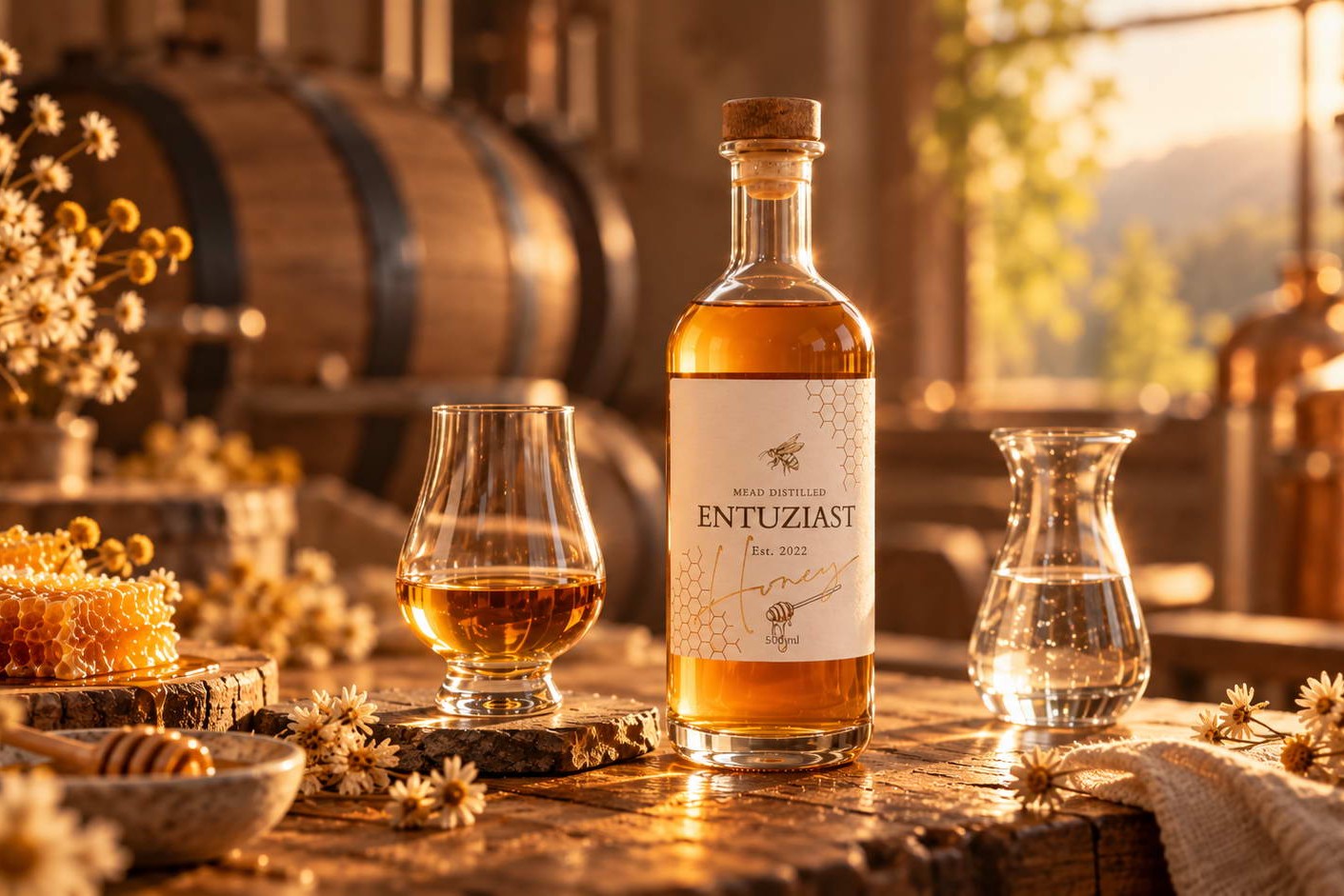
Honey Spirit Aged ENTUZIAST is bottled at 43% ABV.
But the number 43% tells you very little about the drink’s actual character.
The sensory impression is shaped by the honey distillate, extended maturation, French and Ukrainian oak, and the finishing stage involving an Oloroso cask.
As a result, the alcoholic warmth becomes only one part of a more complex profile with oak, spice, dried-fruit and honey-like associations.
Judging such a drink only by the number 43% would be far too simplistic.
Can a Young 40% Distillate Be Excellent?
Absolutely.
Ageing is not a requirement for high quality.
A young distillate can have:
- clean aroma;
- clear raw-material character;
- good texture;
- well-balanced alcohol;
- a pleasant finish.
Sometimes the absence of oak makes it easier to appreciate the character of the original raw material.
Example: Honey Spirit Pure
Honey Spirit Pure ENTUZIAST is an example of an unaged honey distillate where the main emphasis is not on oak, but on the character of the raw material and the distillation itself.
In this case too, ABV by itself cannot tell you how aromatic, dry or textured the drink will be.
How Should You Read ABV on a Label?
Not as a score.
But as one technical characteristic among many.
ABV can help you understand:
- the general alcohol concentration;
- approximate intensity;
- whether stronger alcoholic warmth may be expected;
- how the drink may behave in a cocktail;
- whether adding water might be useful.
But ABV does not tell you about raw-material quality, balance or complexity.
For a broader explanation of how to interpret all the information on a bottle together, see “How to Read the Label on a Strong Alcoholic Drink”.
Should You Choose Between 40% and 43% Based on That Difference Alone?
No.
Three percentage points may be noticeable, but much more important questions are:
- what kind of distillate it is;
- how it was made;
- what the aroma is like;
- what the texture is like;
- whether it was aged;
- how you plan to drink it.
Choosing only by ABV is almost always too simplistic.
Is Strength More Important in Cocktails?
Often, yes.
Once ice, juice, tonic or other ingredients are added, the spirit becomes diluted.
So a stronger or more aromatically intense distillate can maintain its presence more effectively in the final drink.
This is especially noticeable with gin.
Why Does Gin & Tonic Change the Perception of Strength?
Tonic and ice reduce the alcohol concentration in the finished drink.
At the same time, quinine bitterness, carbonation and citrus change the sensory balance.
That is why a gin that feels quite intense neat may feel very easy to drink in a Gin & Tonic.
Is “Smooth” Alcohol Safer to Drink?
Smoothness should not be confused with lower alcohol content.
If two drinks have the same ABV and you drink the same amount, the amount of ethanol consumed will be approximately the same regardless of how easy the drink feels.
In fact, a very smooth profile can sometimes make the true strength less obvious.
What Matters More Than the ABV Number?
When evaluating a spirit, look at the full picture:
- quality of raw materials;
- origin of the distillate;
- aromatic character;
- balance;
- texture;
- cleanliness of flavour;
- finish;
- whether the chosen strength suits the style.
In Short: What Does 40% ABV Mean?
- ABV is the proportion of ethyl alcohol by volume.
- 40% ABV means approximately 40% ethanol by volume in the drink.
- It is a technical specification, not a quality score.
- Two 40% spirits can feel completely different.
- Smoothness is not determined by ABV alone.
- Sweetness, aroma, temperature and texture can mask alcoholic warmth.
- Higher strength does not automatically mean higher quality.
- Lower strength does not automatically mean a worse product.
- The optimal ABV depends on the style of the specific drink.
- Judging alcohol only by the number on the label is not useful.
Conclusion
40% ABV is not a mark of quality and not a universal standard of taste.
It is simply the concentration of ethyl alcohol in the drink.
That number matters, but it does not explain how smooth, aromatic, complex or enjoyable the spirit will be.
One drink at 40% may be sharp and flat.
Another at 43% may be rounded and well balanced.
A third at 46% may be highly aromatic and become very comfortable after a few drops of water.
So ABV should be read not as a rating, but as part of the technical information about the product.
Quality does not begin with the number on the label — it begins with how the raw materials, distillation, aroma, texture, ageing and final bottling strength work together.