




How to Choose a Good Gin and What to Look For
On a store shelf, gin may seem like a fairly simple category.
There is a clear bottle, the word Gin on the label, an alcohol strength somewhere around 40%, and usually some reference to juniper.
But once you taste several different gins, it quickly becomes obvious how dramatically they can differ.
One may be dry, piney and sharp.
Another may be citrus-driven, soft and almost creamy.
A third can show pronounced herbal, floral or spicy notes.
That is why the question “Which gin is good?” does not have one universal answer.
It is much more useful to understand which style you are looking for and which characteristics actually help reveal the quality and personality of the spirit.
Let’s Start with the Basics: Should Gin Smell Like Juniper?
Yes. Juniper is the defining foundation of gin.
Its character traditionally forms the core of the aromatic profile.
But that does not mean that every good gin should smell only of pine needles.
Modern recipes can combine juniper with:
- lemon peel;
- orange;
- coriander;
- cardamom;
- angelica root;
- orris root;
- flowers;
- berries;
- herbs;
- spices.
These ingredients are known as botanicals.
The way they are combined largely determines the individual style of a gin.
What Are Botanicals?
Botanicals are plant-derived ingredients used to shape the aroma and flavour of gin.
Juniper remains the central element, but the producer builds an entire composition around it.
For example, a generous amount of citrus peel can make a gin feel fresher and lighter.
Coriander often contributes spicy and citrus-like nuances.
Roots can create a drier, earthier and more structured background.
Flowers may make the aroma more delicate and perfumed.
So the botanical list can tell you quite a lot about the intended style of a gin — when the producer chooses to disclose it.
Should You Choose Gin by the Number of Botanicals?
No.
More botanicals do not automatically mean a more complex or higher-quality gin.
Ten well-balanced ingredients can create a far more interesting result than twenty components competing with one another.
What matters is not the number of ingredients but their balance.
A well-built profile usually allows you to notice:
- a clear central character;
- secondary aromatic layers;
- a logical transition from aroma to taste;
- a coherent finish.
Should Juniper Dominate?
That depends on the style.
In a classic dry gin, juniper is usually quite prominent.
In modern signature gins, the producer may shift the emphasis toward citrus, herbs, berries or spices.
The important thing is that the juniper character should not disappear entirely.
If the spirit tastes more like flavoured vodka or liqueur and juniper is barely noticeable, the sensory style is already moving away from traditional gin.
Should You Pay Attention to the Spirit Base?
Yes, especially when choosing craft or signature gin.
Many industrial gins use a neutral grain spirit.
Its purpose is to provide a clean background for juniper and other botanicals.
But some gins use a base spirit that has a personality of its own.
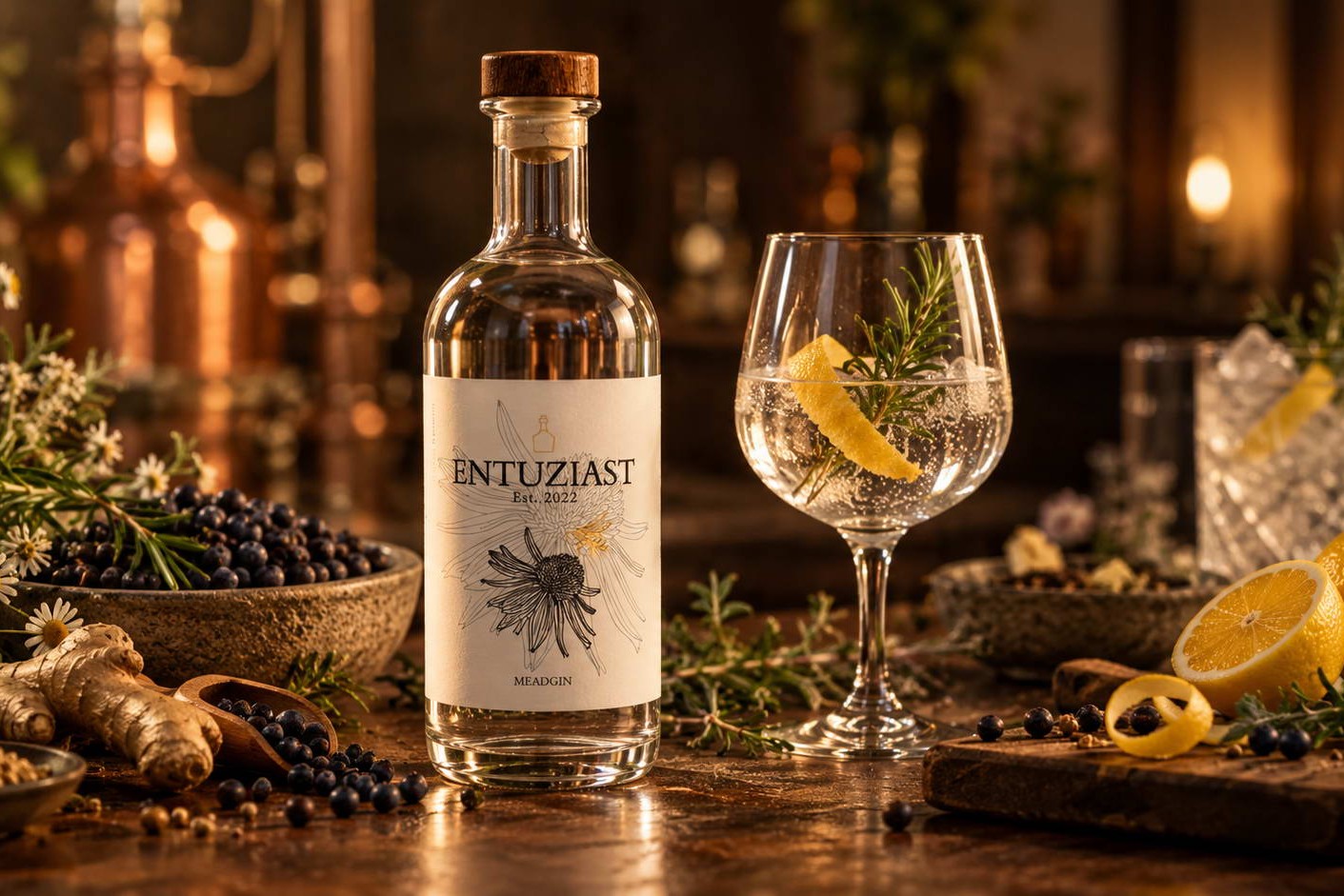
For example, MeadGIN ENTUZIAST is created on a honey distillate base.
In this case the spirit base does more than simply carry juniper and citrus aromas — it also contributes to the overall roundness and texture of the drink.
Does an Unusual Base Automatically Make a Gin Better?
Not necessarily.
It simply makes the gin different.
A neutral base allows the botanicals to appear with maximum clarity.
A more characterful distillate can add another aromatic layer.
But if the base spirit and botanicals compete with each other, complexity quickly turns into confusion.
Once again, the main criterion is balance.
What Should You Look for in the Aroma?
After opening the bottle, do not rush into a large first sip.
Pour a small amount of gin into a glass and let it rest for a few minutes.
In a good gin, the aroma usually develops beyond one sharp alcoholic note.
You may gradually notice:
- juniper;
- citrus peel;
- herbs;
- spices;
- flowers;
- berries;
- earthy or root-like notes.
The alcohol should not completely overpower the aromatic profile.
We explained separately why strong spirits can benefit from a few minutes in the glass in the article “Why Should You Let Strong Spirits Rest in the Glass?”.
Is a Strong Alcohol Smell a Sign of Poor Quality?
Not always.
Gin is a strong distilled spirit, so the aroma of ethanol is naturally present.
It may seem especially sharp during the first sniff or when the spirit is warm.
The problem begins when, even after several minutes in the glass, almost nothing appears behind that alcoholic note.
A well-made gin should gradually reveal its botanicals instead of remaining simply “spirity.”
How Should You Evaluate the Taste of Gin?
The first sip should be small.
Do not try to judge the whole spirit immediately.
Pay attention to the sequence.
What appears first?
What develops in the middle of the sip?
What remains afterwards?
For example, a good gin may begin with juniper and citrus, move toward spices, and finish with dry herbal or root-like notes.
Should a Good Gin Be Smooth?
Smoothness alone is not a measure of quality.
Some gins are intentionally dry, sharp and spicy.
Others may be rounder and easier in texture.
What matters more is whether the alcoholic warmth destroys the aroma and flavour.
Even a relatively strong gin can feel balanced when the alcohol, botanicals and texture work together.
Does ABV Tell You Anything About Gin Quality?
No.
ABV tells you the concentration of ethyl alcohol, but it is not a direct quality score.
Two gins at the same strength can feel completely different.
One may be sharp and dry, another rounded and aromatic.
Perception is influenced by:
- the spirit base;
- the botanicals;
- distillation method;
- temperature;
- texture;
- aromatic balance.
We will look at ABV in much more detail later in this series.
Should You Buy the Strongest Gin?
Not necessarily.
A higher strength can help carry aromatic compounds and may allow a gin to remain more expressive in cocktails.
But strength alone does not guarantee complexity or balance.
If you plan to drink gin neat, a very high ABV may simply be more intense than you personally enjoy.
If the gin is intended primarily for mixed drinks, a stronger aromatic profile may work very well.
Do You Need the Same Gin for Neat Tasting and Gin & Tonic?
Not always.
A gin that performs beautifully when tasted neat may be too delicate once a large amount of tonic is added.
On the other hand, a very juniper-forward and spicy gin may feel rather intense neat but work perfectly in a Gin & Tonic.
So before buying, it is worth asking one simple question:
How am I actually going to drink it?
If You Are Buying Gin for Gin & Tonic
Look for a profile that will not disappear once tonic is added.
Useful characteristics include:
- clearly defined juniper;
- citrus;
- spices;
- a clean dry structure.
An extremely delicate floral gin can easily become lost behind a highly aromatic or sweet tonic.
The tonic itself matters too: ideally it should support the gin rather than overpower it.
If You Want to Drink Gin Neat
In this case, other characteristics become more important:
- balance of alcohol;
- texture;
- aromatic detail;
- the finish;
- absence of harsh, discordant notes.
Drinking gin neat reveals the strengths and weaknesses of the distillate much more clearly because tonic, ice and citrus are not there to mask anything.
Should You Chill Gin Before Tasting It?
Excessive chilling can hide part of the aroma.
Lower temperatures reduce the volatility of aromatic compounds and also soften the perception of alcohol.
As a result, the gin may seem smoother but less expressive.
For Gin & Tonic, that may be perfectly acceptable.
For evaluating the gin itself, freezing it is usually not ideal.
We discuss this in more detail in the article “Can Gin Be Stored in the Refrigerator or Freezer?”.
Why Can Good Gin Turn Cloudy with Ice?
This is not necessarily a defect.
Juniper, citrus peel and other botanicals contain natural essential oils.
When the drink is strongly chilled or diluted with water, some of these compounds can become less soluble and the gin may temporarily turn cloudy.
That is why slight cloudiness should not automatically be interpreted as a sign of poor quality.
This effect is discussed in more detail in the article “Why Does Gin Turn Cloudy After Chilling or Adding Ice?”.
Does Clarity Matter?
For a classic uncoloured gin, clarity is normal, but clarity alone says nothing about quality.
There are also:
- barrel-aged gins;
- berry-based variations;
- gins with post-distillation maceration;
- naturally coloured spirits.
So judging gin only by colour or crystal clarity is not particularly useful.
What Can You Learn from the Label?
A label may provide useful information about:
- alcohol strength;
- country and producer;
- type of spirit;
- ingredients;
- production details;
- bottle volume;
- sometimes the botanicals and spirit base.
But attractive label design is not proof of quality.
Likewise, minimalist packaging does not mean the spirit itself is simple.
In the next article in this series, we will look separately at how to read the label of a strong alcoholic drink.
Should You Judge Gin by Price?
Price can reflect many different factors:
- raw material costs;
- production scale;
- manual labour;
- packaging;
- logistics;
- marketing;
- taxes;
- brand positioning.
So a more expensive gin is not automatically more enjoyable.
At the same time, an extremely low price often means the producer has had to reduce costs somewhere in the process.
Price is therefore best considered together with other characteristics rather than used as the main criterion.
Is Craft Gin Always Better?
No.
Craft production may give the producer more freedom to:
- experiment with botanicals;
- use an unusual spirit base;
- produce smaller batches;
- adjust recipes more closely.
But the word “craft” itself does not guarantee quality.
A large producer can make an excellent and consistent product, while a small distillery can make an unsuccessful one.
We will return to the real differences between craft and industrial spirits in a separate article in this series.
What Should You Look for in the Finish?
After the sip, a good gin does not necessarily need to remain in the mouth for several minutes.
What matters more is what remains.
You may notice:
- juniper;
- citrus;
- dry herbs;
- spices;
- roots;
- slight bitterness;
- warmth.
If the only thing left after the sip is harsh alcoholic burning, the aromatic composition may not have been particularly convincing.
Does a Good Gin Have to Be Complex?
Not necessarily.
A simple, clean and well-balanced gin can be excellent.
Complexity only adds value when the different notes work together.
If the spirit is overloaded with dozens of aromas without a clear structure, that is not an advantage.
How Can You Quickly Evaluate a Gin Before Buying?
If all you have is the bottle, label and product description, look for several things.
- What style is it? Classic juniper-led, citrus, floral, berry-driven or spicy.
- What is the base? Neutral spirit or a characterful distillate.
- What do you want it for? Neat drinking, Gin & Tonic or cocktails.
- What is the ABV? It may indicate intensity, but not quality.
- What does the producer say about the botanicals?
- Is the production method explained clearly?
How Should You Evaluate Gin After Opening the Bottle?
You can do a simple tasting at home.
- Pour a small amount into a glass.
- Let it rest for a few minutes.
- Do not push your nose deep into the glass.
- Smell using short, gentle sniffs.
- Take a small first sip.
- After adapting to the alcohol, take a second sip.
- Evaluate aroma, texture and finish separately.
This method reveals far more than taking a large sip of heavily chilled gin.
What If the Gin Feels Too Strong?
You can add just a few drops of water.
This does not “ruin” the gin.
A small amount of dilution can reduce alcoholic burn and sometimes make the botanicals easier to detect.
We explain why this happens in the article “Should You Add Water to Strong Spirits?”.
MeadGIN ENTUZIAST as an Example
In MeadGIN, the classic juniper character is combined with citrus notes and a honey distillate base.
ENTUZIAST describes it as a signature craft gin produced from honey distillate using traditional distillation in a copper still.
The profile combines juniper, citrus notes of lemon, citron and orange, a dry and spicy taste, and a medium-bodied texture. The current product specification lists its strength at 40% ABV.
This is a useful example of how the base spirit itself can become part of the identity of a gin rather than serving only as a neutral carrier for botanicals.
So What Makes a Good Gin?
It is not necessarily the gin in the most expensive bottle.
It is not the gin with the longest botanical list.
And it is not automatically the gin with the highest ABV.
A good gin is one in which:
- juniper remains recognisable;
- the botanicals work as one composition;
- alcohol does not overpower the aroma;
- the taste logically follows the aroma;
- the finish does not fall apart into unrelated notes;
- the style suits the way you intend to drink it.
In Short: How Do You Choose a Good Gin?
- Decide whether you prefer a classic juniper-led style or a modern signature gin.
- Look at the botanicals used by the producer.
- Pay attention to the spirit base.
- Do not judge quality by ABV alone.
- Do not assume that more botanicals automatically mean a better gin.
- Think about whether you will drink it neat or with tonic.
- Do not panic if gin becomes slightly cloudy after strong chilling.
- Evaluate how the drink develops in the glass, not only its first aroma.
- Look for balance between juniper, citrus, herbs, spices, alcohol and texture.
Conclusion
Choosing a good gin does not begin with the brand name or even the price.
First, it helps to understand which style you enjoy.
Classic dry and juniper-led?
Citrus-driven?
Spicy?
Floral?
Berry-based?
Or perhaps a signature gin built on a distinctive distillate base?
Once you understand that, choosing becomes much easier.
Read the description, pay attention to the botanicals, spirit base, ABV and production method, but do not look for one number or phrase that automatically means “quality.”
A good gin is first and foremost about balance: juniper, botanicals, the spirit base, texture and finish should work together.
And the best gin for you is the one whose style suits the way you actually want to drink it.