





Can You Store Gin and Honey Distillate in the Refrigerator or Freezer?
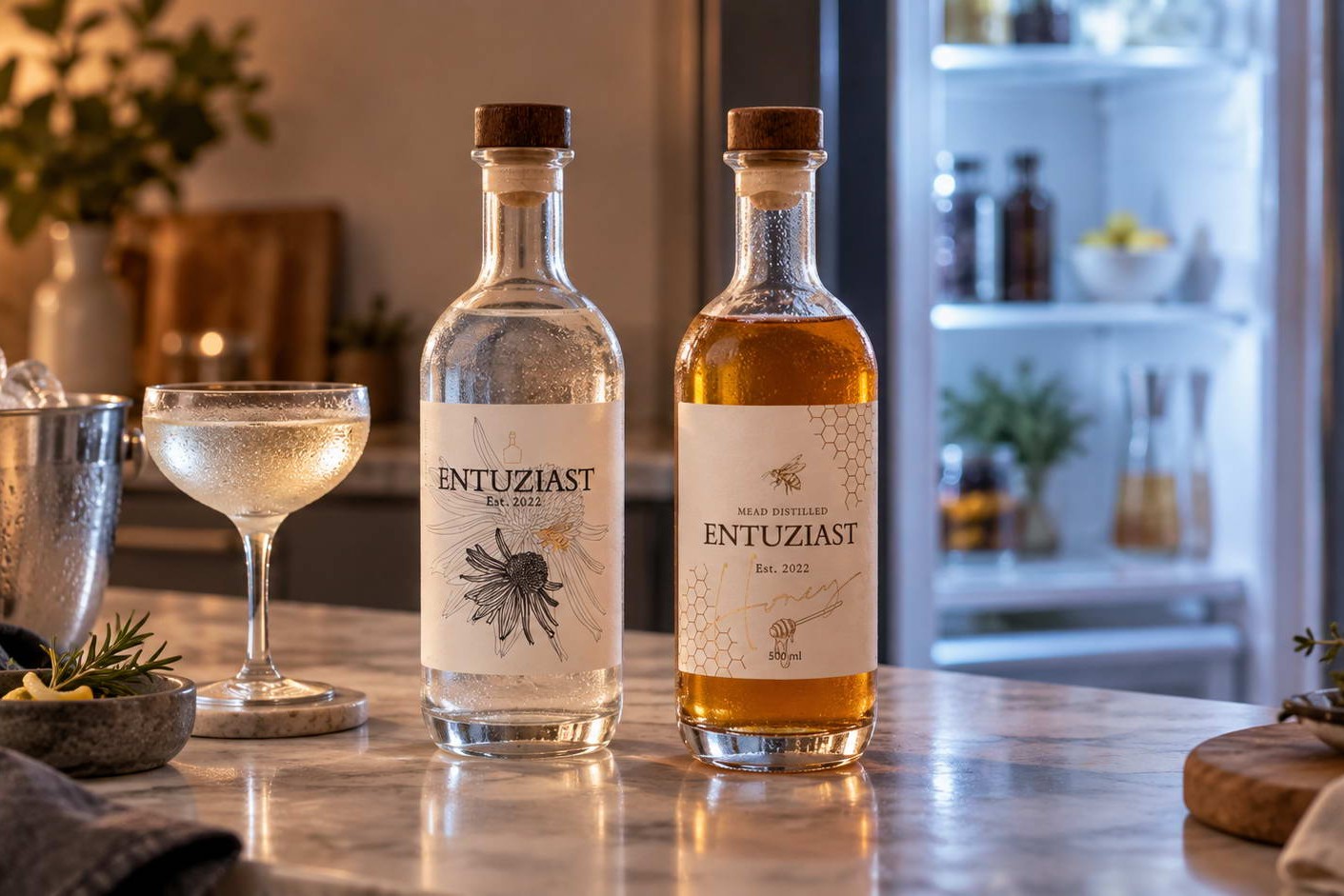
A bottle of gin is standing on the shelf, but before serving you want to chill it properly. This raises a perfectly reasonable question: can you simply put gin in the refrigerator — or even in the freezer?
And what about honey distillate? Will it lose its aroma? Can it become cloudy? And where is the best place to keep craft spirits in general: in the refrigerator, a bar cabinet, or at room temperature?
The short answer is simple: gin and honey distillates usually do not need to be stored permanently in the refrigerator.
In fact, for aromatic spirits, excessive chilling is not always an advantage.
Let us look at what happens to a spirit at different temperatures and how to store it so that its aroma, flavour and character are preserved as well as possible.
Do Strong Spirits Need to Be Stored in the Refrigerator?
In most cases, no.
Distilled spirits are very different from wine, beer or low-alcohol beverages.
Their relatively high alcohol concentration makes them considerably more stable.
For this reason, a sealed bottle of gin or strong honey distillate is usually best stored:
- in a dark place;
- without major temperature fluctuations;
- away from direct sunlight;
- away from radiators, ovens and other heat sources;
- in an upright position.
A normal cupboard or bar cabinet in a room with a moderate and relatively stable temperature is usually perfectly suitable.
Why Is Refrigeration Not Necessary?
The main reason is simple: refrigeration provides little additional benefit for the long-term storage of most strong distilled spirits.
It simply keeps them cold.
For perishable foods and drinks, low temperature is essential. For high-strength spirits, it usually is not.
At the same time, strong chilling can noticeably change how we perceive aroma and flavour.
What Does Cold Do to Aroma?
A drink's aroma is produced by volatile aromatic compounds.
These compounds move from the liquid into the air above the glass and eventually reach our olfactory receptors.
At lower temperatures, their volatility decreases.
As a result, a very cold spirit may seem:
- softer;
- less alcoholic;
- less sharp;
- but also less aromatic.
This is one reason why some simple or neutral spirits are traditionally served extremely cold.
Low temperature suppresses part of their aroma.
For a complex craft distillate, however, the same effect can be a disadvantage: together with the harsher notes, the cold also suppresses many of the aromatic nuances that make the spirit interesting.
What Happens to Gin in the Refrigerator?
Gin is particularly interesting because much of its character comes from botanicals.
Juniper, citrus peel, coriander, herbs, spices and other botanical ingredients contain a wide variety of aromatic compounds.
In MeadGIN ENTUZIAST, the botanical profile is also an important part of the spirit's character.
When such a gin is strongly chilled, some of its aromas become less expressive.
As the drink gradually warms in the glass, those aromatic notes begin to open again.
Can Gin Become Cloudy in the Refrigerator?
Yes, in some cases it can.
This is connected with the natural essential oils found in botanical ingredients.
At lower temperatures, certain aromatic compounds may become less soluble in the alcohol-water mixture.
As a result, a gin that is perfectly clear at room temperature may develop slight opalescence or haze when chilled.
We explain this phenomenon in detail in our separate article about why gin turns cloudy after chilling or adding ice.
If the haze is caused specifically by temperature, it may decrease or disappear as the drink warms up again.
What Happens to Gin in the Freezer?
A domestic freezer is considerably colder than a refrigerator.
Because of its high alcohol content, strong gin usually does not turn into an ordinary solid block of ice in a household freezer.
However, its physical properties change noticeably.
The spirit becomes:
- colder;
- more viscous;
- less aromatic;
- softer in its perception of alcohol.
This is why some people enjoy serving strong spirits directly from the freezer.
For an aromatic gin, however, this is not always the best way to experience its full character.
Does the Freezer Damage Gin?
Short-term chilling itself does not normally mean that gin will become spoiled.
However, there is little technological reason to store an aromatic craft gin permanently at extremely low temperatures.
If you want a cold drink, it is often better to chill it shortly before serving or use ice when preparing a cocktail.
Can You Chill and Warm the Bottle Repeatedly?
Moving a bottle from room temperature to the refrigerator and back once or occasionally is not normally a problem.
But in general, stable conditions are preferable for storage.
Repeated major temperature fluctuations offer no advantage.
It is usually better to keep the bottle in a stable environment and chill only the amount you intend to serve.
What About Honey Distillate?
Honey distillate also does not automatically need to be refrigerated.
When properly produced, it is a strong distilled spirit, and the same basic storage principles apply.
It is especially important to understand the difference between honey distillate and a sweet honey-based drink.
The word “honey” does not mean that the finished distillate is made from honey syrup or should behave like a sweet liqueur.
During production, honey is first fermented, and the resulting fermented material is then distilled.
The finished spirit therefore has very different properties.
For example, Honey Spirit Pure ENTUZIAST is created as an aromatic honey distillate rather than as a sweet honey infusion.
Why Should Honey Distillate Not Be Over-Chilled?
The reason is the same as with gin: low temperature suppresses aroma.
A well-made distillate may contain subtle notes of fermented raw material, floral honey, grain, fruit or oak.
If the spirit is extremely cold, some of these nuances become much more difficult to detect.
For that reason, very low serving temperatures can make it harder to fully appreciate a complex distillate.
What About Aged Honey Distillate?
Serving temperature becomes even more important with an aged spirit.
Oak maturation adds additional aromatic layers.
These may include woody, vanilla, spicy, fruity, wine-like and other notes.
If such a drink is strongly chilled, part of this aromatic complexity becomes less noticeable.
That is why Honey Spirit Aged ENTUZIAST is generally more interesting when tasted at a temperature that allows its aroma to develop gradually rather than when served ice-cold.
Can Cold Change the Taste?
Yes, although it is useful to be precise about what actually changes.
Cold does not necessarily change the chemical composition of the spirit.
It changes our perception of it.
At lower temperatures:
- aromas become less active;
- alcohol may feel softer;
- sweetness may sometimes seem less pronounced;
- the texture may feel denser;
- certain sharp notes become less noticeable.
That is why the same bottle can taste surprisingly different at different serving temperatures.
Where Should an Open Bottle Be Stored?
Once the bottle has been opened, another factor gradually becomes more important than temperature: contact with oxygen.
The less liquid remains in the bottle, the more air is present inside.
Over time, this may gradually alter the aromatic profile.
An opened bottle should therefore be:
- closed tightly;
- stored upright;
- kept in a dark place;
- kept away from heat sources;
- kept away from direct sunlight.
The refrigerator is still not normally required.
Why Should Strong Spirits Be Stored Upright?
This is one of the ways strong spirits differ from many wines.
Wine with a natural cork is traditionally often stored horizontally so that the cork remains moist.
With high-strength distilled spirits, the situation is different.
Prolonged direct contact between high-proof alcohol and cork or other closure materials can be undesirable.
For this reason, gin, whisky, brandy and other strong spirits are normally stored upright.
Does Sunlight Damage Spirits?
Yes. For long-term storage, direct sunlight is a more important concern than the absence of refrigeration.
Light and heat can accelerate undesirable changes in aromatic compounds.
It is particularly unwise to leave a bottle on a sunny windowsill, where it is exposed to both light and repeated heating.
A dark cupboard is often a much better storage location than a decorative shelf beside a window.
What If the Room Is Hot?
A brief rise in temperature does not mean the drink will immediately spoil.
However, for long-term storage it is better to avoid places where the bottle regularly becomes very hot.
For example:
- next to a radiator;
- above a cooker;
- near an oven;
- inside a cabinet heated by direct sunlight;
- inside a car during hot weather.
A stable moderate temperature is far more important than keeping the bottle as cold as possible.
Should Gin Be Chilled Before Making a Gin & Tonic?
It is not essential, but it can be useful.
If the gin, tonic and glass are already chilled, the ice will melt more slowly.
The cocktail therefore stays cold for longer and becomes diluted more gradually.
But this is a question of cocktail preparation rather than bottle storage.
There is no need to keep your entire supply of gin in the refrigerator simply for the sake of making one cocktail.
When Is the Refrigerator Useful?
The refrigerator can be useful when:
- you want to serve the spirit slightly chilled;
- you are preparing cocktails and want the ice to melt more slowly;
- you personally prefer colder spirits;
- you want to chill a bottle temporarily before serving guests or holding a tasting.
In other words, the refrigerator is a useful tool for controlling serving temperature rather than a mandatory place for permanent storage.
When Can the Freezer Be Useful?
A freezer is sometimes used when an extremely cold serving style is desired or when cocktail ingredients need to be pre-chilled.
However, with aromatic gin or a complex aged distillate, it is worth remembering that the lower the temperature, the fewer aromatic nuances you are likely to perceive.
The freezer is therefore a question of personal serving style rather than a universal storage rule.
What Is the Best Temperature?
There is no single ideal number for every spirit.
The best temperature depends on the style of the drink and the way it is being served.
But the principle is simple:
the more complex and aromatic the distillate, the less reason there is to hide its aroma behind extreme cold.
For cocktails, strong chilling is often an advantage.
For careful tasting, it is not always desirable.
What If the Bottle Is Already in the Freezer?
There is no need to worry.
If you want to experience more of the aroma, simply pour the spirit into a glass and allow it to warm slightly.
As the temperature rises, aromatic compounds become more active.
You can even compare the first sip of the very cold spirit with the same drink after 10–15 minutes in the glass.
The difference can sometimes be surprisingly noticeable.
Can You Chill the Glass Instead?
Yes.
In some situations, this is more practical than chilling the entire bottle.
For a cocktail, for example, you can place the glass in the refrigerator beforehand or chill it briefly with ice.
The bottle itself can remain in normal, stable storage conditions.
The Simplest Storage Rule
For most strong craft distillates, the basic rule can be expressed very simply:
dark, upright, stable and away from unnecessary heat.
Use the refrigerator when you want to chill the drink before serving.
Use the freezer if you specifically enjoy an extremely cold serving style.
But permanent deep chilling is not a requirement for the proper storage of gin or honey distillate.
In Short: Refrigerator or Cupboard?
For storage — a cupboard.
For chilling before serving — the refrigerator.
For an extremely cold serving style — the freezer, if that is what you enjoy.
But if you want to experience the full aroma of a complex gin or aged distillate, allow the spirit some time to open up in the glass.
Conclusion
Gin and honey distillate do not need to be stored permanently in the refrigerator or freezer.
For most strong distilled spirits, stable temperature, darkness, upright bottle storage and protection from excessive heat are considerably more important.
A refrigerator can be useful before serving, while a freezer produces a very cold, denser and softer-feeling drink.
However, low temperatures also suppress aroma.
For this reason, with craft spirits such as MeadGIN ENTUZIAST, Honey Spirit Pure or aged Honey Spirit Aged, temperature is not merely a question of storage. It is also a tool that can noticeably change the way aroma and flavour are perceived.
Sometimes the most interesting way to discover a good distillate is not to make it as cold as possible, but to give it time to gradually open in the glass.