





Where Does Citrus in Gin Come From If Lemon Wasn’t Added After Distillation?
In a good gin, you can often clearly notice:
- lemon;
- orange;
- grapefruit;
- citron;
- bergamot;
- sometimes even mandarin or lime-like notes.
And that raises an obvious question:
where does such a vivid citrus aroma come from in a clear distillate if lemon juice or flavouring was not added after distillation?
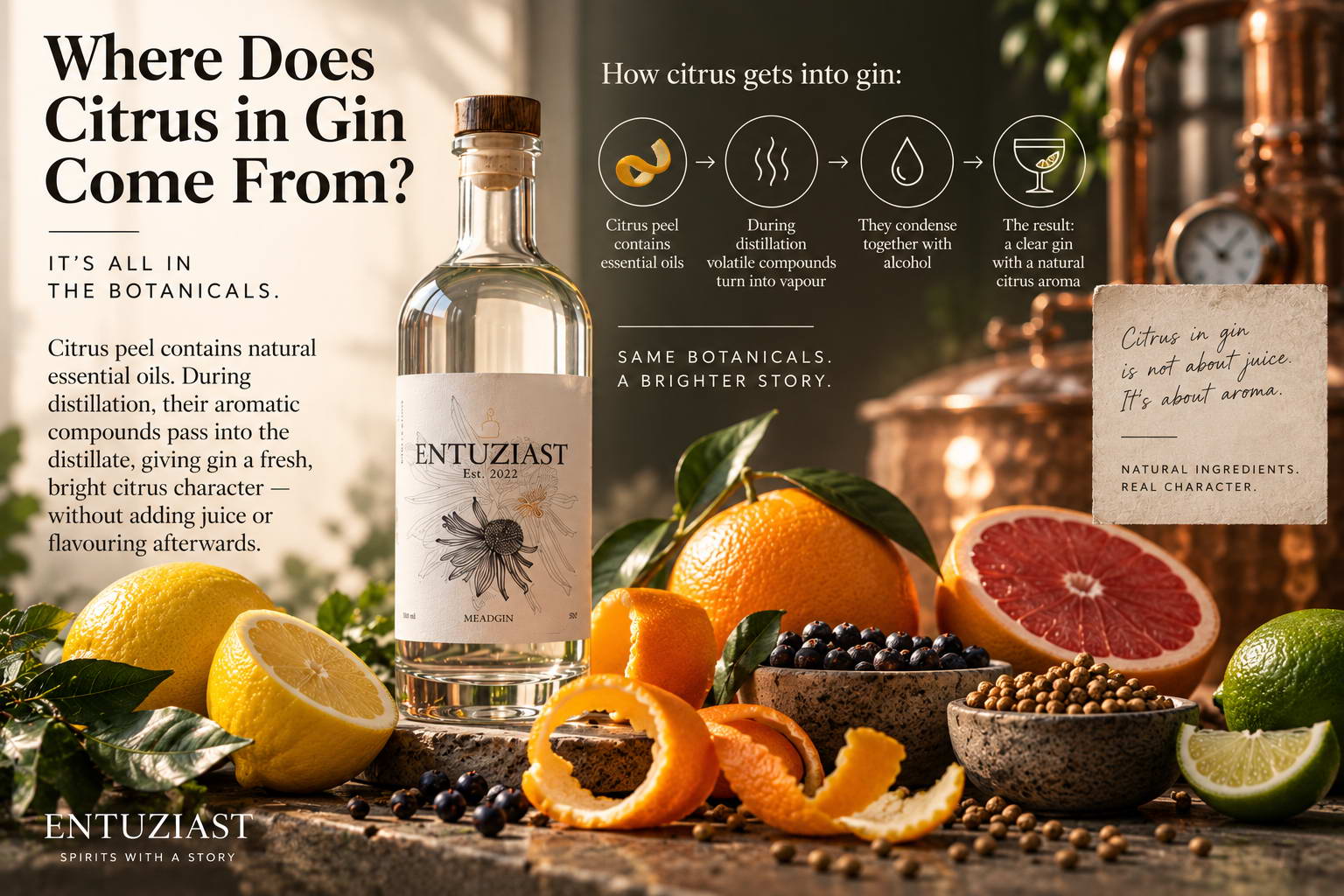
The answer is simple: in gin, aroma is often created during the distillation process itself.
And the main role is played by botanicals — especially citrus peel and other plant ingredients.
Citrus in Gin Does Not Necessarily Mean Juice
When we hear “lemon aroma,” we naturally think of juice.
But in gin, the more important part of the fruit is often not the juice, but the peel.
The outer layer of citrus peel contains a high concentration of essential oils and volatile aromatic compounds.
These compounds create the fresh profile we associate with lemon or orange.
Why Is the Peel More Aromatic Than the Juice?
Juice contains a lot of:
- water;
- acids;
- sugars;
- other dissolved substances.
The peel, especially the outer coloured layer, contains a much higher concentration of essential oils.
Those oils work particularly well when flavouring gin through distillation.
What Happens During Distillation?
The botanicals come into contact with the alcohol base or with alcohol vapour.
As the mixture is heated, volatile aromatic compounds move into the vapour phase.
They then condense together with the alcohol.
As a result, the finished distillate already contains citrus aromatic compounds.
There is no physical lemon left in the bottle, but its aromatic signature has already been transferred into the spirit.
Why Does the Drink Stay Clear?
Because mainly volatile compounds pass into the finished distillate during distillation.
The colour of the peel, most pigments, fibre and heavier non-volatile components remain behind.
That is why a gin can be completely clear and still smell intensely of lemon or orange.
Which Citrus Fruits Are Used in Gin?
Depending on the recipe, producers may use:
- lemon;
- sweet orange;
- bitter orange;
- grapefruit;
- lime;
- citron;
- bergamot;
- mandarin;
- pomelo.
Each creates a slightly different direction.
How Does Lemon Differ from Orange?
Lemon usually gives:
- sharper freshness;
- a drier citrus character;
- a sense of cleanliness;
- a bright top note.
Orange more often gives:
- a softer citrus character;
- a sweeter aromatic association;
- a warmer profile;
- greater roundness.
What About Grapefruit?
Grapefruit can contribute:
- freshness;
- light bitterness;
- dry citrus;
- a more restrained, mature character.
Why Does One Gin Smell Like Lemon and Another Like Orange?
Because the recipes are different.
The producer can change:
- the type of citrus;
- the amount of peel;
- the degree of drying;
- maceration time;
- distillation method;
- the way citrus interacts with other botanicals.
Even a small change can noticeably alter the profile.
Fresh or Dried Peel?
Both can be used.
Fresh peel often gives a juicier, brighter profile.
Dried peel can give a more concentrated, dry and spicy character.
But the result depends on the raw material and the production method.
Does the White Part of the Peel Matter?
Yes.
The white pith beneath the coloured zest contains more bitter compounds.
That is why producers pay attention to exactly which part of the peel is used.
Too much pith can make the profile:
- more bitter;
- rougher;
- drier.
Can Citrus Notes Appear Without Any Citrus Peel?
Yes.
And this is one of the most interesting parts of gin aroma.
Citrus-like associations can also come from other botanicals.
For example:
- coriander;
- cardamom;
- certain herbs;
- some flowers;
- various spices.
So if you smell lemon, that does not automatically mean lemon was definitely used in the recipe.
How Does Coriander Contribute?
Coriander seeds can create a bright citrus-spice impression.
They often work as a bridge between juniper and citrus peel.
This is one reason coriander is so important in many classic gins.
We discussed this in detail in the article “Why Is Coriander Used in Gin and How Does It Affect the Taste?”.
Why Can Different Botanicals Smell Similar?
Because different plants can contain the same or similar volatile molecules.
Our brain does not perceive the name of an ingredient — it perceives a combination of aromatic signals.
So the same lemon-like association can come from different sources.
Can You Identify the Exact Gin Recipe by Smell?
Not reliably.
An experienced taster may make educated guesses about certain botanicals.
But that is still a sensory hypothesis.
Only the producer knows the exact recipe.
Why Shouldn’t You Invent Botanicals Based Only on Aroma?
Because it is easy to be misleading.
If a gin smells like lemon, the recipe may contain:
- lemon peel;
- coriander;
- cardamom;
- a combination of several ingredients.
Aroma is not a laboratory analysis of the ingredient list.
Which Is Stronger: Peel or Coriander?
That depends on the amount used and the production method.
In one gin, citrus peel may dominate.
In another, the citrus effect may be created by several botanicals working together.
There is no universal answer.
How Does Citrus Maceration Work?
The peel can be soaked in the alcohol base before distillation.
The alcohol extracts essential oils and aromatic compounds.
The mixture is then distilled.
Maceration time influences intensity.
Is Longer Maceration Always Better?
No.
Very long maceration can extract more heavy, bitter or rough components.
So the producer has to find the right balance.
What Is Vapor Infusion for Citrus?
The peel does not necessarily have to sit directly in the liquid.
It can be placed in the path of alcohol vapour.
The vapour passes through the botanical material and carries away the most volatile compounds.
This can create a lighter and more delicate citrus profile.
How Is Vapor Infusion Different from Maceration?
With maceration, alcohol stays in contact with the botanical for longer.
With vapor infusion, vapour does most of the extraction.
The result may differ in:
- intensity;
- density;
- freshness;
- aromatic structure.
Why Does Lemon Aroma Survive Distillation?
Because some essential oils and aromatic compounds are volatile enough to travel with the alcohol vapour.
After condensation, those compounds remain in the distillate.
Why Doesn’t Sugar Pass Through in the Same Way?
Sugar is essentially non-volatile under normal distillation conditions.
So it stays behind in the still.
This is why fruit aroma can pass into a distillate while fruit sweetness does not.
Is This Similar to Honey Distillate?
Yes, the principle is partly similar.
Honey can contribute aromatic character to fermented raw material, but its sugar does not pass into the distillate as sweetness.
We discussed this in the article “Why Aren’t Honey Distillates Sweet?”.
Why Can Gin Smell Like Sweet Lemon Without Containing Sugar?
Because aroma and taste are not the same thing.
Citrus oils may remind us of:
- lemon cream;
- candied peel;
- sweet citrus zest;
- lemon pastries.
The brain automatically connects these aromas with sweetness.
But the drink itself may remain completely dry.
Can London Dry Be Very Citrusy?
Yes.
London Dry does not have to be purely piney.
A producer can build a very expressive citrus profile as long as it is created within the production rules of the category.
We discussed the difference between styles in the article “London Dry, Distilled Gin and Gin: What’s the Difference?”.
Can Citrus Be Added After Distillation?
That depends on the gin category.
Some styles permit additional flavouring after distillation.
London Dry follows much stricter rules.
This is why the wording on the label can tell you a lot about the production method.
What If Juice Is Added After Distillation?
Then more than just aroma changes.
Juice adds:
- water;
- acids;
- sugars;
- colouring compounds;
- other non-volatile substances.
That is a completely different production approach.
Why Doesn’t Classic Gin Need Lemon Juice?
Because the desired aroma can be created through botanicals and distillation.
This helps preserve:
- clarity;
- dryness;
- high stability;
- a clean aromatic profile.
Why Does One Citrusy Gin Feel Fresh While Another Feels Sweet?
Because different combinations create different aromatic associations.
For example:
lemon + juniper + coriander can produce a dry, fresh profile.
Orange + flowers + soft spices can feel rounder and sweeter aromatically.
Does Gin Strength Matter?
Yes.
Ethanol helps keep essential oils from botanicals in solution.
So the final ABV influences:
- aromatic intensity;
- stability of essential oils;
- texture;
- behaviour when chilled.
Why Can Gin Turn Cloudy with Ice?
When gin is diluted and chilled, the solubility of some essential oils decreases.
They can form a very fine dispersion, making the drink appear cloudy.
This is not necessarily a defect.
We explain this in more detail in the article “Why Does Gin Turn Cloudy After Chilling or Adding Ice?”.
Does Strong Citrus Aroma Mean There Are Lots of Essential Oils?
Not necessarily in a simple direct way.
Perception depends on:
- the specific molecules;
- their proportions;
- other botanicals;
- ABV;
- temperature.
Why Does Temperature Change Citrus Aroma?
Strong chilling reduces volatility.
As a result, lemon and orange notes may seem weaker.
As the gin warms slightly, the aroma becomes more active.
Why Shouldn’t You Taste Gin Ice-Cold?
If you want to evaluate the botanicals themselves, very low temperature gets in the way.
For Gin & Tonic, cold is excellent.
For analysing aroma, a moderate temperature works better.
Does Tonic Enhance Citrus?
It can.
Especially if the tonic itself contains citrus components.
In addition:
- carbonation lifts aroma;
- quinine bitterness creates contrast;
- ice changes volatility;
- dilution reduces alcoholic burn.
This means a citrus profile can feel very different in Gin & Tonic compared with neat gin.
Do You Need to Add Lemon to Gin & Tonic?
Not necessarily.
If the gin already has a strong citrus profile, an extra lemon garnish can:
- highlight it;
- or overpower more delicate botanicals.
So garnish is best chosen for the specific gin.
Why Can Orange Work Better Than Lemon?
If the gin has a warm, spicy or floral character, orange can work more gently.
Lemon gives sharper freshness.
Orange gives a rounder aromatic impression.
What About Grapefruit?
It works particularly well with dry and slightly bitter profiles.
Especially when the gin already has:
- juniper;
- coriander;
- bitter orange;
- spicy botanicals.
Does MeadGIN ENTUZIAST Have a Citrusy Character?
MeadGIN ENTUZIAST has a clear citrus-juniper direction.
But the exact botanical list and proportions should not be invented without direct information from the producer.
What matters is that citrus character can be created in a complex way — through several botanical sources and through the distillation process itself.
Why Is This a Good Example?
Because the drinker experiences the finished aromatic result, not an ingredient list.
In the glass, what matters is the interaction of:
- juniper;
- the citrus direction;
- the distillate base;
- texture;
- ABV.
How Should You Taste a Citrusy Gin?
Pour a small amount into a glass.
Do not add ice or tonic immediately.
Let it rest for a few minutes.
Then ask yourself:
- does the citrus feel more like lemon or orange;
- is it fresh or dry;
- is there bitterness;
- does the citrus move into a spicy finish.
Why Does the Aroma Change After a Few Minutes?
The drink warms and interacts with air.
Different aromatic compounds have different volatility.
So lemon may dominate at first, while juniper or spice becomes more obvious later.
Can You Add a Few Drops of Water?
Yes.
Especially if the gin feels very alcohol-forward.
A little dilution can make the citrus-botanical profile easier to detect.
We discuss this in the article “Should You Add Water to Strong Spirits?”.
Does Natural Citrus Have to Smell Weaker?
No.
Natural essential oils can be extremely intense.
A relatively small amount of good-quality peel can have a major effect on aroma.
Does a Strong Lemon Aroma Mean Artificial Flavouring Was Used?
No.
This is another common myth.
A very bright citrus profile can be created entirely through natural botanicals and distillation.
How Can You Tell If Flavouring Was Used?
Reliably — from the producer’s information, product category and labelling.
You cannot determine it from smell alone.
Why Does the Label Matter Again?
Because the production category may restrict or permit certain flavouring methods.
For example, London Dry follows much stricter rules about what can be done after distillation.
We discussed how to read these terms in the article “How to Read the Label on a Strong Alcoholic Drink”.
In Short: Where Does Citrus in Gin Come From?
- Citrus peel is one of the most common sources.
- The peel contains a high concentration of volatile essential oils.
- During distillation, some aromatic compounds pass into the distillate.
- This is why finished gin can remain clear while smelling strongly of citrus.
- Lemon, orange, grapefruit, bergamot and other citrus fruits create different profiles.
- Coriander and other botanicals can also create citrus-like associations.
- A lemon aroma does not prove that lemon was definitely used in the recipe.
- A strong citrus aroma does not automatically mean artificial flavouring was used.
- Maceration and distillation methods strongly affect the result.
- The exact recipe should be determined from producer information, not from aroma alone.
Conclusion
Citrus aroma in gin does not require lemon juice to be added after distillation.
Natural botanicals can do most of the work during production.
Citrus peel contains concentrated essential oils, some of which travel with the alcohol vapour into the finished distillate.
Meanwhile, colour, sugar and most non-volatile components remain behind.
That is why a clear, dry gin can smell intensely of lemon, orange or grapefruit.
Coriander, cardamom and other botanicals can also contribute to citrus-like impressions.
In gin, we are not smelling a physical piece of lemon — we are smelling aromatic molecules that the distiller successfully transferred from plant material into the finished spirit.
And in the next article in this series, we will explore why one gin smells like a pine forest while another smells floral, citrusy and herbal, even though both are still gin.