





Why Is Coriander Used in Gin and How Does It Affect the Taste?
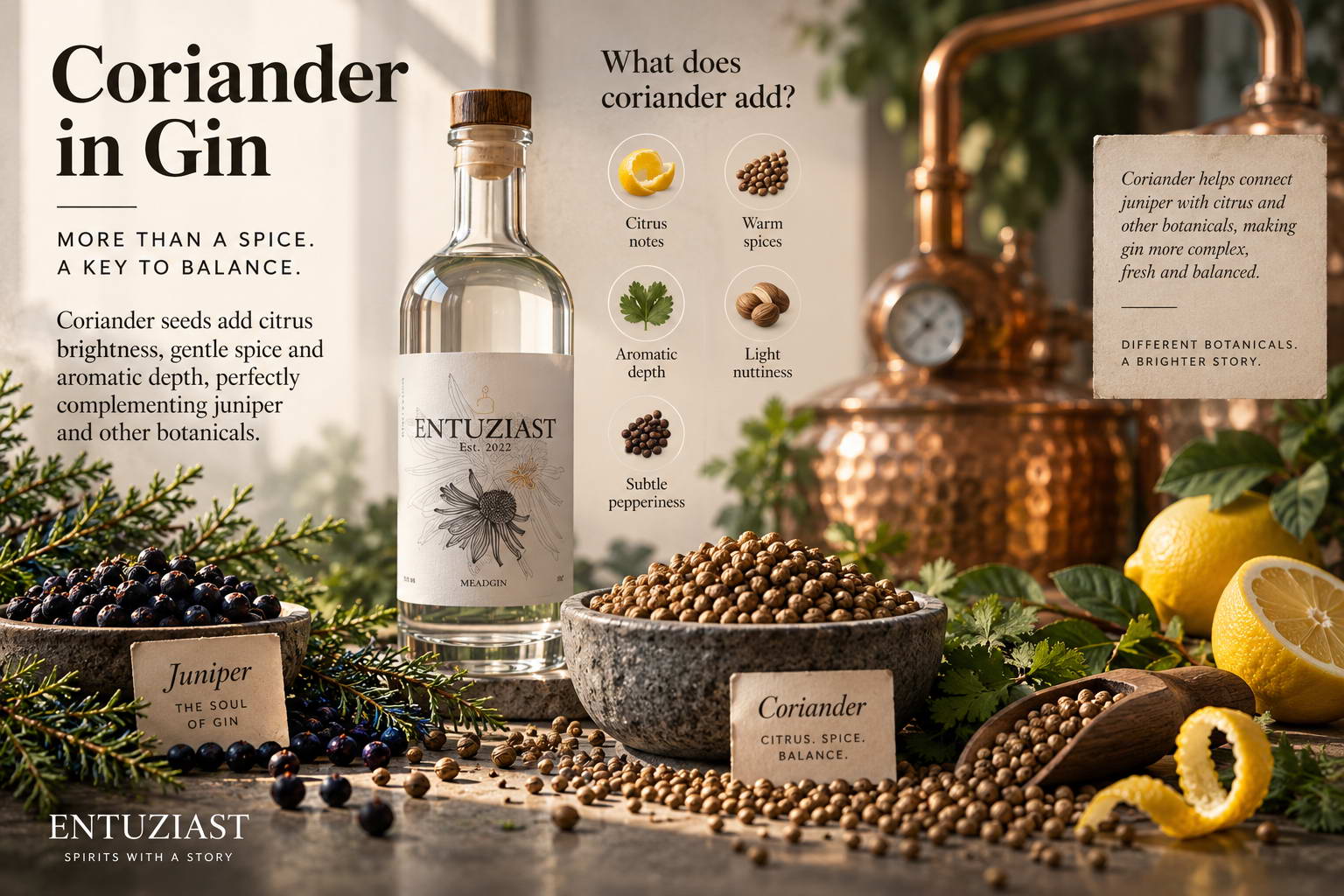
When people talk about gin, juniper is almost always the first thing they mention.
And that makes sense: juniper character defines the category itself.
But if you look more closely at classic gin recipes, another botanical appears very often next to juniper — coriander.
For many people, this is surprising.
After all, coriander is usually associated with cooking, spices and herbs.
So what is it doing in gin?
Why is it used so often?
And why would many classic gins taste completely different without it?
Is Coriander Just a Spice?
Not exactly.
In gin, producers usually use coriander seeds.
Their aroma is much more complex than simply “spicy.”
You may find associations with:
- lemon peel;
- orange;
- dry spices;
- warm herbs;
- light nuttiness;
- peppery notes.
This complexity is exactly what makes coriander so useful in gin recipes.
Why Is Coriander Often Second Only to Juniper?
Because it supports the core gin profile extremely well.
Juniper contributes:
- pine;
- resin;
- dryness;
- a fresh forest-like character.
Coriander adds:
- citrus brightness;
- dry spice;
- warmth;
- additional aromatic depth.
Together, they create a much more complex framework than either would on its own.
Why Can Coriander Smell Citrusy?
Coriander seeds contain volatile aromatic compounds that our brain easily associates with lemon, orange and other citrus fruit.
So a citrus note in gin does not always mean the producer used a large amount of lemon peel.
Part of that impression may come from coriander itself.
So Can Coriander Replace Lemon?
Not exactly.
Lemon peel and coriander seeds create different kinds of citrus character.
Lemon peel tends to give:
- bright freshness;
- citrus-oil intensity;
- a clearly recognisable lemon aroma.
Coriander creates a drier, spicier and more structural citrus direction.
Together, they can be much more interesting than either one alone.
Why Is Coriander Important for Balance?
If a gin contained only juniper, the profile could become too:
- piney;
- resinous;
- linear.
Coriander helps open up the composition.
It adds:
- dry spice;
- freshness;
- a citrus bridge;
- more aromatic movement.
As a result, gin starts to feel less like spirit flavoured with juniper and more like a layered botanical drink.
Does Coriander Make Gin Spicy?
Not necessarily.
The level of spice depends on the amount used, the distillation method and how coriander interacts with the other botanicals.
In moderate amounts, it may simply add a gentle warm spice.
At higher levels, it can become:
- peppery;
- dry;
- sharper;
- more dominant.
Does Coriander Affect the Finish?
Yes.
Its dry and spicy components can remain noticeable after the sip longer than some lighter citrus notes.
This can make the finish feel:
- drier;
- longer;
- spicier;
- more structured.
Is Fresh Coriander Leaf Used?
In classic gin recipes, coriander seeds are far more common.
The green leafy part of the plant has a very different aromatic profile.
It can be:
- grassy;
- green;
- sharp;
- fresh.
That creates a completely different direction.
Do All Gins Contain Coriander?
No.
Coriander is very common, but it is not mandatory.
A producer can make gin without it.
In that case, citrus and spicy support may come from other botanicals.
What Can Be Used Instead of Coriander?
Depending on the style, alternatives may include:
- cardamom;
- pepper;
- citrus peel;
- angelica root;
- lavender;
- local herbs;
- other spices.
But the final result will be different.
Does Coriander Affect Taste or Aroma?
Both.
In gin, most botanicals work on several sensory levels at once.
Coriander can influence:
- aroma;
- taste;
- dryness;
- spice;
- finish.
What Happens to Coriander During Distillation?
When heated, volatile aromatic compounds move into the vapour phase along with alcohol.
After condensation, some of those compounds remain in the finished distillate.
That is why physical pieces of coriander seed do not need to remain in the bottle.
The aroma has already been transferred into the spirit.
Does It Matter When Coriander Is Added?
Yes.
A producer may:
- macerate it together with other botanicals;
- use a shorter maceration;
- distil it separately;
- use vapour extraction.
Each approach can change its intensity and character.
Does Crushing the Seeds Matter?
Yes.
If the seeds are heavily crushed, the surface area in contact with alcohol increases.
Extraction becomes faster and more intense.
But excessive crushing can create a rougher or overly spicy profile.
Does the Origin of Coriander Matter?
Yes.
Coriander from different regions can vary in:
- essential oil content;
- freshness;
- drying level;
- aromatic profile.
So even the same botanical can produce different results depending on the raw material.
Is Fresher Coriander Better?
Not necessarily in the sense of freshly harvested, but the quality and freshness of dried seeds matter.
Older seeds gradually lose some of their essential oils.
That can reduce aromatic intensity.
Why Don’t Producers List the Exact Amount of Coriander?
Because the botanical recipe is often part of a proprietary formula.
A producer may disclose the ingredients but not necessarily the exact proportions.
The balance between botanicals is often one of the things that defines a gin’s style.
Does More Coriander Mean More Citrus?
Up to a point, yes — but not in a simple linear way.
As the amount increases, you may also get more:
- spice;
- dryness;
- pepperiness;
- warm aromatic tones.
So too much coriander does not simply mean “more lemon.”
Can You Recognise Coriander in Finished Gin?
Sometimes.
Especially when it is used quite prominently.
Look for a combination of:
- dry citrus;
- light pepper;
- warm spice;
- herbal dryness.
But in a well-balanced gin, coriander does not necessarily need to stand out on its own.
Why Doesn’t a Good Botanical Always Need to Be Easy to Identify?
Because the goal of a recipe is not always to show every ingredient separately.
Botanicals often work like an ensemble.
You experience:
- balance;
- structure;
- a complete aromatic profile.
Not a list of individual ingredients one after another.
How Does Coriander Work with Juniper?
This is one of the most classic combinations in gin.
Juniper contributes:
- pine;
- resin;
- dryness.
Coriander adds:
- citrus;
- spice;
- light warmth.
Together, they create a very recognisable dry gin structure.
What About Lemon Peel?
Here, coriander can strengthen the citrus impression while making it more complex.
Lemon gives more direct freshness.
Coriander adds a dry and spicy background.
The result is a citrus profile that feels less one-dimensional.
What About Orange?
Orange often creates a softer, sweeter aromatic association.
Coriander can add dryness and spice.
This helps prevent the profile from becoming too candy-like.
What About Cardamom?
The combination becomes much more spice-driven.
Cardamom can contribute:
- eucalyptus-like notes;
- camphor;
- lemon-like tones;
- warm spice.
Together with coriander, this can create a very complex spicy centre.
Why Is Coriander Important in London Dry?
In classic London Dry, the main aromatic profile is formed during distillation.
So each botanical needs to play its role during the distillation itself.
Coriander often works as a bridge between:
- juniper;
- citrus;
- roots;
- spices.
We already discussed the difference between London Dry, Distilled Gin and Gin in the article “London Dry, Distilled Gin and Gin: What’s the Difference?”.
Does Coriander Affect the “Dryness” of Gin?
Yes, sensorially it can.
Coriander does not remove sugar, but its spicy and citrus-dry notes can make the profile feel drier.
Especially when combined with:
- juniper;
- angelica;
- orris root;
- pepper.
Can Coriander Make Gin Seem Sweeter?
Aromatically — sometimes.
If it creates a bright citrus profile, the brain may associate it with ripe fruit or candied peel.
But that is an aromatic association, not necessarily actual sweetness.
Does Coriander Affect Texture?
Indirectly.
The botanical primarily changes aroma and taste.
But through overall sensory perception, its dry and spicy notes can make the gin feel more structured.
Does Coriander Taste the Same Neat and in Gin & Tonic?
No.
Tonic changes the balance.
Carbonation, quinine bitterness and dilution can emphasise some components and soften others.
Coriander’s citrus-spice character often works well with tonic because it does not disappear completely after dilution.
Why Does Coriander Work Well in Cocktails?
Because its aromatic profile can be both persistent and structural.
In cocktails, it can support:
- citrus;
- bitter ingredients;
- vermouth;
- tonic;
- herbal components.
Can Gin Be Made Without Classic Botanicals?
Modern gin recipes can be highly unconventional.
But juniper should still remain a key part of the gin character.
Otherwise, the drink begins to move away from the basic idea of gin itself.
Why Do Modern Gins Sometimes Use Local Herbs Instead of Traditional Spices?
To create a distinct identity.
A producer may use:
- local herbs;
- berries;
- flowers;
- roots.
But coriander remains popular because of its versatility.
Is Coriander Used in MeadGIN ENTUZIAST?
In gin production, the exact botanical composition and proportions may be part of the producer’s proprietary recipe.
So unless the producer states it directly, it is better not to invent a specific ingredient list.
In MeadGIN ENTUZIAST, the important sensory elements are the honey distillate base, juniper and the overall citrus-botanical character.
Why Is That Important?
Because when describing gin, it is easy to start assigning specific botanicals based only on aroma.
If you perceive a coriander-like or cardamom-like note, that does not necessarily mean that exact ingredient was used.
Different compounds can create similar aromatic associations.
How Should You Taste Gin to Notice Coriander More Clearly?
Try the gin neat first.
Do not serve it too cold.
Let it rest in the glass for a few minutes.
Then pay attention to:
- the transition from juniper to citrus;
- dry spice;
- light peppery warmth;
- the finish.
Why Not Add Tonic Immediately?
Because tonic changes the aromatic balance straight away.
If your goal is to understand the gin itself, it is better to take a small neat sip first.
Then compare it with a Gin & Tonic.
Can Water Help?
A few drops can reduce alcoholic burn and make some aromas easier to detect.
There is no need to add much.
We discussed this in more detail in the article “Should You Add Water to Strong Spirits?”.
What Happens If There Is Too Much Coriander?
The profile can become:
- too spicy;
- peppery;
- dry;
- sharp;
- dominant over the juniper.
That is why a good recipe is always about balance.
What If There Is Too Little?
The gin may lose some aromatic cohesion.
Juniper and citrus may feel like separate elements rather than one composition.
Coriander often acts as a connecting link.
Is Coriander the Secret Ingredient of Gin?
Not really.
There is no single “secret ingredient.”
Good gin is a system.
What matters is:
- juniper;
- other botanicals;
- the spirit base;
- distillation method;
- proportions;
- ABV;
- balance.
In Short: Why Is Coriander Used in Gin?
- Coriander is one of the most common gin botanicals after juniper.
- The seeds are usually used.
- It can contribute citrus, spicy and peppery notes.
- It helps connect juniper with citrus and other spices.
- It makes the aromatic profile more complex.
- It can add dryness and structure to the finish.
- Not every gin necessarily contains coriander.
- The amount of coriander should not be judged by the rule “more is better.”
- Origin, quality and extraction method also matter.
- In a good gin, coriander often works as part of the overall balance rather than standing out on its own.
Conclusion
Coriander in gin is far from a random spice.
It plays an important aromatic role between juniper, citrus and other spicy botanicals.
Thanks to coriander, a classic gin profile can feel drier, fresher and more layered.
At the same time, a good recipe should not turn coriander into the main character.
It works best when it helps the other elements sound like one composition.
Juniper gives gin its identity, while coriander often helps bring that identity together into a coherent whole.
And in the next article, we will look at another interesting question: where does the citrus aroma in gin come from if lemon or orange is not added after distillation?