





Where Do Vanilla and Caramel Notes in Aged Spirits Come From?
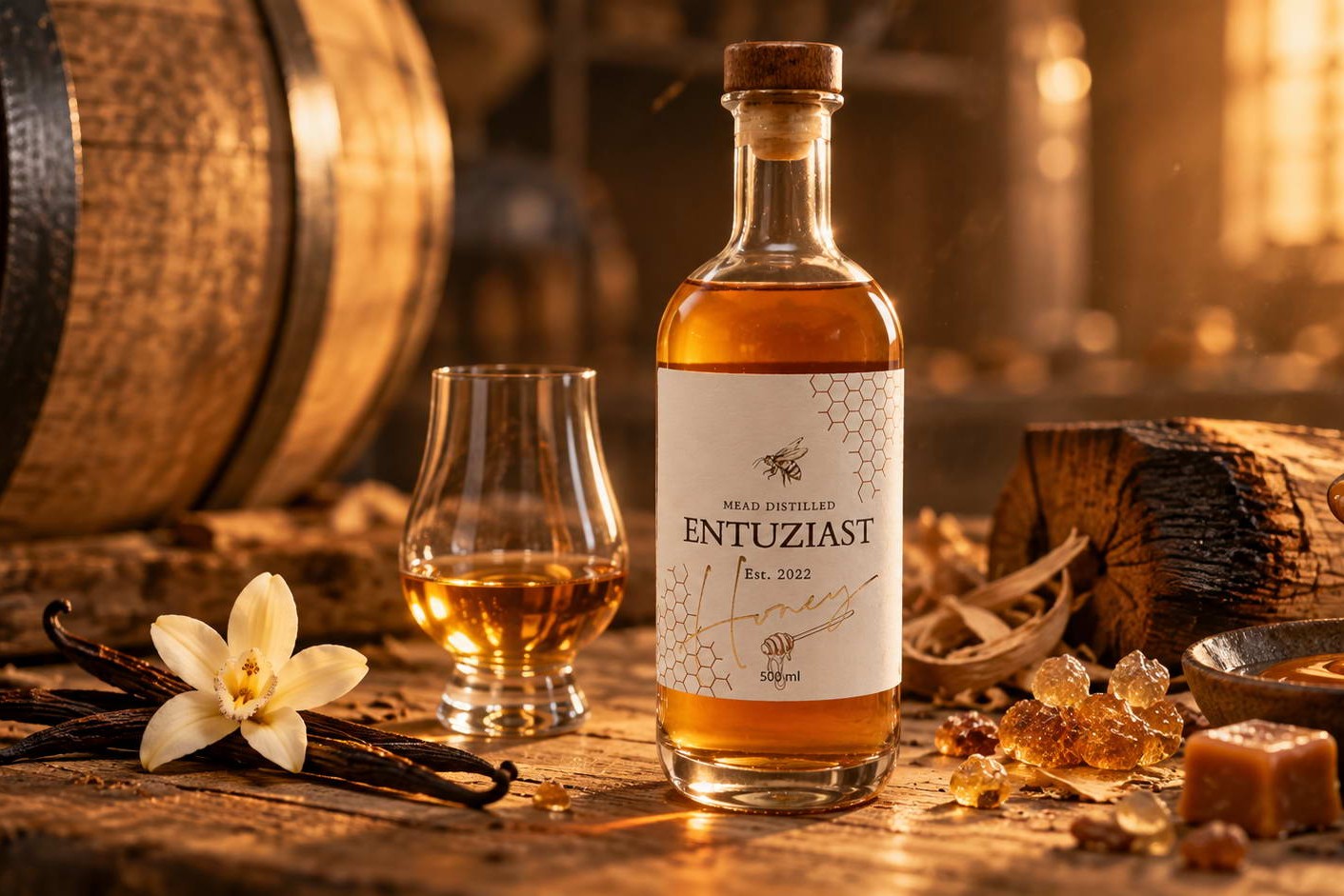
In tasting notes for whisky, brandy, rum or another aged distillate, you will often see words such as vanilla, caramel, coconut, spices, chocolate or toasted bread.
But when you look at the production process, a logical question appears.
Where do vanilla and caramel come from if nobody put vanilla pods or caramel syrup into the barrel?
In most classic aged spirits, the answer is literally all around the liquid — in the oak barrel itself.
Oak is not a neutral container.
During barrel production, toasting or charring, and years of contact with alcohol, dozens of aromatic compounds are released or formed.
These compounds can create familiar associations with vanilla, caramel, coconut, nuts, spices, coffee and many other aromas.
The deeper you look into the process, the clearer it becomes that maturation is not simply storing alcohol in wood.
It is a long interaction between spirit, water, wood, oxygen, temperature and time.
An Oak Barrel Does More Than Store the Spirit
Historically, wooden barrels were primarily practical containers for transport and storage.
Over time, however, people noticed something important: distillate changed during prolonged contact with oak.
It gained colour.
Harshness gradually softened.
And the aroma became much more complex.
That is how a simple transport container became one of the most important technological tools in the production of aged spirits.
We discuss why oak became the dominant wood for this purpose in the article “Why Have Spirits Been Aged in Oak Barrels for Centuries?”.
What Is Oak Made Of?
Wood may look simple from the outside, but chemically it is a complex structure.
Important natural components include:
- cellulose;
- hemicelluloses;
- lignin;
- tannins;
- oak lactones;
- other phenolic and aromatic compounds.
Each of these groups behaves differently during drying, heating and contact with alcohol.
This is why oak can produce such a wide range of aromas.
Where Does the Vanilla Note Come From?
One of the most familiar aromas in aged spirits is vanilla.
A key compound here is vanillin.
Vanillin is most commonly associated with vanilla beans, but it can have another origin as well.
During thermal treatment and the gradual breakdown of lignin-related components in oak, aromatic substances can form, including vanillin.
The alcohol-water mixture then slowly extracts these compounds from the inner surface of the barrel.
That is how a clear vanilla note can appear without any actual vanilla being added.
So Vanilla Aroma Does Not Necessarily Mean Flavouring?
Exactly.
In a classic aged distillate, vanilla character can be a natural result of contact with oak.
Its intensity depends on many factors:
- the species of oak;
- the origin of the wood;
- how the staves were seasoned;
- the degree of toasting or charring;
- the age of the barrel;
- how many times it has been used;
- maturation time;
- the strength of the distillate;
- storage temperature.
That is why two distillates aged for the same two years can show completely different levels of vanilla aroma.
Where Does the Caramel Note Come From?
The mechanism is somewhat different.
The inner surface of a barrel is usually heat-treated before use.
Depending on the production method, this may involve different levels of toasting or charring.
Heat changes the structure of the wood.
In particular, components of hemicellulose begin to break down and form new aromatic substances.
This can produce notes that people describe as:
- caramel;
- burnt sugar;
- toffee;
- toast;
- biscuits;
- nuts;
- coffee;
- light smoke.
No one needs to pour caramel syrup into the barrel.
The aroma is created by the wood itself after heat treatment.
Does Oak Actually Contain Sugar?
Not in the way we normally think of sugar in a sugar bowl.
But wood contains complex carbohydrate structures, including hemicelluloses.
Under heat, these compounds undergo chemical transformations.
The products of those transformations can create sweet, caramelised and toasted aroma associations.
This is why the word “caramel” in tasting notes does not necessarily mean the spirit itself is sweet.
It is primarily a description of aroma and sensory impression.
Why Can a Spirit Smell Sweet Without Being Sweet?
This is an important tasting phenomenon.
Our brain strongly connects certain aromas with familiar flavours.
Vanilla is associated with desserts.
Caramel is associated with sugar.
Coconut is often associated with sweets.
As a result, even a dry distillate with little or no sugar can appear “sweet” on the nose.
Aromatic sweetness and actual sugar content are completely different things.
This is one of the clearest examples of how the brain combines smell, taste and previous experience into one overall impression.
Where Does Coconut Aroma Come From?
Another common association in barrel-aged spirits is coconut.
This is especially noticeable with certain types of oak.
A major role is played by compounds known as oak lactones.
These naturally occurring wood compounds can create notes of:
- coconut;
- sweet wood;
- creaminess;
- sometimes fresh wood shavings.
Their concentration varies depending on the type of oak and the way the barrel was prepared.
This is why the origin of the wood can matter so much to the final profile of the spirit.
Do French and American Oak Smell the Same?
No.
Different oak species have different structures and different natural compositions of aromatic compounds.
American oak is often associated with more pronounced vanilla, coconut and sweet woody notes.
French oak is often associated with a more delicate wood profile, spice, tannic structure and layered complexity.
However, these are broad tendencies, not rigid rules.
You cannot determine a barrel's aroma simply by looking at the flag of the country where it came from.
The exact species, forest, stave seasoning, cooperage methods, toasting and previous use all matter.
Why Are Barrels Toasted or Charred?
Heat treatment of the inner surface serves several purposes.
It changes the structure of the wood, creates new aromatic compounds and affects how easily the spirit can extract them.
In very general terms:
- lighter toasting may emphasise wood, vanilla and spice;
- stronger heat treatment may move the profile toward caramel, roasted nuts, coffee, chocolate and smoke.
The actual result depends heavily on the cooperage and the exact technique used.
This is why the level of toasting or charring is an important parameter when selecting a barrel.
Why Is a More Heavily Charred Barrel Not Necessarily Better?
Because more aroma does not automatically mean better balance.
If the wood becomes too dominant, it can hide the character of the distillate itself.
Instead of a layered drink, you can end up with a spirit dominated by oak, toast and bitter tannins.
The goal of maturation is not to make the drink as “woody” as possible.
The goal is to create balance between the character of the original distillate and what the barrel contributes.
Why Do Small Barrels Give Vanilla and Caramel Faster?
Because of the ratio between wood surface area and liquid volume.
In a smaller barrel, every litre of spirit is in contact with more oak.
As a result, extraction of vanillin, lactones, tannins and other compounds can happen much faster.
In a relatively short time, the spirit may therefore gain intense colour and strong oak notes.
But faster extraction does not mean complete maturation.
We explain that difference in more detail in the article “Why Do Small Barrels Age Spirits Faster?”.
Maturation Is More Than Extraction
This is a crucial point.
If maturation were only about pulling aroma out of oak as quickly as possible, increasing wood contact would solve everything.
But a good aged distillate develops through a much more complex process.
Over time, several things happen simultaneously:
- extraction of compounds from oak;
- slow oxidation;
- interaction between different aromatic compounds;
- changes in acids and alcohols;
- changes in tannic structure;
- gradual softening and integration of flavour.
This is why time cannot be fully replaced by simply increasing contact with wood.
How Does Oxygen Enter a Closed Barrel?
Wood is not a completely airtight material.
Its structure allows very slow gas exchange with the surrounding environment.
This does not mean a barrel “breathes” like a living organism.
But small amounts of oxygen can take part in maturation reactions.
The slow pace of these processes is one reason traditional ageing takes time.
Why Does an Old Barrel Behave Differently from a New One?
A new oak barrel contains a much larger supply of readily extractable wood compounds.
During the first use, it can release large amounts of:
- vanillin;
- tannins;
- lactones;
- toasted compounds;
- colour.
With every subsequent fill, some of the easily available compounds have already been extracted.
An older barrel therefore tends to work more gently.
But that does not make it useless.
A barrel that previously held another beverage can take on an entirely new role.
What Changes When the Barrel Previously Held Wine?
After holding wine, the wood retains part of the aromatic trace of that previous liquid.
A distillate placed into such a barrel interacts with more than oak alone.
It comes into contact with wood that has already spent years working with another drink.
This can introduce additional fruity, vinous, berry-like, nutty or dried-fruit associations.
We discuss this practice in the article “How Wine Barrels Came to Be Used for Ageing Strong Spirits”.
Why Can a Sherry Cask Add Dried-Fruit Notes?
Barrels that previously held sherry retain a complex aromatic imprint in the wood.
When filled with distillate, some of those compounds can gradually become part of its profile.
Tasters may therefore notice associations with:
- raisins;
- figs;
- nuts;
- dried fruit;
- spices;
- dark fruit.
Again, this does not mean raisins or figs were added to the spirit.
We are using familiar words to describe a complex aromatic composition.
How Does This Work in Honey Spirit Aged ENTUZIAST?
In Honey Spirit Aged ENTUZIAST, maturation is one of the key stages in creating the final character of the drink.
The base is a honey distillate that, after distillation, undergoes a long interaction with different barrels.
The spirit is matured for more than two years in French oak barrels previously used for red wines such as Tempranillo and Garnacha.
Part of the blend also works with Ukrainian oak previously used for blackthorn.
The final stage includes six months in Oloroso casks.
The finished aroma therefore comes not only from the honey distillate and not only from oak.
It is the result of the interaction between the original raw material, fermentation, distillation, different types of wood, the previous history of the barrels and time.
The aromatic profile can therefore include honey, wax, spice, wood and delicate vanilla-like notes.
Why Is Simply Adding Vanillin Not the Same as Ageing?
Because real barrel maturation creates far more than a single aroma.
Vanillin is only one small part of a much larger system.
At the same time, the spirit changes in terms of:
- aroma;
- colour;
- structure;
- tannins;
- perceived alcohol harshness;
- finish;
- interaction between hundreds of volatile compounds.
Adding one aromatic compound may create a vanilla smell, but it cannot reproduce the full set of processes that takes place inside a barrel over several years.
Why Does the Colour Change as Well?
Along with aromatic compounds, the spirit extracts substances from the oak that affect colour.
This is why a clear young distillate may gradually become:
- straw-coloured;
- golden;
- honey-coloured;
- amber;
- dark amber.
The intensity depends on the barrel, heat treatment, ageing time and previous use.
We explore this separately in the article “Why Does the Colour of a Distillate Change During Ageing?”.
Can You Determine the Age of a Spirit by Its Colour?
Not reliably.
A darker colour does not necessarily mean longer ageing.
A new, small and heavily toasted barrel can create intense colour much faster than a large, old barrel.
Colour is also influenced by previous barrel use, oak type, spirit strength and other factors.
So colour can provide clues about maturation, but it is not an accurate clock.
Why Is Vanilla Stronger in Some Spirits Than in Others?
Because aroma is never created by one compound in isolation.
Vanillin may be present, but how strongly we perceive it depends on the compounds around it.
Strong fruity, smoky, spicy or wine-derived notes may partially hide it.
In another spirit, the aromatic composition may be cleaner and vanilla becomes much more obvious.
This is why aroma analysis is not just about finding individual molecules, but about understanding the whole composition.
Why Can Different People Describe the Same Barrel Differently?
One person may say “vanilla.”
Another may think of custard.
A third may describe sweet biscuits.
The chemical basis of these associations may partly overlap, but each person's brain compares the aroma with their own sensory memory.
Tasting descriptions therefore do not have to be identical.
We will explore this in another article in the series: “Why Can the Same Drink Smell Different to Different People?”
Does Caramel Aroma Mean Caramel Colouring Was Used?
No.
Caramel-like aroma alone tells you nothing definitive about the use of colouring.
Similar aromatic notes can form naturally through heat treatment of wood and subsequent maturation.
Likewise, a dark colour alone is not enough to determine the entire production method.
For that, you need to look at information from the producer and the specific product category.
Does the Barrel Itself Smell Like Vanilla?
If you smell fresh or newly heat-treated oak, some aromatic directions can indeed already be detected in the wood.
But the final profile of an aged distillate is much more complex.
Alcohol extracts different compounds at different rates.
Oxidation and other chemical changes take place at the same time.
That is why a spirit after several years in barrel does not simply smell like wet wood.
Can a Spirit Be Over-Aged in Oak?
Yes.
More years do not automatically mean a better result.
If contact with wood becomes excessive, the profile may become dominated by:
- dry wood;
- bitter tannins;
- excessive astringency;
- heavy toasted notes.
This is why producers monitor the spirit and decide when a particular barrel has delivered the desired result.
Maturation is not a competition to achieve the largest possible age statement.
What Matters More: the Distillate or the Barrel?
This is the wrong way to frame the question.
A good aged spirit is created through their interaction.
A barrel cannot turn a poorly made base distillate into an exceptional product.
And an excellent distillate can be overwhelmed by the wrong barrel or overly aggressive oak.
The first step is therefore to create a high-quality aromatic base.
The second is to choose a maturation method that develops that character rather than hiding it.
Why Does the Aroma Continue to Change After the Spirit Leaves the Barrel?
After maturation ends, the drink is still a complex mixture of aromatic compounds.
During blending, resting before bottling, and even after opening the bottle, our perception of that composition can change slightly.
This becomes especially noticeable in the glass.
At first, alcohol and wood may dominate.
After a few minutes, vanilla, fruit, honey, spice or nutty notes may become easier to detect.
This is why complex aged spirits often benefit from a little time in the glass before tasting.
How Should You Look for Vanilla and Caramel During Tasting?
There is no need to search literally for the smell of vanilla ice cream or caramel candy.
It is usually better to move from broad categories to more specific associations.
Start by identifying the general direction:
- sweet;
- woody;
- spicy;
- fruity;
- toasted.
Then try to narrow it down.
Does the sweet woody note remind you of vanilla?
Is the toasted character closer to caramel, biscuits or coffee?
This is how a personal tasting vocabulary gradually develops.
In Short: Where Do Vanilla and Caramel Come From?
- Vanilla notes are strongly associated with oak-derived aromatic compounds, including vanillin.
- Vanillin can form from lignin-related components during wood preparation and heating.
- Caramel and toasted associations are largely linked to heat-driven transformations in the wood.
- Oak lactones can contribute coconut and sweet woody notes.
- Tannins influence structure, astringency and the development of the spirit.
- The previous contents of a barrel can add fruit, wine, nut and dried-fruit associations.
- Time allows these components to gradually integrate with the aroma of the distillate itself.
Conclusion
Vanilla, caramel, coconut, spice and toasted notes in aged spirits do not necessarily come from flavourings.
In many cases, the oak barrel itself creates them.
Lignin, hemicelluloses, oak lactones, tannins and other natural wood components change during seasoning and heat treatment, and then slowly interact with the distillate.
Oxygen, temperature, time and the previous history of the barrel add further layers to the process.
This is why maturation can transform a clear young spirit into a drink with a layered aroma in which one person finds vanilla, another caramel, and someone else spice, nuts or dried fruit.
In the case of Honey Spirit Aged ENTUZIAST, that process is combined with the character of the honey distillate itself and maturation in French oak, Ukrainian oak and previously used wine casks.
A barrel is therefore not simply packaging for ageing alcohol. It is an active participant in creating aroma, flavour, colour and character.