





Why Has Alcohol Been Aged in Oak Barrels for Centuries?
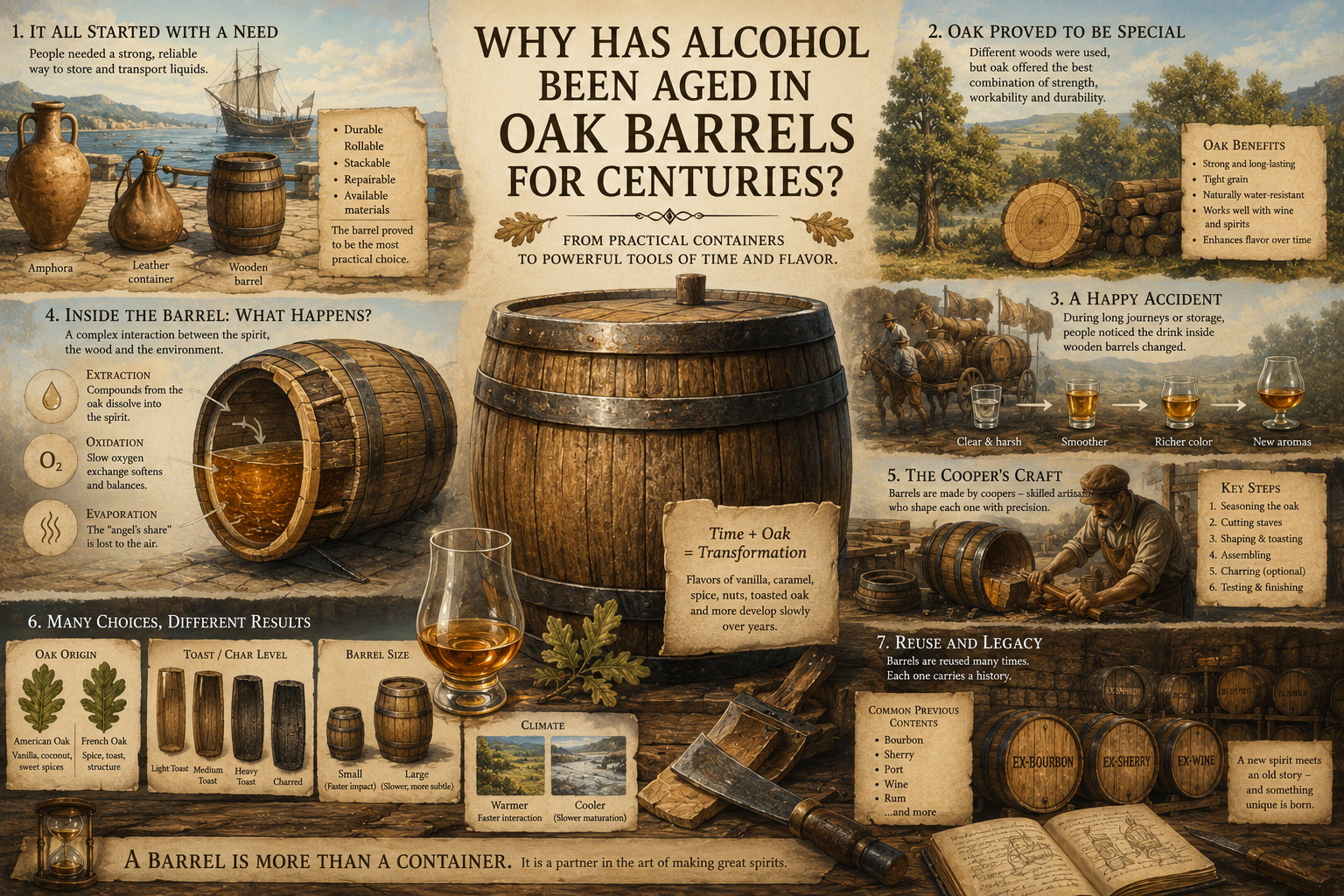
Today, the oak barrel seems inseparable from the world of aged spirits.
Whisky, brandy, Cognac-style distillates, rum, Calvados, and countless craft spirits spend months, years, and sometimes decades in oak.
We are so familiar with this tradition that it is easy to assume oak barrels were originally created specifically for aging alcohol.
But the real story is quite different.
At first, the barrel was simply an exceptionally practical container. Only later did people realize that something interesting was happening to the drink inside it.
What Was Used Before Wooden Barrels?
For thousands of years, people needed reliable ways to store and transport liquids.
They used clay amphorae, ceramic vessels, leather containers, and many other forms of packaging.
Amphorae worked well for wine, oil, and other products, but they had obvious disadvantages.
Ceramic is heavy and fragile.
Large vessels are difficult to move, and a single fall can mean losing both the container and everything inside it.
Wooden barrels offered a completely different solution.
Who Invented the Wooden Barrel?
As with distillation, there is no single inventor we can identify with certainty.
Wooden vessels developed gradually, while the craft of cooperage evolved over a long period of time.
In Europe, barrels became especially important in regions where timber was readily available and woodworking traditions were well established.
The Romans later recognized the practical advantages of wooden barrels and used them extensively for transporting various products.
Why Was a Barrel More Practical Than an Amphora?
Its advantage was not only that wood is less fragile than ceramic.
The shape of a barrel is remarkably practical.
It can be rolled.
Even a heavy full barrel can be moved a short distance by one person simply by rolling it across the ground or floor.
Barrels can also be stacked, repaired, dismantled, and made in different sizes.
For trade and transport, these were enormous advantages.
Why Were Barrels Made from Oak?
Historically, oak was not the only wood used in cooperage.
Depending on the region, coopers also worked with chestnut, acacia, ash, and other species.
But oak gradually proved to be especially well suited to the task.
It combines several useful qualities:
- strength;
- flexibility after proper preparation;
- the ability to form tight-fitting staves;
- durability over long periods of use;
- compatibility with wine and strong spirits.
Later, another major advantage became clear.
Oak does not simply store a drink.
It changes it.
When Did People Realize That Barrels Changed Flavor?
There was probably no single moment of discovery.
More likely, it emerged from repeated observation.
Wine or distillate was placed in a barrel not to improve its taste, but because the barrel was convenient for storage and transport.
Then, months later, the barrel was opened and the drink was no longer quite the same.
Its color had changed.
New aromas had appeared.
Harshness might have softened.
Gradually, what began as a side effect of storage and travel became a deliberate production technique.
Were Barrels Originally Used for Transport Rather Than Aging?
Yes.
This is one of the most interesting facts about the history of aged spirits.
Today, a distiller may fill a barrel and deliberately leave it in a warehouse for years.
Historically, the barrel primarily solved a logistical problem.
It carried products by cart, river, and sea.
Time spent inside wood was simply part of the journey.
Eventually, the results of that journey taught producers that time itself could become part of the production process.
What Happens to Alcohol Inside an Oak Barrel?
A barrel is not an inert container.
A complex interaction takes place between the spirit, the wood, and the surrounding environment.
Alcohol penetrates the upper layers of the oak and comes into contact with compounds naturally present in the wood.
At the same time, slow gas exchange takes place through the wood structure.
Some volatile components gradually evaporate.
And the chemical composition of the spirit continues to evolve over time.
What Does Oak Add to a Spirit?
Oak contains many compounds that can influence aroma, flavor, and structure.
Important contributors include oak lactones, tannins, and compounds derived from the breakdown of lignin and other wood components.
Depending on the type of oak, barrel preparation, level of toasting or charring, and aging time, these can create associations with:
- vanilla;
- caramel;
- spices;
- wood;
- coconut;
- nuts;
- toasted bread;
- cocoa;
- smoky or roasted notes.
But oak aging is not simply a matter of adding “wood flavor.”
The process is much more complex than that.
Why Are Barrels Toasted or Charred?
To bend oak staves into the shape of a barrel, the wood is traditionally heated.
That heat significantly changes the chemistry of the inner surface.
Depending on the temperature and duration, components of the wood break down and form new aromatic compounds.
This means the level of toasting or charring can strongly influence the future character of the spirit.
The barrel stops being simply a wooden container.
It becomes a carefully prepared environment for maturation.
What Is the Difference Between Toasting and Heavy Charring?
They represent different levels and styles of heat treatment.
During toasting, the wood is heated relatively gradually, changing its aromatic potential without creating a thick carbonized layer.
Heavy charring creates a visibly burned surface inside the barrel.
Different spirit traditions use different approaches.
This is one reason a barrel intended for one type of spirit can be very different from a barrel intended for another.
Why Does Alcohol Become Darker in a Barrel?
Fresh distillate is usually clear when it leaves the still.
The golden, amber, or deep copper color of many aged spirits develops largely through contact with wood.
Compounds from the oak move into the liquid, while long-term chemical changes continue to alter its appearance.
The final color depends on factors such as wood type, barrel condition, toast or char level, storage temperature, and aging time.
Why Not Simply Leave a Spirit in the Barrel for as Long as Possible?
Because more oak does not automatically mean a better result.
Early in maturation, the wood may release aromatic compounds quite actively.
Over time, the process changes.
If wood influence becomes excessive, tannic and woody notes can begin to dominate the character of the distillate itself.
Aging is therefore not a competition to achieve the greatest number of years.
It is a search for balance.
Why Do Small Barrels Work Faster?
The key is the ratio between wood surface area and liquid volume.
In a small barrel, relatively more oak is in contact with each liter of spirit.
As a result, extraction from the wood can happen much more quickly.
This is why a small craft barrel can have a very strong influence on a distillate in a relatively short period.
But faster is not the same as longer.
Years of maturation in a larger barrel involve not only extraction from wood, but also slow chemical transformations that cannot be fully reproduced simply by increasing surface contact.
What Is the “Angel’s Share”?
A barrel is not a perfectly sealed system.
During long-term maturation, some water and alcohol gradually evaporate through the wood.
This loss is traditionally known as the angel’s share.
Over several years, the volume of spirit inside a barrel can decrease noticeably.
For the producer, this is literally a loss of product.
But without this slow exchange with the surrounding environment, traditional barrel maturation would be very different.
Why Does Climate Matter?
The same barrel can behave differently under different environmental conditions.
Temperature and humidity influence the movement of liquid through the wood and the rate of evaporation.
In warmer climates, interaction with the barrel is often more intense.
In cooler conditions, maturation may proceed more slowly.
The place where the barrel is stored therefore becomes part of the production process.
Why Are French and American Oak So Popular?
Different oak species have different structures and aromatic potential.
Modern spirit production often uses European oak, including French oak, as well as American oak.
American oak is often associated with more pronounced vanilla, sweet, and coconut-like notes.
French oak may contribute a more restrained profile with spice, tannic structure, and complex woody characteristics.
But the final result depends on much more than the country where the tree grew.
The exact oak species, forest conditions, seasoning method, cooperage technique, heat treatment, and the previous use of the barrel can all matter.
Why Is Oak Seasoned Before a Barrel Is Made?
Freshly cut wood is not ideal for aging spirits.
Staves may undergo a long period of natural or controlled seasoning before being used.
Exposure to air, rain, temperature changes, and time gradually alters the wood.
Some harsh or undesirable components are reduced, while the oak becomes better suited to long-term contact with alcohol.
The quality of a barrel therefore begins long before the first liter of spirit is poured into it.
Who Are Coopers?
Cooperage is one of the traditional crafts without which the history of aged spirits would look very different.
A cooper builds barrels from individual wooden staves.
A classic barrel must hold liquid without ordinary glue between those staves.
Its seal is created through precise shaping, assembly, metal hoops, and the natural swelling of wood when it comes into contact with liquid.
It is a craft that demands remarkable precision.
Why Aren’t Old Barrels Always Discarded?
Because a used barrel can be extremely valuable.
After its first fill, the oak does not stop influencing the spirit.
Its influence simply changes.
A new barrel usually releases fresh wood compounds more intensely.
A refill barrel may act more gently, allowing the spirit to mature longer without excessive oak dominance.
And if the barrel previously held another beverage, the story becomes even more interesting.
Why Age Spirits in Ex-Wine Barrels?
Wood can retain traces of what it held before.
If a barrel previously contained wine, sherry, or another beverage, part of that aromatic history can remain within the wood.
The new spirit then interacts not simply with oak, but with oak that already carries a previous identity.
This is one of the foundations of the modern world of cask finishing and secondary maturation.
Yet the idea itself grew out of the practical habit of reusing valuable containers.
Why Was Reusing Barrels Historically So Natural?
A well-made wooden barrel required quality timber, time, and skilled labor.
Throwing it away after one use made little economic sense.
Barrels therefore traveled between producers, regions, and even countries.
They might carry one product first, another later, and eventually be used for storing distilled spirits.
In this way, the economics of trade unintentionally helped create entirely new flavor traditions.
Why Not Use Metal or Glass Instead?
Glass and stainless steel are excellent for storing alcohol when the goal is to preserve it with minimal change.
But that is exactly the difference.
An oak barrel is not used only for storage.
It is used for transformation.
A stainless steel tank contributes almost no flavor of its own and greatly limits interaction with the environment.
Oak creates an active environment for maturation.
Does Every Spirit Improve in a Barrel?
No.
And this is important.
A barrel is not a universal tool that automatically improves quality.
Some distillates are designed to remain fresh, clear, and strongly expressive of their raw materials or botanicals.
Too much oak could hide those qualities.
The decision to age a spirit always depends on the character the producer is trying to create.
How Did the Barrel Change from Packaging into a Distiller’s Tool?
This is the central historical transformation.
At first, the barrel solved one question:
“How can we transport this drink?”
Then people noticed:
“It changed while it was inside the barrel.”
The next question was completely different:
“What if we control that change?”
That is where deliberate maturation truly begins.
What Can a Modern Distiller Choose?
Today, producers have far more control than their predecessors did centuries ago.
They can choose:
- oak species;
- wood origin;
- barrel size;
- toast or char level;
- new or used barrels;
- what the barrel previously contained;
- maturation time;
- storage conditions;
- combinations of different barrel types.
What began as an accidental result of transportation has become a sophisticated system for shaping flavor.
Why Has the Oak Barrel Survived Centuries of Technological Progress?
Modern industry can produce nearly perfect stainless steel tanks.
Temperature, humidity, and atmospheric conditions can be controlled with remarkable accuracy.
A spirit can be analyzed in a laboratory down to very small chemical components.
And yet, in many distilleries, wooden barrels still sit quietly in warehouses much as they have for centuries.
The reason is simple.
An oak barrel combines several processes that are difficult to reproduce fully with any single alternative technology.
It provides extraction, slow gas exchange, evaporation, and complex chemical transformation over long periods of time.
The History of Oak Aging: In Short
- Alcohol and other liquids were originally stored and transported in many types of containers, including amphorae.
- Wooden barrels proved strong, repairable, and convenient for transportation.
- Many woods were used, but oak became one of the most important for cooperage.
- At first, barrels were primarily transport containers.
- People gradually noticed that prolonged contact with oak changed the color, aroma, and flavor of the drink.
- An accidental effect became a controlled maturation technique.
- Oak species, heat treatment, barrel size, climate, and time all influence the result.
- Reusing barrels created the tradition of aging spirits in casks that previously held other beverages.
- Today, the barrel is not merely packaging but one of the most important tools for shaping the character of aged spirits.
Conclusion
The oak barrel became part of spirit culture almost by accident.
People needed a strong and practical container for storage and transportation.
Wood solved that problem well, and oak proved to be one of the best materials for the job.
Then time made a discovery on our behalf.
A drink that spent months or years inside a barrel came out different.
It gained color, new aromas, and a changed texture.
People observed, compared, and experimented.
Different oak species were explored. Wood seasoning, toasting, and charring were refined. Barrel sizes, maturation periods, and reuse practices all became deliberate choices.
A simple transport container evolved into one of the most sophisticated tools available to a distiller.
And perhaps that is what makes barrel aging so fascinating.
Distillation can create a spirit in a matter of hours. Oak, air, and time can continue working on it for years.