





Why does the color of the distillate change during aging?
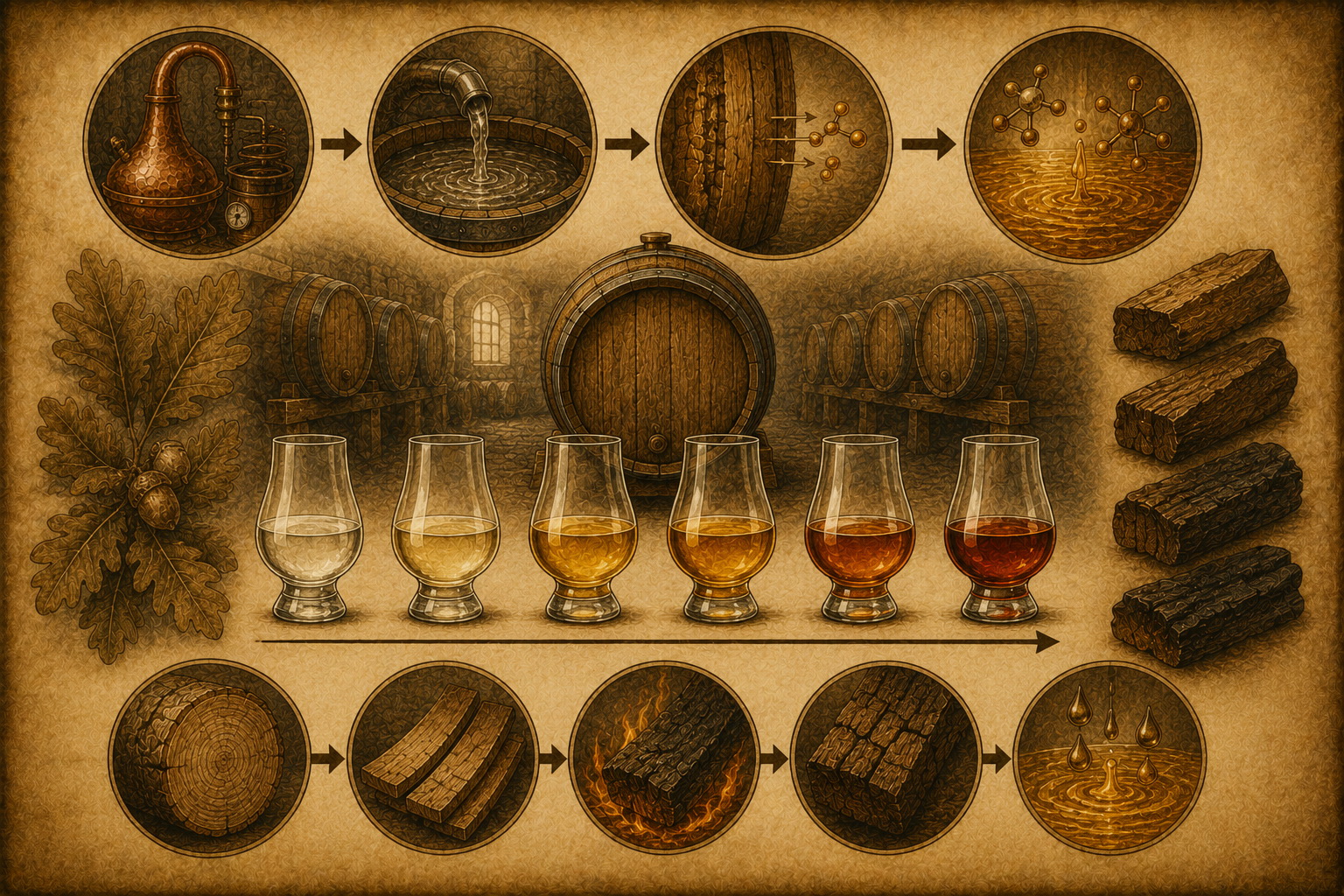
Why is fresh distillate always clear?
Imagine the moment when the distillate has just left the copper still a few minutes ago.
It is absolutely clear.
No golden hue.
No amber.
No copper shine.
This is how almost every distillate is born - regardless of whether it will eventually become whiskey, brandy, rum or honey distillate.
Many people are surprised by this. After all, we are so used to seeing aged drinks as golden that it seems as if they should be that way from the very beginning.
In fact, the color is not created by the still.
It is created by time, the oak barrel and a multitude of imperceptible processes that last for years.
The first gift of oak
As soon as the distillate enters the oak barrel, something begins that cannot be seen with the naked eye.
The alcohol gradually penetrates the smallest pores of the wood, dissolving the natural substances that have accumulated in the oak for decades. When it returns, it brings with it not only aromatic compounds, but also natural pigments.
They are what begin to change the color of the drink.
At first, almost imperceptibly.
Then more and more clearly.
Why does the color change gradually?
Oak does not give everything away at once.
It can be compared to well-brewed tea.
If you immerse a tea bag in hot water for just a few seconds, the water will hardly change color.
In a minute, it will become golden.
In a few minutes, it will become saturated.
Something similar happens with an oak barrel, but instead of minutes, months and years pass.
The longer the interaction of the distillate with the wood continues, the more natural dyes are converted into drink.
From straw to dark amber
If you observe the same barrel for several years, you can see a real evolution of color.
At first, a barely noticeable straw shade appears.
Over time, it becomes golden.
Later it turns into honey.
Then - into a rich amber.
And after a long exposure, it can acquire shades of copper, mahogany or even dark chocolate.
It is similar to an autumn forest that changes colors gradually, day after day, almost imperceptibly for a person.
Why is the same age - different color?
This is where the most interesting thing begins.
Two distillates can to spend the same number of years in a barrel and still look completely different.
Why?
Because color depends not only on time.
The barrel itself is of great importance.
A new oak barrel releases natural substances much more actively than one that has been used for aging other drinks for many years.
The degree of roasting of the inner surface is no less important. Light roasting leaves one character of wood, strong roasting leaves a completely different one, with distinct caramel, coffee and chocolate tones that affect not only the aroma but also the color.
Even the type of oak and the place where it grew can change the final result.
Why do small barrels stain faster?
In the previous article, we already talked about the fact that in a small barrel, each liter of distillate comes into contact with a larger area of wood.
This means that not only the aroma, but also the color appear much faster.
Sometimes after just a few months, the drink takes on the appearance of being aged for several years.
But appearance does not always indicate maturity.
Color can precede the development of flavor.
Why is darker not always older?
This is perhaps the most common myth among people who are just starting to get acquainted with the world of aged spirits.
A dark drink seems more solid.
More expensive.
More aged.
But the reality is much more interesting.
A young distillate in a new, heavily charred small barrel can turn dark amber much faster than an old drink that has matured for many years in a large reused barrel.
That is why experienced tasters never judge age by color alone.
Color can give you a direction.
But it will never tell the whole story.
Why does color continue to change over the years?
Aging is not a one-time thing coloring.
Complex processes are constantly taking place in the barrel. Some substances pass from the wood to the drink, some interact with each other, forming new compounds. At the same time, slow oxidation occurs through the microscopic pores of the oak.
That is why the color never changes abruptly.
It matures along with the distillate itself.
Can you determine the quality by color?
It would be very convenient if it were enough to just look at the glass.
But a great distillate is never judged by the eyes alone.
Color is only the first acquaintance.
Then comes the aroma.
After that, the taste.
And only then does a full impression of the drink form.
That is why professional tasting always begins with the appearance, but never ends there.
Conclusion
During aging, the distillate gradually changes its color due to interaction with the oak barrel. The wood gives off natural dyes and aromatic compounds, and the years allow these processes to develop slowly and harmoniously. That is why the clear drink gradually becomes golden, honey or amber.
However, color is only one aspect of aging. It is influenced by the type of oak, the degree of roasting, the size and previous history of the barrel, the climate and even the storage conditions. Therefore, a darker distillate is not always older or better. The true value of a drink is determined not by its shade, but by the harmony of aroma, taste and character, which are born only when time and the barrel work together.