





At what temperature to serve honey spirits and gin
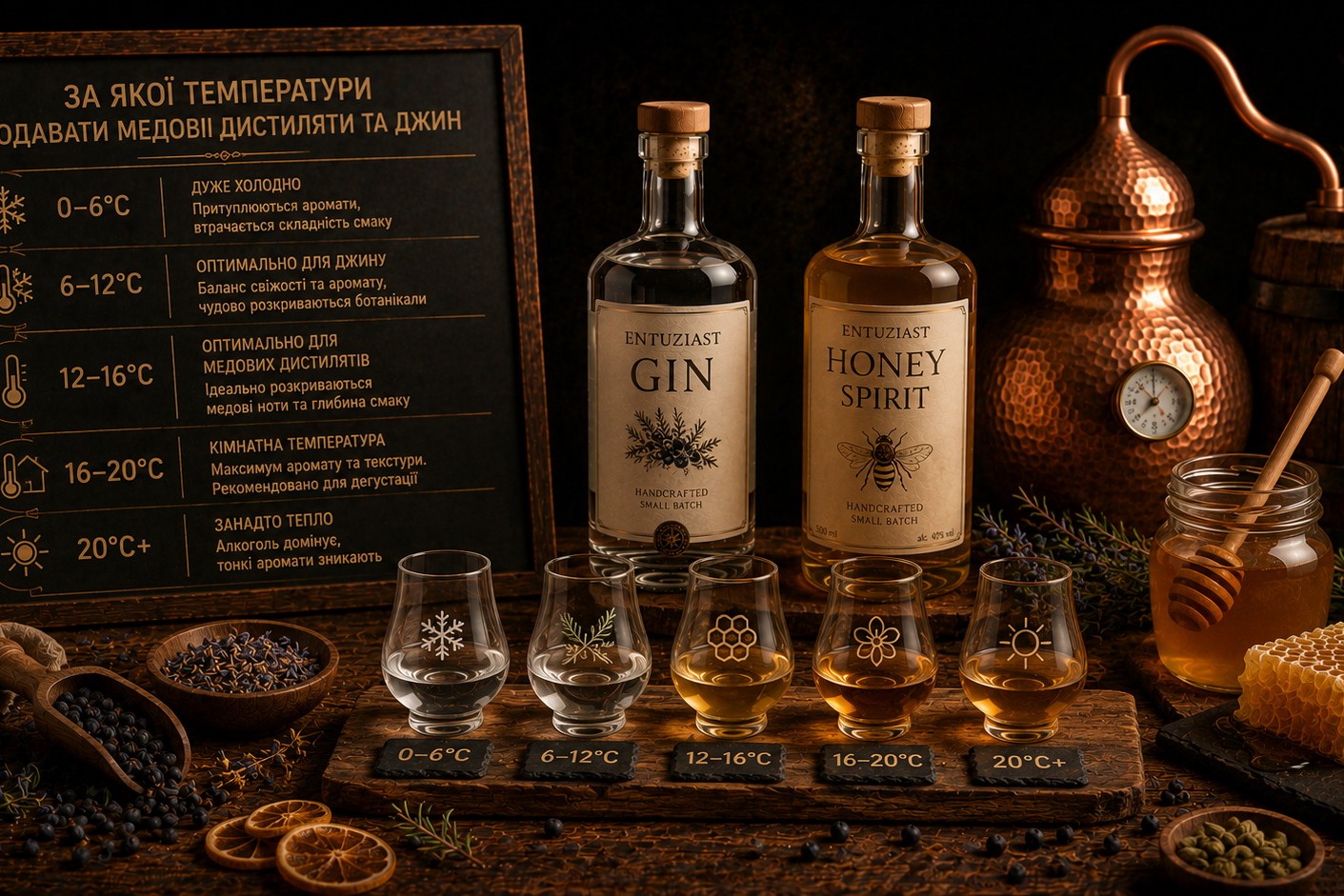
Serving temperature can significantly alter the perception of a spirit. The same distillate may seem fresh and smooth when chilled, but at a higher temperature, it may appear more aromatic, spicy, and full-bodied.
A drink that’s too cold masks some of the subtle aromas. One that’s too warm, on the other hand, can release alcohol vapors too vigorously, causing the honey, fruit, berry, and oak notes to become less noticeable.
That is why there is no one-size-fits-all temperature for all products. Clear honey spirit, aged distillate, apple blend, and berry gin each have their own distinct character and require a tailored approach.
Why Temperature Affects Aroma
A beverage’s aroma is shaped by volatile compounds. These gradually evaporate from the liquid’s surface and reach our receptors.
At lower temperatures, evaporation slows down. The aroma becomes more subdued, and the alcohol content is often perceived as milder. However, along with the sharpness, delicate notes of flowers, wax, honeycombs, apples, citrus, or vanilla may also disappear.
When the drink is warmer, the aromatic components are released more actively from the liquid. The bouquet becomes richer, but at the same time, the smell of alcohol intensifies.
The optimal temperature should strike a balance: the drink should not be harsh, but its aromatic character should remain apparent.
How Temperature Affects Taste
Cold often dampens not only the aroma but also some of the taste sensations. Sweetness, fruitiness, and spiciness may seem weaker, and the texture may feel lighter.
When warmed moderately, the flavor becomes more complex. Notes of honey, wax, bread, apples, berries, spices, and wood become more pronounced.
However, a distillate that is too warm can feel burning. The heat from the alcohol comes to the forefront and interferes with the appreciation of other components.
Therefore, the key to proper serving is not to chill the drink as much as possible or serve it warm, but to find the ideal temperature at which the flavors fully unfold.
What Does “Room Temperature” Mean?
The advice to serve a drink at room temperature can be misleading. In a cool room, this might be around 18–20 °C, while in the summer it could be over 25 °C.
For a well-aged, strong spirit, an overly warm room is often a poor choice. The drink quickly releases a lot of alcohol vapors, and the aroma becomes harsh.
Therefore, “room temperature” is best understood as a moderately cool serving temperature, rather than the temperature of a hot room.
Recommended serving temperatures
The values listed are not strict rules, but they can serve as a convenient starting point for tasting.
- Clear honey distillate: approximately 14–18 °C.
- Aged honey distillate: approximately 16–20 °C.
- Aged honey-apple spirit: approximately 15–19 °C.
- Classic dry MeadGIN: approximately 10–16 °C when served neat.
- MeadGIN Raspberry: approximately 10–15 °C.
- MeadGin Sloe Blackthorn: approximately 12–16 °C.
Personal preference may vary. The best way to find the right temperature is to try the drink slightly chilled and observe how it changes as it gradually warms in the glass.
How to Serve Clear Honey Distillate
Clear Honey Spirit showcases the purity of the distillation, its honey base, and additional grainy or creamy notes. Over-chilling can make it too neutral.
At a moderately cool temperature, the alcohol content is perceived more subtly, but the aroma retains notes of honey, wheat bread, grain, and creamy smoothness.
If the drink has been stored in the refrigerator, it’s best to let it sit for a moment after pouring. As it gradually warms in the glass, it will reveal new nuances.
For your first tasting, avoid serving this clear honey spirit ice-cold or straight from the freezer.
Serving Temperature for Honey Spirit Pure
Honey Spirit Pure has an alcohol content of 40%, a clear color, and a pure alcoholic aroma with a subtle hint of wheat dust.
The flavor combines honey, white wheat bread, and butter. To preserve these nuances, it’s best to serve the drink moderately chilled, but not ice-cold.
A recommended temperature range of 14–18 °C helps reduce the sharpness of the alcohol without masking the grainy-honey profile.
After a few minutes in the glass, Honey Spirit Pure may become rounder, and the bread and butter notes may become more pronounced.
How to Serve Aged Honey Distillate
An aged spirit has a more complex aromatic profile than a clear spirit. Vanilla, spices, wood, dried fruit, and the character of wine barrels are added to the honey and wax.
If it’s chilled too much, the oak and wine notes may almost disappear. The drink will seem smoother, but much simpler.
Excessively high temperatures are also undesirable. The alcohol begins to dominate, and the aroma becomes heavy.
For most aged honey distillates, it’s best to begin tasting at around 16–20 °C.
Serving Temperature for Honey Spirit Aged
Honey Spirit Aged has a multi-layered character, shaped by three stages of distillation, French and Ukrainian oak, and a final aging in an Oloroso cask.
The aroma combines wax, honey, spices, vanilla, and a light, fresh note. The taste is mineral, warming, with honey and allspice.
For this spirit, it’s best to serve it at a temperature of around 16–20 °C. This helps bring out the oak, Oloroso, wax, and spices without excessive alcohol sharpness.
After pouring, it’s best to wait a few minutes. Honey Spirit Aged can gradually evolve in the glass, revealing new nuances upon contact with air.
Serving Temperature for Honey Spirit Apple
Honey Spirit Apple combines honey distillate with classic apple spirits, oak aging, and a finish in a Sauternes cask.
Its aroma reveals notes of baked apples, honey blossom, wax, and wood. The taste is fresh, spicy, and full-bodied, with a hint of apple tartness.
Light chilling can highlight the fruity freshness, but serving it too cold will mask the honey blossom, wax, and barrel character.
For tasting, start at around 15–19 °C. As the gin gradually warms, notes of baked apples, spices, and wood will become more pronounced.
How to Serve Classic Gin
Gin is often served cooler than aged spirits. This highlights the freshness of juniper, citrus, and botanicals.
However, excessive chilling weakens the aroma. The juniper may remain recognizable, but the subtle citrus, spicy, and honeyed notes will become less pronounced.
For a neat tasting of a signature gin, it’s best to serve it moderately chilled. If the drink is later mixed with tonic, it can be chilled more thoroughly, as the cocktail warms up quickly in the glass.
Serving Temperature for Classic MeadGIN
MeadGIN has a dry juniper character with notes of lemon, citron, and orange, and a light, creamy, and refreshing finish.
For sipping neat, aim for a temperature of approximately 10–16 °C.
At the lower end of this range, the drink will seem fresher and more restrained. As it warms, the citrus notes, spice, and honeyed roundness will become more pronounced.
When mixed with tonic, both the gin and the glass can be chilled more thoroughly, but it’s best to avoid overly aromatic or sweet tonics, which will mask the character of MeadGIN.
Serving Temperature for MeadGIN Raspberry
With MeadGIN Raspberry, it’s important to maintain a balance between dry juniper, spices, natural raspberries, and a honeyed finish.
Serving it chilled highlights the freshness of the berries and makes the 43% ABV more pleasant. However, serving it ice-cold may mask the aromas of raspberries and honey.
For a neat tasting, start at around 10–15 °C. As the drink warms, the berry aroma will become more pronounced, while the juniper and spice notes will deepen.
If the drink is served with tonic, it’s best to use enough ice to keep the cocktail cool without diluting it too quickly.
Serving Temperature for MeadGin Sloe Blackthorn
MeadGin Sloe Blackthorn has a lower alcohol content—32%—with a sweet berry flavor, blackthorn tartness, vanilla, and hints of honeycomb.
Moderate chilling makes the berry profile fresher and highlights the natural tartness. If the drink is too cold, the blackthorn, vanilla, and woody notes will become weaker.
For a neat serving, aim for approximately 12–16 °C.
Due to its lower alcohol content, Sloe Blackthorn may warm up more quickly in the glass, so it’s interesting to observe its evolution from a cool, berry-forward start to a warmer, honey-vanilla finish.
Should you store the bottle in the refrigerator?
High-proof spirits generally do not require constant refrigeration. Their high alcohol content makes them more stable than wine or beer.
For everyday storage, the following are more important:
- protection from direct sunlight;
- a stable temperature;
- a tightly sealed bottle;
- a vertical position;
- avoid excessive heat.
Before serving, you can briefly place the bottle in a cool place or the refrigerator, but it’s not necessary to store it there all the time.
Why You Shouldn’t Freeze the Drink
Some strong drinks are traditionally served very cold to reduce the sharpness of the alcohol. However, this is often not advisable for aromatic honey distillates or craft gin.
At very low temperatures:
- the aroma becomes significantly weaker;
- the texture seems thicker;
- the sweetness and spiciness are muted;
- the honey and floral notes almost disappear;
- defects may also be temporarily masked.
If the goal is to taste and get to know the character of the product, the freezer is not the best choice.
Ice: Pros and Cons
Ice both cools and dilutes the drink. This can soften the strength and reveal individual notes as it gradually melts.
However, the cold initially dampens the aroma. In addition, small cubes melt quickly and can make the taste watery.
For aged spirits, it’s better to use a single large ice cube, if you personally prefer this serving method. It melts more slowly and alters the drink gradually.
It’s best to taste any product for the first time without ice and then compare the results.
How to properly chill a bottle
For moderate cooling, there’s no need to keep the bottle in the freezer.
You can:
- place it in the refrigerator for a short time;
- use a bucket of cool water with a small amount of ice;
- chill just the glass;
- pour the drink slightly cooler and let it warm up gradually.
It’s best to chill it gradually. That way, it’s easier to control the temperature and preserve the drink’s aromatic character.
Should you chill the glass?
A chilled glass helps keep gin or berry distillate cool for longer. This is especially useful for cocktails.
For a detailed tasting of aged Honey Spirit, a glass that’s too cold may be counterproductive. The drink will cool down quickly, and the oak and wine notes will become weaker.
A good compromise is to use a glass at room temperature and serve the drink itself slightly chilled.
How the temperature changes in the glass
After pouring, the drink gradually warms to room temperature. This isn’t a drawback, but rather an additional opportunity for tasting.
You can observe three stages:
- Cool start: less alcohol sharpness, more freshness.
- Medium temperature: this is when the main flavor profile typically emerges.
- Warmer finish: spices, oak, honey, and the warmth of the alcohol become more pronounced.
That’s exactly why you shouldn’t rush to finish your glass. A single glass can reveal several different facets of the drink.
How Temperature Affects the Aftertaste
A chilled drink often has a shorter and cleaner finish. Fresh, citrus, and berry notes may be more pronounced but fade more quickly.
At higher temperatures, the finish becomes warmer and longer. Notes of honey, wax, spices, vanilla, wood, and dried fruit become more pronounced.
Excessive heat can leave a harsh, burning alcohol sensation. Therefore, a longer aftertaste doesn’t always mean a better one—what matters is which specific notes linger after a sip.
Serving Temperature for Cocktails
Gin cocktails are usually served well-chilled. Since tonic water, ice, water, juices, or other ingredients are added to the drink, the initial temperature should be lower.
In a Gin & Tonic, it’s important to use a sufficient amount of ice. Paradoxically, a large amount of high-quality ice often melts more slowly than a few small cubes, since the drink cools faster.
For MeadGIN, choose cocktails that don’t mask the honey base, juniper, and natural berries.
Classic MeadGIN requires a dry and fresh balance; Raspberry calls for caution with sweet ingredients; and Sloe Blackthorn requires consideration of its own berry sweetness and lower alcohol content.
Is there one “correct” temperature?
No. Sensory perception depends on personal sensitivity, the shape of the glass, room temperature, and the style of the drink.
The recommended range is just a starting point. Some people prefer their clear honey spirit chilled, while others prefer it after it’s been in the glass for ten minutes.
The best way to find your own preference:
- Serve the drink slightly cooler than your preferred temperature.
- Appreciate the aroma and take a small sip.
- Wait a few minutes.
- Repeat the tasting.
- Note the moment when the balance seems best.
Common Mistakes When Serving
- Storing the aromatic distillate in the freezer before tasting.
- Serving aged Honey Spirit too warm in a hot room.
- Using too much crushed ice, which quickly dilutes the drink.
- Chilling the glass for a complex, aged distillate to a very low temperature.
- Assessing the aroma immediately after pouring without letting it rest briefly.
- Assume that cold always improves the quality of the drink.
- Comparing different products at different temperatures.
- Failing to take into account that the drink gradually warms up in the glass.
Frequently Asked Questions About Serving Temperature
At what temperature should honey distillate be served?
Clear honey spirit can be enjoyed at approximately 14–18 °C, while aged honey spirit is best served at approximately 16–20 °C.
Can Honey Spirit be stored in the refrigerator?
You can chill it briefly before serving, but long-term storage in the refrigerator is generally not necessary.
Can honey spirit be placed in the freezer?
Technically, this high-proof spirit can withstand low temperatures, but this is not recommended for tasting: the cold significantly dulls the aroma.
At what temperature should MeadGIN be served?
For a neat tasting of classic MeadGIN, aim for approximately 10–16 °C. In cocktails, it’s served colder.
Should aged Honey Spirit be chilled?
Light chilling is possible, but temperatures that are too low will mask the oak, vanilla, spices, and the wine-like character of the barrels.
Can you add ice?
Yes, but it’s best to taste the drink without ice first. For gradual cooling, one large ice cube is more appropriate.
Why does warm alcohol seem sharper?
At higher temperatures, alcohol and other volatile components evaporate more rapidly, making the alcohol’s aroma more intense.
How can you tell if the temperature is right?
The alcohol content shouldn’t overpower the aroma, and the characteristic notes of honey, berries, juniper, apples, or oak should remain distinct.
Temperature as Part of a Drink’s Character
Proper serving does not alter the distillate’s composition, but it can completely change our impression of it. Cold makes the drink more restrained and fresher, while warmth brings out the aroma, spices, honey, and wood.
It’s best to start tasting the clear Honey Spirit when it’s moderately chilled. Aged spirits require more warmth to bring out their oak and wine notes. MeadGIN benefits from being served chilled, which preserves the freshness of juniper, citrus, and berries.
In the ENTUZIAST collection, each product has its own unique balance. Honey Spirit Pure showcases purity and a grainy-honeyed smoothness; Honey Spirit Aged highlights the interplay of oak and Oloroso; Honey Spirit Apple features baked apples and Sauternes; and MeadGIN offers juniper, citrus, raspberry, and blackthorn.
The ideal serving temperature is one at which the drink isn’t overshadowed by the cold nor lost in the heat of the alcohol. There’s only one way to find it: let the distillate sit in the glass for a while and carefully observe how it gradually unfolds.