





How Do Light, Heat and Air Affect Strong Alcohol?
Strong alcohol seems like a very stable product.
A bottle can sit on a shelf for months or even years, and nothing appears to happen.
But that does not mean storage conditions do not matter.
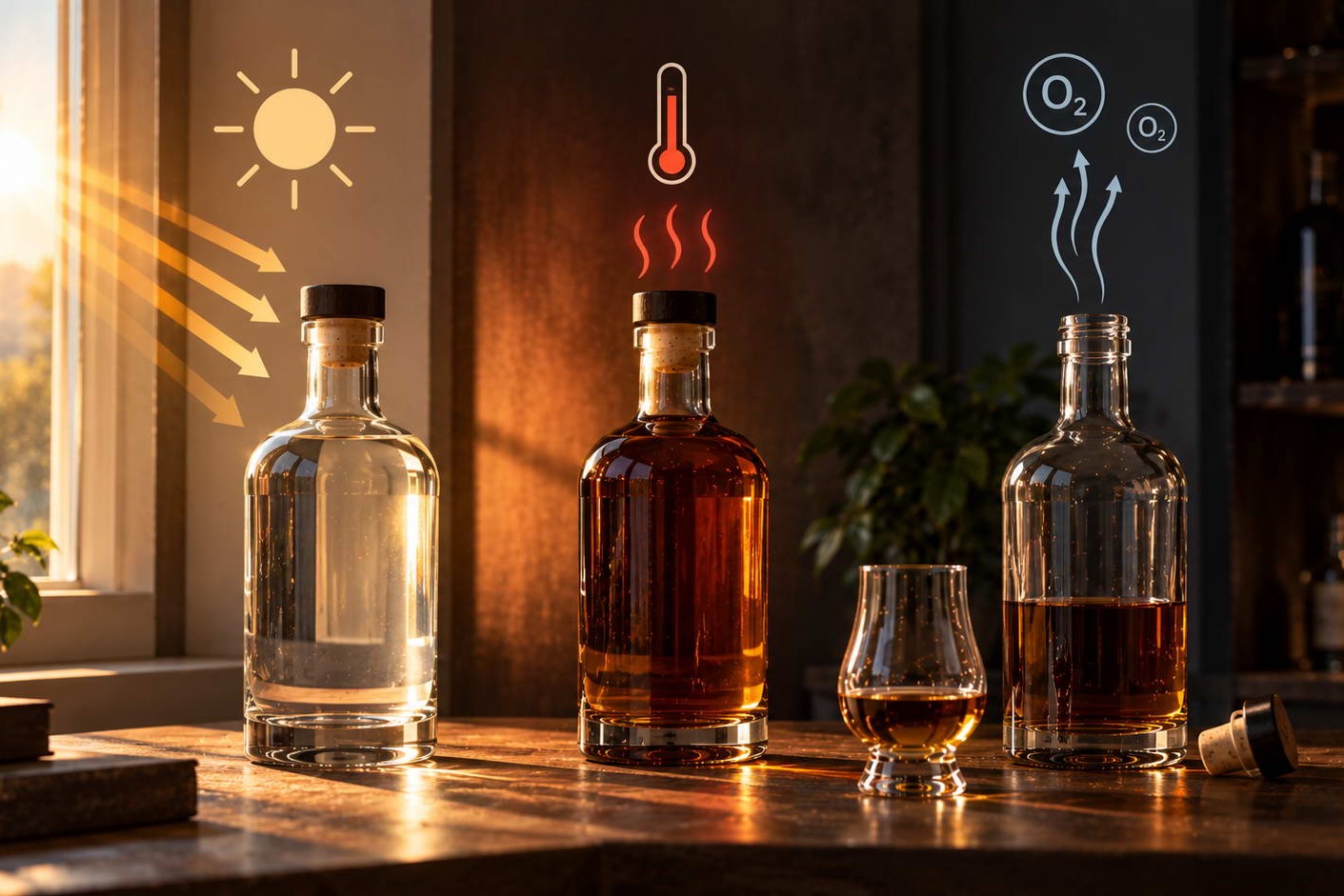
Aroma and flavour are gradually influenced by three main factors:
- light;
- heat;
- air.
For a sealed bottle, light and temperature matter the most.
After opening, another important factor appears — oxygen in the headspace above the liquid.
This is why two identical drinks can taste different after a few years simply because they were stored under different conditions.
Why Does Strong Alcohol Change at All?
An alcoholic drink is not just water and ethanol.
It can contain hundreds of aromatic compounds.
Some of them are relatively stable.
Others are sensitive to:
- oxygen;
- ultraviolet and visible light;
- temperature;
- time;
- how tightly the bottle is sealed.
So even if the ethanol itself does not disappear, the sensory profile can gradually change.
What Does Light Do?
Light can trigger or accelerate photochemical reactions.
This is especially relevant for sensitive aromatic molecules.
Under prolonged light exposure, they may:
- break down;
- transform;
- change the aromatic profile;
- lose intensity.
The worst option is direct sunlight.
Why Is Sunlight Especially Undesirable?
Because it works in two ways at once.
First — through light.
Second — through heat.
A bottle on a windowsill does not only receive intense light.
It also heats up repeatedly.
And that can accelerate many physical and chemical processes.
Does Dark Glass Help?
Yes, partly.
Dark glass reduces the amount of some wavelengths of light that reach the liquid.
This is one reason many drinks are traditionally bottled in:
- brown glass;
- green glass;
- other dark-coloured bottles.
But dark glass does not protect against heat.
So even a dark bottle should not be left in direct sunlight.
Is a Clear Bottle a Problem?
Not by itself.
Clear glass is perfectly suitable if the bottle is stored correctly.
The real issue is prolonged exposure to strong light.
A clear bottle is best kept in:
- a cabinet;
- a box;
- a bar area without direct sunlight;
- a shaded room.
Why Does Heat Accelerate Changes?
In chemistry, higher temperatures generally increase the rate of many reactions.
For spirits, this means that prolonged warmth can accelerate:
- oxidative processes;
- changes in aromatic molecules;
- evaporation of volatile compounds.
So a cool, stable environment is almost always better than a hot one.
What Temperature Is Already Too High?
There is no single magical threshold.
The real issue is not a brief increase in temperature, but long-term storage in excessive heat.
It is especially undesirable if the bottle is constantly:
- warmer than normal room temperature;
- near a radiator;
- close to a stove;
- heated by direct sunlight.
What Is Worse: A Constant 24°C or Fluctuations from 15 to 30°C?
In general, stable conditions are preferable to large fluctuations.
Repeated heating and cooling affect more than the liquid itself.
They also create expansion and contraction cycles in:
- the air inside the bottle;
- the liquid;
- the cork material;
- the seal.
This can make sealing problems more likely in older bottles.
Should Strong Alcohol Be Stored Cold?
Not necessarily.
For most distillates, a moderate and stable room temperature is sufficient.
Something around 18–22°C in a dark place is generally perfectly acceptable.
The main goal is simply to avoid overheating.
Is a Refrigerator Better Than a Cabinet?
Not for most strong distillates.
Refrigeration is unnecessary if the bottle is already stored under normal conditions.
Very low temperatures can also suppress aroma when the drink is served.
We discussed gin storage separately in the article “Can Gin Be Stored in the Refrigerator or Freezer?”.
What Happens to Aromas When a Drink Gets Warm?
Aromatic compounds become more volatile.
Within certain limits, this is useful during tasting.
But excessive warmth is undesirable for long-term storage.
If volatile compounds spend more time in the gas phase and the bottle is not perfectly sealed, they may be lost more quickly.
What Does Air Do?
Once the bottle is opened, air enters.
And with it comes oxygen.
This creates conditions for slow oxidative reactions.
At the same time, a gas space appears above the liquid, where volatile aromatic compounds can accumulate.
What Is Headspace?
Headspace is the air-filled space between the liquid level and the top of the bottle.
When the bottle is full, the headspace is small.
When only 20% of the drink remains, it becomes much larger.
The more headspace there is, the more:
- air;
- oxygen;
- space for aroma compounds to evaporate into.
Why Does an Almost Empty Bottle Change Faster?
Because of the larger headspace.
For example, a bottle containing 700 ml and one with only the last 100 ml have very different ratios of liquid to air.
In the second case, interaction with the gas phase becomes much more important.
Can Air Make a Spirit Better?
Over a short period, sometimes yes.
Some drinks seem softer after limited exposure to air.
Sharp notes can settle slightly.
The aroma may feel more integrated.
This is one reason it can be useful to let a spirit rest in the glass for a few minutes.
But prolonged contact between the entire bottle and a large amount of air is a different situation.
Why Is It Better to Let the Drink “Breathe” in the Glass?
Because the process is controlled.
You pour a small serving.
You give it a few minutes.
And you do not expose the entire bottle to unnecessary air contact.
We discussed this in the article “Why Should You Let Strong Spirits Rest in the Glass?”.
Which Aromas Tend to Fade First?
The most noticeable changes often affect light, volatile notes.
For example:
- fresh citrus;
- floral aromas;
- some herbal notes;
- certain fruity esters;
- essential oils.
Heavier woody, spicy and dried-fruit notes often feel more persistent.
Why Is Gin Especially Sensitive to Air?
Because gin depends heavily on volatile compounds from botanicals.
Juniper, citrus, herbs and spices shape the aromatic profile.
If some of the most delicate compounds are lost, the gin can become less expressive.
Example: MeadGIN ENTUZIAST
In MeadGIN ENTUZIAST, juniper, citrus and other botanical notes are important parts of the profile.
That is why light, heat and prolonged contact with a large amount of air are undesirable: they can gradually reduce the intensity of the most volatile aromas.
The best strategy is simple:
- keep the bottle tightly sealed;
- protect it from direct sunlight;
- avoid overheating;
- store it upright.
How Do Aged Distillates Behave?
They change too.
But their profiles often contain more:
- oak;
- vanilla;
- spices;
- dried fruit;
- nutty notes.
These directions often feel more persistent, although the overall balance can still gradually shift.
Example: Honey Spirit Aged ENTUZIAST
Honey Spirit Aged ENTUZIAST has a layered profile built around honey distillate, French and Ukrainian oak, and finishing in an Oloroso cask.
Oak, spice and dried-fruit notes can be relatively persistent.
But that does not mean the bottle can be stored for years in direct sunlight or with a poorly sealed cork.
What About an Unaged Distillate?
In an unaged spirit, the character of the raw material and distillation plays the central role.
So the loss of lighter aromatic compounds can make the profile feel simpler.
Honey Spirit Pure ENTUZIAST is a good example of a drink where preserving the clean character of the honey distillate is especially important.
Can Light Affect Colour?
Potentially, yes.
Some colour-related and aromatic compounds can change under prolonged light exposure.
But in strong spirits, colour changes are not always obvious.
Sometimes the aroma changes before any visible difference appears.
Can You Judge the Condition by Appearance Alone?
No.
A bottle can look completely normal even after losing part of its aromatic intensity.
That is why the condition of the drink is better evaluated through:
- aroma;
- taste;
- finish;
- storage history.
Does Light Change the ABV?
Light itself should not noticeably change the ABV in a properly sealed bottle.
Poor sealing and long-term evaporation, however, can affect the composition of the liquid.
How Does Heat Affect the Cork?
When a bottle warms up, the liquid and air inside expand.
This can increase pressure on the closure.
When the bottle cools, the process reverses.
Repeated cycles are especially undesirable for:
- old natural corks;
- damaged seals;
- collectible bottles.
Can a Bottle “Breathe” Through the Cork?
No closure is a perfect absolute barrier.
But in a well-sealed modern bottle, exchange with the outside environment is very small.
If the cork is damaged or the cap does not seal properly, that exchange becomes much greater.
Why Is a Tight Seal So Important?
Because it simultaneously reduces:
- evaporation;
- air exchange;
- loss of volatile aromas;
- the risk of contamination.
How Can You Check the Cork or Cap?
Look for:
- cracks;
- crumbling cork;
- signs of leakage;
- stickiness around the neck;
- a noticeable drop in the fill level.
With an older bottle, these can be useful signs of closure condition.
Why Should the Bottle Be Stored Upright?
To prevent constant contact between strong alcohol and the cork.
It also reduces the risk of leakage.
We discussed this in more detail in the article “Should You Store Bottles of Spirits Upright or Horizontally?”.
Do Open Bottles Need Different Storage Conditions?
The basic rules are the same.
But after opening, the role of air becomes much more important.
Especially when only a small amount remains.
We discussed this in the article “How to Properly Store an Open Bottle of Strong Alcohol”.
Does Alcohol Go Bad After Opening?
Classic strong distillates are very stable.
But their sensory profile can gradually change.
So the issue is often not dangerous spoilage, but:
- loss of freshness;
- weaker aroma;
- changes in balance.
More detail is available in “Does Strong Alcohol Go Bad After Opening the Bottle?”.
What Should You Do If Very Little Is Left?
If you plan to finish it soon, simply store it correctly.
If the last 10–20% needs to remain for another year or more, you can transfer it into a smaller glass bottle.
This reduces the amount of air above the liquid.
Should You Use a Vacuum System?
For ordinary strong spirits — rarely.
A good airtight closure is usually enough.
Vacuum systems are more popular with wine because wine is much more sensitive after opening.
What About Inert Gas?
It can be useful for very expensive or rare bottles.
It reduces the amount of oxygen in the headspace.
But for a normal home bar, it is more of an optional extra than a necessity.
Should You Keep the Bottle in Its Box?
Not necessarily, but the box provides good protection from light.
This is especially useful for clear bottles.
If there is no box, a dark cabinet is enough.
Is an Open Bar Shelf Suitable?
Yes, as long as it does not receive direct sunlight and is not near a heat source.
The shelf itself is not the problem.
The surrounding conditions are.
Can You Store Spirits in the Kitchen?
Yes, but not next to:
- the oven;
- the stove;
- a boiler;
- a radiator;
- a sunny window.
An internal cabinet away from heat is a much better option.
What About a Basement?
It can often be a good place if:
- the temperature is stable;
- humidity is not excessive;
- bottles remain clean;
- labels and boxes are protected from dampness.
What Matters More: Darkness or Coolness?
Ideally, you want both.
But if you have to choose between:
a cool place with direct sunlight
and
a dark cabinet at a normal, stable room temperature,
the second option is often more practical.
Should You Worry About Brief Sun Exposure?
No.
If a bottle sits on the table for an hour during dinner, nothing catastrophic has happened.
The real concern is regular or long-term exposure.
What About Brief Heating?
The same principle applies.
One warm day will not normally destroy the drink.
But permanent storage in a hot environment is undesirable.
Why Does the Combination of Factors Matter?
Because they can reinforce each other.
For example:
sunlight + heat + an almost empty open bottle
is a much worse situation than any one of those factors on its own.
The Worst Storage Scenario
It would look something like this:
- an opened bottle;
- only 15% of the drink remaining;
- a poorly sealing cap;
- stored on a sunny windowsill;
- regularly overheated during summer.
Even a very stable spirit will change much faster under these conditions.
And the Best?
- the bottle is tightly sealed;
- stored upright;
- kept in the dark;
- maintained at a stable moderate temperature;
- kept away from heat sources.
For most home bottles, nothing more complicated is required.
Is Serving Temperature the Same as Storage Temperature?
No.
They are two different questions.
Storage temperature is about stability.
Serving temperature is about sensory perception.
We discussed this separately in the article “What Is the Best Serving Temperature for Gin, Distillates and Aged Spirits?”.
Can You Chill a Bottle Before Serving and Then Return It to the Cabinet?
Yes.
But it is better to avoid repeated extreme cycles such as:
freezer → warmth → freezer → warmth.
A single cycle is not critical, but constant temperature swings provide no real benefit.
How to Store Spirits at Home: A Simple Formula
- Keep the bottle upright.
- Seal it tightly after use.
- Keep it away from direct sunlight.
- Do not store it near heat sources.
- Avoid large temperature fluctuations.
- If only a small amount remains in an opened bottle, do not keep it for years unnecessarily.
In Short: How Do Light, Heat and Air Affect Spirits?
- Light can accelerate photochemical changes.
- Direct sunlight both illuminates and heats the bottle.
- Dark glass offers partial protection from light, but not from heat.
- High temperature speeds up many chemical processes.
- Stable conditions are better than repeated temperature swings.
- After opening, oxygen gradually affects the aromatic profile.
- The more air above the liquid, the faster sensory changes may occur.
- Light citrus, floral and herbal notes are often among the most sensitive.
- A tight seal reduces evaporation and air exchange.
- For most strong spirits, a dark place with a stable moderate temperature is enough.
Conclusion
Strong alcohol is much more stable than many other drinks.
But it is not completely immune to its environment.
Light can affect sensitive aromatic compounds.
Heat accelerates physical and chemical processes.
And once a bottle is opened, air gradually changes the aromatic balance.
The combination of these factors matters more than any one factor alone.
A poorly sealed, almost empty bottle on a sunny windowsill is a very bad idea.
A tightly sealed distillate stored upright in a dark cabinet at a stable temperature can preserve its character for a very long time.
Proper storage of strong alcohol does not require complicated equipment: less light, less heat, less unnecessary air — and a better chance of preserving the profile the producer intended.