




What Is the Best Serving Temperature for Gin, Distillates and Aged Spirits?
Temperature has a major effect on how we perceive alcohol.
The same drink can feel completely different at 5°C, 15°C and 22°C.
Cold suppresses aroma, makes the texture feel denser and often reduces the sensation of alcoholic heat.
Warmth does the opposite: it makes aromatic compounds more volatile.
As a result, the drink may smell more expressive, but it can also feel more alcohol-forward.
That is why there is no single ideal temperature for every strong alcoholic drink.
It is better to choose the serving temperature according to the style.
Why Does Temperature Change Aroma So Much?
Aromatic compounds need to move from the liquid into the air above the glass before we can smell them.
At higher temperatures, most volatile compounds become more active.
So a warmer drink usually smells:
- more intense;
- more complex;
- more layered.
A very cold drink, by contrast, can seem almost neutral.
Why Does Cold Make Alcohol Feel Smoother?
Lower temperatures reduce the intensity of many sensory sensations.
As a result, you may perceive less:
- alcohol burn;
- sharp aromas;
- bitterness;
- some acidity.
This is why strongly chilled alcohol often feels lighter and smoother.
But together with the harshness, part of the complexity also disappears.
Does That Mean Strong Alcohol Should Always Be Chilled?
No.
If the goal is simply to make the drink feel as easy as possible, cooling can help.
But if you want to evaluate:
- aroma;
- texture;
- finish;
- botanicals;
- barrel character,
very low temperatures will get in the way.
What Temperature Is Best for Gin?
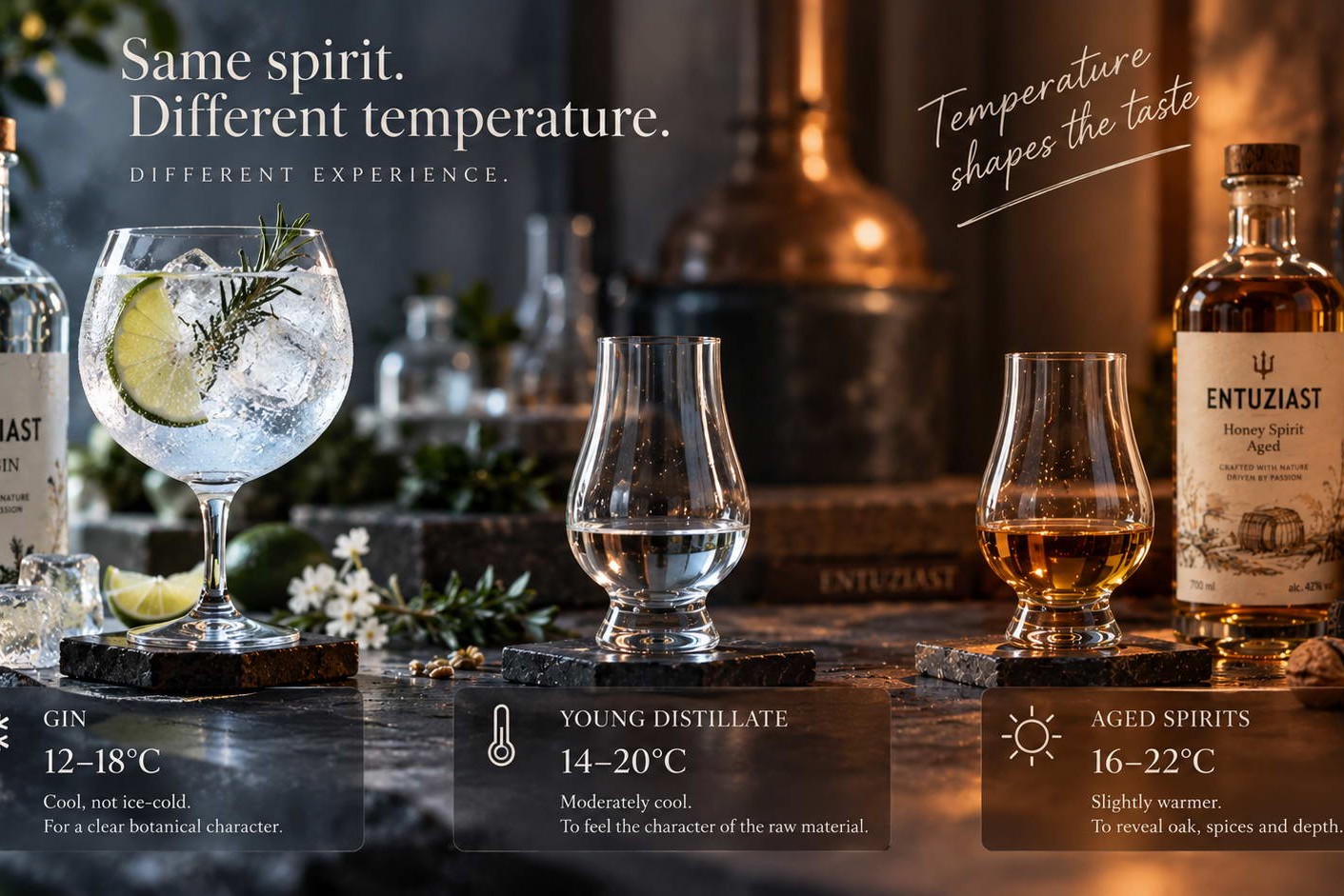
For neat tasting, gin is usually best served cool, but not ice-cold.
A useful general range is around 12–18°C.
At this temperature:
- juniper remains expressive;
- citrus notes are easy to detect;
- botanicals are not heavily suppressed;
- the alcohol does not feel unnecessarily aggressive.
What If You Are Drinking Gin & Tonic?
That is different.
Gin & Tonic is traditionally served cold.
Ice, chilled tonic and a cool glass are all part of the style.
In this format, the goal is not necessarily to reveal every subtle detail of the gin, but to create:
- freshness;
- balance;
- carbonation;
- a clear juniper character;
- citrus brightness.
Should You Keep Gin in the Freezer?
For serving — some people may enjoy it.
For tasting — strong chilling often hides part of the aroma.
We discussed this in more detail in the article “Can Gin Be Stored in the Refrigerator or Freezer?”.
Why Can Very Cold Gin Seem “Better”?
Because cold masks harshness.
If the drink has:
- alcoholic sharpness;
- bitterness;
- aggressive botanical notes,
they may feel less obvious at low temperature.
But that does not mean the drink itself has become higher quality.
What Temperature Is Best for a Young Unaged Distillate?
For a young distillate, a range of around 14–20°C often works well.
This allows you to:
- notice the character of the raw material;
- evaluate the cleanliness of the distillation;
- assess texture;
- avoid overwhelming the aroma with alcohol.
If such a drink is served too cold, it can become much more neutral.
Example: Honey Spirit Pure ENTUZIAST
Honey Spirit Pure ENTUZIAST is an unaged honey distillate.
Its character comes from the raw material, fermentation and distillation rather than oak.
So for tasting, there is little reason to freeze the drink heavily.
A moderately cool or near-room temperature allows more detail to emerge.
What Temperature Is Best for Aged Spirits?
Aged distillates often benefit from a slightly warmer serving temperature.
Approximately 16–22°C is a useful range.
At this temperature, it is easier to detect:
- oak;
- vanilla;
- spices;
- dried fruit;
- nutty notes;
- the finish.
Why Should Aged Spirits Not Be Served Ice-Cold?
Because much of their complexity becomes muted.
With strong chilling:
- oak notes become quieter;
- vanilla and spices are less expressive;
- texture feels denser;
- alcohol feels softer.
For casual drinking, that may be enjoyable.
But for tasting, you lose some of the characteristics the spirit was aged to develop.
Example: Honey Spirit Aged ENTUZIAST
Honey Spirit Aged ENTUZIAST has a layered profile combining honey distillate with French and Ukrainian oak and finishing in an Oloroso cask.
A drink like this is better evaluated at a temperature that does not suppress:
- oak;
- dried fruit;
- spices;
- vanilla notes;
- texture.
So strong chilling is more likely to hide part of its character than help reveal it.
Is 20–22°C Too Warm?
Not necessarily.
It depends on the room temperature and the drink itself.
But once the spirit becomes warmer than a comfortable room temperature, ethanol can begin to dominate the aroma.
At that point, you may notice alcohol vapour before the finer aromatic details.
Why Does Warm Alcohol Feel Harsher?
Because ethanol becomes more volatile.
Its concentration in the air above the glass increases.
As a result, your nose receives more alcohol vapour.
A drink that is too warm may therefore feel:
- sharper;
- more alcohol-forward;
- hotter.
Should You Warm the Glass with Your Hands?
There is no need to do it deliberately.
But when you hold the glass, the drink gradually warms naturally.
This can actually be useful during tasting.
You can observe how the aroma changes from a cooler state to a slightly warmer one.
Why Are the First Five Minutes in the Glass Important?
The drink gradually:
- warms up;
- interacts with air;
- changes the volatility of its aromatic compounds.
That means the aroma after five minutes may be different from the aroma immediately after pouring.
We discussed this separately in the article “Why Should You Let Strong Spirits Rest in the Glass?”.
Does Temperature Change the Finish?
Yes.
A very cold drink may have a shorter, more muted finish.
As the temperature rises slightly, it becomes easier to notice:
- spice;
- oak;
- citrus;
- herbs;
- dried fruit;
- warmth.
Does Temperature Affect Texture?
Yes.
Cold increases viscosity.
As a result, the drink can feel:
- denser;
- more oily;
- smoother.
At a higher temperature, the texture may feel lighter, while the aroma becomes more active.
Why Does Alcohol from the Freezer Feel “Thicker”?
Because of changes in viscosity.
At low temperatures, the liquid moves more slowly and feels denser.
This is a physical effect.
It does not mean the drink suddenly contains more glycerol or sugar.
Does Cold Reduce the ABV?
No.
If you simply chill the bottle, the ABV does not change.
Only your perception changes.
That is why ice-cold strong alcohol can feel very easy to drink even though the ethanol concentration is exactly the same.
Why Is That Important to Remember?
Because sensory smoothness can be misleading.
A cold drink may seem weaker than it really is.
This is especially noticeable in cocktails and strongly chilled distillates.
Is Ice Only About Temperature?
No.
Ice does two things at once:
- it cools the drink;
- it dilutes it.
So when you add ice, both the temperature and the actual ABV in the glass change.
What Happens as the Ice Melts?
Water gradually reduces the alcohol concentration.
At the same time, it can change:
- aroma;
- texture;
- sweetness;
- bitterness;
- alcoholic warmth.
So the same drink with ice changes continuously as you drink it.
Should You Add Ice to an Aged Distillate?
That is a matter of personal preference.
If you enjoy it that way, it is a perfectly valid serving style.
But for analysing the aroma, it is better to try the drink without ice first.
Then you can add a cube and compare.
Are a Few Drops of Water Better Than Ice?
For tasting, often yes.
Water lowers the alcohol concentration without strongly chilling the drink.
This allows aromatic compounds to remain more active.
We discussed this in more detail in the article “Should You Add Water to Strong Spirits?”.
Does Glass Shape Matter?
Yes.
Temperature and glass shape work together.
A glass with a narrower opening concentrates aroma above the surface of the drink.
This means even a cooler distillate can seem more aromatic.
In a wide glass, aromas disperse more quickly.
Should You Chill the Glass Itself?
For Gin & Tonic — this can be useful.
For analytical tasting — usually not.
A strongly chilled glass will again suppress part of the aroma.
What Should You Do in Summer?
If the room is 28–30°C, “room temperature” is no longer an ideal tasting temperature.
In that case, you can cool the bottle or serving slightly.
For example, down to around 16–20°C.
The goal is not to make it ice-cold, but simply to prevent overheating.
What About Winter?
If the bottle has been stored in a very cold room, let it warm up slightly.
At 5–8°C, many aromatic details will be muted.
After 10–20 minutes at room temperature, the profile may become much more interesting.
Can You Determine the Exact Ideal Temperature?
For a specific drink — only by tasting.
General temperature ranges are useful guidelines, but they are not strict laws.
One gin may perform beautifully at 12°C.
Another may be more expressive at 18°C.
The same is true for aged distillates.
How Can You Find the Best Temperature at Home?
You can run a simple experiment.
- Pour a small serving while the drink is cool.
- Smell it immediately.
- Wait 5 minutes.
- Smell it again.
- Wait another 5–10 minutes.
- Compare how the aroma and texture change.
This is one of the simplest ways to understand a specific bottle.
Do You Need a Thermometer?
For normal home drinking — not at all.
The numbers are only guidelines.
It is much more important to understand the principle:
very cold — less aroma, more softness;
warmer — more aroma, but also more alcoholic intensity.
What Is Best for a First Tasting?
Avoid extremes.
Do not freeze the drink.
Do not warm it.
A moderate temperature gives you a more honest impression of the character.
After that, you can experiment with:
- ice;
- water;
- colder serving;
- cocktails.
What If the Producer Recommends a Specific Temperature?
That is a good starting point.
The producer knows the intended style of the product and how it was designed to be served.
But the recommendation does not prevent experimentation.
Alcohol perception is individual.
In Short: What Temperature Should You Serve Spirits At?
- Gin for neat tasting — approximately 12–18°C.
- Gin & Tonic — well chilled with ice.
- Young distillate — approximately 14–20°C.
- Aged spirits — approximately 16–22°C.
- Very low temperatures suppress aroma.
- Cold makes alcohol feel smoother.
- Warmer temperatures increase aroma, but may also emphasise alcoholic harshness.
- Ice both cools and dilutes.
- For tasting, a few drops of water may be more useful than strong chilling.
- The best temperature depends on the specific style and your own preferences.
Conclusion
Serving temperature is not a minor detail.
It can dramatically change how the same drink is perceived.
Alcohol that is too cold feels smoother, but loses part of its aromatic complexity.
Alcohol that is too warm smells more intensely, but ethanol can begin to dominate.
That is why it is best to avoid extremes during a first tasting.
Gin — cool, but not ice-cold.
A young distillate — moderately cool.
An aged spirit — closer to a cool room temperature.
The best serving temperature is the one at which the drink does not hide its aroma behind the cold and does not cover it with alcohol vapours.
And one of the most interesting ways to find that point is simply to observe how the drink changes in the glass over 10–15 minutes.