





Should You Store Bottles of Spirits Upright or Horizontally?
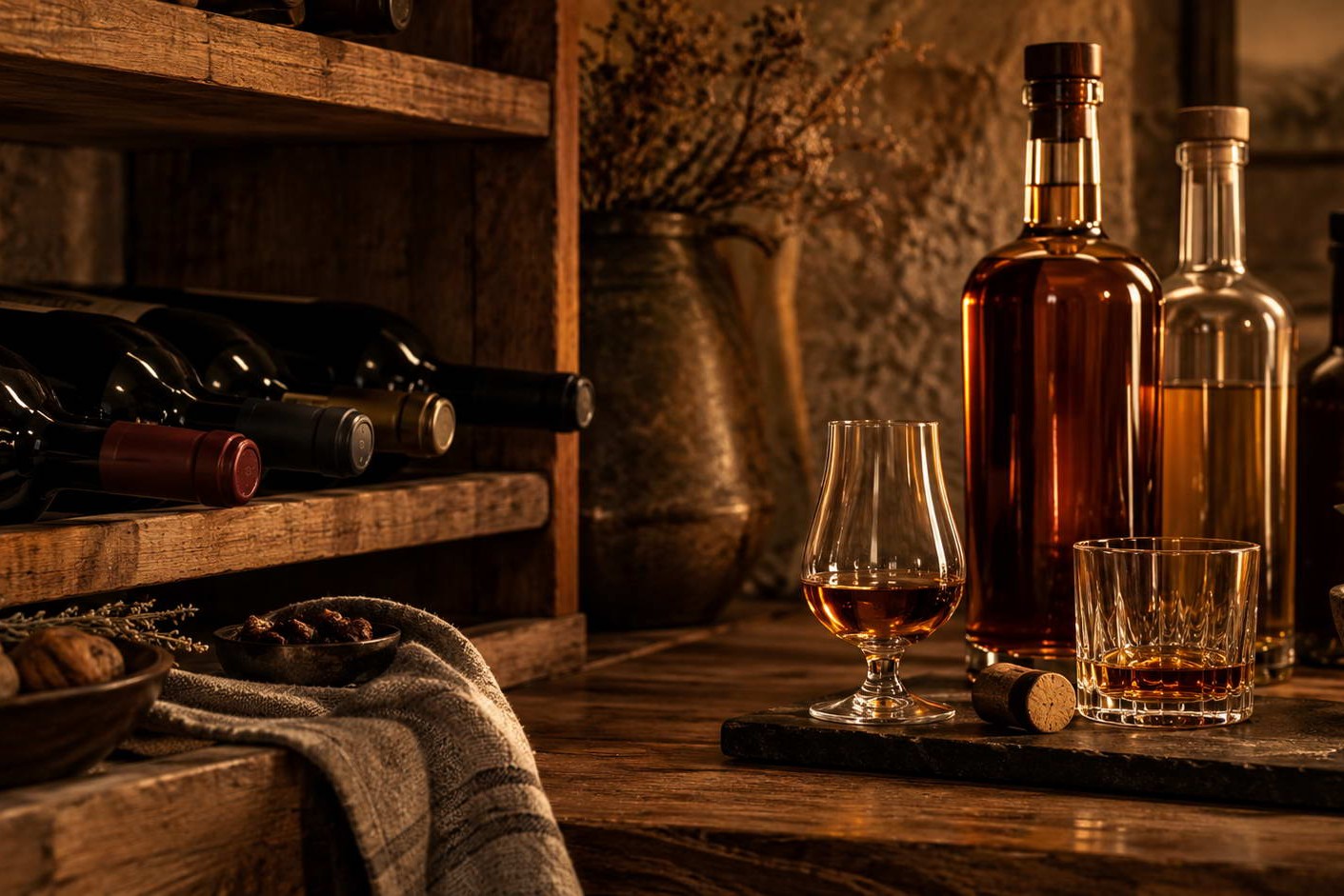
With wine, you often hear the familiar rule:
a bottle sealed with natural cork should be stored on its side.
Sometimes this advice is automatically applied to whisky, brandy, gin, rum and other strong distillates.
But there is an important difference.
Strong alcohol contains much more ethanol than wine.
And constant contact between a concentrated alcoholic solution and natural cork can create a completely different set of problems over time.
That is why the general rule for most strong alcoholic drinks is different:
it is better to store bottles upright.
Why Is Wine Often Stored Horizontally?
The classic explanation is linked to natural cork.
When a wine bottle lies on its side, the liquid remains in contact with the inner surface of the cork.
This helps keep it moist.
If a cork dries out too much, it can:
- shrink;
- lose elasticity;
- seal the bottle less effectively;
- allow more air inside.
For wine that may spend years under natural cork, this has traditionally been very important.
Why Is Strong Alcohol Different?
Because the ethanol concentration is much higher.
Whisky, brandy, gin and other distillates often contain around 40% ABV or more.
This type of alcoholic solution interacts more aggressively with some materials than wine does.
If strong alcohol remains in constant contact with natural cork for years, it can potentially affect:
- the structure of the cork;
- its surface;
- its sealing ability;
- the aroma of the drink.
What Can Happen to the Cork?
Depending on cork quality, bottle age and alcohol strength, the cork may gradually:
- soften;
- crumble;
- deform;
- lose mechanical strength.
This does not mean that any contact between alcohol and cork destroys it immediately.
The concern is prolonged, constant contact over months or years.
So Should Whisky Be Stored Upright?
Yes.
For bottles of strong distilled alcohol, upright storage is generally the safest and most practical option.
Keeping the bottle upright:
- prevents constant liquid contact with the cork;
- reduces the risk of alcohol damaging the closure;
- reduces the risk of leaking;
- makes it easier to monitor the fill level.
What About Gin?
The same principle applies.
Gin bottles are generally best stored upright.
This is especially relevant when the bottle uses a natural or composite cork.
For gin, bottle position is not the only concern. It is also important to protect the drink from:
- direct sunlight;
- high temperatures;
- constant temperature fluctuations.
What If the Bottle Has a Screw Cap?
Then the problem of long-term contact with natural cork effectively disappears.
But upright storage is still usually the most practical option.
It reduces the risk of:
- leaking;
- constant liquid contact with the seal;
- closure deterioration during long-term storage.
Can You Lay a Bottle on Its Side for a Few Hours?
Yes.
Short-term horizontal storage is generally not a problem.
For example:
- during transport;
- in a car;
- inside a box;
- while reorganising a collection.
The concern is long-term storage over months or years.
What If a Bottle Has Already Been Stored on Its Side for Years?
There is no need to panic.
First, place it upright.
Then check:
- the condition of the cork;
- whether there has been any leakage;
- the fill level;
- whether cork particles are visible inside;
- whether any unusual aroma has appeared.
The fact that a bottle was stored horizontally does not automatically mean the drink is spoiled.
What About Cork Drying Out?
This is the main argument used in favour of storing bottles horizontally.
Natural cork can indeed lose moisture over time.
This is especially relevant when a bottle is stored for decades in a very dry environment.
But constant contact with strong alcohol is not the best solution to that problem.
Should You Tilt the Bottle Occasionally?
For very long-term collectible storage, some owners briefly tilt bottles to moisten the inner surface of a natural cork.
The bottle is then returned to an upright position.
This is fundamentally different from permanent horizontal storage.
How Often Should You Moisten the Cork?
For an ordinary home bottle — usually not at all.
If you bought the drink and plan to consume it within a few years, normal upright storage is enough.
This kind of extra attention is mainly relevant to very old collectible bottles with natural cork.
Are All Corks the Same?
No.
Today, producers use different types of closures:
- natural cork;
- agglomerated cork;
- synthetic cork;
- composite closures;
- screw caps;
- glass stoppers;
- different polymer seals.
So long-term behaviour can vary depending on the closure.
What Matters More: Bottle Position or Temperature?
Both matter.
But a bottle standing perfectly upright on a sunny windowsill for years still has poor storage conditions.
Proper storage is a combination of:
- upright position;
- stable temperature;
- protection from direct light;
- good sealing.
Why Is Direct Sunlight Undesirable?
Because it does several things at once:
- heats the bottle;
- creates temperature fluctuations;
- can affect light-sensitive aromatic compounds.
So even an upright bottle should be protected from sunlight.
What About High Temperature?
That is undesirable too.
Heat increases the volatility of the drink’s components and may increase pressure inside the bottle.
If the cork is already old or damaged, heat can further increase the risk of sealing problems.
Should Spirits Be Stored in the Refrigerator?
For most classic strong distillates — no.
A stable moderate temperature is much more important.
A normal dark cabinet is often better than constant refrigeration.
We discussed gin specifically in the article “Can Gin Be Stored in the Refrigerator or Freezer?”.
Should an Open Bottle Also Be Stored Upright?
Yes.
For an opened bottle, upright storage is even more important.
There is already more air inside, and the condition of the cork or cap directly affects sealing.
An opened bottle should therefore:
- stand upright;
- be tightly sealed;
- be protected from overheating;
- be kept away from direct light.
Why Does Sealing Matter More After Opening?
Once the bottle has been opened, there is already more air above the liquid.
If the closure does not seal properly, additional air exchange takes place.
This can accelerate:
- loss of volatile aromas;
- sensory changes;
- evaporation.
We discussed changes in aroma after opening in the article “Why Does the Aroma of a Drink Change After Opening the Bottle?”.
Can Alcohol Leak Through the Cork?
If the bottle is stored horizontally — potentially yes.
Especially if:
- the cork is old;
- it has deformed;
- the bottle experiences temperature fluctuations;
- the closure does not seal perfectly.
Even a small leak means the seal has already been compromised.
What Does a Lower Fill Level in an Old Bottle Mean?
It can indicate gradual evaporation through the closure.
With old collectible bottles, the fill level is sometimes used as one indicator of storage condition.
The more liquid has been lost, the more carefully the cork should be inspected.
Can the Cork Affect Aroma?
Yes.
The closure material has its own aromatic characteristics.
With prolonged unwanted contact, foreign notes may potentially appear in the drink.
This is one reason producers select closures that are suitable for the strength and style of the specific product.
Should an Old Cork Be Replaced?
If it is an ordinary home bottle and the cork is beginning to deteriorate, replacing it with a suitable airtight closure is sensible.
With an expensive collectible bottle, the situation is more complicated because the original closure may affect collector value.
In that case, any intervention should be handled carefully.
What If the Cork Breaks While Opening the Bottle?
There is no need to panic.
If cork fragments fall into the drink, they can be carefully filtered out.
After that, the alcohol is best transferred into a clean glass bottle with a reliable airtight closure.
It is not a good idea to leave the drink for a long time with a damaged cork.
Is a Screw Cap Better for Long-Term Storage?
It has several practical advantages.
For example, it:
- does not dry out like natural cork;
- does not crumble;
- is easy to open and close;
- can provide excellent sealing.
But the quality of the cap and seal still matters.
Is Natural Cork Worse?
No.
It is a traditional, attractive and functional material.
It is often part of the design of premium spirits.
It simply requires a little more attention during very long-term storage.
How Should You Store a Collection of Strong Spirits?
If you have many bottles, the basic principles are simple:
- Store bottles upright.
- Protect them from direct light.
- Avoid high temperatures.
- Keep conditions as stable as possible.
- Periodically check cork condition and fill level.
Do You Need a Special Storage Cabinet?
For a normal home collection — no.
A dark cabinet or shelf in a room with a stable temperature is usually sufficient.
Specialised storage solutions make more sense for a large or valuable collection.
Can Spirits Be Stored in a Basement?
Yes, provided that:
- humidity is not excessive;
- there are no major temperature fluctuations;
- bottles are protected from dirt;
- boxes and labels are not damaged by damp conditions.
Cool conditions can be useful for the alcohol itself, but excessive humidity can damage packaging and labels.
What About the Kitchen?
It can work if the bottle is kept away from:
- the stove;
- the oven;
- radiators;
- sunny windows.
A kitchen cabinet away from heat sources is usually perfectly suitable.
Can Bottles Be Stored on an Open Bar Shelf?
Yes.
But if the shelf receives strong sunlight or becomes warm, it is not the best place for long-term storage.
An attractive display is not always the same as good storage conditions.
What Matters More for a Sealed Bottle: Air or Light?
In a properly sealed bottle, contact with outside air is minimal.
So light and temperature become especially important external factors.
Once the bottle is opened, the role of air becomes much greater.
Should Bottles Be Turned Regularly?
No.
There is no need to rotate or turn strong spirits regularly during storage.
Does Bottle Position Affect Ageing?
No, because active barrel maturation has already ended once the spirit is bottled.
Storing the bottle horizontally will not make the distillate older or more complex.
After bottling, the main goal is to preserve the profile that has already been created.
Why Doesn’t Alcohol Continue to Mature in the Bottle?
Because there is no contact with oak.
It is in the barrel that the drink gains:
- tannins;
- vanilla-related compounds;
- oak lactones;
- spice notes;
- colour;
- part of its structure.
In a glass bottle, that process stops.
Does Upright Storage Apply to Honey Spirit Aged?
Yes.
Honey Spirit Aged ENTUZIAST, like other strong distillates, is best stored upright.
The barrel work has already happened before bottling.
After that, the job of the bottle is to preserve the finished aromatic profile as consistently as possible.
What About Honey Spirit Pure?
The same principle applies.
Honey Spirit Pure ENTUZIAST does not need liquid-to-cork contact in order to develop.
It is also best stored upright, in a dark place and away from excessive heat.
What About MeadGIN?
MeadGIN ENTUZIAST should also be stored upright.
For gin, it is especially important to protect the bottle from heat and light in order to preserve volatile botanical aromas for as long as possible.
What If Only a Small Amount Is Left in an Open Bottle?
The bottle should still remain upright.
But at that point, the larger problem is no longer the cork — it is the large amount of air above the liquid.
If only 10–20% remains and you want to keep it for a long time, transferring it into a smaller clean glass bottle can make sense.
Why Does That Help?
A smaller bottle reduces the amount of air above the drink.
This is especially useful for aromatic distillates where volatile compounds are important.
Should You Use a Decanter?
For long-term storage — not necessarily.
Many decorative decanters do not seal as tightly as the original bottle.
So they are often better for serving than for storage over months or years.
Why Is the Original Bottle Often Best?
Because the producer has already selected:
- the glass;
- the closure;
- the seal;
- the neck design
for the specific product.
If the original bottle is in good condition, there is usually little reason to transfer the drink elsewhere.
In Short: Upright or Horizontal?
- Strong alcohol is generally best stored upright.
- The horizontal-storage rule for wine should not automatically be applied to spirits.
- Constant contact between high-proof alcohol and natural cork is undesirable.
- Short-term horizontal positioning is usually fine.
- Opened bottles should also be stored upright.
- Cork condition matters especially during long-term storage.
- Natural cork can dry out over time, but that is not a reason to store the bottle permanently on its side.
- Darkness and stable moderate temperature are just as important as bottle position.
- Screw caps simplify storage, but upright positioning is still practical.
- Once bottled, spirits do not continue barrel ageing regardless of bottle position.
Conclusion
For most strong alcoholic drinks, the answer is simple:
store the bottle upright.
Horizontal storage makes traditional sense for wine sealed with natural cork, but with strong distillates, constant contact between concentrated alcohol and the closure is undesirable.
Keeping the bottle upright reduces that contact, lowers the risk of leakage and helps preserve the closure in good condition.
But bottle position is only one part of proper storage.
The bottle should also be protected from direct sunlight, excessive heat and large temperature fluctuations.
If the bottle has already been opened, good sealing becomes especially important.
So the simple rule for strong spirits is: upright, tightly sealed, in the dark and away from heat.