




Why Does the Aroma of a Spirit Change After Opening the Bottle?
You open a bottle, pour the first glass and clearly remember the aroma.
A few weeks later, you return to the same bottle — and the drink seems slightly different.
The aroma may feel softer.
Or less intense.
One note may have faded while another becomes more noticeable.
Sometimes the alcohol seems sharper, while at other times the drink appears to have “opened up.”
This raises a natural question: does alcohol really change after opening the bottle, or is it only our perception?
The correct answer is: both are possible.
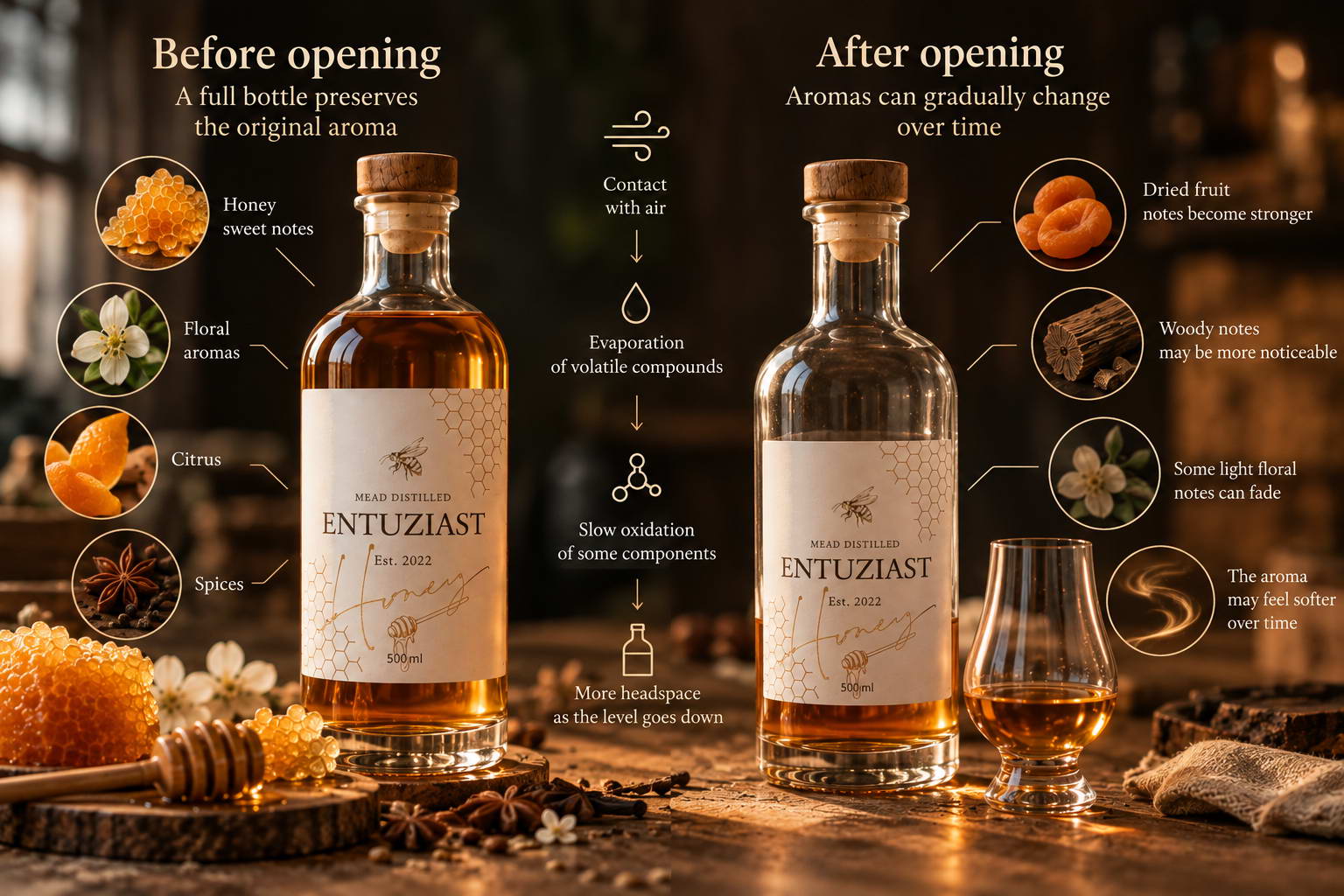
After opening, the environment inside the bottle changes. There is more contact with air, some volatile aromatic compounds gradually evaporate, and certain components can slowly interact with oxygen.
At the same time, we change too. Serving temperature, glassware, food, mood and sensory memory can make the same bottle seem different on another occasion.
Let us look at what actually happens.
What Changes When a Bottle Is Opened for the First Time?
Before opening, the bottle is an almost closed system.
There is already a small amount of gas above the liquid, but once the cork or cap is removed, the spirit comes into contact with room air.
When some of the liquid is poured out, its place is taken by new air.
That air contains oxygen.
The more spirit is consumed, the larger the empty space above the liquid becomes. This space is often called headspace.
And that headspace plays an important role in how an opened bottle changes over time.
Why Does the Amount of Air in the Bottle Matter?
Imagine two identical bottles.
One still contains 90% of the spirit.
The other contains only 20%.
The second bottle has much more air above the liquid.
That means the aromatic components interact with a larger gas volume, and more oxygen remains in the bottle after it is closed again.
This is why a nearly full bottle usually preserves its character more reliably than one with only a small amount left.
Do Strong Spirits Oxidise?
Yes, some compounds can react with oxygen.
However, this happens very differently from what occurs in an opened bottle of wine.
Strong distilled spirits are generally much more stable because of their alcohol concentration and overall composition.
An opened bottle of gin, whisky or honey distillate does not become unusable within a few days simply because it has been opened.
The changes are usually much slower.
But they are not completely impossible either.
What Can Oxygen Actually Change?
The aroma of a spirit is created by many volatile organic compounds.
Some are relatively stable.
Others can gradually change when exposed to oxygen.
Over time, this may slightly shift the balance between:
- fruity notes;
- floral aromas;
- herbal components;
- spices;
- oak-derived notes;
- alcoholic sharpness.
This does not mean the bottle turns into a completely different drink after a month.
Usually, the changes are more subtle — certain accents become weaker while others become more noticeable.
Why Do Some Aromas Simply Evaporate?
Aromatic compounds are described as volatile because they can move from the liquid into the gas phase.
Every time the bottle is opened, some aromatic molecules leave with the air.
Pouring the drink increases this exchange.
The most volatile compounds may be lost faster than heavier ones.
This means delicate top notes — such as fresh citrus or light floral aromas — may sometimes change more noticeably than heavier woody or spicy notes.
Why Does a Spirit Sometimes Seem Softer After Opening?
There can be several reasons.
First, the concentration of some highly volatile compounds may gradually change.
Second, the drink is no longer unfamiliar, so the second tasting can feel less aggressive.
Third, the tasting conditions may have changed.
For example:
- the serving temperature is different;
- a different glass is used;
- the drink rests longer after pouring;
- the sip is smaller;
- the senses are less affected by food or surrounding smells.
This is why not every difference between the first and second tasting should automatically be explained by chemical changes inside the bottle.
Does Alcohol “Breathe” in an Opened Bottle?
This expression is often used, but it can be misleading.
A drink does not literally breathe.
What actually happens is contact between the liquid, its aromatic compounds and the surrounding air.
This effect is usually much stronger in the glass than in a closed bottle because the exposed surface area is much larger.
That is why a few minutes in the glass can change perception more noticeably than briefly opening the bottle.
We explore this in detail in the article “Why Should You Let Strong Spirits Rest in the Glass?”.
Does a Spirit Become Better After Opening?
Not necessarily.
Sometimes a person returns to a bottle and finds the aroma more harmonious.
But this does not mean every spirit benefits from months of exposure to a large amount of air.
Some components may soften.
Others may gradually weaken.
Opening a bottle is therefore not a way to artificially “age” a spirit.
Does Whisky or Distillate Continue Ageing in the Bottle?
Not in the same way it ages in a barrel.
This is a fundamental difference.
Inside an oak barrel, the distillate continuously interacts with wood.
It receives:
- tannins;
- vanillin;
- oak lactones;
- toasted compounds;
- other wood-derived substances.
Slow gas exchange also occurs through the structure of the barrel.
None of these conditions exist in the same way inside a glass bottle.
So ten years in a sealed bottle do not equal ten additional years of barrel maturation.
Why Does a Nearly Empty Bottle Change Faster?
Because of the ratio between liquid and air.
When only a quarter or a third of the bottle remains, the headspace becomes much larger.
Every time the bottle is opened, some of the old air is replaced with fresh air.
The bottle is then closed again with this new portion of air inside.
This is why it may not be ideal to keep a very small amount of an aromatic distillate for many years without a reason.
How Quickly Does an Opened Bottle Change?
There is no universal time limit.
It depends on:
- alcohol strength;
- style of the drink;
- how much remains in the bottle;
- how often it is opened;
- temperature;
- light exposure;
- how tightly the bottle is closed;
- the nature of its aromatic compounds.
A full or nearly full bottle of strong spirit stored correctly can remain very stable for a long time.
A bottle with only a small amount left and opened frequently exists under very different conditions.
Why Is Gin Especially Interesting After Opening?
A large part of gin's character comes from volatile aromatic compounds in botanicals.
Juniper, citrus peel, herbs and spices contain essential oils and other aromatic substances.
Some are highly volatile.
That makes proper storage particularly important for an opened gin:
- keep the bottle tightly closed;
- protect it from heat;
- avoid direct sunlight;
- store it under stable conditions.
In MeadGIN ENTUZIAST, juniper and natural citrus botanicals form an important part of the aromatic profile, so correct storage helps preserve their expression for as long as possible.
Should Opened Gin Be Stored in the Refrigerator?
Usually, this is not necessary.
Strong gin can generally be stored in a dark place at a stable temperature with the bottle tightly closed.
Permanent refrigeration is not required for proper storage.
In addition, very low temperatures suppress aroma during tasting.
We discuss this in more detail in the article “Can Gin Be Stored in the Refrigerator or Freezer?”.
What Happens to an Aged Distillate?
An aged spirit has a complex aromatic profile.
It may contain:
- aromas from the original raw material;
- fermentation-derived compounds;
- distillation-derived components;
- vanilla and woody notes;
- spices;
- dried fruit;
- wine-like or nutty nuances from the previous history of the barrel.
If the balance between these components changes even slightly, a taster may notice it quite easily.
This is why a complex aged spirit can sometimes seem different several months after opening.
An Example: Honey Spirit Aged ENTUZIAST
Honey Spirit Aged ENTUZIAST has a layered aromatic profile in which honey distillate, wax, spice, vanilla and oak-derived notes work together.
Some of these aromatic components are delicate.
For that reason, an opened bottle is best kept tightly closed, upright, away from direct sunlight and away from strong heat.
This helps preserve the balance that developed during maturation.
What About Unaged Honey Distillate?
A young distillate has no oak-derived layer, but this does not mean its aroma is simple.
Its character can be shaped by the raw material, fermentation and distillation method.
For example, Honey Spirit Pure ENTUZIAST is created from fermented spring honey and has its own clean honey-and-grain aromatic profile.
It should also be kept tightly sealed and protected from unnecessary exposure to heat and light.
Can the Aroma Become Stronger After Opening?
During tasting, it can certainly feel that way.
This is especially possible if the first tasting happened when the drink was very cold or immediately after pouring.
On another occasion, the person may:
- give it more time in the glass;
- use different glassware;
- taste it at a warmer temperature;
- take a smaller sip;
- simply know better what to look for.
The result may feel as though the bottle has “opened up.”
Part of that effect may come from the drink, and part from the taster.
Why Can the First Glass from a New Bottle Seem Different?
There is no mystery here either.
During the first tasting, the person is unfamiliar with the drink and has not yet adapted to its aromatic profile.
The first alcoholic vapours may seem sharper.
People also often taste the first glass immediately without giving it time to rest.
The next tasting is different because the brain already knows roughly what to expect.
It recognises familiar notes faster.
Should You Intentionally Leave the Bottle Open?
No.
There is little reason to leave a bottle of strong spirit open for hours just to let it “breathe.”
This mainly increases the loss of volatile aromatic compounds.
If you want the drink to interact with air before tasting, it is more sensible to pour the required amount into a glass.
The main bottle can then remain closed.
Should Spirits Be Transferred into a Decanter?
For long-term storage of aromatic strong spirits, usually not.
Many decorative decanters seal less effectively than the original bottle.
Their wider shape can also increase contact with air.
A decanter may be attractive for serving, but the original bottle is often more practical for storage.
Should an Opened Bottle Be Stored Upright?
Yes. For most strong distilled spirits, this is the best approach.
Unlike wine, high-proof alcohol is generally not stored in constant contact with the cork.
Upright storage:
- reduces prolonged contact between strong alcohol and the closure material;
- reduces the risk of unwanted interaction;
- is the standard storage position for most strong spirits.
Why Is Sunlight More Harmful Than Ordinary Room Air?
Direct sunlight can heat the bottle and affect sensitive aromatic compounds.
A bottle on a windowsill may also go through repeated heating and cooling cycles.
These conditions are much worse than stable storage in a dark cupboard.
So even an attractive bottle should not spend months in direct sunlight merely as decoration.
Does High Temperature Matter?
Strong heat is undesirable for long-term storage.
Higher temperatures increase evaporation and can accelerate chemical reactions.
A bottle is therefore best kept away from:
- radiators;
- ovens and cookers;
- sunny windowsills;
- cars during hot weather;
- other constant sources of heat.
Can You Reduce the Amount of Air in a Nearly Empty Bottle?
For particularly valuable spirits, some enthusiasts transfer a small remaining amount into a smaller clean glass bottle with an airtight closure.
The idea is to reduce the volume of air above the liquid.
However, the new bottle should be completely clean, odour-free and suitable for strong alcohol.
For an ordinary bottle that will be finished within a reasonable period, this is usually unnecessary.
Do You Need Vacuum Stoppers?
They are not normally required for strong distilled spirits.
Systems commonly used for wine are designed for a different category of drink and different storage times after opening.
For most gin, whisky, brandy and distillates, the original cork or cap combined with proper storage conditions is enough.
How Can You Tell Whether the Drink Changed or Your Perception Changed?
It can be difficult to determine from a single tasting.
But you can make the conditions more consistent.
For example, compare the drink:
- using the same type of glass;
- at approximately the same temperature;
- without strongly flavoured food beforehand;
- after the same amount of resting time in the glass.
This makes differences easier to evaluate.
This is one reason sensory tasting tries to control conditions as much as possible.
Why Can the Aroma Seem Different Even the Next Day?
Not necessarily because the bottle changed.
Our sense of smell does not work exactly the same every day.
Perception can be affected by:
- fatigue;
- nasal congestion;
- food;
- coffee;
- perfume;
- the surrounding environment;
- serving temperature;
- attention and expectations.
A difference between two evenings therefore does not automatically prove that the chemical composition of the drink changed significantly.
When Are Changes Most Likely to Become Noticeable?
Pay more attention to bottles where:
- only a small amount of liquid remains;
- the aromatic profile is very delicate;
- the bottle is opened frequently;
- the cork or cap does not seal properly;
- the bottle is stored in heat or sunlight;
- storage continues for a very long time.
It is usually the combination of several factors that matters more than simply opening the bottle once.
How Should an Opened Bottle Be Stored?
For most strong aromatic spirits, a few simple rules are enough:
- Close the bottle tightly after every use.
- Store it upright.
- Keep it away from direct sunlight.
- Avoid strong and repeated heating.
- Do not transfer it unnecessarily into poorly sealed decorative decanters.
- If only a very small amount remains, do not keep it for years just for a “special occasion.”
In most situations, this is more than enough.
Should You Be Afraid to Open a Good Bottle?
No.
Sometimes the desire to preserve a drink “perfectly” becomes so strong that people leave interesting bottles unopened for years.
But quality spirits are ultimately made to be tasted.
A properly closed and correctly stored bottle of strong distillate is not ruined by being opened once.
It simply means the internal environment of the bottle is no longer exactly the same as before the first pour.
In Short: Why Does the Aroma Change After Opening?
- When liquid is poured out, air takes its place.
- The less spirit remains, the larger the headspace becomes.
- Some volatile aromatic compounds gradually evaporate.
- Certain components may slowly interact with oxygen.
- Light and heat can accelerate undesirable changes.
- A difference in perception does not always mean the drink itself has changed.
- Temperature, glassware, food and sensory memory also affect aroma.
Conclusion
Strong spirits do not begin to spoil immediately after the bottle is opened.
Gin, honey distillate, whisky and other strong drinks are far more stable than wine or beer.
However, an opened bottle is no longer exactly the same closed system it was before the first pour.
The amount of air inside increases, aromatic molecules gradually leave the liquid, and some compounds may slowly change through contact with oxygen.
These effects become more noticeable when only a small amount remains or when the bottle is stored poorly for a long time.
The basic rules are therefore simple: close the bottle tightly, store it upright, and protect it from sunlight and excessive heat.
And if the aroma seems slightly different the next time you taste it, do not immediately blame the bottle.
The serving conditions, temperature and even your own perception may have changed as well.
The aroma of a strong spirit is not a frozen picture. It is a balance between volatile compounds, storage conditions and the way we perceive them at a particular moment.