





How to Properly Compare Two Strong Spirits During a Tasting
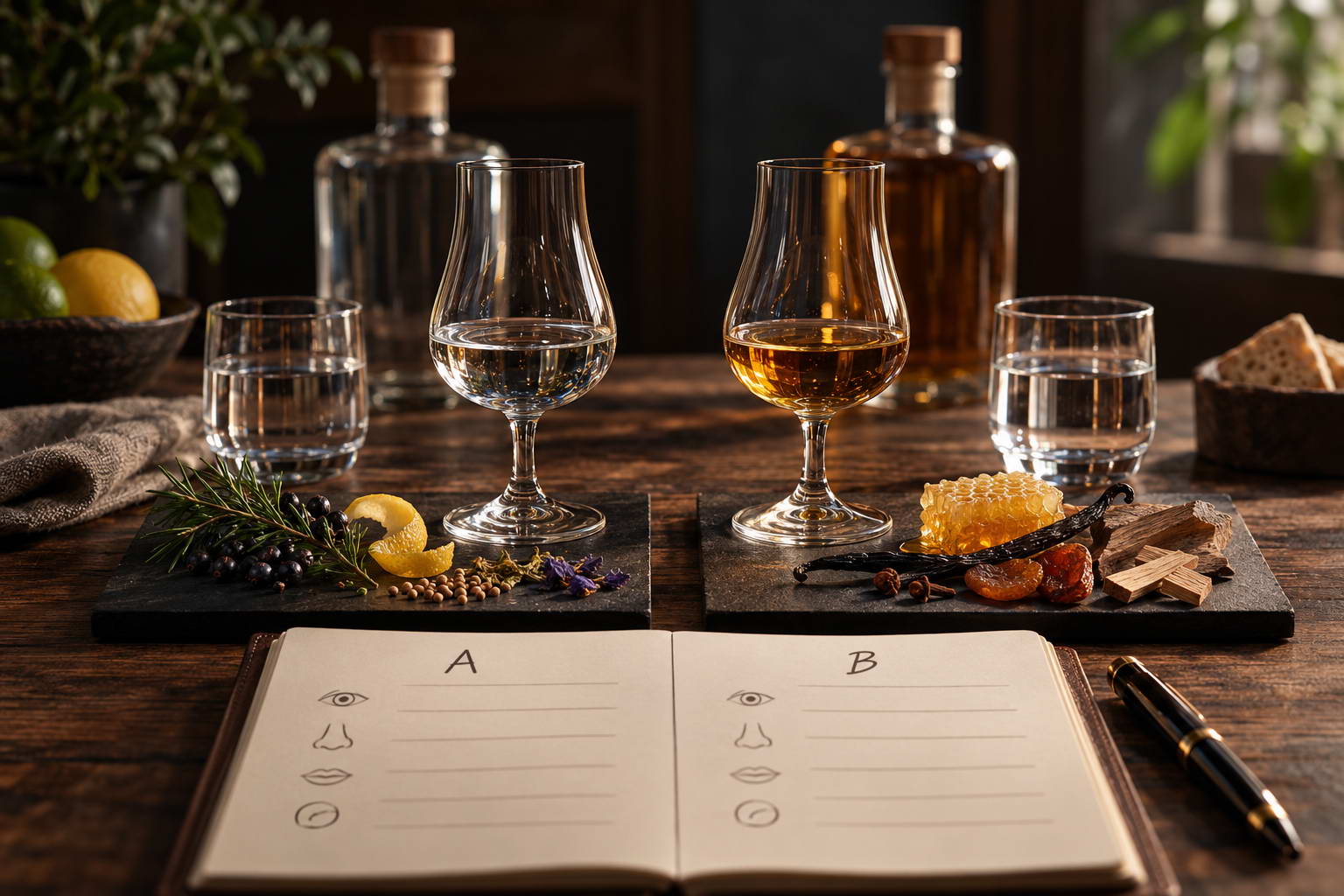
Comparing two strong spirits seems very simple.
Pour the first.
Taste it.
Pour the second.
Then choose the one you like more.
But if you want to do more than simply say “this one tastes better,” and actually understand the difference between two gins, distillates or aged spirits, the conditions matter.
Temperature, glass shape, tasting order, food, water, sip size and even what you tasted five minutes earlier can significantly affect the result.
That is why a good comparison does not begin with the first sip, but with equal conditions for both drinks.
Why Isn’t It Enough to Simply Taste Them One After Another?
Because human perception adapts very quickly.
The first drink changes:
- sensitivity to alcohol;
- perception of sweetness;
- perception of bitterness;
- aromatic sensitivity;
- the condition of the mouth and mucous membranes.
That means you are already evaluating the second sample under different sensory conditions.
Rule One — Keep the Temperature the Same
Temperature can dramatically change perception.
A colder drink usually seems:
- smoother;
- denser;
- less alcohol-forward;
- less aromatic.
A warmer drink usually seems:
- more aromatic;
- more active;
- more alcohol-forward.
If one gin is at 12°C and another is at 22°C, you are partly comparing two temperatures rather than two gins.
Do You Need a Thermometer?
Not necessarily.
For a home tasting, it is usually enough that both bottles:
- have been kept in the same room;
- for roughly the same amount of time;
- and that one is not coming straight from the refrigerator while the other is from a warm shelf.
The key is equal starting conditions.
Rule Two — Use Identical Glasses
Glass shape affects aroma.
A narrower opening concentrates volatile compounds.
A wide glass lets them disperse more quickly.
So if one drink is served in a tasting glass and another in a wide tumbler, the comparison is not really fair.
Which Glasses Are Best?
Two identical glasses with slightly narrowed openings are convenient for comparative tasting.
They help:
- concentrate aroma;
- reduce rapid loss of volatile notes;
- keep the conditions consistent between samples.
Can You Compare Both Drinks Using One Glass?
You can, but it is less convenient.
The glass has to be washed thoroughly, and you need to make sure no aroma from the previous sample remains.
Two identical glasses make the process much easier.
Rule Three — Pour the Same Amount
Even the amount of liquid affects how aroma behaves in the glass.
So it is better to pour roughly the same small amount of each drink.
For example, around 15–25 ml of each sample is usually enough.
You do not need a large pour for comparison.
Why Shouldn’t You Pour Too Much?
Because the goal is to compare, not to drink a full serving.
A large amount:
- causes sensory fatigue faster;
- increases the impact of ethanol;
- makes repeated comparison more difficult.
Should You Start with Aroma or Taste?
It is better to begin with aroma.
Smell both drinks one after another before taking the first sip.
Try to identify only the main direction.
For example:
- juniper;
- citrus;
- fruit;
- flowers;
- spices;
- oak.
Why Shouldn’t You Search for Dozens of Notes Immediately?
Because your first task is to notice the difference between the two samples.
If one seems more citrus-driven and the other more woody, that is already useful information.
You can become more specific later.
Should Both Drinks Rest in the Glass?
Yes, and ideally for the same amount of time.
If the first sample has been sitting for 10 minutes while the second is tasted immediately after pouring, the conditions are already different.
So it is convenient to pour both samples at roughly the same time.
We discussed why strong spirits can benefit from resting in the glass in the article “Why Should You Let Strong Spirits Rest in the Glass?”.
Does Tasting Order Matter?
Very much.
If one drink is significantly:
- stronger;
- sweeter;
- more heavily oaked;
- more bitter;
- more aromatic,
it can strongly affect how the next one is perceived.
Which Drink Should You Taste First?
Usually, the more delicate one.
For example:
- a young distillate before a heavily aged one;
- a softer gin before a very piney and spicy one;
- a lower-strength sample before a higher-strength one.
This helps prevent the stronger profile from overwhelming the subtler one.
What If the Two Drinks Are Very Similar?
Then it is useful to reverse the order during a second round.
For example:
A → B,
then B → A.
This can reveal whether the order itself influenced your judgement.
Why Is This Useful?
Because the second sample can sometimes seem smoother simply because your senses have already adapted to alcohol.
We discussed this in the article “Why Does the First Sip Feel Different from the Second?”.
Should the First Sip Be an Adaptation Sip?
Yes, especially if both drinks are strong.
Take one small first sip of each sample.
Then pause briefly.
Only after that should you move to the main evaluation.
Why Is That Fairer?
Because you are not comparing the first “shock” sip of one drink with an already adapted second sip of another.
Both samples receive roughly the same conditions.
How Large Should the Sips Be?
Small and roughly equal.
Do not barely wet your lips with one sample and take a large mouthful of the other.
Sip size strongly affects:
- burn;
- aroma;
- texture;
- finish.
Should You Hold Both Drinks in Your Mouth for the Same Amount of Time?
Roughly, yes.
If you swallow one immediately but hold the other for 10 seconds, they will show themselves differently.
How Should You Compare Aroma?
Do not stop at “I like this one more.”
Ask yourself a few questions:
- Which drink is more aromatic?
- Which smells cleaner?
- Which seems more complex?
- Which feels more coherent?
- In which one does alcohol interfere with aroma less?
How Should You Compare Taste?
Pay attention to:
- sweetness;
- bitterness;
- acidity;
- dryness;
- alcoholic warmth.
There is no need to decide immediately which one is “better.”
First, simply identify the difference.
How Should You Compare Texture?
Ask which drink feels:
- denser;
- more oily;
- lighter;
- drier;
- more watery.
Texture strongly affects the overall impression, but it is easy to overlook.
How Should You Compare the Finish?
After each sip, pause briefly.
Pay attention to:
- what remains;
- how long it remains;
- whether the finish changes over time;
- whether the ending is pleasant.
Does a Longer Finish Mean a Better Finish?
No.
Persistent bitterness or harsh alcoholic burn can also last a long time.
So evaluate not only length, but also the quality of the finish.
How Should You Compare Balance?
Comparing two drinks side by side is a very good way to understand balance.
In one sample, alcohol may push forward sharply.
In another, it may feel better integrated.
In one, oak may cover the distillate.
In another, it may support it.
We discussed this in detail in the article “What Does Balance Mean in Strong Spirits and How Can You Recognise It?”.
Should You Drink Water Between Samples?
Yes.
Neutral water helps:
- refresh the palate;
- reduce accumulated alcoholic warmth;
- restore some sensitivity.
But do not drink it immediately if you still want to evaluate the finish.
Still or Sparkling Water?
For comparative tasting, neutral still water is usually easier.
Carbonation can add another sensation in the mouth and slightly influence perception.
Can You Add Water to the Spirits Themselves?
Yes, but only after the first comparison neat.
First, evaluate both drinks as they are.
Then you can add the same small number of drops of water to each and compare again.
We discussed the effect of water in the article “Should You Add Water to Strong Spirits?”.
Why Should You Add the Same Amount of Water?
Because otherwise you change the ABV differently in each sample.
One may suddenly seem smoother simply because it was diluted more.
Should You Eat Between Samples?
Not necessarily.
If the tasting is short, water is often enough.
If food is needed, choose something neutral:
- plain bread;
- unsalted crackers;
- a neutral dry biscuit.
What Should You Avoid Before Tasting?
- Spicy food.
- Very sweet desserts.
- Strong coffee.
- Mint chewing gum.
- Smoking immediately before tasting.
- Very aromatic foods.
All of these can influence both taste and smell for quite a while.
Do Surrounding Smells Matter?
Very much.
It is difficult to evaluate gin properly in a room strongly smelling of:
- perfume;
- coffee;
- food;
- smoke;
- scented candles.
For comparison, neutral air is best.
Should You Wear Perfume Before a Tasting?
If you are planning to evaluate aroma carefully, it is better not to.
Strong fragrance on your hands or clothing easily enters the sensory field.
Should You Look at the Bottles?
If you want to evaluate the drinks as independently as possible, you can use a blind tasting.
That means you do not know which sample is which while tasting.
What Does Blind Tasting Change?
It reduces the influence of:
- brand;
- price;
- bottle design;
- expectations;
- reputation.
The result can sometimes be surprising.
Do You Need a Double-Blind Tasting?
Not for a simple home comparison.
It is enough for someone else to pour two samples and label them, for example, A and B.
Why Does Price Affect Perception So Strongly?
If someone knows that one bottle costs three times more, the brain may already expect:
- greater complexity;
- better balance;
- a longer finish.
That does not mean the differences are imaginary.
But expectations can amplify or shape part of the experience.
Should You Compare Drinks from Different Categories?
You can, but the goal needs to be clear.
For example, asking whether gin or an aged honey distillate is “better” is not very useful.
They are different styles.
But you can compare:
- texture;
- perceived strength;
- length of finish;
- overall aromatic intensity.
When Is Comparison Most Useful?
When the drinks share something in common.
For example:
- two gins;
- two young distillates;
- two aged spirits;
- the same spirit before and after adding water;
- the same gin with two different tonics.
How Should You Compare Two Gins?
Start with:
- juniper intensity;
- citrus;
- floral character;
- herbal notes;
- spice;
- dryness;
- texture.
You do not need to guess the exact botanical recipe.
Example with MeadGIN ENTUZIAST
MeadGIN ENTUZIAST can be compared with another gin by style rather than by the abstract question “which one is better?”
For example:
- which one shows more juniper;
- where citrus is brighter;
- which has a more characterful base;
- which feels drier;
- which has the longer finish.
This approach gives much more useful information.
How Should You Compare a Young and an Aged Distillate?
This can be especially interesting.
It allows you to see what oak actually changes.
Compare:
- freshness;
- raw-material aroma;
- vanilla;
- spices;
- dryness;
- texture.
Honey Spirit Pure and Honey Spirit Aged
A logical comparison is Honey Spirit Pure ENTUZIAST versus Honey Spirit Aged ENTUZIAST.
The goal is not to determine a “winner,” but to observe how maturation changes:
- aromatic structure;
- dryness;
- oak character;
- texture;
- finish.
Why Shouldn’t You Expect the Aged Spirit to Win Automatically?
Because these are different styles.
The young spirit may show the raw material more clearly.
The aged one may offer greater oak complexity.
Which is more interesting to you is a matter of personal preference.
Should You Write Down Your Impressions?
It is very useful.
After several sips, memory starts to mix impressions together.
A simple note is enough:
- aroma;
- taste;
- texture;
- finish;
- balance.
Do You Need to Give Scores from 1 to 10?
Not necessarily.
Especially at the beginning.
It is often more useful to write:
“A is more citrus-driven”
or
“B has a longer, drier finish.”
Those notes are usually more informative than an abstract score of 8.2.
Why Does Comparative Tasting Teach You Faster?
Because the brain is often better at detecting differences than judging absolute intensity.
On its own, a drink may seem “quite aromatic.”
Next to another one, it becomes much easier to understand how aromatic it really is.
What Is Sensory Fatigue?
After several strong samples, sensitivity begins to decrease.
You become worse at distinguishing:
- aromas;
- alcohol strength;
- subtle differences;
- the finish.
When Is It Better to Stop?
If you notice that all the samples are beginning to taste similar, it is time to stop.
Continuing will not produce more accurate results.
Can You Return to the Samples Later?
Yes, and that can be very useful.
After 20–30 minutes, the aroma in the glass may have changed.
Sometimes the sample that initially seemed simpler becomes more interesting.
Is That Still a Fair Comparison?
Yes, if both samples have rested for the same amount of time.
Again, equal conditions are the key.
How Can You Compare Two Spirits as Simply as Possible?
You can use this method:
- Same temperature.
- Identical glasses.
- Same volume.
- Pour both at the same time.
- Compare aroma first.
- Take a small adaptation sip of each.
- Take a second sip and evaluate taste and texture.
- Evaluate the finish.
- Drink a little water.
- Repeat in reverse order.
In Short: How Do You Compare Two Strong Spirits Fairly?
- Both samples should be at the same temperature.
- Use identical glasses if possible.
- Pour approximately the same amount.
- Give both drinks the same amount of time in the glass.
- Start with the more delicate profile.
- Use the first sip for adaptation.
- Do not rush between sips.
- Use neutral still water.
- Avoid strong smells and intense food before tasting.
- If possible, try a blind comparison.
- Evaluate aroma, taste, texture, balance and finish separately.
- Repeat the comparison in reverse order.
Conclusion
Properly comparing two strong spirits does not require a complicated professional ritual.
You simply need to remove the factors that accidentally give one sample an advantage.
The same temperature.
Identical glasses.
The same volume.
A calm pace.
Neutral water.
And ideally, as little information about price and brand as possible until the tasting is finished.
Once those conditions are equal, the differences between the drinks become much easier to understand.
The best comparison is not the one where you simply choose a winner, but the one where you can explain exactly how one drink differs from the other.
And in the final article of Pack #13, we will look at tasting terms that are used constantly but often very vaguely: what “clean,” “complex,” “harmonious” and “harsh” actually mean when describing strong spirits.