





What Does Balance Mean in Strong Spirits and How Can You Recognise It?
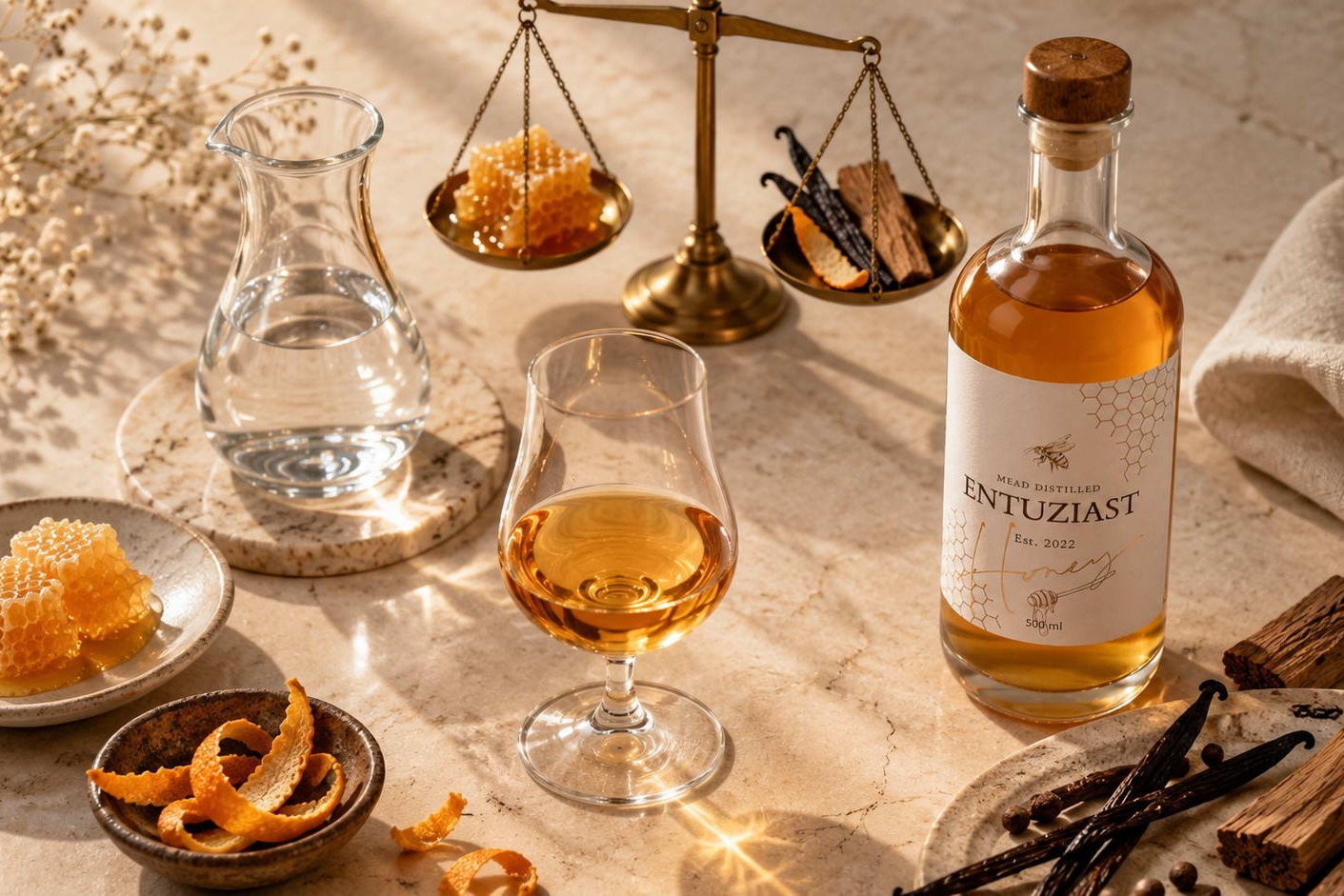
The word “balance” appears constantly in tasting notes.
“A well-balanced gin.”
“A harmonious aged distillate.”
“The alcohol is well integrated.”
But what does this actually mean in practice?
Balance is not a specific aroma and not one particular taste.
It is about how well the different parts of a drink work together without interfering with one another.
In a balanced strong spirit, no single element should accidentally destroy the overall composition.
Does Balance Mean Everything Is Equally Mild?
No.
Balance does not mean every characteristic has to be equally intense.
A drink can have very strong:
- juniper;
- oak;
- citrus;
- spice;
- alcoholic warmth.
And still remain well balanced.
The important thing is that the other elements support the style instead of conflicting with it.
What Exactly Needs to Be Balanced?
Several sensory levels work at the same time in strong spirits:
- aroma;
- taste;
- alcohol strength;
- texture;
- sweetness;
- bitterness;
- acidity;
- astringency;
- finish.
It is the interaction between these elements that creates the overall impression.
Can a Strong Aroma Be Unbalanced?
Yes.
For example, a gin may have an intense citrus aroma.
But if it suddenly becomes harshly bitter, hollow or overly alcoholic in the mouth, there is a disconnect between aroma and taste.
The aroma promises one thing.
The palate delivers another.
What Does “The Alcohol Is Well Integrated” Mean?
It means ethanol feels like part of the drink rather than a separate aggressive layer.
Strong alcohol naturally creates:
- warmth;
- burning;
- alcohol vapour.
But in a well-balanced spirit, these sensations do not overwhelm:
- aroma;
- texture;
- taste;
- finish.
Does Balance Mean Smoothness?
Not necessarily.
A drink can be:
- dry;
- spicy;
- strong;
- astringent;
- intense
and still be very well balanced.
Smoothness is only one characteristic.
Can a Very Smooth Spirit Still Be Unbalanced?
Yes.
Too much softness can sometimes mean a lack of structure.
The drink may feel:
- watery;
- hollow;
- short;
- without clear character.
Balance is not about reducing intensity to a minimum — it is about proportion.
How Is Balance Related to ABV?
ABV alone does not determine balance.
One drink at 40% may feel harsh.
Another at 43% may feel rounded and harmonious.
A third at 46% may become beautifully balanced after a few drops of water.
What matters is not the number itself, but how alcohol strength works with aroma and texture.
Why Can One Spirit “Carry” High Strength Better Than Another?
Because it may have enough:
- aromatic concentration;
- texture;
- structure;
- finish.
If the profile is weak, high ABV can easily begin to dominate.
What Does Balanced Sweetness Mean?
Sweetness can be real or aromatic.
Actual sugar changes taste and texture.
Aromas of vanilla, honey, caramel or ripe fruit can create an impression of sweetness even when very little sugar is present.
Balance begins to suffer when sweetness:
- overpowers other notes;
- makes the drink feel sticky;
- masks too much alcohol;
- destroys the dry character of the style.
What About Bitterness?
Bitterness can be very useful.
It can add:
- contrast;
- structure;
- dryness;
- a longer finish.
But excessive bitterness can easily start to dominate.
Is Astringency Part of Balance Too?
Yes.
Especially in aged spirits.
Oak tannins can add:
- dryness;
- structure;
- a tightening sensation;
- a longer finish.
In the right amount, this adds depth.
In excess, it makes the drink rough and overly woody.
How Can You Tell There Is Too Much Oak?
If after a few sips you can barely detect the distillate itself and mostly notice:
- wood;
- tannins;
- dry bitterness;
- spice,
the barrel may have started to dominate the drink.
Is Balance in Aged Spirits Basically Distillate Plus Barrel?
Exactly.
Good maturation should not completely erase the character of the original raw material.
Oak should add:
- structure;
- new aromas;
- texture;
- complexity.
It should not replace the entire drink.
Example: Honey Spirit Aged ENTUZIAST
With Honey Spirit Aged ENTUZIAST, balance can be evaluated as an interaction between several layers.
There is the character of the honey distillate.
There is oak.
There are spicy and dried-fruit associations.
There is alcoholic warmth.
During tasting, it is useful to ask:
does the maturation support the base distillate, or does it begin to cover it?
What Does Imbalance Look Like in a Young Distillate?
There is no oak here, so attention shifts to:
- cleanliness;
- raw-material aroma;
- alcoholic warmth;
- texture.
If alcoholic harshness overwhelms everything else, the drink feels unbalanced.
If the aroma is interesting but the palate feels watery, that is another kind of imbalance.
Example: Honey Spirit Pure ENTUZIAST
In Honey Spirit Pure ENTUZIAST, oak does not add another structural layer.
So balance is found between:
- the character of the honey distillate;
- dryness;
- strength;
- texture;
- finish.
How Do You Evaluate Balance in Gin?
With gin, the key question is:
do the botanicals work together?
For example:
- juniper should not disappear accidentally;
- citrus should not turn the gin into simple lemon flavouring;
- flowers should not make the profile overly perfumed;
- spices should not overpower everything else.
Does Juniper Always Have to Be the Strongest Note?
Not necessarily.
In contemporary gin, it may be one part of a broader composition.
But the gin identity should remain recognisable.
Example: MeadGIN ENTUZIAST
With MeadGIN ENTUZIAST, it is interesting to evaluate the interaction between:
- the juniper direction;
- citrus associations;
- the honey distillate base;
- dryness;
- alcoholic warmth.
Good balance means none of these elements feels randomly “attached” to the others.
Does Good Balance Mean a Complex Drink?
No.
A very simple drink can be beautifully balanced.
It may have only a few clear directions, but they work logically together.
And the opposite is also true: a highly complex aroma with dozens of notes can still feel chaotic.
Are Balance and Complexity Different Things?
Yes.
Complexity is about how many layers and nuances you can find.
Balance is about how well those layers coexist.
A complex drink can be unbalanced.
A simple one can be extremely harmonious.
What Is Harmony?
It is a concept very close to balance.
A drink is often described as harmonious when the transition between:
- aroma;
- taste;
- texture;
- finish
feels natural.
Does Aroma Have to Match Taste?
Not literally.
But there should be some logic between them.
For example, a very fruity aroma followed by a dry, spicy palate can be interesting.
The problem begins when the transition feels abrupt, random or unpleasant.
What Does It Mean When a Drink “Falls Apart”?
This is sometimes used to describe a lack of cohesion.
For example:
the aroma is good.
The first taste is good too.
Then suddenly harsh bitterness or aggressive alcohol appears.
The individual parts may be interesting, but they do not form one complete composition.
Is the Finish Important for Balance?
Very.
The finish is the final part of the drink’s story.
If the aroma and palate are excellent but all that remains afterwards is:
- harsh burning;
- unpleasant bitterness;
- rough wood,
the overall balance suffers.
Does a Short Finish Mean Imbalance?
Not necessarily.
Some styles naturally have a shorter, cleaner finish.
Balance does not require maximum length.
The ending simply needs to suit the style.
How Can Water Change Balance?
A few drops of water can:
- reduce alcoholic burn;
- make aroma more noticeable;
- change texture;
- emphasise bitterness or dryness.
So water does not simply “soften” the spirit — it rebuilds the balance.
We discussed this in more detail in the article “Should You Add Water to Strong Spirits?”.
Why Can Water Sometimes Make a Drink Worse?
Because the bottling strength chosen by the producer may already be close to optimal.
Too much dilution can reduce:
- body;
- aromatic concentration;
- structure.
That is why water is best added literally a few drops at a time.
How Does Temperature Change Balance?
Cold suppresses:
- aroma;
- alcoholic warmth;
- some bitterness.
Warmth makes both aroma and ethanol vapour more active.
So the same drink can seem differently balanced at different temperatures.
Why Shouldn’t You Judge Balance in a Very Cold Drink?
Cold can hide flaws.
Harshness becomes weaker.
Aroma becomes quieter.
For analytical tasting, it is better to avoid extreme temperatures.
Does Ice Change Balance?
Yes, continuously.
Ice:
- cools;
- melts;
- lowers the ABV;
- changes aroma.
So the balance of a drink with ice changes gradually while it sits in the glass.
What About Tonic?
Tonic changes the balance of gin even more dramatically.
It adds:
- water;
- quinine bitterness;
- sweetness;
- carbonation;
- its own aroma.
That is why Gin & Tonic becomes a separate drink with its own balance.
We discussed this in detail in the article “What Really Changes in Gin When You Add Tonic?”.
Does Food Change the Perception of Balance?
Yes.
Before tasting, your receptors can be strongly affected by:
- sweets;
- spicy food;
- coffee;
- very salty foods;
- fatty foods.
That is why comparative tasting works best with a relatively neutral palate.
Why Can the First Sip Distort Your Evaluation?
The first sip often feels more alcohol-forward.
Your senses have not yet adapted to ethanol.
So the drink may seem less balanced than it does during the second small sip.
The next article in this series will focus exactly on that difference.
How Can You Evaluate Balance in Practice?
After a few small sips, ask yourself five questions.
- Does the alcohol overpower the aroma?
- Is there any note that dominates unpleasantly?
- Does the taste follow the aroma logically?
- Does the texture suit the character of the drink?
- Does the finish end pleasantly?
That is already enough for a useful basic evaluation.
Do You Need to Give Scores?
Not necessarily.
For home tasting, it is often more useful to write down:
- what dominates;
- what supports it;
- what gets in the way;
- what remains after the sip.
A Simple Exercise for Understanding Balance
Take two different spirits of the same type.
For example, two gins.
Taste them in identical glasses at the same temperature.
Do not ask first:
“Which one is better?”
Ask:
“In which one does no single element interfere with the others?”
That is a much more useful question.
Does Balance Mean a Lack of Character?
Quite the opposite.
A strong character can be beautifully balanced.
For example, a very piney gin can still feel harmonious if:
- citrus adds freshness;
- spices add structure;
- alcohol does not overwhelm the aroma;
- the finish logically continues the profile.
Does Imbalance Always Mean Bad Alcohol?
Not necessarily for every drinker.
Some people genuinely enjoy extreme styles.
For example:
- very bitter;
- extremely piney;
- heavily oaked;
- maximally dry.
But from a tasting perspective, that becomes a deliberate accent that should be judged within the style.
Why Are Personal Preference and Balance Not the Same Thing?
You may dislike floral gin.
And still recognise that it is very well balanced.
Likewise, you may love an extremely sweet or heavily oaked spirit even though one characteristic clearly dominates.
Can You Learn to Recognise Balance?
Yes.
The best way is through comparison.
When you taste several drinks side by side, it becomes much easier to notice:
- where alcohol pushes forward;
- where aroma feels too weak;
- where the finish changes abruptly;
- where everything works together.
Why Is Slow Tasting Useful?
Balance does not reveal itself in one second.
First comes the aroma.
Then the first contact in the mouth.
Then texture and retronasal aroma.
Then the finish.
A quick large sip tells you very little about balance.
How Does This Connect to the Previous Article?
To evaluate balance, you first need to separate:
- aroma;
- taste;
- texture;
- finish.
That was the focus of the article “How to Learn to Tell Aroma, Taste and Finish Apart”.
In Short: What Is Balance in Strong Spirits?
- Balance is the interaction of all the sensory parts of a drink.
- It does not mean every characteristic must have the same intensity.
- Strong juniper, oak or spice can still be part of good balance.
- Alcoholic warmth should not unnecessarily overpower aroma.
- Sweetness, bitterness and astringency should suit the style.
- Aroma and taste do not have to be identical, but there should be a logical transition between them.
- The finish is an important part of balance.
- Complexity and balance are not the same thing.
- Temperature, water, ice and tonic can all change balance.
- The best way to learn balance is through slow comparison of different drinks.
Conclusion
Balance is not a specific taste you can find in the glass.
It is the feeling that the drink works as a complete whole.
The aroma does not fight with the palate.
The alcohol supports the structure instead of overwhelming it.
Sweetness, bitterness or oak do not seize all the attention without reason.
And the finish logically completes what began in the aroma.
At the same time, a balanced spirit does not have to be neutral or extremely smooth.
It can be intense, dry, piney, spicy or heavily oaked.
Balance is not the absence of character. It is what happens when the character of a drink does not fall apart into separate pieces, but works as one composition.
And in the next article, we will explore why the first sip of a strong spirit often feels completely different from the second.