





How to Learn to Tell Aroma, Taste and Finish Apart
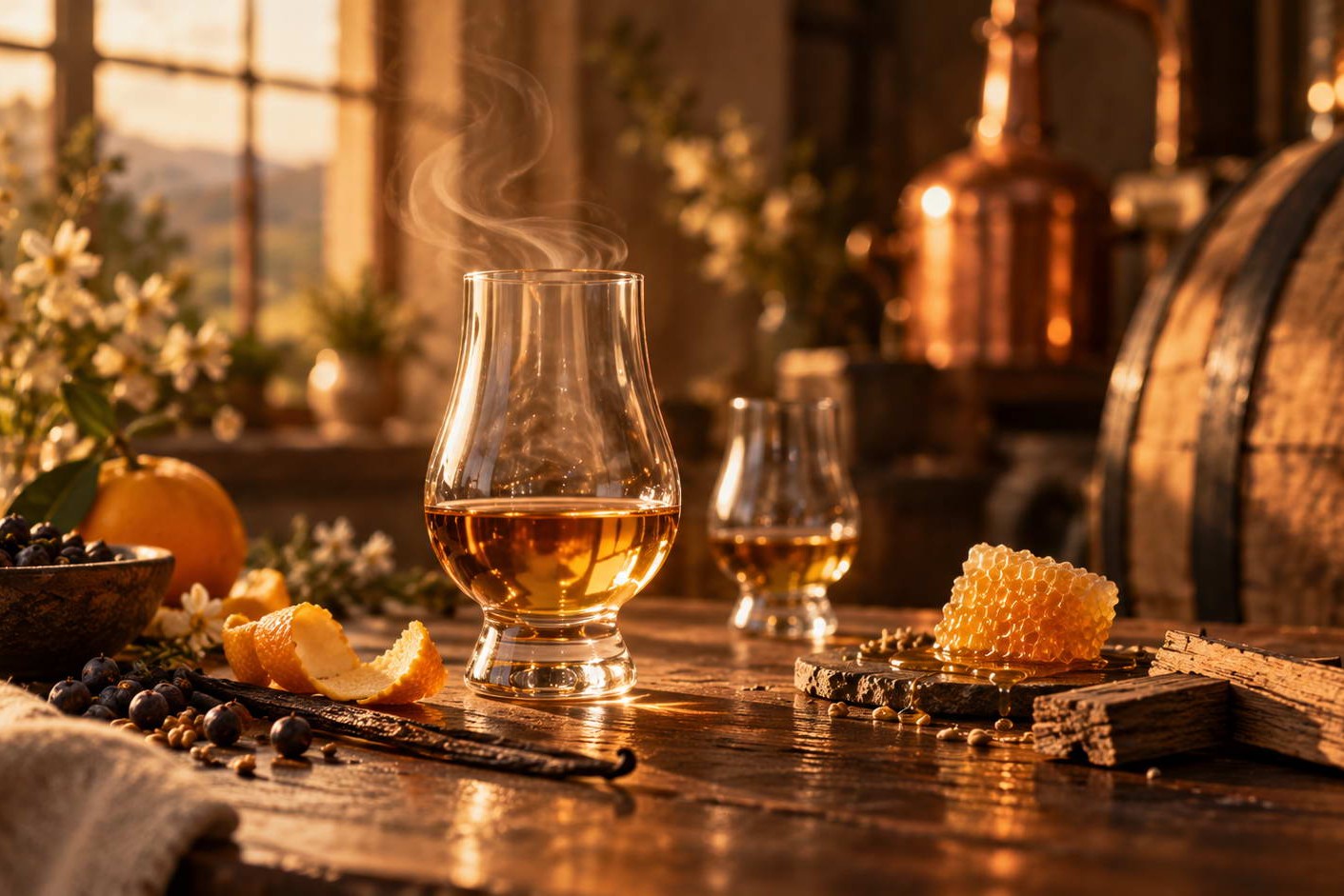
When tasting strong alcohol, people often say things like “vanilla taste,” “citrus taste,” “honey taste” or “juniper taste.”
But technically, a large part of what we casually call taste is actually aroma.
Your tongue, nose, temperature perception, texture and even the sensations that remain after swallowing all work together so closely that the brain combines them into one overall experience.
That is why beginners sometimes find it difficult to answer:
- what am I smelling;
- what is my tongue actually tasting;
- what remains after the sip;
- and what is simply alcoholic warmth.
Learning to separate these sensations is not as difficult as it may seem.
The key is not to search for twenty different notes immediately, but to break the tasting process into a few simple stages.
What Is Aroma?
Aroma is what we perceive through the olfactory system.
Before you even take a sip, you may already notice:
- juniper;
- citrus;
- flowers;
- herbs;
- fruit;
- vanilla;
- wood;
- spices.
These impressions reach the nose because volatile aromatic molecules leave the surface of the drink and enter the air.
Why Does One Spirit Smell Stronger Than Another?
Aroma intensity depends on:
- the amount of volatile aromatic compounds;
- temperature;
- ABV;
- glass shape;
- time after pouring;
- production method.
That is why one gin may immediately fill the glass with citrus and juniper, while another opens much more slowly.
Why Shouldn’t You Take a Deep Sniff Immediately?
Because together with the aroma, you also inhale a significant amount of ethanol vapour.
If you push your nose deep into the glass and inhale strongly, alcoholic irritation can overwhelm more delicate notes.
It is better to smell the drink:
- with short sniffs;
- from a small distance;
- several times;
- gradually moving the glass closer.
Why Let the Drink Rest in the Glass?
The aroma does not remain static after pouring.
The drink warms slightly, comes into contact with air and releases different volatile compounds at different speeds.
That means you may notice something after a few minutes that was barely detectable at first.
We discussed this in more detail in the article “Why Should You Let Strong Spirits Rest in the Glass?”.
So What Is Taste?
In the narrower sense, taste is what the taste receptors detect.
The main taste directions are:
- sweet;
- sour;
- bitter;
- salty;
- umami.
In strong spirits, we most often pay attention to:
- sweetness;
- bitterness;
- acidity;
- the balance between them.
But I Can Taste Lemon on My Tongue
A large part of the sensation of “lemon” does not actually come from the taste receptors.
Your tongue can detect acidity.
But the characteristic lemon aroma comes from the olfactory system.
The brain combines these signals and produces one complete impression of “lemon.”
What Is Retronasal Perception?
This is one of the most important mechanisms in tasting.
When the drink is already in your mouth, aromatic molecules can reach the olfactory receptors not through the nostrils from the front, but from the mouth through the back of the throat.
This is called retronasal perception.
It is the reason why, during or after a sip, you may suddenly notice:
- citrus;
- fruit;
- vanilla;
- juniper;
- spices;
- oak.
Why Does Aroma in the Mouth Feel Different from Aroma in the Glass?
Because the conditions are different.
In the mouth, the drink:
- warms up;
- mixes with saliva;
- spreads across a larger surface;
- releases some compounds more actively.
That is why an aroma that seemed weak when smelling the glass may suddenly become vivid during the sip.
Why Should You Take a Small Sip?
A large sip of strong alcohol creates intense:
- warmth;
- burning;
- irritation;
- an obvious alcoholic sensation.
Against that background, subtle aromas are harder to evaluate.
A small sip makes it easier to separate the character of the drink from the simple reaction to ethanol.
What Is Texture?
Texture is neither taste nor aroma.
It is how the drink physically feels in the mouth.
For example, it may feel:
- light;
- dense;
- oily;
- silky;
- watery;
- dry;
- astringent.
Because all these sensations appear at the same time, texture is very easy to describe incorrectly as “taste.”
Can Sweetness Also Affect Texture?
Yes, partly.
Real sugar can make a drink feel denser and rounder.
But even without sugar, aromas of vanilla, honey or ripe fruit can create an impression of sweetness.
So it is useful to ask yourself:
am I actually tasting sweetness, or am I smelling something that I associate with sweet foods?
Why Is This Especially Interesting with Honey Distillates?
The word “honey” immediately creates an expectation of sweetness.
But after fermentation and distillation, the finished distillate can be dry.
At the same time, some honey-like aromatic associations may remain.
We discussed this in the article “Why Aren’t Honey Distillates Sweet?”.
What Is the Finish?
The finish is what remains after the drink has been swallowed.
It can include:
- aroma;
- taste;
- alcoholic warmth;
- dryness;
- astringency;
- textural sensations.
So the finish is not one single flavour note.
It is the final phase of the tasting experience.
When Does the Finish Begin?
Roughly, it begins immediately after swallowing.
But the boundary is not perfectly clear.
Taste and aroma gradually transition into the finish.
This is why tasters often use the word finish rather than treating it as something completely separate.
What Does a Long Finish Mean?
It means sensory impressions remain noticeable for a relatively long time after the sip.
For example:
- juniper;
- spices;
- oak;
- citrus;
- dried fruit
may remain noticeable for some time.
Does a Long Finish Always Mean High Quality?
No.
Unpleasant bitterness or harsh alcoholic burning can also last a long time.
Duration alone is not enough.
What matters is what remains and whether it is pleasant.
How Is the Finish Different from Alcohol Burn?
Alcoholic warmth is only one part of the finish.
If the only thing left after the sip is burning, that does not automatically mean the drink has a complex finish.
An interesting finish may combine:
- aromatic notes;
- dryness;
- spice;
- texture;
- warmth.
Why Is the Second Sip Often More Interesting Than the First?
The first sip introduces your senses to the alcohol strength.
Alcoholic warmth often attracts most of your attention.
After a short period of adaptation, the second small sip makes it easier to notice:
- texture;
- taste;
- aroma;
- finish.
We will explore this topic separately later in this series.
How Can You Divide Tasting into Stages?
The simplest method is to use four steps.
- Aroma before the sip.
- First sensations in the mouth.
- Development of aroma and texture during the sip.
- The finish.
Do not try to evaluate everything at once.
Stage One: Aroma
Bring the glass toward your nose.
Do not inhale strongly.
At first, try to identify only the broad aromatic direction.
For example:
- piney;
- citrusy;
- floral;
- fruity;
- spicy;
- woody.
That is already enough.
You Don’t Need to Search for “Sicilian Lemon” Immediately
One common beginner mistake is trying to be too specific.
If you simply smell “citrus,” that is already a valid description.
With practice, you may narrow it down:
citrus → lemon → lemon peel.
But broad categories are the best place to start.
Stage Two: First Contact in the Mouth
Take a small sip.
Pay attention to:
- sweetness;
- bitterness;
- acidity;
- alcoholic warmth;
- body.
Do not try to identify every aromatic note yet.
Stage Three: Development
This is where retronasal perception becomes especially important.
The aroma seems to rise from the mouth toward the nose.
You may suddenly notice:
- fruit;
- flowers;
- juniper;
- vanilla;
- spices.
Stage Four: The Finish
After swallowing, do nothing for a few seconds.
Do not immediately drink water.
Pay attention to:
- what remains;
- where you feel it;
- how long it lasts;
- how it changes.
Why Is Water Useful Between Sips?
It helps refresh the palate and reduce the accumulation of alcoholic warmth.
This is especially important when comparing several drinks.
But it is better to drink water between tasting sips rather than immediately after each one if you want to evaluate the finish.
Can You Add Water to the Spirit Itself?
Yes, with some strong distillates this can be useful.
A few drops of water can reduce ethanol dominance and change the way aromatic compounds are perceived.
We discussed this in more detail in the article “Should You Add Water to Strong Spirits?”.
How Does Temperature Affect Aroma and Taste?
Very strongly.
Cold:
- suppresses aroma;
- reduces alcoholic burn;
- makes texture feel denser.
A warmer drink:
- smells more actively;
- reveals more nuance;
- but may feel more alcohol-forward.
Why Should Two Drinks Be Compared at the Same Temperature?
Otherwise, you are comparing both the drinks and the temperatures.
The colder sample will almost always seem:
- smoother;
- less aromatic;
- denser.
That can distort your conclusions.
How Should You Read Gin?
With gin, it is useful to start with broad directions:
- juniper;
- citrus;
- herbs;
- flowers;
- spices.
You do not need to guess the exact botanical.
Different plants can create similar aromatic impressions.
Example: MeadGIN ENTUZIAST
With MeadGIN ENTUZIAST, you can evaluate several levels separately.
First — the overall gin aroma.
Then — how that character develops in the mouth.
Finally — what remains after the sip.
There is no need to guess the exact botanical recipe: for tasting, it is more useful to describe the real sensory impression.
How Should You Read an Unaged Distillate?
Here, it is interesting to focus on the character of the raw material itself.
In Honey Spirit Pure ENTUZIAST, there is no oak-derived layer covering the profile.
So you can pay more attention to:
- the aroma of the distillate itself;
- dryness;
- texture;
- cleanliness of the finish.
How Should You Read an Aged Spirit?
Here, there are more layers.
On top of the distillate character, you may find:
- oak;
- vanilla-like associations;
- spices;
- dried fruit;
- tannic dryness.
So it is useful to ask yourself:
what belongs to the distillate itself, and what may have come from maturation?
Example: Honey Spirit Aged ENTUZIAST
In Honey Spirit Aged ENTUZIAST, the character of the honey distillate is combined with a complex oak influence.
During tasting, you can follow separately:
- the first aroma;
- sweet aromatic associations;
- oak dryness;
- spices;
- texture;
- the finish.
Why Shouldn’t You Be Afraid of “Wrong” Associations?
Everyone has a different aromatic memory.
If one person notices:
apple,
and another notices pear,
that does not necessarily mean one of them is wrong.
Both impressions may belong to the same broad fruity direction.
Do You Need Professional Tasting Vocabulary?
No.
Simple words are enough for a good tasting.
For example:
- fresh;
- citrusy;
- dry;
- spicy;
- smooth;
- woody.
Accuracy is more useful than complicated vocabulary.
Why Do Different People Give Different Tasting Notes?
Because people differ in:
- sensory sensitivity;
- aromatic memory;
- experience;
- context;
- expectations.
So tasting always contains a subjective element.
Does That Mean Tasting Is Completely Subjective?
No.
There are objective parameters such as:
- ABV;
- sweetness;
- acidity;
- temperature;
- duration of sensations.
But the way an individual describes those sensations can differ.
How Can You Train Aromatic Memory?
The simplest way is to smell ordinary products more consciously.
For example:
- lemon peel;
- orange;
- juniper;
- coriander;
- vanilla;
- honey;
- nuts;
- wood;
- spices.
The more real aromas you store in memory, the easier it becomes to recognise associations in the glass.
Do You Need Professional Aroma Kits?
Not at the beginning.
Your kitchen, garden, spices, fruit and herbs already provide a huge amount of material for training.
Why Is It Useful to Write Down Your Impressions?
Because sensory memory changes quickly.
It is enough to record:
- aroma;
- taste;
- texture;
- finish.
After a few months, it can be very interesting to compare your notes.
A Simple Tasting Framework
You can use just four lines:
Aroma: what do I notice before the sip?
Taste: sweet, bitter, sour?
Texture: light, dense, oily, dry?
Finish: what remains and for how long?
What Should You Avoid Doing?
You do not need to:
- invent aromas you do not actually perceive;
- repeat the producer’s tasting notes;
- assume a more complicated description is more correct;
- judge the drink after one large sip;
- taste immediately after very spicy or very sweet food.
Why Can the Producer’s Description Influence You?
If you read:
“vanilla, orange, honey and almond”
before tasting, your brain may immediately start searching for exactly those associations.
So it can be interesting to taste first without hints and read the official description afterwards.
Can Tasting Be Learned?
Yes.
It is not a talent reserved for professionals.
The most useful things are:
- attention;
- comparison;
- practice;
- aromatic memory.
The more often you consciously separate aroma, taste, texture and finish, the easier it becomes.
In Short: Aroma, Taste and Finish — What’s the Difference?
- Aroma is perceived through the olfactory system.
- Taste in the narrow sense is perceived by taste receptors.
- A large part of “fruit taste” is actually aroma.
- Retronasal perception allows you to smell the drink during the sip.
- Texture is a separate physical sensation in the mouth.
- The finish begins after the sip and may include aroma, taste, dryness, warmth and texture.
- A long finish does not automatically mean high quality.
- Small sips reveal more detail.
- You do not need to identify dozens of specific notes immediately.
- The best way to learn is to compare regularly and write down your own impressions.
Conclusion
Tasting becomes much easier to understand once you stop describing the entire experience with the single word “taste.”
First, the nose works.
Then the tongue and tactile receptors become involved.
During the sip, retronasal aroma joins the experience.
And after swallowing, the finish begins.
Once you learn to separate these stages even approximately, a familiar drink can suddenly become much more complex.
Do not try to find the “correct” notes. First learn to understand where the sensation is coming from: the nose, the tongue, the texture or the finish.
And in the next article in this series, we will look at another word that is constantly used in tasting but rarely explained clearly: what balance means in strong spirits and how to recognise it.