





What Really Changes in Gin When You Add Tonic?
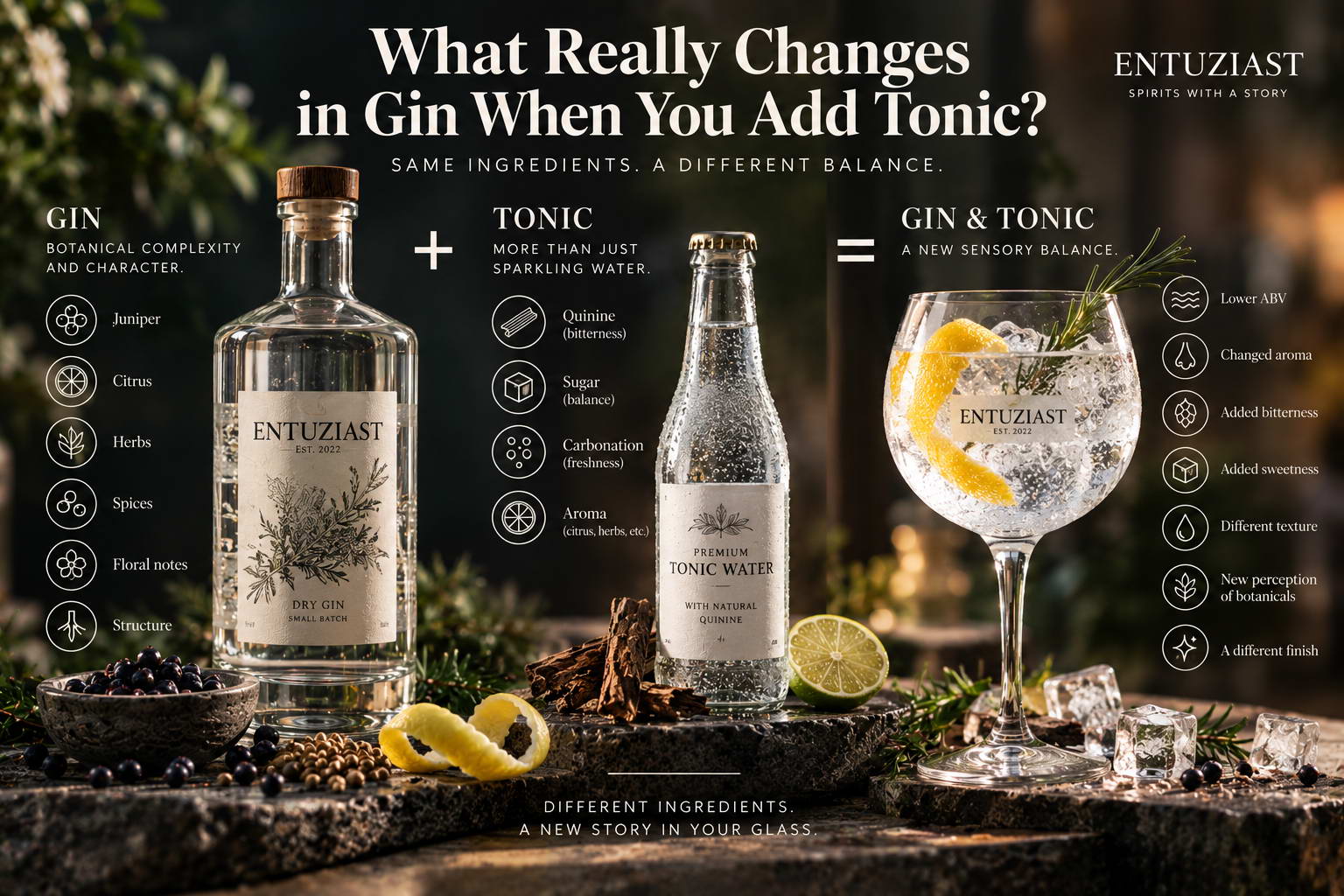
Gin & Tonic seems like a very simple drink.
Gin.
Tonic.
Ice.
Sometimes — a slice of lemon, grapefruit or another garnish.
But in reality, adding tonic changes gin much more than it may seem.
It changes:
- the actual alcohol strength in the glass;
- the aroma;
- bitterness;
- sweetness;
- acidity;
- texture;
- the perception of botanicals;
- the finish.
So Gin & Tonic is not simply “the same gin, only weaker.”
It is a separate sensory balance.
The First Thing That Changes Is the Strength
This is the most obvious effect.
When gin is mixed with tonic, the alcohol concentration in the finished drink decreases.
For example, if the gin is 40% ABV, once a significant amount of tonic is added, the drink in the glass is no longer 40% ABV.
The actual strength depends on:
- how much gin is used;
- how much tonic is added;
- the amount of ice;
- how much water has melted from the ice.
Why Does Gin & Tonic Feel Much Smoother?
For several reasons at once.
Tonic:
- dilutes the ethanol;
- chills the drink together with the ice;
- adds sweetness;
- adds bitterness;
- adds its own aroma.
As a result, alcohol is no longer the only strong sensory signal.
Does Tonic Simply Mask the Alcohol?
Partly, yes.
But it is not only masking.
Dilution genuinely reduces the ethanol concentration in the glass.
So the alcoholic burn becomes weaker not only psychologically, but physically too.
Cold and sweetness can soften the perception even further.
What Is Quinine and Why Is It in Tonic?
Quinine is a substance with a characteristic bitter taste.
That bitterness is one of the defining sensory features of tonic water.
Once tonic is mixed with gin, a new contrast appears:
juniper + botanicals + alcohol + sweetness + quinine bitterness.
Why Does Tonic Bitterness Work So Well with Gin?
Because many gins already have a dry botanical character.
Quinine bitterness can support:
- juniper;
- citrus;
- roots;
- dry spices.
In a good pairing, the bitterness does not overpower the gin — it gives the drink structure.
Why Is There Sugar in Tonic?
It balances quinine bitterness.
Without sweetness, tonic could taste excessively harsh.
When tonic is added to gin, the sweetness also changes the way the alcohol is perceived.
The drink may feel:
- smoother;
- rounder;
- less alcohol-forward.
Does Tonic Make Gin Sweet?
That depends on the tonic and the proportions.
Some tonics are fairly dry.
Others contain more sugar and can significantly change the character of the gin.
This means the same gin with two different tonics can feel almost like two different cocktails.
Why Does Tonic Change the Aroma?
Because tonic has its own aromatic profile.
It may contain:
- citrus notes;
- herbs;
- floral components;
- spices;
- bitter botanical nuances.
All of these mix with the botanicals already present in the gin.
Does Carbonation Affect Aroma?
Yes.
Carbon dioxide can help some aromatic compounds leave the liquid more actively.
Bubbles rise to the surface and can carry aroma upward toward the nose.
That is why a freshly poured Gin & Tonic can smell very expressive.
Why Does Flat Tonic Work Worse?
Because when carbonation disappears, more than just texture changes.
The drink also loses:
- freshness;
- aromatic activity;
- a sense of lightness;
- part of its structure.
That is why Gin & Tonic is best made with freshly opened tonic.
What Happens to the Juniper?
Strong juniper character often survives dilution quite well.
Especially when the gin is very piney to begin with.
But its context changes.
Now it is accompanied by:
- quinine;
- sweetness;
- citrus;
- carbonation.
So juniper no longer feels exactly the same as it does in neat gin.
What Happens to Floral Notes?
They can behave very differently.
A neutral, delicate tonic may preserve them.
A very aromatic or sweet tonic may easily cover them.
This is why tonic selection is especially important for floral gin.
What About Citrus?
Citrus profiles often work very well with tonic.
Especially if the tonic itself contains lemon, lime or grapefruit-like notes.
But it is easy to overdo it.
Citrusy gin + citrus tonic + lemon garnish can make the whole drink feel one-dimensional.
Why Does Tonic Pairing Matter?
Because tonic is not neutral sparkling water.
It is a full ingredient with its own:
- sweetness level;
- bitterness;
- acidity;
- aroma;
- carbonation.
So it should be chosen almost as carefully as the gin itself.
Why Doesn’t Classic Dry Tonic Work with Every Gin?
Because some modern gins have very delicate profiles.
Strong bitterness can easily overwhelm:
- flowers;
- berries;
- light herbs;
- soft citrus.
For those styles, a more neutral tonic may work better.
What About a Piney Gin?
A strongly juniper-led gin often handles a classic tonic very well.
Its aromatic structure is strong enough not to disappear after dilution.
We discussed the difference between piney and floral styles in the article “Why Is One Gin Piney While Another Is Floral?”.
Why Do Proportions Matter?
Because tonic can easily start to dominate.
If there is too little gin and too much tonic, you are mostly tasting tonic.
If there is too little tonic, the drink may remain too alcohol-forward.
So there is no single universal ratio.
What Gin-to-Tonic Ratio Is a Good Starting Point?
A practical starting point is roughly:
1 part gin to 2–3 parts tonic.
Then adjust according to:
- the gin’s strength;
- the intensity of its botanicals;
- the sweetness of the tonic;
- your own preferences.
Why Might a Delicate Gin Need Less Tonic?
To preserve the aroma.
If the gin has a subtle floral or light citrus profile, excessive dilution can make it almost disappear.
What About a Very Intense Gin?
It can often handle more tonic.
Especially if it has:
- strong juniper;
- higher ABV;
- bold spices;
- intense citrus.
Does Ice Only Chill the Drink?
No.
Ice simultaneously:
- chills;
- dilutes;
- changes aromatic volatility;
- changes texture.
So ice is a real part of the Gin & Tonic formula.
Why Can a Large Ice Cube Be Better?
A large piece of ice has less surface area relative to its volume.
So it usually melts more slowly.
This helps:
- keep the drink cold for longer;
- control dilution;
- preserve balance.
Is a Lot of Ice Bad?
Not necessarily.
Paradoxically, a glass filled well with good-quality ice can sometimes dilute more slowly than a glass with just two small cubes.
The reason is that more cold ice chills the drink quickly and then melts more slowly once the temperature has dropped.
What Happens to Texture?
Carbonation makes the drink feel lighter and more dynamic.
Ice and water reduce the density of the alcoholic sensation.
That is why Gin & Tonic usually feels much lighter than neat gin.
Why Do Bubbles Change Mouthfeel?
Carbon dioxide creates a light tingling sensation.
This adds:
- freshness;
- energy;
- a sense of dryness.
That is why even a slightly sweet tonic can still feel fresh.
Does Tonic Change the Finish?
Yes.
Neat gin may finish with:
- juniper;
- spice;
- citrus;
- dryness.
In Gin & Tonic, quinine bitterness and the tonic’s own aroma become part of the finish.
Why Does Bitterness Often Last the Longest?
Quinine has a strong and persistent bitter profile.
So after the sip, its bitterness may remain longer than some of the lighter gin aromas.
Can Tonic Hide Flaws in Gin?
To some extent, yes.
Dilution, cold, sweetness and bitterness can make:
- alcoholic harshness less obvious;
- sharpness weaker;
- a simple profile seem more interesting.
But a good tonic cannot turn badly made gin into great gin.
Can Tonic Ruin a Good Gin?
Yes.
If it is:
- too sweet;
- too strongly flavoured;
- too bitter;
- flat;
- used in excessive quantity.
Then the character of the gin can almost disappear.
Why Should You Taste Gin Neat First?
So you understand what you are mixing.
Take a small sip without tonic.
Evaluate:
- juniper;
- citrus;
- flowers;
- spices;
- texture;
- finish.
Then add tonic.
This makes it much easier to notice what actually changed.
Should You Taste the Tonic Separately?
If you want to pair seriously — yes.
Taste a small amount of tonic on its own.
Pay attention to:
- sweetness;
- bitterness;
- acidity;
- aroma;
- carbonation.
Then it becomes clearer what it will contribute to the cocktail.
Is Garnish Just Decoration?
No.
Especially when it is fresh citrus peel, herbs or spices.
Garnish adds aroma directly near your nose.
Sometimes it becomes the first note you notice.
What Does Lemon Do?
Lemon peel usually adds:
- freshness;
- bright citrus;
- light dryness.
It often works well with classic dry gin.
What Does Orange Do?
Orange creates a softer, rounder citrus direction.
It can work especially well with:
- spicy gins;
- floral styles;
- softer contemporary recipes.
What Does Grapefruit Do?
It contributes:
- dry citrus;
- light bitterness;
- freshness.
It works especially well with gins that already have a dry citrus profile.
What About Rosemary?
It can reinforce:
- piney notes;
- herbal character;
- dryness.
But rosemary is very aromatic, so it should be used carefully.
Why Shouldn’t Garnish Be Chosen Only for Appearance?
Because it genuinely changes the drink.
A beautiful rosemary sprig can completely overpower a delicate floral gin.
And too much lemon peel can hide other botanicals.
How Should You Choose Garnish?
There are two basic approaches.
Reinforcement:
citrusy gin + citrus.
Contrast:
floral gin + dry grapefruit.
Both approaches can work.
Is There One Correct Gin & Tonic?
No.
There are many good versions.
The result depends on:
- the gin;
- the tonic;
- the ratio;
- the ice;
- the garnish;
- personal preference.
Example: MeadGIN ENTUZIAST
MeadGIN ENTUZIAST has a juniper-citrus direction built on a honey distillate base.
In a Gin & Tonic, its final profile will depend not only on the MeadGIN itself, but also on the specific tonic.
A more neutral tonic will preserve more of the gin’s own character.
A more aromatic tonic will add another layer.
So there is no single “correct” pairing.
Does the Honey Base Become Sweeter with Tonic?
No, not by itself.
If the Gin & Tonic tastes sweeter, the sweetness usually comes from the tonic.
A honey distillate base does not mean the gin contains a large amount of residual honey sugar.
We discussed this in the article “Why Aren’t Honey Distillates Sweet?”.
Can Tonic Highlight MeadGIN’s Citrus Character?
Yes.
Especially if the tonic itself is neutral or citrus-driven.
Carbonation and reduced alcoholic burn can make some fresh notes easier to perceive.
Can It Hide Them Too?
Yes.
If the tonic is very sweet or strongly flavoured, it can start to dominate.
Why Does One Tonic Make Gin Feel “Drier” and Another “Sweeter”?
Because of differences in:
- sugar;
- quinine;
- acidity;
- aromatic components.
So the word “tonic” does not describe one standard flavour.
Is Zero-Sugar Tonic Always Better for Dry Gin?
Not necessarily.
Sweeteners have their own sensory profiles too.
They can change:
- sweetness;
- finish;
- the perception of bitterness.
So again, it is better to evaluate the specific pairing.
Can You Use Sparkling Water Instead?
Yes.
But it will no longer be a classic Gin & Tonic.
Sparkling water:
- dilutes the gin;
- adds carbonation;
- but does not add the characteristic quinine bitterness.
The result is closer to a Gin Highball or Gin & Soda.
What Actually Remains of the Gin After Tonic Is Added?
That depends on how strong the gin’s profile is.
The characteristics that often survive best are:
- juniper;
- strong citrus;
- dry spices;
- structural botanicals.
The most delicate floral and light herbal notes may become less obvious.
Why Doesn’t That Mean Delicate Gin Is “Bad for Tonic”?
It simply needs a different pairing.
For example:
- less tonic;
- a more neutral tonic;
- a less aggressive garnish.
This helps preserve the gin’s character.
How Can You Run a Simple Experiment at Home?
Take one gin and two different tonics.
Make three small servings:
- gin neat;
- gin + the first tonic;
- gin + the second tonic.
Compare:
- juniper;
- citrus;
- bitterness;
- sweetness;
- texture;
- finish.
The difference is often surprisingly large.
Why Is This a Good Way to Understand Gin?
Because it quickly shows which parts of the profile are robust and which are easily changed.
This helps you understand both the gin and the tonic much better.
Can You Say Tonic “Opens Up” Gin?
Sometimes.
But a more accurate way to say it is:
tonic rebuilds the balance of the gin.
It can highlight some notes and hide others.
The result is effectively a new drink.
Does Tonic Make Gin Better?
Not automatically.
For one gin, tonic creates an excellent balance.
Another may be more interesting neat.
It depends on the style and personal preference.
In Short: What Does Tonic Really Change in Gin?
- It lowers the actual ABV in the glass.
- It reduces alcoholic burn.
- It adds quinine bitterness.
- It usually adds some sweetness.
- It adds its own aroma.
- Carbonation changes how aromas are released.
- Ice cools and further dilutes the drink.
- Strong juniper often survives dilution well.
- Delicate floral notes can become less obvious.
- Garnish also actively changes the aromatic profile.
- Different tonics can make the same gin feel almost unrecognisable.
- The best tonic pairing depends on the specific style of gin.
Conclusion
When tonic is added to gin, much more changes than just the alcohol strength.
Quinine adds bitterness.
Sugar adds sweetness.
Carbonation adds freshness and a new texture.
Water lowers the alcohol concentration.
Ice changes the temperature and continues the dilution over time.
And garnish adds another aromatic layer.
As a result, some botanicals become more expressive while others can almost disappear.
This is why tonic should not be treated as a neutral mixer.
Gin & Tonic is not simply gin plus sparkling water — it is a new balance between gin, quinine, sweetness, acidity, carbonation, temperature and aroma.
And the best pairing is not necessarily the most expensive or complicated one. It is the one where the tonic supports the character of the gin instead of replacing it.