





Why Is One Gin Piney While Another Is Floral?
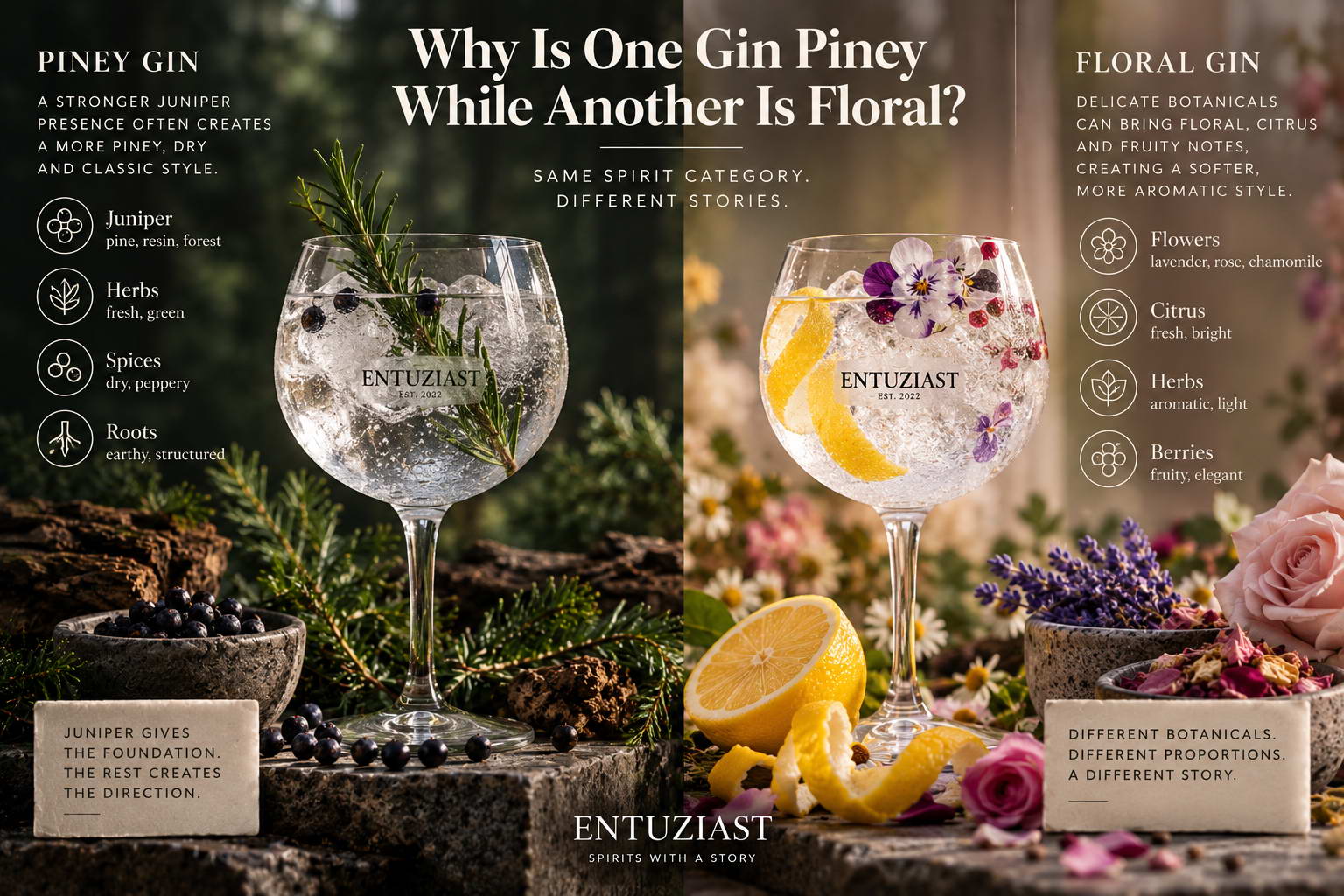
Gin is one of those spirit categories where two bottles can taste dramatically different even though both are still unmistakably gin.
One may smell like:
- pine needles;
- juniper;
- resin;
- dry spices.
Another may feel almost perfumed:
- flowers;
- citrus;
- herbs;
- berries.
And that raises an obvious question:
if gin is defined by juniper, why does one feel like a pine forest while another feels like a flower garden?
The answer lies in the balance of botanicals, their proportions, the distillation method and the character of the spirit base itself.
Juniper Is Essential, but It Does Not Have to Be the Only Aroma
Juniper character is the foundation of gin.
It is what separates gin from simply flavoured spirit.
But that does not mean juniper has to overpower everything else.
Depending on the recipe, the producer may make it:
- dominant;
- very expressive;
- moderate;
- one part of a more complex composition.
What Does Juniper Contribute?
Juniper berries can create associations with:
- pine needles;
- forest;
- resin;
- dry wood;
- pepper;
- herbs;
- sometimes even a light citrus note.
This is why gins with a strong juniper presence are often described as “piney.”
Why Can One Juniper Smell Different from Another?
Because even the same botanical is not always identical.
Its character can be influenced by:
- region of origin;
- ripeness of the berries;
- drying conditions;
- freshness;
- essential oil content.
One batch of juniper may therefore feel more resinous, while another may seem softer or even slightly fruity.
What Makes a Gin Floral?
A floral profile can come from botanicals with obvious flower-like aromas.
These may include:
- lavender;
- chamomile;
- elderflower;
- rose;
- violet;
- other aromatic flowers.
But floral character can also appear without literal flowers being used.
How Can a Floral Aroma Appear Without Flowers?
In the same way citrus can appear without lemon.
Different botanicals can contain similar aromatic molecules.
So floral associations may also come from:
- herbs;
- roots;
- spices;
- the spirit base itself.
Aroma cannot always be read literally as an ingredient list.
Why Is One Gin More Piney?
Usually because juniper plays a larger role in the recipe.
The pine-like effect may also be reinforced by:
- certain herbs;
- resinous botanicals;
- roots;
- dry spices.
This style often feels:
- drier;
- more austere;
- more traditional;
- more forest-like.
Why Does Another Gin Feel Floral?
Because the producer shifts the balance toward more delicate botanicals.
There may be more:
- floral components;
- citrus;
- soft herbs;
- berries;
- an aromatic spirit base.
Juniper is still present, but it does not necessarily dominate the entire profile.
Is Floral Gin Less “Real”?
No.
If the juniper character remains recognisable and the product fits the gin category, a floral style can still be fully legitimate gin.
It simply uses a different aromatic balance.
Is Piney Gin Automatically More Traditional?
Often, yes in terms of style.
Classic London Dry and traditional dry gins frequently show:
- clear juniper;
- a dry profile;
- coriander;
- citrus;
- roots;
- spices.
But even within traditional styles, there can be major differences.
Can London Dry Be Floral?
Yes.
London Dry is defined by production rules, not by one mandatory aroma profile.
A producer can create a more floral London Dry as long as that character is built within the technological requirements of the category.
We discussed the categories in the article “London Dry, Distilled Gin and Gin: What’s the Difference?”.
What Is Contemporary Gin?
This term is often used for modern gins in which juniper is not necessarily the most dominant aroma.
More attention may be given to:
- flowers;
- citrus;
- local herbs;
- berries;
- unusual botanicals.
This gives producers much more room to create distinctive profiles.
Why Do Proportions Matter More Than the Ingredient List?
Because two gins can use almost the same botanicals and still smell completely different.
For example, both may contain:
- juniper;
- coriander;
- lemon peel;
- angelica root.
But if one uses much more juniper, it will feel more piney.
If another emphasises citrus and softer botanicals, it may feel fresher and more delicate.
Why Doesn’t the Number of Botanicals Tell You How Complex a Gin Is?
Because complexity is not arithmetic.
Ten botanicals can create a beautifully integrated composition.
Thirty can feel chaotic.
What matters more is:
- balance;
- proportions;
- intensity;
- how the aroma develops;
- the finish.
How Does Coriander Change the Style?
Coriander often contributes:
- citrus brightness;
- dry spice;
- warm background notes;
- light pepperiness.
It can help connect piney juniper with citrus and floral elements.
We discussed its role in detail in the article “Why Is Coriander Used in Gin and How Does It Affect the Taste?”.
How Does Citrus Affect the Style?
Citrus can make gin feel:
- fresher;
- lighter;
- brighter;
- less resinous in perception.
Even with the same amount of juniper, a strong citrus layer can dramatically change the overall impression.
Why Does Floral Aroma Sometimes Feel Sweet?
Because the brain often associates floral aromas with:
- perfume;
- honey;
- syrups;
- sweet fruit.
This is an aromatic association.
The gin itself may still be completely dry.
Can a Dry Gin Be Floral?
Absolutely.
Dryness and floral character are different characteristics.
A drink can:
- smell floral;
- contain very little sugar;
- have a dry finish.
Why Does Piney Gin Often Feel Drier?
Resinous, piney and spicy aromas naturally create associations with dryness.
Juniper, roots and pepper can reinforce that impression.
But that does not necessarily mean the gin contains less sugar.
How Does the Spirit Base Affect the Aroma?
Very strongly.
Classic gins often use a highly neutral spirit base.
This leaves the botanicals in the foreground.
If the base itself has aroma, it becomes another layer in the composition.
Can the Spirit Base Itself Make Gin Floral or Fruity?
Yes.
A characterful distillate can have its own:
- fruity;
- honey-like;
- floral;
- grain-derived
associations.
These do not necessarily disappear once botanicals are introduced.
Example: MeadGIN ENTUZIAST
MeadGIN ENTUZIAST is created on a honey distillate base.
That means the overall profile is shaped not only by juniper and other botanical directions, but also by the character of the distillate base itself.
This is one reason a signature gin can feel very different from a classic gin built on a highly neutral spirit.
Do You Need to Know the Exact MeadGIN Botanical Recipe to Describe It?
No.
In fact, it is better not to invent botanicals that the producer has not directly disclosed.
It is more accurate to describe what is actually perceived:
- juniper direction;
- citrus associations;
- dryness;
- spice;
- texture.
Why Does Distillation Method Change Aroma?
Because different aromatic compounds have different volatility.
The distillation regime influences which compounds and how much of them reach the final distillate.
Important factors include:
- temperature;
- distillation speed;
- contact time with botanicals;
- still design;
- cut selection.
Why Can the Same Botanical List Produce Different Gins?
Because of the production method.
For example, one recipe may use:
- long maceration;
- direct botanical distillation.
Another may use a more delicate vapor-infusion approach.
The results can differ even when the plant ingredients are similar.
What Does Maceration Do?
Longer contact between alcohol and botanicals often creates a denser, more concentrated profile.
It may emphasise:
- roots;
- spices;
- juniper;
- bitter components.
What Does Vapor Infusion Do?
Vapor infusion can often create a profile that feels:
- lighter;
- more delicate;
- fresher;
- more ethereal.
This can be particularly interesting for delicate floral or citrus components.
Does That Mean Floral Gin Is Made Only with Vapor Infusion?
No.
It is simply one possible tool.
Floral styles can be created through different production methods.
How Do Roots Affect the Aroma?
Roots often create a structural base layer.
They can contribute:
- earthiness;
- dryness;
- herbal character;
- a longer finish.
This helps balance lighter floral and citrus notes.
Why Can Floral Gin Feel Too Perfumed Without “Lower” Notes?
Because the composition needs structure.
If it contains only light top notes such as:
- flowers;
- citrus;
- sweet-smelling aromas,
the profile can feel too airy.
Juniper, roots and spices provide a foundation.
Is This Similar to Perfumery?
In a way, yes.
Perfumery often talks about:
- top notes;
- heart notes;
- base notes.
You can use a similar analogy to understand gin.
For example:
- citrus and flowers — bright top notes;
- juniper and spices — central character;
- roots — structural background.
This is not a strict technical classification, but it is a useful way to think about balance.
Why Do Some Aromas Appear First?
Because aromatic molecules differ in volatility.
The most volatile components move into the air fastest.
So the first things you notice are often:
- citrus;
- flowers;
- light herbs.
Heavier aromas may appear later.
Why Does Gin Change in the Glass?
Because it:
- warms up;
- interacts with air;
- releases different aromatic compounds over time.
This is why the same gin may smell citrusy at first and become more juniper-driven and spicy a few minutes later.
Does Temperature Change the Piney Character?
Yes.
Strong chilling reduces aroma intensity overall.
Delicate floral and citrus notes may be suppressed particularly strongly.
As a result, the balance can seem different.
Why Shouldn’t Floral Gin Be Served Freezing Cold?
Because the most delicate aromas are often the first to disappear.
If the goal is to understand the composition, serve the gin cool rather than ice-cold.
Does Tonic Change the Style of the Gin?
Yes, significantly.
Gin & Tonic creates a completely new sensory balance.
Tonic adds:
- bitterness;
- sweetness;
- carbonation;
- water;
- its own aroma.
As a result, some botanicals become more obvious while others move into the background.
What Happens to a Piney Gin in Tonic?
Strong juniper often remains clearly noticeable even after dilution.
This is why classic piney gins often work extremely well in Gin & Tonic.
What About a Floral Gin?
Here, tonic selection becomes more important.
A very sweet or strongly flavoured tonic can easily overwhelm a delicate floral profile.
A more neutral tonic can preserve the gin’s subtle character.
Does Garnish Change the Perception?
Yes.
For example:
- lemon can emphasise freshness;
- grapefruit can emphasise dryness and bitterness;
- orange can add roundness;
- rosemary can strengthen herbal and piney directions.
So garnish can either support the gin’s character or change it dramatically.
Should You Add Rosemary to a Piney Gin?
It depends on the goal.
It can beautifully reinforce the forest-like direction.
Or it can make the drink too herbal.
Balance is more important than the idea that “more aroma is always better.”
What About Floral Garnish with Floral Gin?
That is not always the best choice either.
Adding another floral note can become excessive.
Sometimes a contrasting citrus garnish works better.
Why Does One Gin Work Better in a Martini and Another in Gin & Tonic?
Because of structure.
In a Martini, the gin is highly exposed, so styles that are:
- dry;
- juniper-forward;
- structured
often work very well.
Gin & Tonic can accommodate a much wider range, including citrus and floral gins.
Is Piney Gin Better for Cocktails?
Not universally.
A strong juniper profile simply survives competition with other ingredients more easily.
A delicate gin can also work beautifully if the cocktail is designed around it.
Can You Choose the Style from the Label?
Sometimes the producer’s description helps.
Look for words such as:
- juniper-forward;
- citrus;
- floral;
- herbal;
- spicy.
But the final profile only becomes fully clear after tasting.
Why Does the Word “Botanicals” Alone Tell You Very Little?
Because almost every gin uses botanicals.
What matters is not simply that they are present, but:
- which aromatic directions they create;
- in what proportions;
- how they are distilled;
- how they interact with each other.
How Should You Taste Different Gin Styles?
The best way is to compare them under the same conditions.
For example:
- Use identical glasses.
- Serve them at the same temperature.
- Pour small amounts.
- Do not add ice or tonic at first.
- Let them rest in the glass for a few minutes.
This makes the difference between piney and floral styles much easier to recognise.
What Should You Pay Attention To?
Try to evaluate separately:
- the first aroma;
- juniper intensity;
- citrus;
- flowers;
- spices;
- herbs;
- the finish.
Is the Most Aromatic Gin the Best?
No.
A very intense aroma can be impressive without being balanced.
Good gin is not about maximum intensity.
It is about composition.
Is More Complex Gin Better?
Again, no.
A simple classic juniper profile can be excellent.
A complex floral-citrus profile can also be excellent.
The important question is whether the style works as a coherent whole.
In Short: Why Are Gins So Different?
- Juniper is the foundation of gin, but its intensity can vary significantly.
- A piney profile often means a larger role for juniper and dry botanicals.
- A floral style is built around delicate floral and herbal aromas.
- Citrus can make gin feel fresher and lighter.
- Coriander can connect juniper with citrus and spices.
- The spirit base can also have its own aromatic character.
- Proportions matter more than the number of botanicals.
- Distillation method changes which aromas reach the finished spirit.
- Temperature, tonic and garnish can strongly change how the style is perceived.
- Piney and floral gins are not “better” and “worse” — they are simply different styles.
Conclusion
The difference between piney and floral gin does not come from one magical spice.
It is the result of the entire recipe.
Juniper creates the foundation.
Citrus adds freshness.
Coriander adds spice and links the aromatic layers.
Flowers and herbs can make the profile more delicate.
Roots provide structure.
And the distillation method determines how all of this reaches the final drink.
This is why gin is not simply “juniper-flavoured alcohol,” but an entire system of aromatic balances in which a producer can create anything from a pine forest to a citrus garden or an almost floral composition.
And in the next article in this series, we will look at the final topic: what really changes in gin when tonic is added.