





Why Does the First Sip Feel Different from the Second?
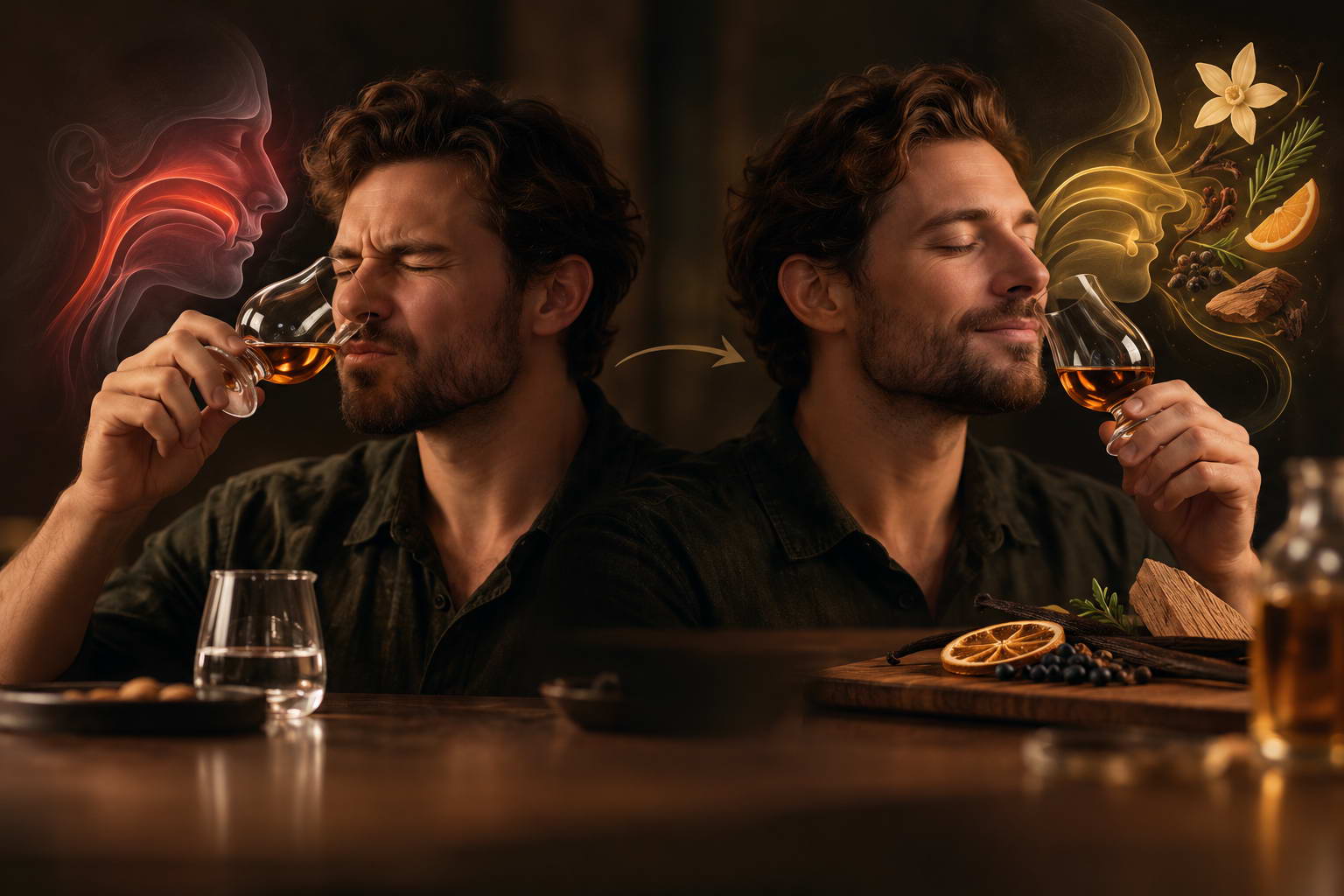
During a tasting of strong spirits, the same situation happens surprisingly often.
The first sip feels:
- sharp;
- hot;
- alcohol-forward;
- even slightly aggressive.
But the second sip already feels noticeably calmer.
Suddenly, it becomes easier to notice:
- aroma;
- texture;
- citrus;
- spices;
- oak;
- the finish.
Sometimes it can seem as if the drink itself changed within just a few minutes.
In reality, much of the change happened in your perception and sensory adaptation.
The First Sip Is an Introduction to Ethanol
Strong alcohol creates a powerful sensory signal immediately.
Ethanol affects more than just taste receptors.
It can create:
- warmth;
- burning;
- irritation of the mucous membranes;
- alcohol vapour in the nose.
During the first sip, your senses have not yet adapted to that signal.
So your attention naturally focuses on the strength of the drink.
What Is Sensory Adaptation?
Sensory adaptation is a gradual decrease in sensitivity to a constant or repeated stimulus.
We experience it every day.
For example, after a few minutes we may stop noticing:
- perfume;
- the smell of a room;
- the sound of a fan;
- the feeling of clothing against the skin.
Something similar happens with alcoholic warmth.
Does That Mean the Alcohol Stops Burning?
Not exactly.
The ethanol does not disappear.
The ABV remains the same.
But after the first contact, the nervous system already expects the sensation.
So the second sip may feel less aggressive.
Why Does the Second Sip Often Feel More Aromatic?
Because alcohol burn is no longer taking all of your attention.
The brain has more opportunity to process:
- retronasal aromas;
- texture;
- taste signals;
- the finish.
The aroma was present during the first sip too.
You simply may not have noticed it as clearly.
Does the Drink Itself Also Change Between the First and Second Sip?
Yes, slightly.
While you are tasting, the drink in the glass:
- interacts with air;
- warms up;
- releases different aromatic compounds.
So the second sip may genuinely have a slightly different aromatic profile.
But in most cases, the biggest difference still comes from the change in your perception.
Why Is It Important Not to Rush?
If you take the second sip immediately after the first, neither your senses nor the drink itself have much time to settle.
It is better to pause for at least a few dozen seconds.
During that time:
- alcoholic irritation can decrease slightly;
- the aroma in the glass can develop;
- you have time to evaluate the finish.
Why Is a Large First Sip a Bad Idea?
A large sip creates too strong a sensory impact.
You get:
- more ethanol;
- stronger burning;
- more alcohol vapour;
- less opportunity to notice delicate details.
For tasting, the first sip is better kept small.
How Small Should It Be?
Just enough to lightly coat the mouth and introduce your senses to the strength.
The first sip does not have to be a complete evaluation.
It can simply serve as preparation.
Should You Swallow Immediately?
There is no need to rush.
Let the small amount of spirit remain in the mouth for a few seconds.
This helps you:
- notice texture;
- activate retronasal perception;
- spread alcoholic warmth more evenly;
- evaluate taste signals more clearly.
What Happens to Temperature in the Mouth?
Even a cool drink warms very quickly toward the temperature of the mouth.
This increases the volatility of aromatic compounds.
That is why aroma during the sip can feel stronger than it did in the glass.
Why Is Retronasal Aroma Especially Important on the Second Sip?
After the first period of adaptation, your attention is less dominated by alcohol.
That makes it easier to notice aromatic signals travelling from the mouth toward the nose.
This is where you may suddenly detect:
- vanilla;
- citrus;
- fruit;
- juniper;
- oak;
- spices.
Why Does the First Sip Sometimes Feel Drier?
Strong alcoholic warmth can emphasise dryness.
Ethanol also affects the way saliva and texture are perceived.
After adaptation, the second sip may feel:
- rounder;
- denser;
- less sharp.
Can the Second Sip Seem Sweeter?
Yes.
Especially when the aroma contains:
- vanilla;
- honey-like associations;
- ripe fruit;
- caramel-like notes.
When alcoholic burn moves into the background, these “sweet” aromatic signals become more noticeable.
That does not mean the drink suddenly contains more sugar.
Why Can the Second Sip Sometimes Seem Worse?
That can happen too.
Once you adapt to the ethanol, other characteristics may become more obvious:
- bitterness;
- tannins;
- excessive oak;
- dryness;
- an unpleasant finish.
So the second sip does not necessarily “improve” the drink.
It often simply gives you a more accurate picture.
Why Is This Important for Evaluating Balance?
If you judge the drink only by the first sip, you may overestimate the role of alcohol.
The second and third small sips are better for evaluating:
- whether ethanol really dominates;
- whether there is enough aromatic structure;
- whether the texture works;
- whether the finish makes sense.
We discussed balance separately in the article “What Does Balance Mean in Strong Spirits and How Can You Recognise It?”.
Should You Take a Third Sip?
Often, yes.
You can use a simple framework:
- first sip — adaptation;
- second sip — main evaluation;
- third sip — checking details and finish.
This is not a strict rule, but it is a very useful method.
Do More Sips Always Give a More Accurate Evaluation?
Only up to a point.
After that, another problem appears — sensory fatigue.
Your receptors and sense of smell gradually adapt so much that differences become harder to detect.
What Is Sensory Fatigue?
It is a decrease in sensitivity after repeated exposure to strong aromas or flavours.
With strong spirits, it can appear as:
- reduced sensitivity to alcohol;
- difficulty distinguishing aromas;
- less accurate comparison.
How Many Drinks Should You Taste at Once?
For careful home tasting, there is little reason to work through dozens of samples.
Two or three drinks already provide plenty of material for comparison.
Especially if the goal is not simply to try them, but to understand the differences.
Why Is Water Important Between Samples?
Water helps:
- refresh the palate;
- reduce accumulated alcoholic warmth;
- partly restore sensitivity.
But if you want to evaluate the finish, do not drink water immediately after the sip.
How Long Should You Wait Before Drinking Water?
Wait at least a few seconds, or longer if necessary, until you understand what remains after the sip.
Then take a small sip of neutral water.
Does Food Between Sips Help?
Sometimes.
But for analytical tasting, it is better to use very neutral foods.
For example:
- plain bread;
- a neutral cracker;
- water.
Sweet, spicy or very salty food can strongly distort perception.
Why Is Coffee Not the Best “Palate Cleanser”?
Coffee itself has:
- a strong aroma;
- bitterness;
- a long finish.
So delicate spirits become harder to evaluate after coffee.
Does Temperature Affect the Difference Between the First and Second Sip?
Yes.
If the drink is very cold, the first sip can feel smoother.
As it sits in the glass, the temperature rises.
The second sip may become:
- more aromatic;
- warmer;
- more alcohol-forward.
So part of the difference may come not only from sensory adaptation, but also from temperature.
Why Is It Useful to Compare at a Stable Temperature?
So you do not confuse two different causes:
- changes in the drink;
- changes in your perception.
This is why analytical tasting benefits from stable conditions.
Does Glass Shape Matter?
Yes.
A glass with a narrower opening concentrates aromatic vapours.
That can make changes between the first and second sip easier to notice.
Should You Swirl the Glass?
With strong alcohol — gently.
Aggressive swirling can suddenly increase the concentration of ethanol vapour.
A light movement of the glass is enough.
Why Is the First Sniff Different from the Second?
The same principle of sensory adaptation applies to smell.
The first sniff may seem very alcohol-forward.
After a few seconds, it becomes easier to detect:
- citrus;
- juniper;
- flowers;
- oak;
- spices.
Can You Smell a Spirit Too Much?
Yes.
If you keep your nose over the glass continuously, your sense of smell adapts quickly.
Short pauses work better.
Why Does the First Sip of Gin Often Feel Very Juniper-Forward?
Juniper is a strong and recognisable aromatic signal.
On first contact, the brain may latch onto it immediately.
Later, it becomes easier to notice:
- citrus;
- herbs;
- spices;
- other botanical directions.
Example: MeadGIN ENTUZIAST
When tasting MeadGIN ENTUZIAST, the first small sip can be used mainly to adapt to the alcohol strength.
On the second sip, it becomes more useful to evaluate:
- the juniper direction;
- citrus associations;
- texture;
- dryness;
- the finish.
This gives much more information than one large sip of heavily chilled gin.
Why Is a Young Distillate Especially Revealing?
There is no oak layer to cover or soften part of the profile.
So the first contact with ethanol can be particularly obvious.
After adaptation, it becomes easier to evaluate the character of the original raw material.
Example: Honey Spirit Pure ENTUZIAST
With Honey Spirit Pure ENTUZIAST, the second small sip can be especially useful for evaluating:
- cleanliness;
- dryness;
- aromatic character;
- texture.
What About Aged Spirits?
With aged alcohol, the first sip may hide more complex oak-derived layers behind alcoholic warmth.
After adaptation, it becomes easier to notice:
- vanilla;
- oak;
- dried fruit;
- spices;
- tannic dryness.
Example: Honey Spirit Aged ENTUZIAST
With Honey Spirit Aged ENTUZIAST, the first sip introduces the strength and overall structure.
The second allows you to look more closely at how the following interact:
- honey distillate;
- oak;
- dried-fruit notes;
- spice;
- the finish.
Is the Second Sip Always “More Correct”?
Not necessarily.
The first sip also provides useful information.
It shows:
- how aggressive the first contact feels;
- how quickly the aroma appears;
- the immediate overall impression.
It simply should not be the only basis for your final judgement.
Why Can the First Sip Feel Different in a Bar Than at Home?
Because context matters.
Perception is influenced by:
- food;
- room aromas;
- temperature;
- glassware;
- previous drinks.
The same spirit can therefore feel different from the very first sip in different environments.
Do Psychological Expectations Matter Too?
Yes.
If you expect a drink to be “very strong,” your brain is already prepared to look for burning.
If you expect “a smooth premium spirit,” your attention may shift in another direction.
This is one reason blind tastings can produce very interesting results.
Should You Read the Tasting Notes Before the First Sip?
If you want the most independent impression possible, it can be better to taste without hints first.
Then compare your own notes with the producer’s description afterwards.
A Simple Three-Sip Method
For home tasting, you can use this approach:
Sip 1 — adaptation.
Small and calm, without trying to identify every note.
Sip 2 — main evaluation.
Aroma, texture, balance.
Sip 3 — finish and details.
Check whether the impression repeats and what remains after the sip.
What Should You Avoid?
- Do not make the first sip large.
- Do not rush into the second sip.
- Do not drink water immediately if you want to evaluate the finish.
- Do not judge the drink immediately after spicy food.
- Do not make a final decision based only on strong first-sip burn.
How Does This Connect to Aroma, Taste and Finish?
During the first sip, these elements can easily blur together because of alcoholic irritation.
After adaptation, they become easier to separate.
This is why it helps to understand the difference between aroma, taste, texture and finish first.
We discussed this in the article “How to Learn to Tell Aroma, Taste and Finish Apart”.
In Short: Why Do the First and Second Sip Feel Different?
- The first sip creates the strongest initial contact with ethanol.
- Your senses have not yet adapted to alcoholic warmth.
- After the first sip, sensitivity to burning decreases slightly.
- On the second sip, aroma, texture and finish are easier to notice.
- The drink itself also changes slightly through air exposure and warming.
- A large first sip hides many details.
- A small first sip can be used as an adaptation sip.
- The second sip does not always seem better — sometimes it reveals bitterness or imbalance.
- A third sip can help confirm the impression.
- Too many samples eventually cause sensory fatigue.
Conclusion
The first and second sip of the same spirit can feel surprisingly different even when the actual alcohol strength has not changed at all.
During the first contact, ethanol creates a strong sensory signal.
A large part of your attention goes toward that signal.
After a short period of adaptation, it no longer feels quite as dominant.
That allows aroma, texture, bitterness, sweet aromatic associations, oak, spices and the finish to become more noticeable.
At the same time, the drink itself has spent a few minutes interacting with air and warming in the glass.
That is why the first sip is better treated as an introduction rather than a final verdict on the drink.
And in the next article in this series, we will look at how to compare two strong spirits properly so that temperature, tasting order and other factors do not distort the result.