





What Do “Clean,” “Complex,” “Harmonious” and “Harsh” Mean in Spirits?
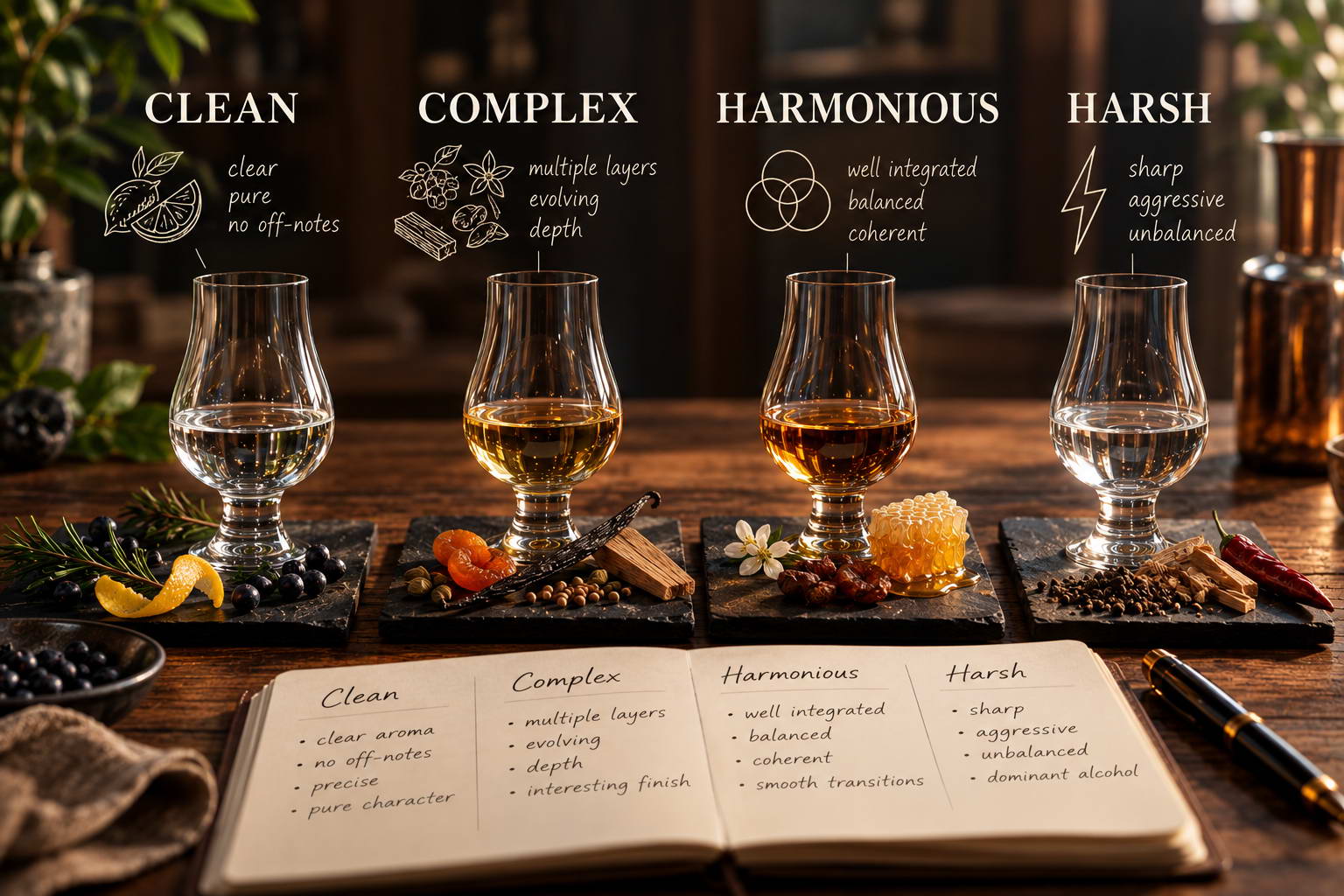
In tasting notes for strong spirits, certain words appear again and again.
They sound familiar — but in practice, different people may use them slightly differently.
For example:
- clean;
- complex;
- harmonious;
- harsh;
- smooth;
- dense;
- dry;
- structured.
If you only read elegant descriptions on labels or in reviews, these terms can sound almost poetic.
But most of them describe very real sensory experiences.
The key is to understand what exactly is being evaluated: aroma, taste, texture, strength, finish or the interaction between them.
What Does “Clean” Mean?
When a taster describes a spirit as clean, they usually do not mean the liquid is transparent.
“Clean” means there are no obvious unwanted or distracting notes interfering with the character of the drink.
A clean distillate may have:
- a clear expression of the raw material;
- controlled alcoholic warmth;
- a logical finish;
- no obvious unpleasant technical or off-notes.
What Can Make a Spirit Feel “Unclean”?
Different sensory problems can create that impression.
For example:
- excessive alcoholic harshness;
- an unpleasant solvent-like direction;
- heavy sulphur-like notes;
- rough bitterness;
- stale or musty aromas;
- a component that feels disconnected from the rest of the profile.
But it is important not to confuse an unusual style with a defect.
A very spicy, dry or heavily oaked spirit is not automatically “unclean.”
Does Clean Mean Neutral?
No.
This is an important distinction.
A spirit can be highly aromatic and still be clean.
For example, gin may have strong:
- juniper;
- citrus;
- herbs;
- spices.
If those notes are clear, coherent and free from unpleasant distractions, the profile can still be described as clean.
Why Is the Word “Clean” Especially Important for Young Distillates?
Because there is no oak maturation adding another aromatic layer.
In an unaged distillate, it is easier to notice:
- the character of the raw material;
- fermentation quality;
- the character of the distillation;
- the structure of the alcohol.
So unwanted notes are often more obvious.
Example: Honey Spirit Pure ENTUZIAST
With Honey Spirit Pure ENTUZIAST, the focus is on the character of the honey distillate itself without an oak-derived layer.
During tasting, it is useful to evaluate:
- how cleanly the base distillate presents itself;
- whether alcoholic warmth overwhelms it;
- how logically aroma develops into taste and finish.
What Does “Complex” Mean?
Complexity is about the number of sensory layers and the way they change over time.
A complex drink does not necessarily reveal everything immediately.
It may develop like this:
first citrus,
then spices,
then wood,
and in the finish — dried fruit or vanilla.
So complexity is not simply “a lot of aromas.”
How Is Complexity Different from Chaos?
This is a crucial distinction.
In a complex drink, the notes:
- have a logical relationship;
- support one another;
- develop gradually;
- form a coherent whole.
In a chaotic drink, there may simply be many different impressions without any clear structure.
More Aromas Means More Complexity?
Not necessarily.
Ten well-integrated notes can create a more complex experience than twenty random ones.
Complexity depends not only on the number of components, but on how they interact.
Why Do Aged Spirits Often Feel More Complex?
Because barrel influence adds another layer to the character of the distillate.
You may get:
- vanilla;
- wood;
- spices;
- dried fruit;
- nuts;
- tannic dryness.
These elements create additional layers.
Can a Young Spirit Be Complex?
Absolutely.
Complexity can already come from:
- raw materials;
- fermentation;
- distillation;
- botanicals.
So the absence of oak does not mean a simple profile.
Can Gin Be Complex?
Of course.
In gin, complexity can come from the interaction between:
- juniper;
- citrus;
- herbs;
- spices;
- floral directions;
- the spirit base itself.
At the same time, a good complex gin should not smell like “every spice in the kitchen at once.”
Example: MeadGIN ENTUZIAST
In MeadGIN ENTUZIAST, you can evaluate the juniper-citrus direction, dryness, texture and the character of the honey distillate base separately.
The interaction between these layers is more interesting than simply counting botanicals.
What Does “Harmonious” Mean?
A harmonious spirit is one where the different parts of the profile feel like one composition.
There is no sense that:
- the aroma exists separately;
- the alcohol exists separately;
- the oak exists separately;
- the finish belongs to a completely different drink.
Everything flows naturally from one stage to another.
Are Harmony and Balance the Same Thing?
They are very closely related, but not completely identical.
Balance is more about the relationship between components.
Harmony is more about the sense of unity and natural transitions.
We discussed balance in detail in the article “What Does Balance Mean in Strong Spirits and How Can You Recognise It?”.
How Can You Recognise Harmony?
Ask yourself a simple question:
is there a point where the drink suddenly “breaks apart”?
For example:
the aroma is pleasant,
the beginning of the palate is good too,
and then suddenly harsh bitterness appears.
Or after an attractive oak profile, all that remains is sharp alcoholic burning.
These kinds of transitions can create a sense of disharmony.
Does a Harmonious Spirit Have to Be Smooth?
No.
A harmonious drink can be very:
- dry;
- strong;
- spicy;
- bitter;
- oaky.
If these characteristics make sense for the style and support one another, harmony can still be present.
Example: Honey Spirit Aged ENTUZIAST
With Honey Spirit Aged ENTUZIAST, harmony can be evaluated through the interaction of:
- the character of the honey distillate;
- oak maturation;
- spicy nuances;
- dried-fruit associations;
- alcoholic warmth;
- the finish.
If these layers feel like one continuous story rather than separate components, the profile can be called harmonious.
What Does “Harsh” Mean?
Harshness is a feeling of excessive sensory aggression.
It is most often connected with:
- strong alcoholic burn;
- very active ethanol vapour;
- sharp bitterness;
- aggressive dryness;
- an unpleasantly abrupt finish.
Does Harsh Mean Strong?
Not necessarily.
This is one of the most common misconceptions.
A 40% spirit can feel harsher than one at 43% or 46%.
What matters is not only the amount of ethanol, but how well it is integrated into the overall profile.
Why Can One 40% Spirit Burn More Than Another?
Because of differences in:
- aromatic structure;
- texture;
- temperature;
- residual or added components;
- distillation;
- maturation.
So ABV is not a scale of harshness.
Can the First Sip Make a Good Spirit Seem Harsh?
Yes.
On the first sip, your senses have not yet adapted to ethanol.
So even a balanced spirit may initially feel more aggressive.
We discussed this in the article “Why Does the First Sip Feel Different from the Second?”.
Does Cold Hide Harshness?
Yes.
Strong chilling reduces the intensity of alcoholic warmth and suppresses some aromas.
This is why a cold drink may feel smoother.
But that does not mean the profile has permanently changed.
Can Water Reduce Harshness?
Sometimes.
A few drops of water lower the ethanol concentration and can change how aromas are perceived.
But excessive dilution can make the drink watery.
We discussed this in the article “Should You Add Water to Strong Spirits?”.
What Does “Smooth” Mean?
A smooth spirit is one where alcoholic warmth does not feel aggressively dominant.
It may have:
- rounded texture;
- moderate burning;
- well-integrated ethanol;
- no rough transitions.
Does Smooth Mean High Quality?
Not always.
A very smooth drink can also be:
- simple;
- watery;
- short;
- unexpressive.
Smoothness is only one characteristic, not a quality score.
What Does “Dry” Mean?
This word can be used in several ways.
Most often, it may refer to:
- low sweetness;
- lack of stickiness;
- a spicy or herbal character;
- tannic or textural dryness.
So “dry” is not always only about sugar.
What Does “Structured” Mean?
A structured drink has a clear sensory framework.
You can feel:
- a beginning;
- development;
- a finish.
And there is a logical relationship between them.
What Creates Structure?
Depending on the drink, structure may come from:
- alcohol strength;
- juniper;
- bitterness;
- tannins;
- spices;
- texture;
- acidity.
Does Structured Mean Heavy?
No.
Even a light gin can have a clear structure.
Structure is not about weight — it is about how the sensory profile is organised.
What Does “Flat” Mean?
A flat drink lacks development.
It may have a pleasant opening aroma, but then very little happens.
For example:
- the aroma is one-dimensional;
- the texture is watery;
- the finish is short;
- there is little progression.
Does Flat Always Mean Bad?
Not always.
A very direct profile can sometimes work perfectly well as a simple cocktail component.
But for slow neat tasting, flatness is often perceived as a weakness.
What Does “Bright” Mean?
A bright spirit has notes that are immediately recognisable and expressive.
For example:
- very clear citrus;
- strong juniper;
- expressive berries;
- active spices.
Brightness does not automatically mean complexity.
What Does “Delicate” Mean?
A delicate profile is not the same as a weak profile.
The aromas may be subtle but clearly noticeable with careful tasting.
For example:
- flowers;
- light herbs;
- soft citrus;
- subtle fruit notes.
Why Is Delicate Alcohol Easy to Overwhelm with Serving Choices?
Its subtle notes can easily be covered by:
- very low temperature;
- strongly flavoured tonic;
- aggressive garnish;
- spicy food;
- perfume in the room.
What Does “Expressive” Mean?
It means the character of the drink is easy to read.
For example, in gin it may be immediately clear:
- where the juniper is;
- where the citrus direction is;
- where the dryness comes from;
- where the spice appears.
The profile does not necessarily have to be extremely intense.
What Does “Rounded” Mean?
A rounded spirit has no harsh corners in its transitions.
Aroma moves smoothly into taste.
Alcohol strength does not stand apart.
The texture feels integrated.
The finish does not end abruptly.
Are Rounded and Harmonious the Same?
They are very close concepts.
But rounded more often describes smooth transitions and texture.
Harmonious is a broader description of the whole composition.
Can These Words Be Used Objectively?
Partly.
For example, two tasters may agree that one drink:
- burns more strongly;
- has a longer finish;
- is more oaky;
- has brighter citrus.
But words such as “harmonious” or “complex” inevitably contain some interpretation.
Why Can Two Tasters Describe the Same Drink Differently?
Because people differ in:
- aromatic memory;
- sensitivity;
- experience;
- expectations;
- tasting context.
But that does not mean every description is equally precise.
How Can You Make a Tasting Description More Precise?
Do not begin with a judgement.
Describe the observation first.
For example, instead of:
“the gin is harsh”
you could say:
“on the first sip, alcoholic burn overwhelms the citrus notes.”
That is much more informative.
Instead of “Complex,” What Should You Say?
For example:
“first juniper and citrus, then spices, and in the finish a dry herbal direction appears.”
This explains why you consider the drink complex.
Instead of “Harmonious”?
For example:
“alcoholic warmth does not overwhelm the aroma, oak supports the distillate, and the finish logically continues the palate.”
Why Is a Specific Description Better Than Beautiful Words?
Because it helps another person understand the real character of the drink.
Words such as “premium,” “refined” or “incredibly harmonious” say very little without explanation.
How Can These Terms Help During Comparison?
This is where they become especially useful.
For example:
- A is cleaner but simpler;
- B is more complex, but the oak dominates more strongly;
- A is smoother;
- B is harsher, but has a longer finish.
This is far more useful than simply saying “A is better.”
How Should You Compare Spirits Properly?
They should be given equal conditions:
- the same temperature;
- identical glasses;
- the same volume;
- the same amount of time in the glass.
We discussed the method in detail in the article “How to Properly Compare Two Strong Spirits During a Tasting”.
Do You Need to Know Every Tasting Term?
No.
For normal tasting, a few clear categories are enough.
For example:
- clean;
- smooth;
- harsh;
- dry;
- dense;
- complex;
- harmonious.
The important thing is to use them consciously.
Do You Need to Describe Alcohol “Like a Professional”?
No.
If it is clearer for you to say:
“first lemon, then pine, and slightly bitter at the end,”
that may be far more useful than a complicated pseudo-professional phrase.
How Can You Build Your Tasting Vocabulary?
The best way is through comparison.
Taste two drinks and look for differences rather than absolute scores:
- this one is drier;
- this one is denser;
- this one is cleaner;
- this one has a longer finish;
- this one shows the alcohol more strongly.
This quickly gives the terms real meaning.
A Simple Cheat Sheet
- Clean — no obvious unwanted or distracting notes.
- Complex — several sensory layers that develop over time.
- Harmonious — all parts of the profile work as one composition.
- Harsh — alcohol, bitterness or another element feels excessively aggressive.
- Smooth — alcoholic warmth is well integrated and does not dominate.
- Dry — low sweetness or a sensory impression of dryness.
- Structured — a clear progression from beginning to finish.
- Flat — little development or sensory progression.
- Bright — aromas are easy to recognise and appear quickly.
- Delicate — subtle, non-aggressive profile that rewards careful tasting.
In Short: How Should You Understand Tasting Terms?
- They describe more than taste — they describe the whole sensory profile.
- “Clean” does not mean neutral.
- “Complex” does not simply mean many aromas.
- “Harmonious” describes the integrity of the transitions.
- “Harsh” is not a synonym for high ABV.
- “Smooth” is not automatically a synonym for high quality.
- “Dry” can describe texture as well as sugar level.
- “Structured” means the profile develops in a logical way.
- Different people may describe the same drink somewhat differently.
- The most useful description explains why a particular term was used.
Conclusion
Tasting language should not make alcohol harder to understand.
Its purpose is the opposite — to explain sensations more precisely.
“Clean” describes the absence of distracting unwanted notes.
“Complex” describes several layers that develop over time.
“Harmonious” describes a sense of unity.
“Harsh” describes an excessively aggressive sensory element.
But these words work best when they are explained.
Instead of simply saying “complex,” describe how the aroma develops.
Instead of “harsh,” explain what creates the harshness.
Instead of “harmonious,” explain which elements work well together.
A good tasting note is not a collection of beautiful adjectives, but a clear explanation of what happens in the drink from the first aroma to the final note of the finish.