





Why a copper still?
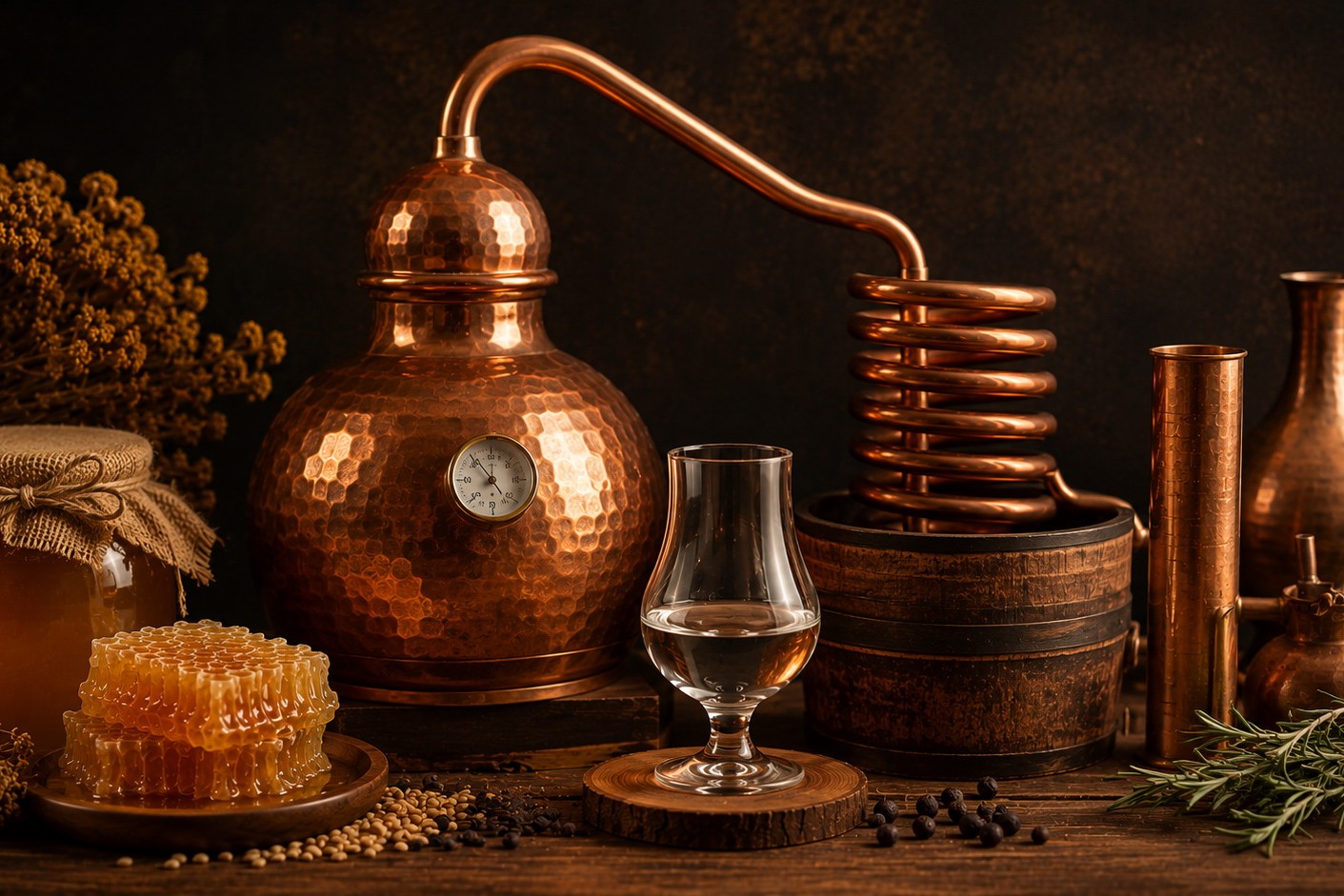
A copper still is easily recognizable by its rounded distillation pot, elongated neck, and the warm sheen of the metal. It looks like a symbol of an ancient craft, but its significance is not limited to tradition or its beautiful form. Copper plays a direct role in shaping the distillate’s aromatic profile.
During distillation, the fermented mash is heated; alcohol vapors rise inside the still, come into contact with its surface, cool, and condense back into liquid. The material of the equipment, the shape of the pot still, the length of the neck, the intensity of heating, and the rate of distillate collection all influence which components end up in the finished beverage.
That is why a copper alembic should not be viewed merely as a vessel for distillation. It is a tool that allows the master distiller to work with the purity, aroma, texture, and character of the future distillate.
What Is an Alembic?
An alembic is a traditional batch-distillation apparatus. A specific amount of fermented liquid or intermediate distillate is loaded into it; a single distillation cycle is carried out, after which the apparatus is cleaned and prepared for the next batch.
In the classic design, the components include the distillation pot, the helmet or dome, the neck, the vapor outlet tube, and the condenser. During heating, the volatile components turn into vapor, travel to the cooling system, and condense.
At first glance, the principle is quite simple. However, even minor differences in the apparatus’s shape can alter the degree of reflux, the contact between the vapors and the copper, and the amount of heavy aromatic components in the final distillate.
Why Alembics Are Traditionally Made of Copper
Copper has several properties that are important for distillation. It conducts heat well, is easy to shape, and allows for the creation of stills with complex, curved designs. But its main advantage lies in its ability to interact with certain volatile compounds formed during fermentation and distillation.
The fermented mash contains not only ethyl alcohol and water. It also contains acids, esters, aldehydes, higher alcohols, sulfur-containing compounds, and other aromatic components. Some of these contribute to the desired flavor, while others, in excessive concentrations, can create harsh, heavy, or unpleasant notes.
Contact with a copper surface helps reduce the impact of certain undesirable sulfur-containing compounds. As a result, the distillate’s aroma can become cleaner, and harsh sulfur, vegetal, or metallic notes become less noticeable.
At the same time, the role of copper should not be oversimplified. It does not transform a mediocre fermented base into a high-quality beverage, nor does it replace the proper selection of fractions. It is merely one of the important elements in a complex technological process.
How Copper Affects Sulfur-Containing Compounds
Volatile sulfur compounds can form during fermentation. In small quantities, some of them contribute to the complex aromatic profile, but an excess can evoke associations with cooked vegetables, rubber, matches, or other undesirable odors.
When hot alcohol vapors come into contact with copper, some of these compounds react with it and are retained on the surface of the equipment. After distillation is complete, the interior of the still is cleaned to remove the resulting deposits.
This is precisely why the condition of the copper surface is so important. It is not enough simply to have a copper still—it must be properly maintained, cleaned, and kept in working order.
The effect of copper depends on the specific compound, the duration of contact, the temperature, and the design of the equipment. Therefore, the statement “copper removes all sulfur” is overly simplified. It is more accurate to say that it helps manage some of the undesirable sulfur-containing components and create a cleaner aromatic profile.
Copper does not make the distillate neutral
A high-quality craft distillate should not be completely devoid of character. If too many aromatic components are removed, the drink may become clean but bland.
The distiller’s task is to find the right balance. It is necessary to reduce unwanted harsh notes while preserving the components that reflect the raw materials, fermentation, and the chosen production method.
A copper pot still is well-suited for this approach. It produces a clean distillate but, when operated correctly, retains sufficient aromatic depth. This is precisely why pot still spirits are often described as more expressive, rounded, and full-bodied compared to the maximally neutral column spirits.
How the Shape of the Alembic Affects the Drink
Two copper stills may look similar but produce distillates with different characteristics. Key factors include the volume of the pot, the shape of the dome, the height and angle of the neck, the length of the steam pipe, and the design of the condenser.
Tall Neck
In a tall neck, some of the heavier vapors cool earlier, condense, and return to the still. This phenomenon is called reflux. As a result, lighter and more volatile components reach the condenser more frequently, and the distillate can become purer and more delicate.
Short or Wide Neck
A shorter vapor path and a lower level of reflux can promote the passage of a greater number of heavy aromatic components. Such a distillate often has a denser, richer, and oilier character.
Head shape
A rounded, onion-shaped, or other type of head affects vapor flow and the contact area with the copper surface. Even minor design changes can influence how the distillate unfolds in aroma and flavor.
Therefore, producers often consider the shape of the still to be part of the recipe. Replacing the still or making a significant change to its design can alter the character of the product, even if the raw materials and fermentation process remain the same.
The heating rate also matters
An alembic does not operate on its own. The master distiller determines how quickly to heat the liquid, the intensity of the distillation, and when to adjust the fractionation mode.
Heating too quickly can increase the vapor flow rate and reduce its contact with the copper surface. Slow distillation allows more time for interaction, reflux, and more precise control of the fractions.
However, slower does not always automatically mean better. The mode must be tailored to the specific equipment, raw materials, and product style. Craft distillation does not require adherence to a single universal rule, but rather an understanding of the behavior of each batch.
Heads, Hearts, and Tails
During distillation, the distillate does not emerge as a homogeneous liquid. Its aroma and composition change gradually, so the distiller conventionally divides the process into several fractions.
The initial portion has a higher concentration of the most volatile components and is often characterized by a sharp aroma. The final fractions contain more heavy compounds, which can add harshness, oiliness, or undesirable notes.
Between them lies the “heart”—the main part of the distillate used to create the finished beverage. The transition points are not the same for every distillation run. They depend on the raw materials, distillation parameters, equipment, and the desired style.
A copper alembic helps shape the aromatic profile, but it is the distiller’s decisions that determine which part of the distillate will become the final product. Therefore, the quality of the distillate is the result of the interplay between the raw materials, the equipment, and human expertise.
How an Alembic Differs from a Column
Column stills and copper pot stills are not necessarily competitors. They perform different technological tasks and can be used in the same production cycle.
A column distiller provides multiple cycles of evaporation and condensation within the system. This allows for more precise separation of components, increases alcohol strength, and achieves a high degree of purification.
An alembic is simpler in design but often better preserves the aromatic character of the raw materials. It can produce a rich distillate with noticeable honey, fruit, grain, berry, or spice notes.
Combining column and pot still distillation allows you to first obtain a clean base and then add roundness and depth to it. It is precisely this multi-stage technology that can be useful for complex signature drinks.
Why the Entire Still Doesn’t Have to Be Made of Copper
Modern distillation often uses equipment made of a combination of steel and copper. Stainless steel is strong, durable, relatively easy to maintain, and has almost no interaction with the product.
Copper is used in those parts of the system where active contact with vapor or liquid is required. These may include the head, neck, column trays, screens, inserts, or other components.
What matters is not the amount of copper used for decorative purposes, but rather sufficient surface area and duration of actual contact with the vapors. It is this contact that produces the desired technological effect.
Can There Be Too Much Copper?
Copper is beneficial for distillation, but its use requires careful monitoring. The equipment must be cleaned regularly, and the finished product must meet established safety and quality standards.
Improper maintenance, corrosion, or exposure to corrosive substances can negatively affect the condition of the still. Therefore, professional production involves strict procedures for cleaning, inspecting, and preparing the equipment before each cycle.
Simply having a copper still is not in itself a guarantee of high quality. Sanitary conditions, process discipline, process control, and the distiller’s expertise remain crucial.
Why Copper Alembics Are Associated with Craft Distillation
The craft approach emphasizes attention to small details and the ability to influence each batch. The still aligns well with this philosophy because it operates in cycles and allows the distiller to evaluate each distillation run individually.
The distiller can adjust the heating, the rate of distillate collection, and the fraction cut-offs depending on the behavior of a specific base spirit. In mass production, the main advantages are often stability and productivity, whereas artisanal distillation focuses more on character and the nuances of flavor.
That is why the copper alembic has become not only a symbol of tradition but also a working tool for modern producers of artisanal gins, fruit spirits, brandy, whiskey, and other complex distillates.
The Copper Alembic in the Production of Honey Distillates
A fermented honey base has its own aromatic character. It can develop floral, waxy, fruity, grainy, and spicy notes. The goal of distillation is to purify the beverage without losing its origin.
A copper still helps to make the honey profile more rounded and cohesive. The finished beverage may retain associations with honey, wax, honeycombs, white bread, or flowers, even if the distillate itself remains dry and lacks pronounced sweetness.
When working with berries and botanicals, the still also allows for a more nuanced aromatic result. After maceration, a second distillation helps integrate raspberries, blackthorn, juniper, citrus, and spices into the overall composition.
How ENTUZIAST Uses the Copper Alembic
At the ENTUZIAST mead distillery, the copper alembic is an integral part of the process for creating various signature products.
In the production of classic MeadGIN, distillation takes place in a copper alembic with a juniper basket and citrus accents. This helps to combine the dry character of juniper, the freshness of botanicals, and the roundness of the honey distillate.
For MeadGIN Raspberry, raspberries macerated in honey distillate, juniper, and fresh berries are combined in a copper alembic. For MeadGin Sloe Blackthorn, after macerating blackthorn berries, distillation is also carried out in an alembic, after which the spirit is aged in new barrels.
In the Honey Spirit Aged process, the alembic is the final stage of a three-step distillation process. After processing through a continuous-action column and a pot still, it is the alembic distillation that gives the drink its roundness, depth, and distinctive craft character.
Can you tell if a spirit was distilled in an alembic just by tasting it?
It’s difficult to definitively identify the type of equipment based on just one sip. The taste is influenced by the raw materials, yeast, fermentation conditions, number of distillations, fraction selection, alcohol content, maceration, blending, and aging.
However, alembic distillates often have a more pronounced texture and retain the distinct character of the original base spirit. They can be richer, rounder, and more aromatically complex than highly purified neutral spirits.
It is more accurate to evaluate not the mere fact of using copper, but the overall balance of the beverage: the purity of the aroma, the absence of harsh notes, the distinctiveness of the raw materials, and a harmonious finish.
Frequently Asked Questions About Copper Alembics
Why is copper needed during distillation?
Copper conducts heat well and interacts with some of the volatile sulfur-containing compounds, helping to create a cleaner aromatic profile for the distillate.
Does a copper still make the drink smoother?
It can contribute to a cleaner and rounder profile, but the smoothness also depends on the raw materials, fermentation, the number of distillations, fraction selection, alcohol content, and aging.
How does an alembic differ from a rectification column?
A column allows for a higher degree of purification and more precise separation of components. An alembic tends to preserve more of the aromatic properties of the raw materials.
Does the entire alembic have to be made of copper?
Not necessarily. Modern equipment can combine stainless steel and copper elements. The key is sufficient contact between the vapor and a clean copper surface.
Does the shape of the still affect the taste?
Yes. The height of the neck, the shape of the helmet, the angle of the steam outlet tube, and other design features affect reflux and the transfer of aromatic components.
Does a copper alembic guarantee high quality?
No. Quality depends on the raw materials, the sanitary condition of the equipment, the fermentation process, proper fraction selection, and the distiller’s expertise.
Copper, Form, and Craftsmanship
The copper still remains relevant not out of respect for the past, but because it performs a specific technological function. Copper interacts with some of the undesirable volatile compounds, the shape of the still directs the movement of the vapor, and the distillation mode determines the aromatic richness of the distillate.
However, the still does not create the beverage on its own. Its full potential is realized only in the hands of a master who understands the raw materials, senses the right moment for selection, and knows what character they aim to achieve.
For ENTUZIAST, the copper alembic is not a museum piece, but a fully-fledged tool for creating honey distillates and signature gins. It is within this still that technological precision meets craftsmanship, and the fermented honey base gradually transforms into a beverage with its own distinct character.