





Why Can the Same Drink Smell Different to Different People?
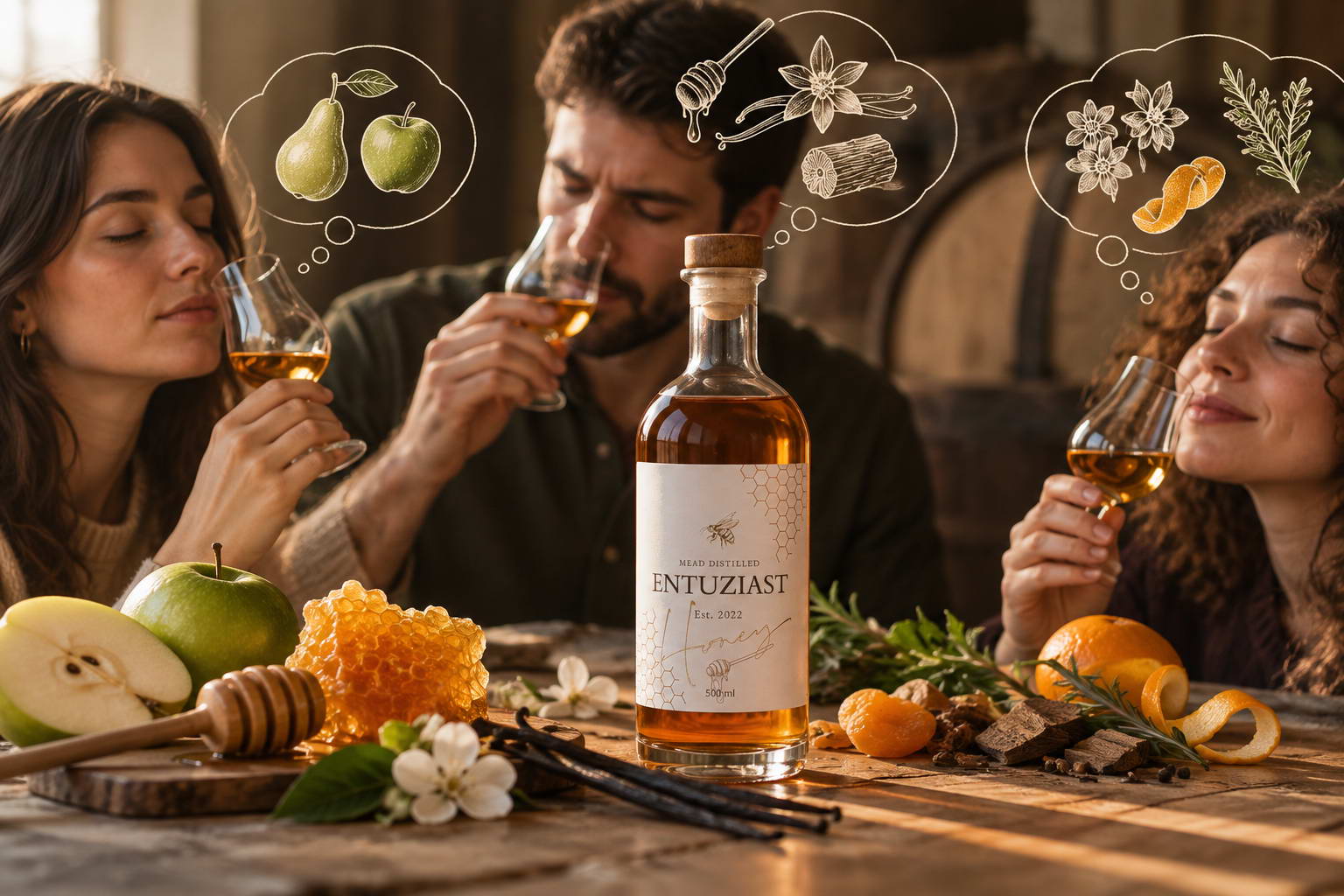
One person smells the glass and says, “Apple.”
Another immediately replies, “No, that’s pear.”
A third person detects flowers, honey or citrus peel instead.
They are all tasting the same drink.
So who is wrong?
Most often — nobody.
The aroma of a drink exists objectively, but it is always perceived by an individual person.
Our receptors, genetics, experience, aroma memory, the temperature of the drink, the shape of the glass and even what we ate a few minutes earlier can influence which notes we notice first.
This is why professional tasting is not simply about finding one single “correct” answer.
Let us look at why our sense of smell can be so individual.
A Drink's Aroma Is a Complex Mixture
Any aromatic distillate contains many volatile compounds.
Some come from the original raw material.
Others are formed during fermentation.
Some pass into the finished spirit during distillation.
In aged drinks, compounds from oak are added to the composition.
In gin, botanicals contribute their own aromatic molecules.
So when we smell a glass, our receptors are not receiving one single aroma but a complex molecular composition.
The brain then has to decide which signals are most noticeable and what they resemble.
We Do Not Smell Molecules as Names
An olfactory receptor does not tell the brain, “this is pear.”
It responds to specific molecules.
The brain then compares the resulting pattern with what it already knows.
This is why different people can describe the same set of aromatic signals in different ways.
One person remembers ripe pear from childhood.
Another finds the same composition closer to green apple.
A third may not have a clear fruit association at all and simply describe it as “fresh” or “floral.”
What Is Aroma Memory?
Aroma memory is our internal library of smells.
Throughout life, the brain stores thousands of aromatic associations.
We remember the smell of:
- apple;
- pear;
- freshly cut grass;
- honey;
- coffee;
- vanilla;
- wood;
- orange peel;
- wet earth;
- bread;
- smoke;
- spices.
When we taste a drink, the brain searches for similarities between the new signal and this existing library.
If someone has never consciously smelled a particular product, it may be much harder for them to use that word in a tasting description.
Why Do Experienced Tasters Find More Notes?
Not necessarily because they have a “better nose.”
Often, the main difference is a more developed aroma memory.
They have compared smells many times, learned to group them and memorised characteristic differences.
So instead of simply saying “fruity,” they may say:
“green apple,” “ripe pear,” “dried apricot” or “citrus peel.”
The drink itself has not changed.
What has changed is the person's vocabulary and ability to recognise details.
Does Genetics Matter?
Yes.
People differ in their sensitivity to individual smells.
One person may detect a particular aromatic compound very easily, while another perceives it much more weakly.
For some compounds, these differences can be quite pronounced.
So different perceptions of the same spirit are not simply about experience or imagination.
Some variation may come from real physiological differences in the olfactory system.
Does This Mean Tasting Is Completely Subjective?
No.
It would be incorrect to conclude that anyone can say anything and every description is equally accurate.
A drink has a real chemical composition.
Specific volatile aromatic compounds are genuinely present.
This is why tasters often show substantial agreement.
For example, several people may independently identify the overall direction as:
- fruity;
- citrusy;
- woody;
- vanilla-like;
- smoky;
- herbal;
- spicy.
But the exact wording may differ.
Pear or Apple — Who Is Right?
It is entirely possible that both people are.
Complex aromatic compositions rarely resemble one product with perfect precision.
A group of molecules may create a profile somewhere between several familiar aromas.
Fruit itself also smells different depending on variety and ripeness.
Green apple, baked apple and overripe apple are three very different aromatic pictures.
The same is true of pear.
So arguing over whether something is “apple or pear” is often less useful than understanding the broader character of the aroma.
Why Can Alcohol Smell Mainly of Spirit at First?
Ethanol vapours can be very noticeable, especially in a high-strength drink.
If you take a strong, deep sniff immediately after pouring, the alcoholic component may temporarily dominate over more delicate aromas.
This is why a distillate often benefits from a few minutes of rest in the glass.
We explain this in detail in the article “Why Should You Let Strong Spirits Rest in the Glass?”.
After a short rest, one person may suddenly notice fruit, while another picks up honey, spice or wood.
Does Temperature Matter?
Very much.
The volatility of aromatic compounds depends on temperature.
When a drink is cold, some aromas become less noticeable.
As the drink warms in the glass, certain compounds become more active.
This means two people can describe the same drink differently simply because they evaluated it at different moments.
One smelled it immediately after refrigeration.
Another waited ten minutes.
The sensory picture will already be different.
Why Does Very Cold Alcohol Seem Simpler?
Low temperatures suppress the evaporation of many aromatic compounds.
As a result, a very cold drink may seem:
- cleaner;
- softer;
- less alcoholic;
- but also less layered.
This is especially important for aromatic gins and aged distillates.
In the article “Can Gin Be Stored in the Refrigerator or Freezer?”, we already discussed how cold affects aroma perception.
Can Water Change What We Smell?
Yes.
A few drops of water reduce the alcohol concentration and alter the behaviour of volatile compounds.
As a result, some aromas may become more noticeable while others move into the background.
For example, before adding water, someone may notice mostly alcohol and oak.
After a few drops, flowers, fruit, vanilla or honey may become more obvious.
This is why careful tasting sometimes includes evaluating the spirit both neat and after slight dilution.
We have a separate article on this method: “Should You Add Water to Strong Spirits?”.
Does Glass Shape Matter?
Yes, because the shape of the glass affects how aromatic compounds accumulate and escape.
In a wide glass, aroma disperses more quickly.
In a glass with a slightly narrower opening, volatile compounds become more concentrated near the nose.
So the same spirit can genuinely seem slightly different when tasted from different glasses.
This is not magic and it is not simply marketing.
We are changing the conditions under which aromatic molecules reach our receptors.
Does the Distance from the Glass Matter?
Yes.
If you place your nose deep inside a glass of strong alcohol, the concentration of alcohol vapour may be too high.
This can quickly overwhelm the sense of smell.
Sometimes you can learn more by starting from a slight distance.
Then gradually move closer and change the angle of the glass.
This can reveal different aromatic layers.
Why Does the Aroma Seem to Disappear After Several Sniffs?
Our sense of smell adapts.
If receptors receive the same signal continuously, the brain gradually pays less attention to it.
That is why a drink may seem less aromatic after prolonged smelling.
The molecules have not disappeared from the glass.
Our sensitivity has changed.
During tasting, it is useful to take short sniffs and small pauses.
Why Do Perfumes Interfere with Tasting?
Because the sense of smell cannot isolate only one object.
Strong perfume, room fragrance, smoke, food or even scented hand cream creates an additional aromatic background.
The brain has to process all of these signals at the same time.
As a result, subtle notes in the drink become more difficult to identify.
This is why professional tastings are usually held in as neutral an environment as possible.
Does Food Matter?
Yes.
Especially foods with strong flavours or aromas, such as:
- garlic;
- onion;
- hot spices;
- coffee;
- chocolate;
- mint;
- smoked foods.
After consuming them, some aromas in the drink may seem weaker or simply different.
For comparative tasting, it is therefore better to start with relatively neutral receptors.
Does Mood Matter?
It can affect the overall sensory experience.
Smell perception does not exist separately from the brain.
Context, expectations, fatigue and attention can all influence how carefully we analyse aroma.
A drink that seems complex during a quiet tasting may simply register as “pleasant alcohol” at a loud party.
The chemical composition has not changed.
The conditions of perception have.
Can the Label Influence Aroma Perception?
It can influence the way we describe what we smell.
If someone is told before tasting that the drink contains “apple, vanilla and honey notes,” they may unconsciously start looking for exactly those aromas.
This does not necessarily mean they are inventing them.
But prior information can direct attention.
This is one reason blind tastings are so interesting.
They allow us to evaluate aroma without the influence of brand, price, label or someone else's description.
Why Do Experts Sometimes Disagree Too?
Because an expert is still a human being.
Experience improves the ability to recognise and organise aromas, but it does not make every person's sense of smell identical.
Two professional tasters may agree that a spirit is fruity and oak-aged, while one describes the fruit as pear and the other as yellow apple.
One may notice more vanilla.
Another may focus on spice.
This is a normal part of sensory analysis.
Should You Read the Tasting Notes Before Trying the Drink?
If you want the most independent impression possible, it is better not to read them first.
Try to identify:
- the general aromatic direction;
- two or three main associations;
- the character of the taste;
- the finish.
Then read the producer's description and compare.
This is an excellent way to train sensory memory.
How Can You Train Your Sense of Smell?
The easiest way is not to start with alcohol at all.
Consciously smell ordinary products.
For example:
- cut an apple and remember the aroma;
- compare apple and pear;
- smell lemon and orange peel;
- compare vanilla, cinnamon and clove;
- compare fresh and dried fruit;
- smell different types of honey;
- pay attention to the aroma of oak or wood shavings.
Over time, this builds a reference library that the brain can use during tasting.
An Example with MeadGIN ENTUZIAST
MeadGIN ENTUZIAST has a pronounced botanical profile.
One person may notice juniper first.
Another may focus on citrus.
A third may perceive more herbal or spicy notes.
All of these impressions can belong to the same composition.
It is especially interesting to compare the aroma immediately after pouring and again after a few minutes in the glass.
An Example with Honey Spirit Aged
An even more complex example is Honey Spirit Aged ENTUZIAST.
Here, the character of the honey distillate is combined with oak maturation and the previous history of the barrels.
One person may focus on honey and wax.
Another may notice wood and vanilla.
Someone else may perceive dried fruit, spice or wine-like notes.
This is where the individuality of perception becomes especially interesting.
Is It Worth Tasting the Same Drink More Than Once?
Yes.
Sometimes that can be more useful than immediately trying ten different bottles.
Try the same spirit:
- on different days;
- at slightly different temperatures;
- after a few minutes of rest;
- with and without a few drops of water.
You may be surprised by how differently the same composition can appear.
Should People Argue About the “Correct” Aroma?
Usually, no.
A more interesting question is:
“What exactly does this aroma remind you of?”
This turns tasting from a competition into a way of viewing the same drink from different perspectives.
Sometimes another person's association helps you notice a note you had not recognised yourself.
In Short: Why Do We Perceive the Same Drink Differently?
- People differ in the sensitivity of their olfactory receptors.
- Everyone has a different aroma memory.
- Experience affects the ability to name and separate aromas.
- Temperature changes the volatility of aromatic compounds.
- Glass shape affects aroma concentration.
- Water can alter the balance of volatile components.
- Food, perfume and surrounding smells influence perception.
- Expectations and context can direct attention.
Conclusion
The same drink really can smell different to different people.
This does not mean aroma is imaginary.
There is a real composition of volatile compounds in the glass, but every brain analyses it through its own receptors, experience and aroma memory.
That is why one person finds pear, another apple, and someone else flowers.
Temperature, glass shape, water, time after pouring and surrounding smells can further change the impression.
Tasting therefore becomes much more interesting when we stop looking for one single correct answer and start paying closer attention to our own perception.
A good tasting note is not a list of aromas you are required to find. It is an invitation to listen more carefully to what you actually perceive.