





Why Does Alcohol Smell Fruity If There Is No Fruit in It?
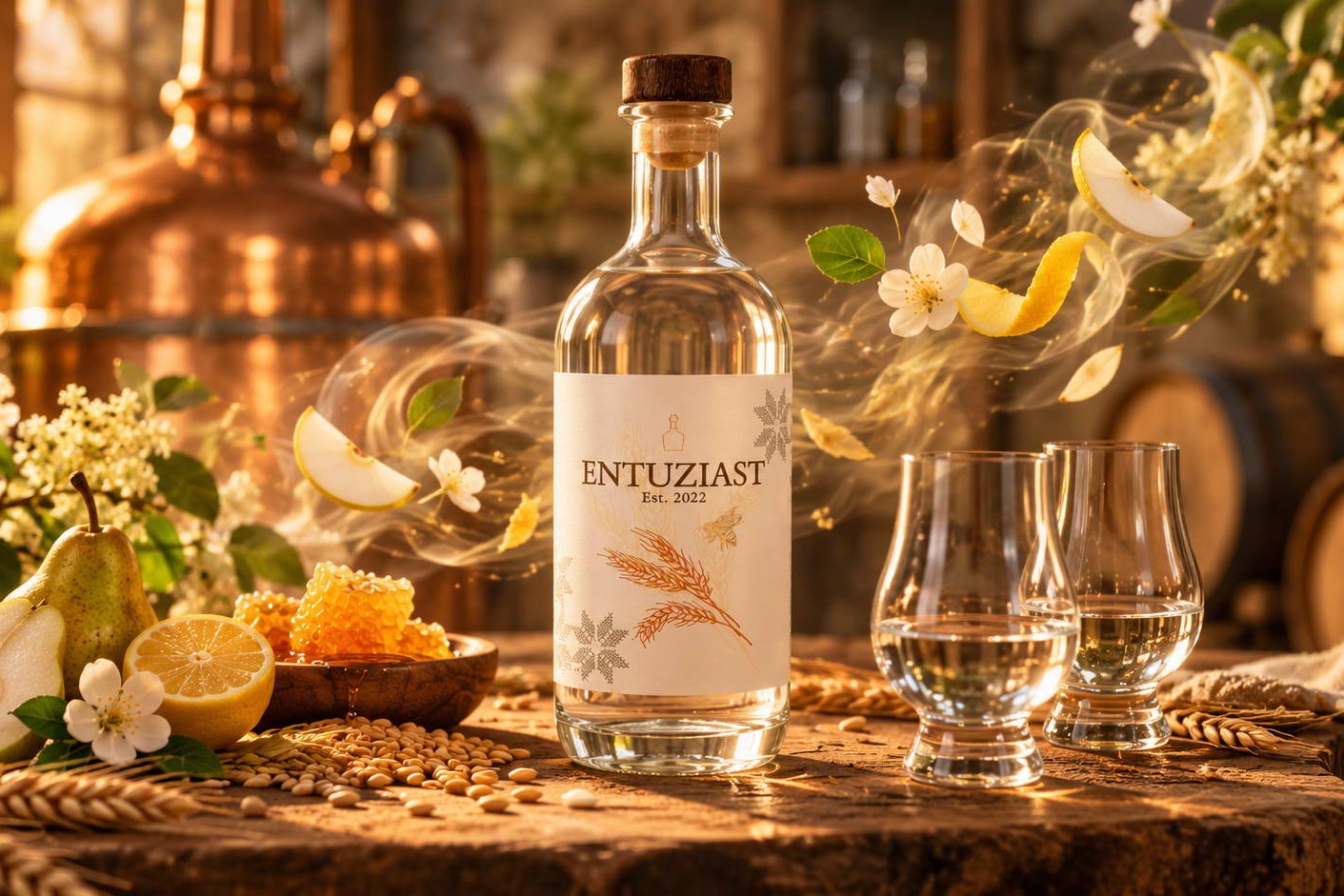
You pour a spirit into a glass, bring it to your nose — and suddenly you smell apple.
Or pear. Banana. Peach. Apricot. Citrus peel. Ripe berries.
Then you look at the ingredients — and there is no apple, pear or banana anywhere in the recipe.
So where does that aroma come from?
The most interesting part is that real fruit is not required for a spirit to develop fruity aromas.
Aroma is created by molecules. And many of the molecules our brain associates with fruit can form naturally during fermentation, distillation, maturation and ageing.
That is why grain, honey or even cane-based distillates can sometimes smell like fruits that were never used as ingredients.
Let us look at how this works.
Aroma Is Not the Fruit Itself — It Is a Set of Molecules
When we say “this drink smells like pear,” it does not mean that pear must actually be present in the glass.
Our sense of smell does not identify products as complete objects.
It reacts to volatile aromatic molecules that evaporate from the liquid, enter the air and reach the olfactory receptors in our nose.
The brain then analyses the combination of these signals and compares them with aromas already stored in memory.
If the combination resembles ripe pear, we say “pear.”
If it resembles green apple, we perceive apple.
If it reminds us of banana, pineapple or peach, that is how we describe it.
In other words, a tasting note such as “apple” is primarily a sensory association, not an ingredient list.
The Same Aromatic Compound Can Exist in Both Fruit and Alcohol
In nature, aromatic molecules are not exclusive to one particular food.
A compound that we associate with fruit may also be found in completely different products.
Moreover, similar molecules can form naturally during the biochemical processes of fermentation.
This is why a spirit can smell remarkably like fruit even when no fruit was ever used in the recipe.
The Main Aroma Factory: Fermentation
Fermentation is often described very simply:
yeast consumes sugar and produces alcohol.
That is correct, but incomplete.
Fermentation produces much more than ethanol.
At the same time, many other compounds are formed, including:
- organic acids;
- higher alcohols;
- aldehydes;
- esters;
- volatile aromatic compounds;
- substances that can later take part in additional reactions.
These compounds are present in much smaller amounts than water or ethanol, but even tiny concentrations can strongly influence the character of a spirit.
Among them, esters are especially important for fruity aromas.
What Are Esters in Alcohol?
Esters are a large group of organic compounds, many of which have vivid aromas.
Humans can detect some of them even at extremely low concentrations.
Depending on the specific compound, they may remind us of:
- apples;
- pears;
- bananas;
- pineapple;
- peach;
- tropical fruit;
- berries;
- flowers.
In a real drink, aroma is almost never created by just one molecule.
We perceive a complex mixture of dozens or even hundreds of volatile compounds.
But some of them are so distinctive that they can strongly shape the overall impression.
Why Does Yeast Create Fruity Aromas?
Yeast does not “try” to create pleasant fruit aromas.
These aromas are by-products of yeast metabolism.
As yeast processes sugars, amino acids and other compounds, it produces alcohols and acids.
Some of these substances react with each other and form aromatic esters.
The exact compounds and their concentration depend on factors such as:
- yeast strain;
- fermentation temperature;
- available sugar;
- composition of the raw material;
- nutrient availability;
- acidity;
- fermentation time;
- fermentation speed.
This is why the same raw material can produce noticeably different aromatic profiles under different fermentation conditions.
Why Does One Spirit Smell Like Apple and Another Like Banana?
Because their volatile compound profiles are different.
You can imagine aroma as a huge mixing console.
There are hundreds of controls.
One affects fruity esters.
Another affects floral compounds.
Others influence herbal, spicy, grain-like or woody notes.
Changing only a few of these “controls” can completely alter what we perceive.
This is why two spirits with the same alcohol strength can smell completely different.
Do These Aromas Survive Distillation?
Yes. Some aromatic compounds can pass into the distillate together with the vapours during distillation.
This is where the difference between an aromatic distillate and highly neutral spirit becomes especially important.
When producing an aromatic distillate, the goal is not simply to obtain ethanol.
The distiller also tries to preserve desirable volatile compounds while separating unwanted ones.
We discuss this principle in more detail in the article “What Is the Difference Between Distillation and Rectification?”.
This is why the art of distillation is, to a large extent, about working not only with alcohol, but also with aroma.
So Distillation Does Not Always “Remove Everything”?
Not necessarily.
It depends on the type of product the producer wants to create.
If the goal is a highly neutral spirit, the process aims to remove as many aromatic compounds as possible.
If the goal is an aromatic distillate, some volatile compounds are desirable.
They carry the character of the raw material, fermentation and distillation method.
That is why a fruity note in a distillate can be a natural result of the process rather than an added flavour.
Can Honey Distillate Smell Fruity?
Yes.
And fruit juice or flavouring does not have to be added for that to happen.
Honey is a complex natural raw material, and after fermentation its aromatic profile changes even further.
Fermentation creates new volatile compounds that can remain in the finished spirit after proper distillation.
That is why the aroma of honey distillate is not simply “the smell of honey.”
It may contain floral, herbal, waxy, grain-like, spicy or fruity associations.
We have already written about how the raw honey itself can influence the final profile in the article “Why Do Different Types of Honey Produce Different Distillate Aromas?”.
An ENTUZIAST Example: Honey Spirit Pure
A good example of how aroma can be shaped by technology rather than by flavour additives is Honey Spirit Pure ENTUZIAST.
Its base is fermented spring honey.
During fermentation, the original raw material changes: yeast processes sugars, alcohol forms, and a complex set of new aromatic compounds is created.
The aromatic profile then goes through another stage of selection during distillation.
The finished spirit is therefore not “liquid honey with alcohol.”
It is an independent drink with its own sensory profile, created through fermentation, distillation and further processing.
What If Fruity Notes Appear in a Grain Distillate?
The principle is the same.
Grain itself may smell like bread, malt or cereal.
But after fermentation, the aromatic picture becomes much more complex.
Yeast creates new compounds, and some of them may have clearly fruity associations.
This is why whisky or another grain distillate may show notes of apple, pear, banana or tropical fruit even before it has touched an oak barrel.
Do All Fruity Notes Come from Fermentation?
No.
This is an important point.
Fermentation is only one source of aroma.
The sensory profile of a spirit may develop at several stages:
- raw material;
- fermentation;
- distillation;
- maturation;
- blending;
- storage and serving conditions.
This means that the same fruity association can have different origins depending on the drink.
What Does Oak Add?
If a distillate is matured in wood, the aroma becomes even more complex.
Oak contains many compounds that gradually enter the spirit or form through chemical transformations during ageing.
The barrel may contribute associations such as:
- vanilla;
- caramel;
- coconut;
- spices;
- dried fruit;
- nuts;
- baked fruit;
- wood.
So a fruity note in an aged drink may be the result of several processes working together: fermentation aromas interacting with compounds from the wood.
This is exactly what the next article in our series will explore — where vanilla and caramel notes come from in aged spirits when nobody actually added vanilla or caramel.
Why Do Tasting Notes Often Mention Dried Fruit?
In tasting descriptions, you may encounter notes such as:
- raisins;
- prunes;
- dried apricot;
- dried cherry;
- fig.
This does not mean these ingredients were placed in the barrel.
It simply means that the combination of aromatic molecules reminds the brain of familiar dried-fruit aromas.
These associations can become especially complex in spirits aged in casks that previously held wine.
Why Does MeadGIN Smell Citrusy?
Here the mechanism is different.
In gin, part of the aroma is often created directly by the botanicals.
For example, in MeadGIN ENTUZIAST, the aromatic profile is built around juniper and citrus botanicals used during distillation.
So the citrus note here has a different origin from, for example, a pear-like note in a grain distillate.
This is why it is useful to distinguish between:
- aroma from the original raw material;
- aroma created during fermentation;
- botanical aroma;
- barrel-derived aroma;
- aroma formed by the interaction of several sources.
Does Fruity Aroma Mean Flavouring Was Added?
No.
This is one of the most common misunderstandings.
If a spirit smells like banana, pear or apple, you cannot automatically conclude that flavouring was added.
Such aromas can form completely naturally during fermentation and distillation.
At the same time, this does not mean flavourings are never used.
Different categories of alcoholic drinks may be produced in different ways.
This is why it is better to look at the ingredient list, product category and producer information rather than trying to determine production methods from aroma alone.
Why Can Aroma Be Stronger Than Taste?
Because the human sense of smell is extremely sensitive to many volatile compounds.
A substance may be present at a concentration too low to create an obvious taste sensation, while still producing a strong aroma.
This is why a spirit can smell strongly of pear without tasting like pear juice.
That is completely normal.
Aroma and taste are connected, but they are not the same thing.
Why Can Fruity Notes Become Stronger After a Sip?
During tasting, we do not perceive aroma only by smelling the glass.
After a sip, volatile molecules can also reach the olfactory receptors from inside the mouth.
This is called retronasal perception.
Because of this, some notes may become more obvious after swallowing than they were when smelling the drink directly.
For example, a spirit may initially seem grainy or spicy, while apple or dried-fruit notes emerge later in the finish.
Why Does Temperature Change Fruity Aroma?
Aromatic compounds have different levels of volatility.
When a drink is very cold, the evaporation of many compounds slows down.
As a result, some fruity notes may become difficult to detect.
As the temperature rises, the aroma becomes more active.
This is why a complex distillate may noticeably change over ten or fifteen minutes in the glass.
It does not mean new ingredients have suddenly appeared.
We are simply becoming more able to perceive compounds that were already present.
Why Can a Few Drops of Water Reveal Fruity Notes?
Changing the alcohol concentration affects the behaviour of aromatic molecules.
A few drops of water can reduce alcoholic sharpness and change the way volatile compounds move into the air above the glass.
As a result, a previously hidden fruity or floral note may become much easier to detect.
This is why professional spirit tasting sometimes includes comparing the aroma before and after adding a small amount of water.
We discuss this in more detail in the article “Should You Add Water to Strong Spirits?”.
Do All People Smell the Same Fruity Notes?
No.
And that is completely normal.
One person may say “green pear.”
Another may say “apple.”
A third may describe the same aroma as floral.
Our perception depends on:
- olfactory sensitivity;
- tasting experience;
- aroma memory;
- genetic differences;
- the temperature of the drink;
- the shape of the glass;
- the environment;
- food and drinks consumed beforehand.
We will explore this in another article in the series: why the same drink can smell different to different people.
Are Tasting Notes Just Made Up?
Sometimes people read descriptions such as “pear, vanilla, dried fruit and spice” and wonder where all of that came from.
But a proper tasting note is not a recipe.
It is an attempt to translate a complex molecular aroma into understandable human language.
We cannot realistically describe a smell as “a mixture of dozens of volatile organic compounds in specific concentrations.”
So instead we use familiar associations:
apple, pear, honey, vanilla, flowers, nuts, wood, spices.
This becomes a kind of shared vocabulary for talking about aroma.
Do You Need to Find Every Note Mentioned in the Description?
No.
Tasting is not an exam.
If a producer or sommelier detects pear and you do not, that does not mean you are tasting “incorrectly.”
Perhaps the same group of aromas reminds you more of apple.
Or perhaps you notice a completely different part of the profile.
It is much more useful to gradually build your own aroma memory than to try to guess the “correct” answer.
How Can You Learn to Recognise Fruity Notes More Easily?
The simplest method is to consciously smell real foods.
When you cut an apple, pay attention to the aroma.
Compare green and ripe apples.
Smell pear skin, peach flesh, raisins, dried apricots, lemon peel and orange peel.
This is how the brain builds its own library of smells.
The next time you taste a spirit, it becomes easier to compare an unfamiliar aromatic composition with something you already know.
Why Is This Important for Understanding Craft Spirits?
Because an aromatic distillate is much more than alcohol plus a raw ingredient.
Its character is shaped at every stage.
Fermentation may create new fruity and floral compounds.
Distillation determines which of those compounds remain in the final spirit.
Botanicals can add another aromatic layer.
Oak can create yet another.
And temperature, water and glass shape influence how clearly we perceive all of it.
This is why two drinks with the same alcohol strength can have completely different personalities.
In Short: Where Does Fruity Aroma Come From Without Fruit?
- During fermentation, yeast creates many aromatic compounds.
- Among them are esters that may smell strongly fruity.
- Some of these compounds pass into the distillate during distillation.
- Oak ageing can add new fruity and dried-fruit associations.
- The brain describes complex molecular mixtures through familiar smells such as apple, pear, banana or peach.
- A fruity aroma is not automatic proof that fruit or flavouring was added.
Conclusion
If a spirit smells like fruit that does not appear in the ingredient list, there is nothing unusual about it.
The aroma of a strong alcoholic drink is shaped by much more than the original raw material.
Fermentation creates many new volatile compounds, distillation selects and concentrates some of them, and maturation may add another layer of aromas.
This is why honey, grain and other raw materials can produce distillates in which people perceive apple, pear, flowers, tropical fruit or dried fruit.
And that is one of the most fascinating things about spirits:
in the glass, we do not experience only what was put into the recipe. We experience what the raw material, yeast, distillation, time and technology created together.