





How craft gin differs from mass production?
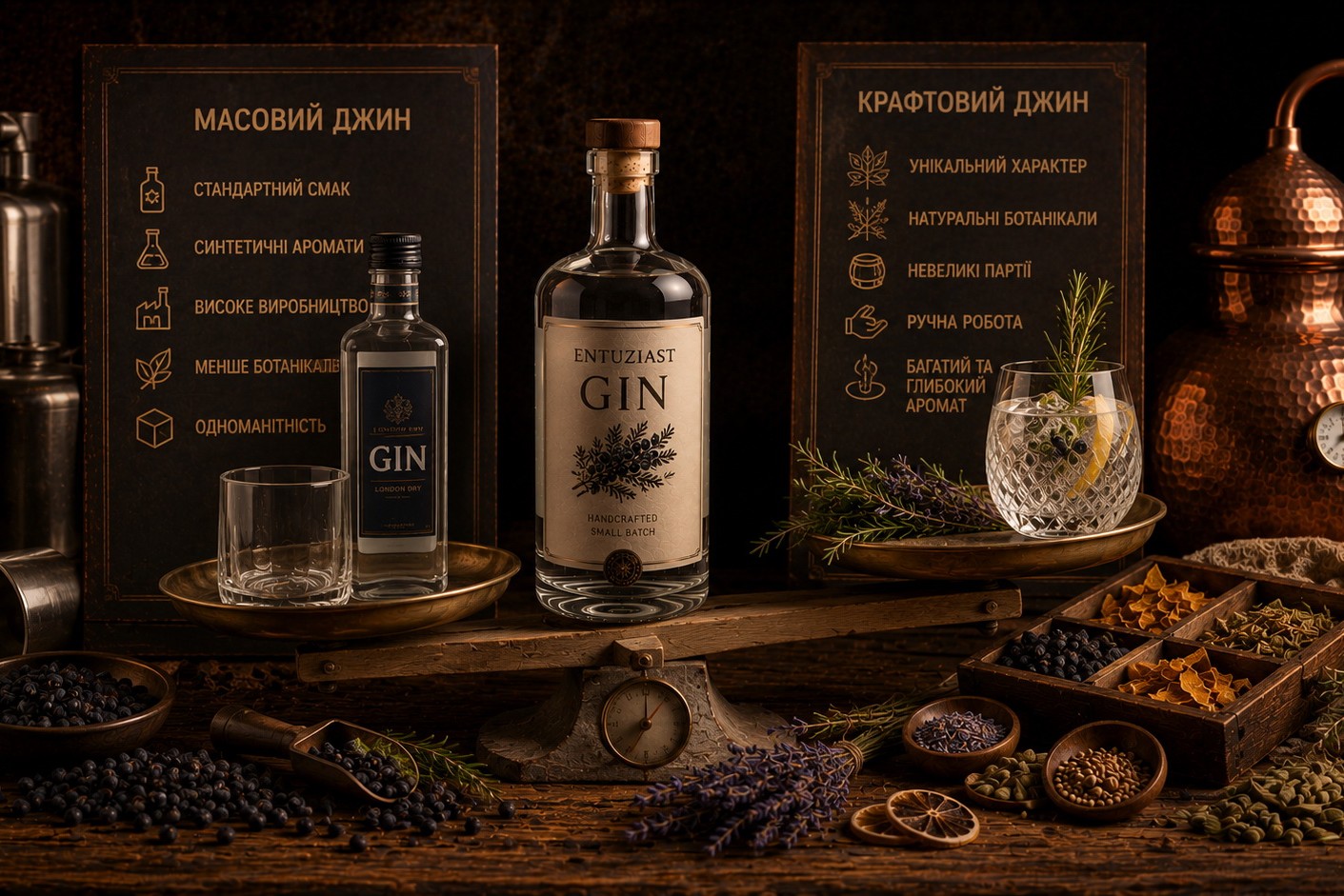
On a store shelf, different bottles may all bear the same label reading “gin,” have a similar alcohol content, and carry the familiar aroma of juniper. However, these outward similarities often mask different approaches to production. One drink is produced in large, consistent batches with an emphasis on repeatability, while the other is made in small batches using a proprietary recipe and with constant attention to the characteristics of the natural ingredients.
Craft gin is typically associated with small-scale production, a proprietary recipe, careful selection of botanicals, and the ability to monitor every batch. Mass production focuses more on flavor consistency, large volumes, process efficiency, and the precise replication of a defined profile.
This does not mean that any craft product is automatically better, or that a mass-produced one is worse. Quality depends on the raw materials, equipment, production discipline, and the producer’s skill. The main difference lies in the philosophy behind creating the drink and the approach to working with its character.
What Does “Craft Gin” Mean?
The term “craft” does not always have a single, universal definition. Most often, it describes a product made in relatively small batches with significant involvement by the distiller in formulating the recipe, distillation, and quality control.
Craft gin may be characterized by:
- a signature recipe;
- small or limited batches;
- use of natural botanicals;
- controlled maceration and distillation;
- the use of local or unusual spirit bases;
- the ability to adjust the process to a specific batch of raw materials;
- a distinctive character that sets the product apart from neutral, generic styles.
A craft approach does not necessarily mean entirely manual labor. A producer may use modern stills, automatic temperature control, and professional equipment. What matters more is the extent to which the technology serves the specific vision for the beverage.
What Is Mass Production of Gin
Mass production focuses on high volumes and consistency. Consumers expect a bottle purchased today to taste nearly the same as a drink from another batch or even another year.
To achieve this, producers standardize raw materials, recipes, alcohol content, maceration time, distillation parameters, and blending methods. Individual components may be purchased in large batches, and finished distillates may be blended to even out the flavor profile.
This system is not a flaw in and of itself. It allows for consistent quality, product availability, and uniform characteristics across a large number of bottles.
However, the pursuit of maximum consistency often leaves less room for seasonal variations, experimentation, and the distinct character of individual batches.
The difference starts with the spirit base
Many classic gins use a neutral spirit. Its main purpose is not to compete with juniper and other botanicals.
A neutral base helps the producer achieve a clean and predictable result. The aromatic profile is almost entirely determined by the botanical ingredients.
A craft distiller may take a different approach and use a spirit with its own character—grain, fruit, grape, or honey-based. In this case, the base becomes an integral part of the recipe.
ENTUZIAST’s MeadGIN uses a honey distillate. It can add roundness and notes of wax, flowers, bread, or cream to the drink, while still letting juniper remain the primary gin note.
Signature Recipe vs. Versatile Profile
Mass-market gin is often created for a broad audience. Its aroma must be straightforward, consistent, and well-suited for use in popular cocktails.
A craft distiller can afford a more niche and distinctive style. The spirit can be extremely dry, berry-forward, citrusy, spicy, or built around an unusual base.
A signature recipe is more than just a long list of botanicals. It determines:
- which ingredient will be the main one;
- how prominent the juniper will be;
- what role citrus fruits will play;
- whether the berries will be fresh, jam-like, or tart;
- how the honey or other base will come through in the finish;
- what alcohol strength will best bring out the aroma.
A good recipe has an internal logic. It doesn’t include ingredients just to make for a nice-looking list on the label.
The number of botanicals does not determine quality
Craft gins often attract attention with their unusual botanicals. A producer may use local berries, herbs, flowers, honey, roots, or spices.
However, a large number of ingredients does not automatically make the drink more complex. If the components don’t blend well, the aroma becomes chaotic, and the juniper gets lost.
Sometimes, just a few carefully selected botanicals create a more distinctive result than a recipe featuring dozens of plants.
The craft approach is not about using the maximum number of ingredients, but about carefully working with their proportions, preparation, and the method of extracting the aroma.
Natural Raw Materials and Their Variability
Juniper, citrus zest, raspberries, blackthorn, and other botanicals depend on the season, growing region, ripeness, and storage conditions.
One batch of juniper might be more resinous, while another is dry and spicy. Raspberries vary in aromatic intensity, and citrus zest varies in the amount of essential oils.
Large-scale production seeks to compensate for these differences as much as possible through standardization, large-scale blending, and strict formulation parameters.
A craft producer, on the other hand, tends to evaluate each batch individually. They may slightly adjust the maceration time, the degree of grinding, or the distillation parameters to maintain the overall style of the beverage.
This approach requires experience, as naturalness without control is not an advantage in and of itself.
Small Batches and Process Control
Small-batch production allows for closer monitoring of each distillation run. The master distiller can assess the aroma at various stages, more precisely define the boundaries of the fractions, and adjust the rate of collection.
Large-scale continuous production also involves strict control, but it relies more on standardized parameters and automated systems.
A craft batch often undergoes an individual organoleptic evaluation. The master distiller not only checks the numbers but also decides whether the aroma matches the intended concept.
Small batch sizes offer greater flexibility but also increase responsibility: a single mistake can affect the entire batch.
Maceration in Craft Gin
Maceration is the process of infusing botanicals in an alcohol base. During this process, juniper berries, other berries, citrus peel, and spices impart their aromatic and flavor components to the spirit.
In mass production, maceration parameters are typically standardized as much as possible. This is necessary to ensure consistency.
A craft producer can work with the ingredients individually:
- macerate juniper for a longer period;
- add citrus zest for a shorter period;
- process delicate berries at a lower temperature;
- place some of the botanicals in the botanical basket;
- combine individual macerates before distillation or blending.
This approach is more complex but allows for more precise control over each layer of the composition.
Botanical Basket and Steam Extraction
During steam extraction, the botanicals are not immersed directly in the alcohol base. Instead, they are placed in a special basket through which hot alcohol vapors pass.
This method helps produce lighter, fresher, and more delicate notes. It can be combined with maceration: the deeper components infuse in the liquid, while the more delicate ones impart their aroma through the vapor.
In craft gin, this combination often becomes part of the distiller’s signature style. It allows for the creation of an aroma that unfolds gradually, rather than presenting a single, direct note.
The Role of the Copper Alembic
The copper still is one of the hallmark tools of artisanal distillation. It operates in separate cycles, so each distillation run can be controlled individually.
The contact between the vapors and the copper helps create a cleaner aromatic profile. The shape of the still, the intensity of the heat, and the rate of distillate collection all influence the balance of light and heavy components in the finished beverage.
Large-scale producers may also use copper equipment. Therefore, the mere presence of an alembic does not automatically make a product “craft.”
What makes the difference is how the producer uses this tool: whether they adjust the process to suit specific raw materials, evaluate each fraction, and strive to preserve the individuality of the base spirit.
Fraction Selection
During distillation, the aroma and composition of the spirit gradually change. The initial fractions contain more light and sharp components, while the final ones contain heavier and oilier ones.
The heart of the distillate becomes the base for the future gin. However, its boundaries can be defined more broadly or narrowly depending on the desired style.
A narrower selection creates a cleaner and lighter profile. A broader selection can add body and aroma, but requires precision to avoid harsh notes.
With a small batch, the master distiller can assess changes almost in real time and make decisions based not only on a standard chart but also on the aroma.
Consistency and Uniqueness of Batches
For a mass-market brand, consistency is the top priority. Consumers must experience a familiar taste regardless of the bottling date.
Craft gin should also remain recognizable. However, small natural variations between batches may be more noticeable.
One batch of berries might yield a fresher aroma, while another might have a deeper, jam-like aroma. The barrel might have a slightly more pronounced or milder influence.
These differences are acceptable only if they do not compromise the overall quality and style of the product. “Craft” is not an excuse for inconsistency, but rather the ability to work with living raw materials.
The Color of Craft Gin
Classic distilled gin is usually clear. The natural pigments in botanicals generally do not vaporize during distillation.
Berry-based craft gin may have a natural hue if, after distillation, there is additional contact with the berries or another process specified in the recipe.
In the mass-market segment, approved processing methods may be used to ensure color stability. Craft producers often emphasize the natural origin of the hue, although this may result in slight variations between batches.
It is important to evaluate not only the color but also how it was obtained and whether it matches the character of the drink.
Craft gin isn’t necessarily stronger
Sometimes artisanal gins are bottled at a higher alcohol content to better preserve the essential oils and the distinct character of the botanicals. However, high alcohol content is not a mandatory characteristic of craft gin.
The producer chooses the alcohol content according to the style:
- for a dry juniper profile;
- for bright citrus notes;
- for delicate raspberry notes;
- for an aged berry-forward spirit;
- for a rounded, honey-like finish.
The right alcohol content should bring out the aroma, not just create a strong alcoholic warmth.
Craft gin doesn’t always have to be drunk neat
Artisanal gin often has a complex enough profile for neat tasting. This is the best way to appreciate the base, juniper, berries, citrus, and finish.
However, this doesn’t mean it can’t be used in cocktails. On the contrary, its distinctive character can become the centerpiece of an interesting mix.
It’s important that the other ingredients don’t overpower the gin. Sweet syrup, an overly aromatic tonic, or too much juice can mask its subtle nuances.
For craft gin, it’s best to choose recipes that highlight its dominant note.
Marketing and True Craftsmanship
The word “craft” has become popular, so it is sometimes used primarily as a marketing term. An unusual label, a small bottle, or a story about handcrafted production does not necessarily guarantee a meaningful difference in production methods.
When making your choice, pay attention to specific details:
- what the base spirit is made of;
- what botanicals are used;
- how maceration is carried out;
- what equipment is used for distillation;
- whether natural berries are used;
- whether aging or blending takes place;
- what aroma and flavor the manufacturer claims the product has.
The more transparently a brand explains its production process, the easier it is to understand what the term “craft” really means.
Can mass-produced gin be high-quality?
Yes. High production volume does not necessarily mean low quality. Well-known brands may have precise recipes, professional equipment, strict laboratory controls, and years of experience.
Their advantage is consistency: the consumer knows what to expect from every bottle.
Craft gin offers a different kind of value—a more distinctive character, a unique foundation, locally sourced ingredients, or an unusual combination of techniques.
Therefore, the choice depends not only on the abstract concept of quality but also on the experience the buyer is seeking.
Classic Style or Experiment
A craft producer can work within the classic style, emphasizing pure juniper and citrus. They can also create bolder versions with berries, a honey base, or oak aging.
Experimentation only makes sense when it maintains balance. An unusual ingredient shouldn’t be used just for the sake of novelty.
For example, raspberries should pair well with juniper, blackthorn with a honey base and woody notes, and citrus should complement the gin’s dry character.
A successful craft product remains approachable even with a complex recipe.
The Craft Character of MeadGIN
ENTUZIAST’s MeadGIN line is built around honey distillate rather than a neutral base. This is what gives all the products their shared character.
In the classic MeadGIN, honey spirit is combined with juniper, lemon, citron, and orange. The drink remains dry and spicy, but has a light, creamy, and refreshing finish.
MeadGIN Raspberry features raspberries macerated in honey distillate and distilled in a copper still with a basket of botanicals. The berries complement the juniper without turning the drink into a typical sweet liqueur.
MeadGin Sloe Blackthorn combines the maceration of blackthorn berries, distillation in a copper alembic, and aging in new barrels. In it, the berry’s tartness meets vanilla and honeycombs.
Three versions—three ways to showcase craft
MeadGIN
Showcases a creative reinterpretation of classic dry gin through a honey base and citrus notes.
MeadGIN Raspberry
Showcases the use of natural, delicate berries, maceration, and a basket of botanicals.
MeadGin Sloe Blackthorn
Combines berry ingredients, distillation, and oak aging to create a more complex and full-bodied style.
The craft character here is evident not only in the small-scale production but also in the unique production methods used for each product.
How to Choose a Craft Gin
Start not with the bottle design, but with the description of the drink’s character.
Pay attention to:
- the base spirit;
- the main botanicals;
- the stated dryness or sweetness;
- alcohol content;
- the presence of berry maceration;
- distillation in a copper still;
- oak aging;
- description of the finish.
For those looking to explore a more traditional style, a dry juniper-citrus gin is a good choice. For a more aromatic profile, try a raspberry gin. For a rich, berry-forward character with oak notes, opt for a blackthorn gin.
How to Taste Craft Gin
It’s best to taste it neat for your first tasting. Pour a small amount into a glass and wait a few minutes.
Evaluate the drink step by step:
- What aroma comes through first?
- How noticeable is the juniper?
- Can you detect the character of the spirit base?
- What citrus, berry, or spicy notes emerge next?
- What lingers in the finish?
After that, you can add a little water or try the drink with a neutral tonic. Diluting it sometimes reveals notes that were masked by the higher alcohol content.
Frequently Asked Questions About Craft Gin
What does “craft gin” mean?
It’s usually gin produced in small batches using a proprietary recipe, with careful control over ingredients, maceration, distillation, and flavor.
Is craft gin always better than mass-produced gin?
No. Quality depends on the technology and craftsmanship. A craft product often offers a more distinctive character, while mass-produced gin offers greater consistency.
How does the base spirit differ?
Mass-produced gins often use neutral alcohol. Craft gins can be made from grain, fruit, grape, or honey distillates, each with its own distinct aroma.
Does “craft” mean handmade?
Not necessarily. Modern professional equipment can be used. What matters most is a distinctive approach, batch control, and transparency in the production process.
Why might craft batches vary slightly?
Natural botanicals and berries vary depending on the season and origin. The producer adjusts the production process to maintain the style, but minor natural variations are possible.
Does a greater number of botanicals mean higher quality?
No. It’s all about balance. A small number of well-chosen ingredients can create a more distinctive gin than a long, haphazard list.
How is MeadGIN different from regular gin?
It’s based on a honey distillate, which is combined with juniper, citrus, berries, and botanicals, giving the blend its own unique character.
What’s the best way to try craft gin for the first time?
Start by sipping a small amount neat to appreciate the base, juniper, botanicals, and finish. After that, you can add water or tonic.
It’s Not About Scale, It’s About Approach
The main difference between craft gin and mass-produced gin lies not only in the number of bottles produced. It begins with the approach to raw materials, the recipe, and the character of each batch.
Mass production is valued for its stability and predictability. Craft production is valued for the opportunity to work with an unusual base, local berries, various maceration methods, and signature distillation techniques.
In ENTUZIAST’s MeadGIN, the craft approach is evident in the honey distillate, the copper still, natural raspberries and blackthorn, citrus fruits, and the use of oak aging.
It is precisely these choices that create a drink that does not strive to be one-size-fits-all. It has its own style, production history, and character, which unfolds not through a single aroma, but through a sequence of nuances.