





Where Does Astringency in Aged Spirits Come From?
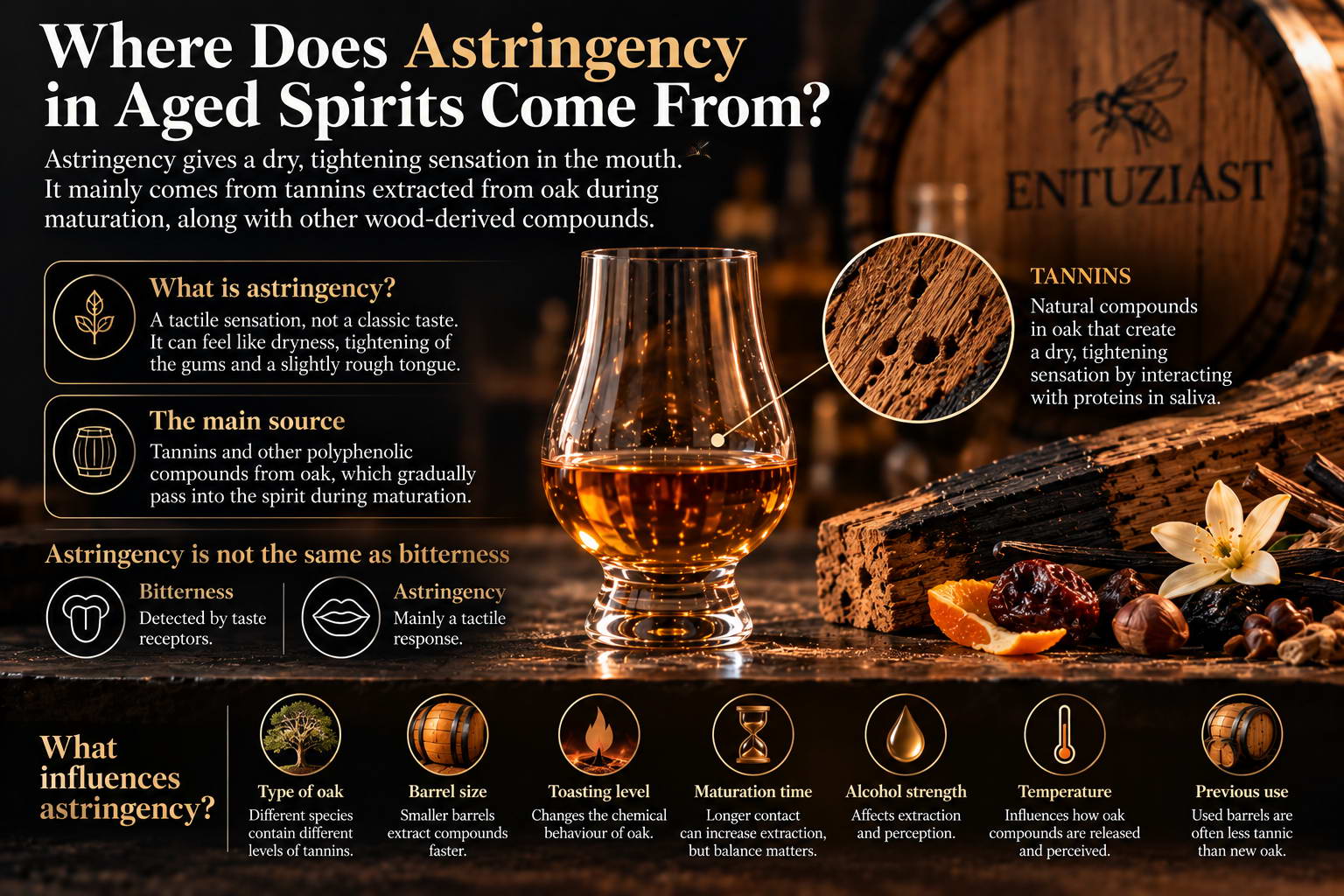
You take a sip of an aged distillate and notice an unusual sensation.
The mouth seems slightly drier.
The tongue and gums feel as though they have tightened.
Sometimes there is a subtle roughness.
At the same time, the drink may not taste particularly bitter at all.
This sensation is called astringency.
It is especially common in drinks that have spent time in oak barrels.
But where does it come from?
Why can one aged spirit feel pleasantly dry and structured while another becomes rough and overly woody?
And most importantly: astringency, bitterness and dryness are not exactly the same thing.
Let us look at how they differ and why oak plays such an important role.
What Is Astringency?
Astringency is primarily a tactile sensation rather than a classic taste.
It may feel like:
- dryness in the mouth;
- tightening of the gums;
- a slightly rough tongue;
- reduced slipperiness of saliva;
- a drying sensation that remains after the sip.
A familiar example is very strong black tea.
Another is a young dry red wine rich in tannins.
Aged spirits can create a similar sensation because oak contains compounds capable of producing astringency.
Is Astringency a Taste?
Not in the same sense as sweetness, bitterness or acidity.
Astringency is mainly a tactile response.
It occurs when certain compounds interact with proteins in saliva.
This changes the lubricating properties of saliva and increases friction between surfaces in the mouth.
The result is that characteristic dry, tightening sensation.
So when someone says that a spirit “dries the mouth,” they may actually be describing astringency rather than flavour itself.
What Are Tannins?
Tannins are a large group of naturally occurring polyphenolic compounds.
They are found in many plants and plant-derived materials, including:
- grape skins;
- tea;
- some fruits;
- nuts;
- bark;
- wood.
Oak contains tannins too.
When a distillate spends time in an oak barrel, some of these compounds gradually pass from the wood into the liquid.
They become part of the drink's structure and can influence both mouthfeel and finish.
Why Does Oak Contain Tannins?
Tannins are natural components of wood.
They play a role in the tree's own biological protection and structure.
For spirit maturation, however, they become part of a much larger system of oak-derived compounds.
Oak can also contribute substances associated with:
- vanilla;
- coconut;
- spices;
- toast;
- caramel;
- wood;
- smoke;
- nuts.
This is why a barrel does much more than simply add colour.
How Do Tannins Enter the Spirit?
During maturation, alcohol and water extract different compounds from the oak.
This extraction happens gradually.
Its intensity depends on many factors:
- type of oak;
- age of the barrel;
- degree of toasting or charring;
- barrel size;
- alcohol strength;
- temperature;
- length of maturation;
- previous use of the barrel.
The longer the interaction continues, the more the balance of the spirit changes.
But “more extraction” does not automatically mean “better.”
Why Does Astringency Make the Mouth Feel Dry?
Saliva normally creates a lubricating layer in the mouth.
Tannins can interact with salivary proteins.
This reduces lubrication.
As a result, surfaces inside the mouth feel less slippery.
The tongue, gums and cheeks may seem slightly rougher.
This is the physical basis of the sensation we describe as astringency.
Astringency and Bitterness Are Not the Same Thing
This distinction is important.
Bitterness is detected by taste receptors.
Astringency is mainly tactile.
A drink can therefore be:
- bitter but not strongly astringent;
- astringent without much bitterness;
- both bitter and astringent;
- neither.
In real tasting, the sensations may overlap and are easy to confuse.
How Can You Tell Bitterness from Astringency?
Ask yourself a simple question.
Do I taste something bitter, or does my mouth physically feel dry and tightened?
If the main impression resembles:
- grapefruit peel;
- strong coffee;
- bitter herbs,
you are probably dealing mainly with bitterness.
If the sensation resembles:
- strong black tea;
- young red wine;
- drying of the gums and tongue,
astringency is likely playing a larger role.
What Does “Dry” Mean in an Aged Spirit?
The word “dry” can describe several different things.
It may mean:
- little or no perceived sweetness;
- tannic astringency;
- a dry finish;
- a combination of oak, spices and low sweetness.
This is why tasting language can sometimes be confusing.
When describing a drink as dry, it is useful to clarify whether you mean flavour or tactile dryness.
Why Do Aged Spirits Often Feel Drier Than Young Ones?
A young distillate has not yet extracted tannins and other structural compounds from oak.
Its mouthfeel is shaped mainly by:
- the base distillate;
- alcohol strength;
- water;
- fermentation-derived compounds;
- distillation style.
After maturation, oak introduces an additional structural layer.
The spirit may feel:
- drier;
- more structured;
- more astringent;
- more complex in the finish.
Does Longer Ageing Always Mean More Astringency?
Not necessarily in a simple linear way.
More time in wood generally means more opportunity for extraction and transformation.
But the result depends heavily on the barrel itself.
An old barrel behaves differently from a new one.
A previously used wine barrel behaves differently from fresh oak.
Barrel size also matters.
So two spirits aged for the same number of years can have very different levels of astringency.
Why Do Small Barrels Act Faster?
In a smaller barrel, there is more wood surface area relative to the amount of liquid.
This can accelerate the extraction of oak compounds.
As a result, colour, wood aroma and tannic structure may develop more quickly.
But there is also a risk.
If the spirit remains in a highly active small barrel for too long, oak influence can become excessive.
The drink may become overly woody, dry and astringent.
We discuss this separately in the article “Why Do Small Barrels Mature Spirits Faster?”.
Does the Type of Oak Matter?
Yes.
Different oak species contain different proportions of tannins, lactones and aromatic precursors.
They can therefore influence:
- aroma;
- structure;
- astringency;
- spice character;
- vanilla notes;
- the overall mouthfeel.
But species is only one factor.
Seasoning, cooperage, toasting and previous barrel use also matter.
What Does Barrel Toasting Change?
Before use, the inside of an oak barrel is usually heated to a certain degree.
This heat treatment transforms components of the wood.
It can influence the formation or release of compounds associated with:
- vanilla;
- caramel;
- toast;
- spices;
- smoke;
- coffee;
- wood.
At the same time, heat treatment also changes how the wood interacts structurally with the spirit.
This means toast level influences far more than aroma alone.
Why Can New Oak Be More Powerful?
Fresh oak contains a large reserve of extractable compounds.
When a spirit enters a new barrel, extraction can be intense.
The drink may quickly develop:
- strong wood character;
- vanilla;
- spices;
- colour;
- tannic structure.
Used barrels are often less aggressive because some compounds have already been extracted during previous fills.
Why Are Previously Used Wine Barrels Different?
A barrel that previously held wine has already undergone extraction.
It also carries part of the aromatic history of its previous contents.
Depending on the barrel, the spirit may gain associations with:
- dried fruit;
- berries;
- nuts;
- wine;
- spices;
- oxidative notes.
At the same time, its tannic influence may differ greatly from that of fresh oak.
Why Has Oak Been Used for Spirits for So Long?
Oak combines several useful properties.
It is strong enough for barrels, yet its structure allows slow interaction between spirit, wood and the surrounding environment.
At the same time, it contains compounds that can add aroma, colour and structure.
We discuss the reasons in more detail in the article “Why Have Spirits Been Aged in Oak Barrels for Centuries?”.
Can Astringency Be Pleasant?
Absolutely.
Moderate astringency can add:
- structure;
- dryness;
- contrast;
- length to the finish;
- a sense of complexity.
It can balance sweeter aromatic associations such as vanilla, caramel and ripe fruit.
This contrast is often very important in aged spirits.
Why Is Some Dryness Useful?
Imagine a spirit dominated entirely by sweet-smelling vanilla, caramel and fruit.
Without any contrasting dryness or spice, the profile could feel too soft or one-dimensional.
A small amount of tannic structure creates tension between:
- sweet aroma;
- dry mouthfeel;
- spice;
- alcoholic warmth;
- oak.
This makes the drink feel more complex.
When Does Astringency Become Excessive?
When the drying sensation dominates everything else.
The mouth may feel:
- too dry;
- rough;
- hard;
- aggressively woody;
- unpleasantly bitter.
The aromatic profile begins to disappear behind the wood.
Instead of adding structure, oak starts to control the entire drink.
What Does “Over-Oaked” Mean?
This term is used when oak influence becomes excessive for the style.
An over-oaked spirit may show:
- dominant raw wood;
- strong tannic dryness;
- bitterness;
- excessive spice;
- a rough finish;
- loss of the original distillate character.
The important word here is balance.
The barrel should complement the spirit rather than erase it.
Can a Very Old Spirit Become Too Woody?
Yes.
Age alone does not guarantee balance.
If the interaction with the barrel continues beyond the point where the profile remains harmonious, the spirit can become overly dry or woody.
This is why the oldest possible spirit is not automatically the best one.
How Does Astringency Affect Texture?
Astringency is itself an important part of mouthfeel.
It can make a spirit feel:
- drier;
- firmer;
- more structured;
- less oily;
- more serious or austere.
This is why two spirits with similar aromas can feel very different in the mouth.
Can an Aged Spirit Be Both Oily and Astringent?
Yes.
These characteristics are not opposites in a strict sense.
A drink may initially feel rich and oily.
Then, as the sip develops, tannins may create dryness around the gums and tongue.
This contrast can be one of the most interesting parts of a mature spirit.
How Does Astringency Affect the Finish?
Tannic dryness often continues after the liquid has been swallowed.
This means the finish can contain both aromatic and tactile elements.
For example:
- vanilla aroma;
- spice;
- wood;
- dried fruit;
- warmth;
- a dry tannic sensation.
This is one reason aged spirits often have more structurally complex finishes.
Does Astringency Make the Finish Longer?
It can make the finish feel more persistent because the tactile sensation remains after swallowing.
But persistence alone does not automatically mean quality.
An unpleasantly dry, bitter finish can also last a long time.
The important questions are:
- Is the astringency balanced?
- Does aroma remain alongside it?
- Is the dryness pleasant?
- Does it suit the style?
Can Alcohol Strength Influence Astringency?
Indirectly, yes.
Alcohol concentration changes the overall extraction and perception of many compounds.
It also affects warmth and irritation.
A highly alcoholic spirit with strong tannins may therefore feel especially intense.
But ABV alone does not determine tannic character.
Can Adding Water Change Astringency?
Yes.
A small amount of water changes the balance of the entire drink.
It may:
- reduce alcoholic burn;
- make some aromas more noticeable;
- change the perception of dryness;
- make tannins easier to distinguish.
Interestingly, a drink does not always seem less astringent after dilution.
Sometimes, once the alcohol becomes less dominant, the tannic structure becomes more obvious.
Does Temperature Influence Astringency?
Yes, because temperature changes the overall sensory balance.
A very cold spirit may suppress aroma and some tactile detail.
As it warms, oak, spices and dry structural notes may become more noticeable.
This is another reason tasting an aged distillate extremely cold can hide part of its character.
An Example: Honey Spirit Aged ENTUZIAST
In Honey Spirit Aged ENTUZIAST, the character of honey distillate interacts with oak maturation.
Alongside honeyed, spicy, vanilla and woody notes, the barrel can also contribute structure and dryness.
This is important because the aromatic profile contains elements that may seem naturally “sweet” — honey, vanilla and mature fruit associations.
A controlled dry oak structure creates contrast.
The result is not simply sweet-smelling or woody, but more layered.
Why Is Balance Especially Important in Honey Distillate?
Honey-derived aromas can naturally create associations with sweetness and softness.
Oak adds another direction:
- dryness;
- wood;
- spice;
- tannic structure.
If these elements are balanced, the spirit becomes more complex.
If oak dominates too strongly, the original honey-distillate character can become harder to recognise.
How Can You Evaluate Astringency During Tasting?
Take a small sip and pay attention not only to flavour, but also to the physical sensation.
Ask yourself:
- Does the mouth become drier?
- Do the gums feel slightly tightened?
- Does the tongue feel rougher?
- Is the sensation pleasant?
- Does it remain after swallowing?
- Does aroma continue alongside the dryness?
This helps separate astringency from bitterness and alcohol burn.
Why Is a Small Sip Better?
A large sip of strong alcohol creates powerful warmth and irritation.
This can mask more delicate tactile sensations.
With a small sip, it is easier to notice:
- texture;
- dryness;
- astringency;
- oak structure;
- how the finish develops.
Why Does the Second Sip Sometimes Reveal More Tannins?
The first sip often introduces the alcohol strength and general profile.
After sensory adaptation, the second small sip can make structural details easier to notice.
The alcohol may seem less dominant, while dryness and tannins become clearer.
This is another reason not to judge an aged spirit from one large first sip.
Does Food Affect the Perception of Astringency?
Yes.
Fatty food can coat the mouth and temporarily soften dry sensations.
Sweet food can change the balance between sweetness and tannic dryness.
Strongly spicy or bitter foods can make evaluation even more difficult.
For a more neutral comparison, it is useful to taste the spirit without strongly flavoured food immediately beforehand.
Is Astringency a Sign of Quality?
No.
Astringency is a characteristic, not a quality score.
A good aged spirit may have noticeable tannic structure.
Another style may intentionally be much softer and less drying.
What matters is whether the astringency is:
- balanced;
- clean;
- appropriate for the style;
- integrated with aroma;
- pleasant in the finish.
Is More Oak Better?
No.
This is one of the easiest mistakes to make when thinking about aged spirits.
More oak can mean more:
- vanilla;
- wood;
- colour;
- spice;
- tannins.
But after a certain point, these characteristics can begin to suppress the distillate itself.
The barrel should shape the drink, not replace it.
Can Colour Tell You How Astringent a Spirit Will Be?
No.
A darker colour does not automatically mean more tannins or stronger astringency.
Colour depends on many factors, including:
- type of barrel;
- toast or char level;
- previous use;
- maturation conditions;
- time;
- production choices.
Two spirits of similar colour can feel completely different in the mouth.
What Is Pleasant Oak Structure?
It is a situation where the barrel adds form without overwhelming the spirit.
You may notice:
- light dryness;
- controlled astringency;
- spices;
- vanilla;
- wood;
- a long structured finish.
But the original character of the distillate remains visible.
This is the difference between maturation and simply tasting wood.
How Are Astringency, Softness and Texture Connected?
They are different parts of the same sensory system.
A spirit can be soft in terms of alcoholic burn but still have a dry tannic finish.
It can be oily at the beginning and astringent at the end.
It can smell sweet but feel dry.
This is why simple descriptions such as “soft” or “harsh” never tell the whole story.
In Short: Where Does Astringency in Aged Spirits Come From?
- Oak naturally contains tannins and other polyphenolic compounds.
- During maturation, some of these compounds pass into the spirit.
- Tannins interact with salivary proteins and create a dry, tightening sensation.
- Astringency is mainly tactile and is not the same as bitterness.
- Barrel type, size, age and previous use influence tannic extraction.
- Toasting changes the chemical behaviour of oak.
- Moderate astringency can add structure and complexity.
- Too much can make a spirit rough, woody and unbalanced.
- More ageing and more oak do not automatically mean better quality.
Conclusion
Astringency in aged spirits comes largely from the interaction between the distillate and oak.
Tannins and related compounds extracted from wood change the physical sensation in the mouth.
They can create dryness, structure and that characteristic tightening sensation around the tongue and gums.
But astringency is not the same as bitterness.
And it is not automatically a defect.
In the right amount, it can balance vanilla, caramel, fruit and other “sweet” aromatic associations, giving the spirit more depth and structure.
In excess, however, oak can become dominant and turn the finish rough, dry and overly woody.
That is why good maturation is not simply about keeping a spirit in a barrel for as long as possible.
It is about finding the moment when wood and distillate still work together.
The best oak structure is not the one you notice most strongly. It is the one that makes the entire drink feel more complete without hiding where the spirit itself came from.