





What Is Aftertaste and What Determines How Long It Lasts?
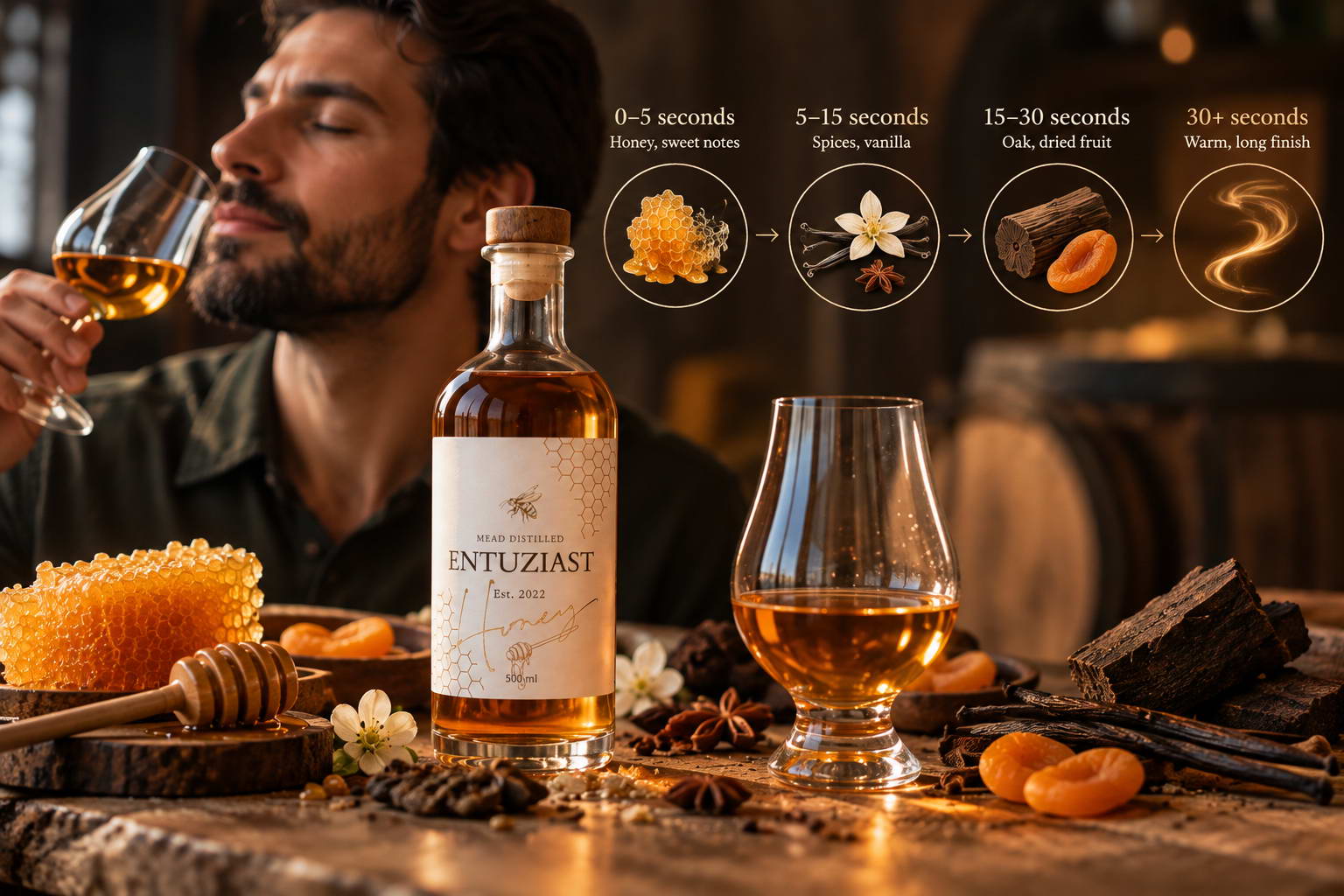
You take a sip, swallow the drink — but the flavour does not disappear.
For a few more seconds, you may still notice fruit.
Then spice appears.
After that — perhaps a touch of wood, honey, citrus or alcoholic warmth.
Only gradually do these sensations fade.
This part of tasting is called the aftertaste or finish.
For many strong spirits, the finish is just as important as the aroma or the first impression on the palate.
Sometimes the most interesting notes appear only after the drink has already been swallowed.
But why does one spirit disappear almost immediately while another remains noticeable for tens of seconds?
And does a long finish automatically mean higher quality?
Let us look at what actually determines the aftertaste of a spirit.
What Is Aftertaste in Simple Terms?
Aftertaste is the combination of flavour, aroma and tactile sensations that remain after the drink has been swallowed — or spat out during professional tasting.
A person may continue to perceive:
- sweetness;
- acidity;
- bitterness;
- astringency;
- warmth;
- fruit notes;
- herbs;
- spices;
- wood;
- vanilla;
- honey;
- citrus;
- nutty or dried-fruit nuances.
Together, these sensations form what tasters call the finish.
Aftertaste Is Not Only What the Tongue Feels
This is one of the most important things to understand about tasting.
When we talk about “taste,” a large part of the experience is actually created by the sense of smell.
After a sip, volatile aromatic compounds continue to reach the olfactory receptors from the mouth.
This is called retronasal perception.
That is why, even after the liquid has left the mouth, a person may still clearly perceive:
- apple;
- pear;
- vanilla;
- juniper;
- smoke;
- spices;
- dried fruit.
This is not simply “flavour sticking to the tongue.”
It is the result of taste, smell and tactile perception working together.
Why Can New Notes Appear After the Sip?
Because the conditions of perception change.
Before drinking, we mainly evaluate aroma through the nose.
During the sip, the spirit comes into contact with the entire mouth, warms up, mixes with saliva, and volatile compounds reach the olfactory receptors more actively.
This can make the aromatic composition feel quite different.
For example, a drink may seem mostly woody in the glass.
After swallowing, dried fruit, honey or vanilla may suddenly become more obvious.
This is one reason why judging a strong spirit only by its aroma is not enough.
What Do “Short,” “Medium” and “Long” Finish Mean?
These terms are used to describe, approximately, how long the character of the drink remains noticeable after the sip.
There is no universal strict time scale that applies equally to every category of alcohol.
The terms are usually relative.
A short finish means the main notes fade quickly and almost disappear.
A medium finish means the character remains identifiable for a while before gradually fading.
A long finish means the aromatic and flavour impression remains noticeably longer and may even evolve over time.
In complex spirits, the finish can sometimes develop in stages: one note appears first, followed by another.
What Determines the Length of the Finish?
There is no single reason.
The finish is influenced by several factors at the same time:
- the composition of aromatic compounds;
- alcohol strength;
- raw material;
- fermentation;
- distillation;
- botanicals;
- maturation;
- tannins;
- texture;
- serving temperature;
- the amount of added water;
- individual sensory sensitivity.
This is why two spirits with the same alcohol strength can have completely different finishes.
Does Alcohol Strength Matter?
Yes, but not in a simple way.
Higher strength often increases the sensation of warmth and can help maintain the intensity of some aromatic components for longer.
But high alcohol strength alone does not guarantee a long and pleasant finish.
If the alcohol is too aggressive, the only thing that remains may be burning heat.
That is technically a long-lasting sensation, but it tells us very little about the aromatic complexity of the spirit.
When evaluating a finish, it is important not only to ask how long it lasts, but also what exactly remains.
Is Long Alcohol Burn the Same as a Long Finish?
Alcoholic warmth is technically part of the finish.
But when tasters talk about a good long finish, they usually mean more than just heat.
The value comes from the continuation of the spirit's character:
- fruit;
- spices;
- honey;
- juniper;
- oak;
- vanilla;
- nuts;
- flowers;
- other recognisable notes.
If only sharp alcoholic burning remains, the sensory result is quite different.
Why Do Aromatic Compounds Remain After the Sip?
Different volatile compounds behave differently.
Some evaporate quickly and create a bright first impression.
Others are less volatile and appear more slowly.
Some compounds also remain for a short time on the surfaces inside the mouth or in the thin layer of liquid left after swallowing.
They continue to evaporate gradually.
This is why the finish can last much longer than the actual contact of the liquid with the tongue.
Why Do Oily or Rich Spirits Often Seem to Have a Longer Finish?
Texture also affects perception.
If a spirit feels dense, oily or viscous, aromatic and flavour compounds may remain in the mouth for longer.
This can make the finish feel richer and more persistent.
But this is not a universal rule.
A light-textured distillate can still have a very long aromatic finish if its volatile profile is complex and well balanced.
What Role Does Fermentation Play?
A very important one.
Fermentation produces much more than ethanol and carbon dioxide.
Yeast creates many secondary aromatic compounds, including:
- esters;
- higher alcohols;
- organic acids;
- aldehydes;
- other volatile compounds.
Some of these remain in the finished spirit after distillation and influence not only the aroma, but also the finish.
This is why an aromatic distillate may leave a fruity or floral impression even when fruit was never used in the recipe.
Why Does Distillation Affect the Finish?
During distillation, the producer effectively shapes the aromatic composition of the future spirit.
Different compounds behave differently during evaporation and condensation.
The design of the still, distillation regime and fraction selection all affect which volatile substances reach the final distillate.
When the goal is an aromatic spirit, the aim is not to remove everything except ethanol.
The desirable character of the raw material and fermentation must also be preserved.
These compounds later contribute to the finish as well.
What Does Oak Maturation Add?
Oak can change the finish significantly.
During maturation, compounds are extracted or formed that may create associations with:
- vanilla;
- spices;
- wood;
- caramel;
- nuts;
- dried fruit;
- toast;
- coffee.
Oak also contributes tannins, which influence structure and astringency.
This is one reason aged spirits often feel more complex and drier in the finish than young distillates.
What Are Tannins in the Finish?
Tannins are natural polyphenolic compounds that can enter the spirit from wood.
They create a characteristic drying or astringent sensation.
A similar effect can be experienced with strong tea or red wine.
In moderation, tannins can make the finish feel drier, more structured and longer.
If there are too many, the aftertaste may become rough, excessively astringent or bitter.
So once again, a long finish is not automatically a good finish.
An Example: Honey Spirit Aged ENTUZIAST
In Honey Spirit Aged ENTUZIAST, the finish is formed by several layers at once.
The spirit has an alcohol strength of 43%, and its character is built around honey distillate and oak maturation.
Honey, wax, spice, vanilla and warming woody notes all contribute to the way the drink develops after the sip.
So what remains is not simply alcoholic warmth.
The honeyed, spicy and oak-derived components continue to work together and create a developing finish.
Does Gin Have a Finish Too?
Of course.
In gin, the finish is often built around botanicals.
It may leave notes of:
- juniper;
- citrus peel;
- coriander;
- herbs;
- spices;
- floral components.
Some botanical notes can be especially noticeable after the sip.
This is why judging gin only by smelling the bottle or even the glass means missing part of its full profile.
Why Does Bitterness Often Last Longer?
Bitter and spicy sensations can be quite persistent.
This is why drinks with botanicals, oak, spices or certain plant components can have a dry and lasting finish.
A slight bitterness can add structure.
But if it becomes sharp and overwhelms everything else, the balance is lost.
Why Can a Sweet Drink Have a Short Finish?
Sweetness alone does not guarantee persistence.
A drink can be very sweet and intense in the mouth but lose its aroma quickly after swallowing.
Conversely, a dry distillate may leave a long aromatic trail.
The duration of the finish depends on the entire composition, not on one characteristic.
Does Serving Temperature Affect the Finish?
Yes.
Low temperatures reduce the volatility of many aromatic compounds.
As a result, a very cold drink may seem softer, but the details of its finish can be harder to perceive.
As the temperature rises, aromatic compounds become more active.
This is why excessive chilling is not always helpful when carefully tasting a complex spirit.
Can Water Change the Finish?
Yes, sometimes quite noticeably.
A small amount of water lowers the alcohol strength and changes the behaviour of aromatic compounds.
As a result, the finish may:
- become softer;
- lose some alcoholic burn;
- reveal new fruity or floral notes;
- become shorter if the drink is over-diluted;
- change the balance between aroma and texture.
This is why water is best added gradually.
We discuss this method in more detail in the article “Should You Add Water to Strong Spirits?”.
Why Can Too Much Water Shorten the Finish?
When a drink is heavily diluted, the concentration of aromatic and flavour compounds decreases.
The spirit may lose density and intensity.
This is why excessive dilution can make a drink feel “empty.”
The finish may then become weaker and shorter.
This is another reason to add water a few drops at a time and compare the result.
Does Time in the Glass Affect the Finish?
Yes.
Immediately after pouring, alcoholic vapours may dominate the aroma.
After a few minutes, some of the sharper vapours disperse, the temperature stabilises, and the aromatic profile becomes easier to read.
This affects more than the nose.
When the aromatic structure becomes clearer, it is also easier to understand what continues into the finish.
This is why a complex distillate often benefits from a few minutes of rest in the glass.
We explore this topic separately in “Why Should You Let Strong Spirits Rest in the Glass?”.
Does Sip Size Matter?
Yes.
A large sip of strong alcohol is more likely to overwhelm the receptors and produce a stronger sensation of alcoholic heat.
Subtle aromatic details can become harder to notice.
For tasting, smaller sips are usually better.
This makes it easier to distribute the drink across the mouth, evaluate texture and follow the development of the finish calmly.
Why Do the First and Second Sips Feel Different?
The first sip often acts as a kind of adaptation.
The receptors are suddenly exposed to alcohol, temperature and the overall intensity of the drink.
The next small sip may feel calmer.
It becomes easier to focus on details.
This is why it is not always useful to make a final judgement about the finish based only on the first sip.
Does Glassware Affect the Finish?
Indirectly, yes.
Glass shape has a stronger effect on aroma before the sip, but the overall sensory experience works as one system.
If the glass helps concentrate aromas more effectively, it becomes easier to recognise which notes continue into the finish.
In a wide open glass, aroma disperses more quickly.
In a tasting glass with a narrower opening, it remains more concentrated.
Can the Finish Change Over Time?
Yes, and this is one of the things that makes complex spirits interesting.
The finish may develop in stages.
For example:
- immediately after the sip — honey and warmth;
- a few seconds later — spices;
- then — oak and vanilla;
- at the end — dry spice or a light fruit note.
This kind of development is often described as a layered or complex finish.
What makes it interesting is not only its duration, but also the way its character changes over time.
Does a Long Finish Always Mean High Quality?
No.
This is a very common simplification.
A long finish can be pleasant, complex and harmonious.
But it can also consist of excessive bitterness, aggressive oak or alcoholic burn.
Likewise, a shorter finish does not automatically make a drink poor quality.
Some lighter styles are intentionally designed to be fresh, clean and quick.
It is more useful to evaluate:
- length;
- cleanliness;
- pleasantness;
- complexity;
- balance;
- whether the finish suits the style of the drink.
What Does a “Clean Finish” Mean?
A clean finish is one in which no unwanted sensations appear and disrupt the overall profile.
The aromatic notes fade in a logical and consistent way.
The drink does not leave a harsh chemical note, rough bitterness or unpleasant burning that does not fit its style.
Cleanliness of the finish is often more important than record-breaking length.
What Is a Dry Finish?
“Dry” does not necessarily mean that sweet aromas are completely absent.
It describes the overall sensation after the sip.
In a dry finish, obvious sweetness may be limited while other characteristics become more noticeable:
- wood;
- spices;
- juniper;
- tannins;
- herbs;
- mineral or spicy nuances.
Vanilla or fruit aromas may still remain.
What Is a Warm Finish?
This describes the gradual sensation of warmth after the sip.
For strong spirits, this is completely natural.
A good warm finish usually feels smooth and controlled.
It does not have to become sharp burning.
It is especially interesting when the warmth is accompanied by continuing aromatic notes.
How Should You Evaluate the Finish?
Try a simple sequence.
- Pour a small amount of the drink.
- Let it rest for a few minutes.
- Evaluate the aroma first.
- Take a small sip.
- Do not immediately take another one.
- Pay attention to the first sensations after swallowing.
- Notice which notes remain after several seconds.
- Observe whether the character of the finish changes.
- Evaluate not only length, but also pleasantness and balance.
The most important thing is to give yourself time.
Do You Need to Count the Seconds?
For everyday tasting, no.
A stopwatch will not necessarily make the analysis more useful.
It is often better to compare several drinks.
One disappears almost immediately.
Another remains much longer.
A third changes character several times.
These comparisons gradually build sensory memory.
Why Do Different People Judge the Finish Differently?
For the same reasons they perceive aroma differently.
People differ in:
- receptor sensitivity;
- aroma memory;
- attention;
- experience;
- sensitivity to bitterness and astringency;
- sensitivity to alcohol.
This is why one person may call the finish long while another describes it as medium.
That is normal, as long as the overall description remains coherent.
Why Is the Finish Especially Important in Aged Distillates?
Because the interaction between the base distillate and the barrel often becomes especially clear after the sip.
At first, honey, fruit or grain may dominate.
In the middle, the alcohol structure becomes more noticeable.
Then, in the finish, oak, spices, vanilla, dried fruit or tannic dryness may remain.
The finish often shows whether these components are integrated or simply sitting next to each other.
In Short: What Determines the Length of the Finish?
- The composition of volatile aromatic compounds.
- Alcohol strength and balance.
- Raw material and fermentation.
- Distillation style.
- Botanicals in gin and similar drinks.
- Oak maturation and tannins.
- The texture of the spirit.
- Serving temperature.
- The amount of added water.
- The individual perception of the taster.
Conclusion
Aftertaste is not simply the residual flavour left after a sip.
It is a separate stage of tasting in which taste receptors, retronasal aroma, texture, alcoholic warmth, tannins and aromatic compounds continue to work together.
This is why a good finish can develop gradually: fruit gives way to spice, then wood, honey, vanilla or dry herbal notes.
Its length depends on raw materials, fermentation, distillation, maturation, alcohol strength, temperature and many other factors.
But the longest finish is not automatically the best one.
What matters more is whether it is clean, balanced, pleasant and consistent with the character of the drink itself.
So next time you take a sip, do not immediately rush into the next one.
Wait a few seconds. Sometimes the most interesting part of a spirit begins only after the glass has already left your lips.