





Why Can One Spirit Feel Softer Than Another at the Same Alcohol Strength?
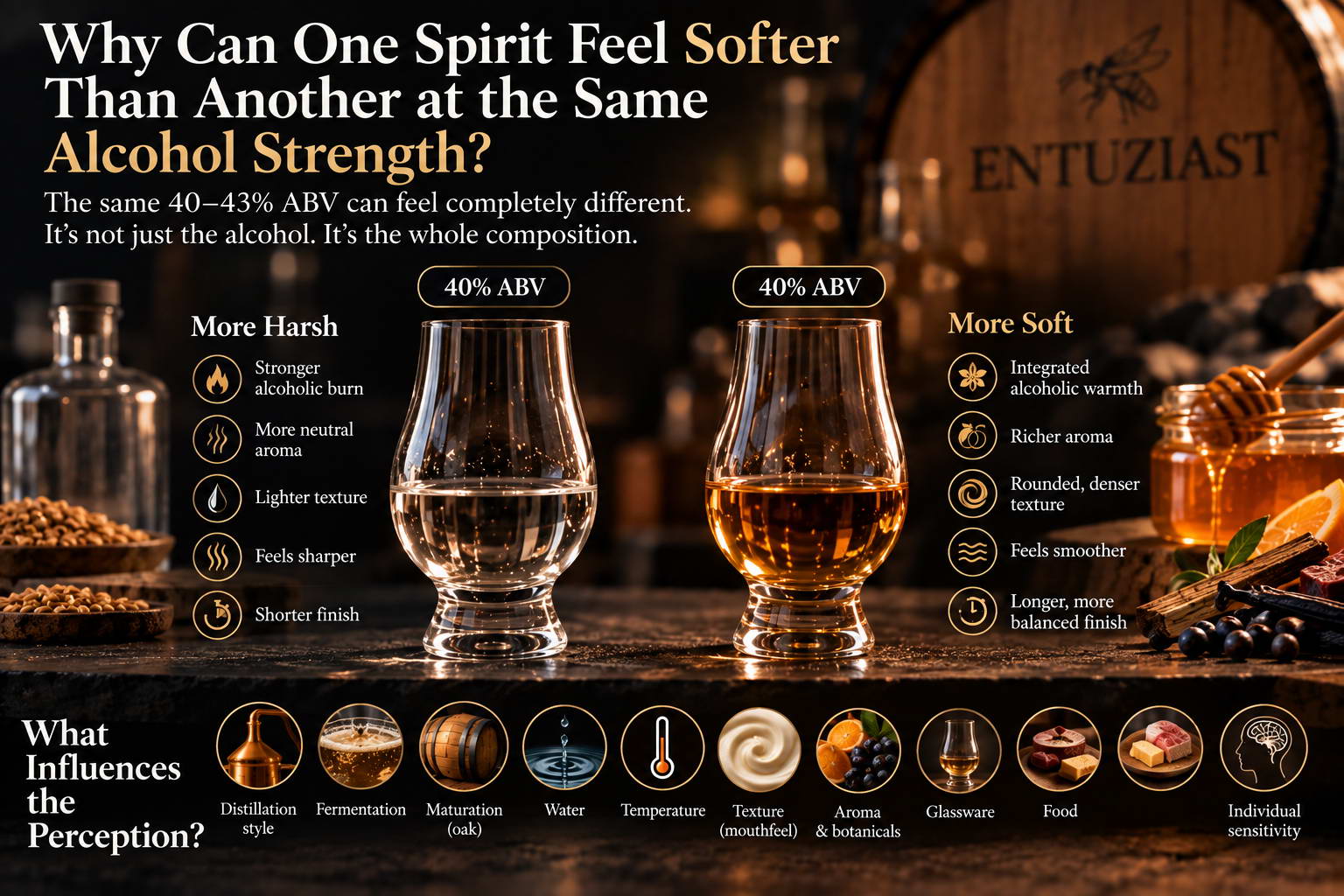
Two bottles show the same number on the label.
For example — 40%.
Or 43%.
You take a sip of the first drink, and it feels sharp, burning and strongly alcoholic.
You try the second one — and the same 40–43% feels noticeably softer.
Sometimes so much softer that you feel like checking the label again.
How is that possible if the alcohol concentration is almost the same?
The answer is simple: ABV tells you how much ethanol is present, but it does not describe the entire sensory character of the drink.
How “soft” or “harsh” a spirit feels depends on many things at once: aroma, temperature, texture, volatile compounds, water, distillation style, maturation and even the size of the sip.
So the same strength does not mean the same experience.
What Does “Smooth” or “Soft” Alcohol Actually Mean?
In tasting, the word “soft” does not refer to one measurable laboratory parameter.
It is a sensory description.
A spirit is usually described as soft when:
- alcoholic burn does not dominate;
- warmth develops gradually;
- there is no sharp ethanol attack;
- the texture feels rounded;
- the aroma is not overwhelmed by alcohol;
- the finish remains clean and balanced.
So “softness” does not mean the absence of alcohol.
It describes how well the alcohol is integrated into the overall profile.
What Does 40% or 43% ABV Actually Mean?
ABV — alcohol by volume — shows the proportion of ethanol in the drink by volume.
If a bottle says 40% ABV, approximately 40% of its volume is ethanol.
But the rest of the drink is not simply “nothing.”
It contains water and many aromatic and flavour compounds in much smaller concentrations.
Those compounds strongly influence how the same 40% alcohol is perceived.
Why Does Ethanol Burn in the First Place?
Ethanol affects receptors involved in the perception of heat and irritation.
This is why strong alcohol can create sensations such as:
- warmth;
- burning;
- tingling;
- dryness;
- irritation of the mouth.
But how much attention we give to that sensation depends on the rest of the sensory profile.
If alcoholic warmth is well integrated with aroma, texture and finish, the same ABV can feel much softer.
Why Can Two Drinks of the Same Strength Burn Differently?
Because our receptors interact with the actual liquid, not with the number printed on the label.
Perception is influenced by:
- ethanol concentration;
- other volatile compounds;
- temperature;
- acidity;
- texture;
- aroma;
- oak-derived components;
- botanicals;
- the amount of water;
- individual sensitivity.
So equal ABV is only one shared characteristic between two drinks, not a guarantee of identical sensory behaviour.
What Role Does Distillation Play?
A very important one.
During distillation, the producer is not simply obtaining ethanol.
They are shaping the aromatic and structural character of the final spirit.
Different volatile compounds evaporate and condense in different ways.
This means that factors such as the following matter:
- the type of still;
- distillation speed;
- temperature regime;
- fraction selection;
- the number of distillation runs;
- the producer’s chosen style.
As a result, two spirits with the same ABV can differ greatly in aromatic intensity and perceived sharpness.
Does Multiple Distillation Automatically Make a Spirit Softer?
Not necessarily.
Repeated distillation can make the alcohol base cleaner and lighter in style.
But along with unwanted compounds, some raw-material character may also be reduced.
The goal of a good distillate is not simply to make it as neutral as possible.
The real challenge is finding a balance between:
- cleanliness;
- aroma;
- texture;
- structure;
- alcoholic warmth.
What Is “Alcoholic Harshness”?
This usually describes a situation where ethanol stands out too strongly.
Instead of first noticing the character of the drink, the taster mainly experiences:
- a sharp alcoholic smell;
- burning;
- tingling;
- dryness;
- aggressive warmth.
The aromatic part of the drink moves into the background.
A smooth spirit does not necessarily contain less alcohol.
It simply does not make the alcohol feel separate from everything else.
Does Fermentation Matter?
Yes.
Fermentation produces more than ethanol.
During yeast activity, many secondary compounds are formed, including:
- esters;
- higher alcohols;
- acids;
- aldehydes;
- other aromatic compounds.
Some of these compounds later pass into the distillate.
They can affect aroma, texture and the overall impression of sharpness or roundness.
This is why the quality and character of fermentation still matter after distillation.
Are “Fusel Notes” and Softness the Same Issue?
No.
In everyday speech, the term “fusel” is often used very broadly for almost any heavy, harsh or unpleasant alcoholic smell.
In reality, a distillate contains many different compounds.
Some higher alcohols and related components are a natural part of fermentation and distillation.
The important thing is not simply whether they exist, but whether they are in balance.
A compound that adds character in the right amount can create roughness when present in excess.
Why Does Aroma Affect the Perception of Strength?
The brain does not assess alcoholic burn separately from smell.
If the spirit contains many pleasant aromatic signals, attention is distributed among them.
These may include:
- fruit;
- honey;
- vanilla;
- juniper;
- citrus;
- spices;
- wood.
As a result, alcohol may seem less dominant.
This is why an aromatic 43% distillate can sometimes feel softer than a more neutral spirit with a lower ABV.
Why Do Sweet Aromas Create an Impression of Softness?
Vanilla, caramel, ripe fruit and honey are strongly associated with soft and sweet foods.
Even when there is almost no actual sugar present, these aromas can make the overall profile seem more rounded.
The brain effectively adds a familiar sense of “sweetness” to the sensory picture.
This can make alcoholic warmth feel less aggressive.
Can Real Sugar Also Mask Alcoholic Harshness?
Yes, it can.
Sweetness can change the overall sensory balance and make alcohol less noticeable.
This is why a liqueur with fairly high ABV may sometimes feel much easier to drink than a dry spirit of the same strength.
But this does not mean there is less ethanol.
Its sensory impact is simply being partly masked by sweetness and aroma.
Why Can Texture Make a Spirit Feel Softer?
A dense, rounded or oily texture changes the overall character of the sip.
The drink does not feel thin or sharply alcoholic.
It moves across the tongue more slowly and can seem more integrated.
Against this background, alcoholic warmth may feel smoother and more gradual.
This is why mouthfeel is so important when evaluating the softness of strong spirits.
Does a Light Distillate Always Feel Harsher?
No.
A light spirit can be extremely clean and delicate.
But if the texture is thin and the aroma is not especially expressive, alcoholic warmth may become more obvious.
The brain simply has fewer other sensations to focus on.
Once again, softness is about balance rather than maximum density.
How Does Temperature Affect Softness?
Very strongly.
A cold drink usually feels:
- less aromatic;
- thicker;
- less sharp;
- softer.
Low temperature suppresses part of the aromatic and irritating sensory response.
This is one reason some strong drinks are traditionally served very cold.
Why Does the Same Spirit Feel Stronger at Room Temperature?
As the drink warms, volatile compounds move into the air more actively.
You notice more:
- aroma;
- ethanol vapours;
- spices;
- botanicals;
- some sharper compounds.
At room temperature, a spirit often feels more open and expressive, but the alcohol can also seem more noticeable.
Does That Mean Strong Spirits Should Always Be Served Very Cold?
No.
Cold suppresses not only harshness, but also useful aromatic detail.
At very low temperatures, it becomes harder to perceive:
- fruity esters;
- vanilla;
- floral notes;
- honey-like aromas;
- botanicals;
- subtle oak nuances.
So “softer” does not always mean “better for tasting.”
We discuss the effect of low temperature separately in the article “Can Gin Be Stored in the Refrigerator or Freezer?”.
Why Can Water Make a Spirit Feel Softer?
Because it actually lowers the concentration of ethanol.
A few drops or a small amount of water can:
- reduce burning;
- soften sharp alcohol vapours;
- change texture;
- make aromatic notes easier to notice.
The result can feel more open and less aggressive.
Why Can Aroma Become Stronger After Adding Water?
A water-and-ethanol mixture is a complex system.
When the ratio between water and ethanol changes, the behaviour of aromatic molecules changes too.
Some components may become easier to perceive through the nose.
At the same time, reduced alcohol irritation makes it easier to focus on aroma.
We explore this in more detail in the article “Should You Add Water to Strong Spirits?”.
Why Can Too Much Water Make the Experience Worse?
Because reducing alcohol concentration also reduces the overall concentration and intensity of the drink.
The spirit may become:
- thin;
- watery;
- short;
- less expressive.
The goal is not to remove alcoholic character completely.
The goal is to find a balance where alcohol does not interfere with the identity of the spirit.
How Does Oak Maturation Affect Softness?
Maturation can strongly change the way alcohol is perceived.
Oak contributes new aromatic and structural components such as:
- vanilla;
- woody notes;
- spices;
- oak lactones;
- tannins;
- toasted nuances.
At the same time, the overall integration of the distillate changes with time.
Alcohol may begin to feel less separate from the rest of the profile.
Why Are Aged Distillates Often Described as Rounded?
Because the individual sensory elements can seem better integrated.
The alcohol does not stand alone.
The oak does not stand alone.
The raw-material aroma does not stand alone.
Everything feels more like one composition.
This is what tasters often mean by roundness.
Does Any Amount of Ageing Automatically Make a Spirit Softer?
No.
Excessive oak influence can create:
- too much astringency;
- bitterness;
- hard woody character;
- excessive dryness.
In such a case, the spirit may actually become rougher.
Again, balance matters more than maximum ageing time.
An Example: Honey Spirit Aged ENTUZIAST
In Honey Spirit Aged ENTUZIAST, alcoholic warmth works together with the character of honey distillate and oak maturation.
Spicy, vanilla, woody and other barrel-derived nuances are added to the base profile.
This layered structure can make 43% ABV feel more integrated than one might expect from the number on the label alone.
In other words, we are not perceiving only 43% ethanol — we are perceiving the whole drink as one sensory system.
What About a Young Distillate?
An unaged spirit does not have an oak-derived layer that can reshape structure and aroma.
This means more attention is drawn to:
- the raw material;
- fermentation;
- distillation;
- cleanliness of the alcohol profile;
- texture.
A young distillate is therefore a useful way to evaluate the quality of the base spirit without oak influence.
An Example: Honey Spirit Pure ENTUZIAST
Honey Spirit Pure ENTUZIAST makes it possible to assess honey distillate without the masking influence of wood.
The balance between aroma, alcoholic warmth, texture and distillation cleanliness becomes especially noticeable.
Comparing a young and aged distillate is a good way to understand how strongly oak can change the perception of alcohol strength.
What Happens in Gin?
In gin, alcoholic sensation interacts strongly with botanicals.
Juniper, citrus, coriander, herbs and spices all create powerful sensory signals of their own.
One gin may feel:
- dry;
- sharp;
- strongly juniper-driven;
while another at the same ABV may feel:
- rounded;
- citrusy;
- softer;
- more aromatic.
MeadGIN ENTUZIAST and the Perception of Strength
In MeadGIN ENTUZIAST, the alcohol base works together with juniper, citrus and other botanicals.
When tasting a gin like this, it is useful to evaluate more than just alcoholic warmth.
Pay attention to:
- whether alcohol overwhelms the juniper;
- whether citrus remains noticeable;
- how spices develop;
- how smoothly the sip moves into the finish.
This is how the real integration of strength is assessed.
Does Time in the Glass Matter?
Yes.
A freshly poured strong spirit can sometimes seem harsher.
Volatile compounds are actively released into the space above the liquid.
After a few minutes:
- some of the sharpest vapours disperse;
- temperature stabilises;
- the aromatic profile becomes easier to read.
The same spirit may then seem softer and more balanced.
Should You Leave the Bottle Open to Make the Spirit Softer?
No.
It is enough to pour a small amount into a glass.
The surface area exposed to air is much larger in the glass.
There is no need to leave the entire bottle open for hours.
Why Does a Large Sip Make Alcohol Feel Harsher?
Because a larger amount of ethanol contacts the mucous membranes at the same time.
The receptors receive a much stronger signal.
The sensations that move to the foreground are:
- burning;
- warmth;
- irritation.
Subtle aromatic and textural details become harder to notice.
This is why two sips of the same spirit can feel completely different simply because of their size.
Why Does the Second Sip Often Feel Softer?
After the first sip, sensory adaptation begins.
The receptors are already familiar with:
- alcohol strength;
- temperature;
- aroma;
- texture.
The second small sip often feels calmer.
The spirit has not become weaker.
The person’s response has changed.
Why Does Food Change the Perception of Softness?
Food consumed beforehand can strongly affect sensory perception.
For example:
- fatty food can leave a coating in the mouth;
- spicy food irritates receptors;
- sweet food changes the perception of dryness;
- coffee may leave bitterness;
- acidic foods affect flavour balance.
This is why the same spirit can feel very different after dinner and during a clean tasting session.
Does Glassware Affect Softness?
Indirectly, yes.
The shape of the glass determines how strongly volatile compounds are concentrated near the nose.
If a glass concentrates ethanol vapours too aggressively, the drink may seem harsher.
If aromatic compounds are presented more evenly, the experience may feel softer.
The shape of the rim also affects how the liquid enters the mouth.
Can You Judge Quality by Softness Alone?
No.
This is a common oversimplification.
An extremely soft drink may be simple and almost neutral.
A vivid, characterful distillate may have noticeable alcoholic warmth — and that can be part of its style.
So quality should not be reduced to one question:
“Does it burn or not?”
What Matters More Than Absolute Softness?
Balance.
During tasting, it is more useful to evaluate:
- whether the alcohol profile is clean;
- whether alcohol overwhelms the aroma;
- whether the warmth suits the style;
- whether the texture is harmonious;
- whether the finish is pleasant;
- whether there is unnecessary harshness;
- whether the drink feels integrated.
Softness is only one part of the picture.
Is More Expensive Alcohol Always Softer?
No.
Price may depend on many factors:
- raw materials;
- production method;
- maturation;
- rarity;
- production volume;
- brand;
- packaging.
A high-priced spirit may intentionally be dry, spicy, tannic and powerful.
Softness is not a universal scale of price or quality.
Can 43% Feel Softer Than 40%?
Yes.
There is no contradiction in that.
If a 43% distillate has:
- better-integrated alcoholic warmth;
- a more rounded texture;
- expressive aroma;
- balanced maturation;
- a clean finish,
it can easily feel softer than a 40% product with a harsher profile.
This is why estimating alcohol strength “by taste” is unreliable.
Why Is It Risky to Judge Alcohol Strength by Softness?
Because a pleasant and well-balanced spirit can hide the sensory impact of high ABV.
A person may think:
“It barely feels strong.”
But the physical amount of ethanol has not disappeared.
Sensory softness does not mean lower alcohol strength.
The actual ABV on the label is more reliable than subjective sensation.
Why Do Different People Call the Same Spirit Soft or Harsh?
Because sensory sensitivity varies between individuals.
People respond differently to:
- ethanol;
- bitterness;
- acidity;
- astringency;
- spices;
- temperature.
Tasting experience also matters.
Someone who regularly tastes strong distillates may find it easier to separate alcoholic warmth from the aromatic profile.
A beginner may experience the same spirit as much harsher.
How Can You Compare the Softness of Two Spirits Properly?
If you want a more meaningful comparison, keep the conditions as similar as possible.
- Use the same type of glass.
- Pour approximately the same amount.
- Bring both drinks to a similar temperature.
- Give them the same amount of time in the glass.
- Take small sips.
- Drink water between samples.
- Avoid very spicy or sweet food beforehand.
This makes the difference much easier to notice.
What Should You Pay Attention to During the Comparison?
Not just the burn.
Try to evaluate:
- the aroma before the sip;
- the initial alcohol attack;
- texture;
- warmth in the middle of the sip;
- how well the aroma remains;
- the character of the finish;
- whether only alcoholic heat remains at the end.
This makes the word “soft” much more specific.
Are “Soft,” “Smooth” and “Rounded” the Same Thing?
Not exactly.
Soft — alcoholic irritation does not dominate.
Smooth — the drink moves easily and evenly across the tongue.
Rounded — the individual components are well integrated and do not have harsh sensory edges.
These qualities often appear together, but they describe slightly different aspects.
What Does a “Hot” Spirit Mean?
In tasting language, a spirit may be called “hot” when alcoholic warmth stands too far forward.
It may:
- overwhelm aroma;
- create sharp burning;
- last longer than the other flavour notes;
- make the finish feel less balanced.
This is not the same thing as a pleasantly warming character.
What Does “Pleasantly Warming” Mean?
The warmth is still noticeable, but it develops more gradually.
At the same time, other elements continue to work:
- aroma;
- spices;
- fruit;
- honey;
- oak;
- botanicals.
The warmth becomes part of the finish rather than the only sensation.
In Short: Why Can the Same Alcohol Strength Feel Different?
- ABV tells you the amount of ethanol, not the entire composition of the drink.
- Distillation determines the balance of volatile and aromatic compounds.
- Fermentation creates substances that influence aroma and structure.
- Aroma can make alcoholic warmth feel less dominant.
- A dense and rounded texture can create a softer impression.
- Cold suppresses alcoholic sharpness but also hides part of the aroma.
- Water genuinely lowers ethanol concentration.
- Oak maturation changes aroma, structure and alcohol integration.
- Sip size and time in the glass strongly affect perception.
- Individual sensitivity also varies from person to person.
Conclusion
Two drinks with the same number on the label can feel completely different.
40% is not a description of flavour.
43% is not a description of softness either.
It is simply the concentration of alcohol.
The actual sensory character is created by the entire system: raw material, fermentation, distillation, water, aromatic compounds, temperature, texture, maturation and finish.
This is why a well-integrated 43% distillate can sometimes feel softer than a harsher spirit at 40% ABV.
But it is important to remember that sensory softness does not make alcohol physically weaker.
So during tasting, it is better to ask more than simply “how much does it burn?”
Does the alcoholic warmth fit the overall composition?
Does the aroma remain clear?
Is the texture harmonious?
Is the finish pleasant?
The softness of a good distillate is not the absence of strength. It is what happens when strength stops feeling separate and becomes part of the complete character of the drink.