





Why Does Strong Alcohol Feel Warm Even at Room Temperature?
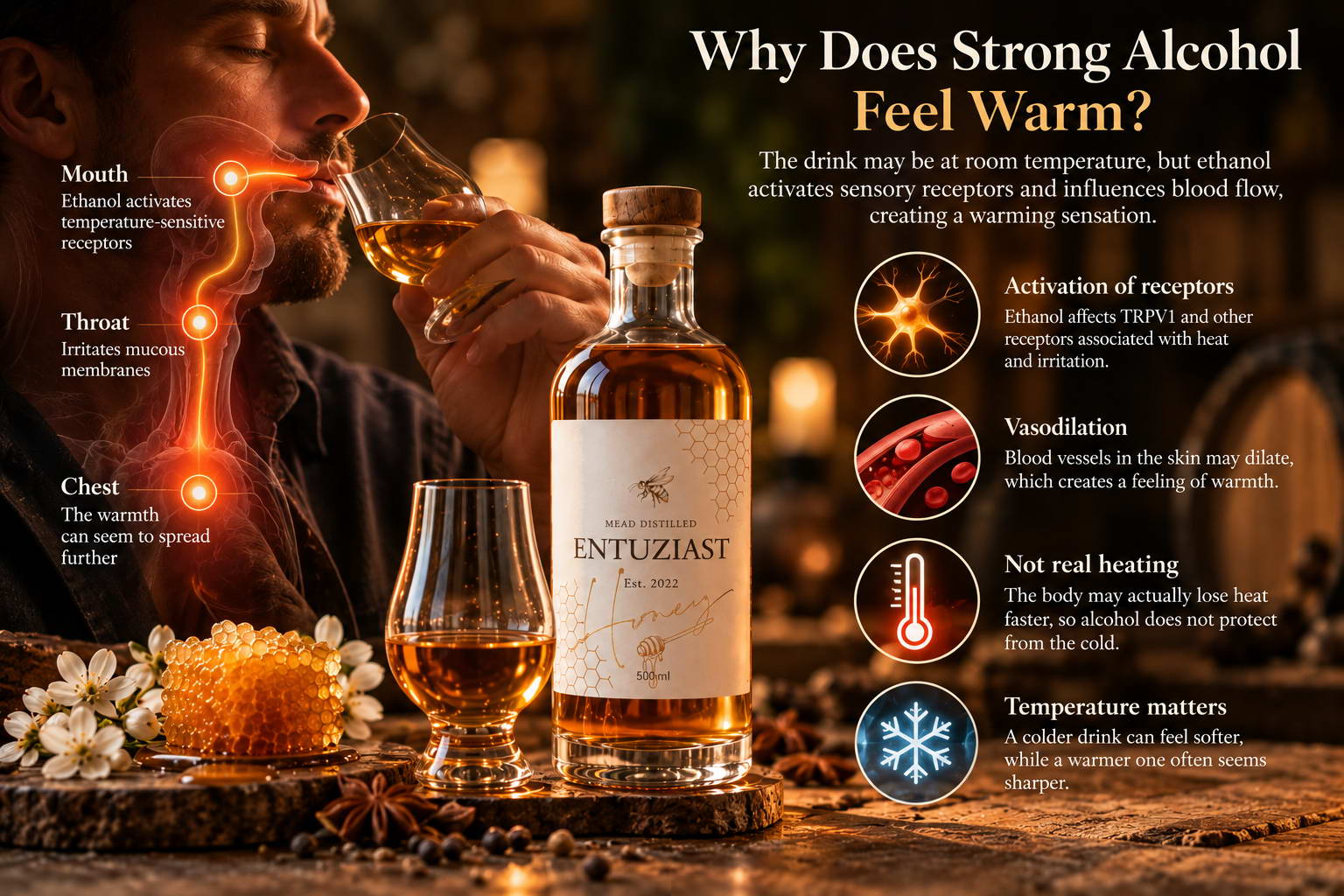
You take a sip of a strong distillate — and almost immediately you feel warmth.
First in the mouth.
Then in the throat.
A few seconds later, the warmth seems to spread further.
Yet the drink itself may be at ordinary room temperature — roughly the same temperature as water, which produces no similar sensation.
So where does that feeling come from?
The most important point is this: alcohol does not feel warm simply because the liquid itself is warm.
Ethanol interacts with receptors involved in the perception of temperature and irritation. At the same time, after alcohol enters the body, blood flow in peripheral tissues can change.
As a result, the brain receives signals that we interpret as warmth.
This is why strong alcohol can feel “warming” even when its actual temperature is not high at all.
Temperature Perception Is a Function of the Nervous System
We often think that warmth is felt only when something is physically hot.
For example, hot tea actually raises the temperature of the tissues it touches.
But human sensory perception is more complex.
The lining of the mouth, throat and other tissues contains nerve receptors that respond to:
- temperature;
- chemical substances;
- mechanical irritation;
- acidity;
- certain plant compounds.
This means that we can sometimes experience sensations of heat or cold without a major real change in tissue temperature.
Why Does Chilli Pepper “Burn” Even When It Is Not Hot?
This is a useful example of how our sensory system works.
A piece of chilli pepper may be at room temperature.
Yet the capsaicin it contains activates receptors associated with heat and irritation.
The brain receives a signal similar to the one produced by high temperature.
That is why we say it “burns.”
The mechanism with alcohol is not identical, but the general principle is similar: a chemical substance can alter the activity of temperature-sensitive receptors.
What Role Does Ethanol Play?
Ethanol is not simply a molecule that contributes to taste.
At a sufficient concentration, it irritates the mucous membranes and affects receptors associated with heat perception.
Receptor systems such as TRPV1 are involved in this process.
These receptors are well known for responding to high temperatures and capsaicin.
Ethanol can alter their sensitivity, making the normal temperature of the mouth feel “hotter.”
This contributes significantly to the characteristic burning sensation of strong alcohol.
Why Does 40% Alcohol Feel Different from 10%?
Concentration matters a great deal.
The more ethanol a drink contains, the stronger its effect on mucous membranes and temperature-sensitive receptors can generally be.
This is why:
- beer;
- wine;
- gin;
- whisky;
- brandy;
- strong distillates
can create very different sensations even when served at the same actual temperature.
However, alcohol strength is far from the only factor.
Why Can Two Drinks of the Same Strength Feel Different?
This is where things become especially interesting.
Two distillates can both be 40% or 43% ABV, yet one may feel sharp and burning while the other seems much softer.
Possible reasons include:
- the composition of volatile compounds;
- the quality and style of distillation;
- the fermentation profile;
- maturation;
- botanicals;
- texture;
- serving temperature;
- the amount of water;
- individual sensory sensitivity.
This is why ABV alone does not describe the full sensory character of a spirit.
We will explore this separately in another article: why one drink can feel softer than another even at the same alcohol strength.
Why Is the Warmth Felt So Strongly in the Throat?
When swallowed, strong alcohol comes into contact with the mucous membranes of the mouth, pharynx and oesophagus.
These areas contain many nerve endings.
That is why the sensation can seem to move together with the sip:
mouth → throat → chest.
Part of this effect comes from sensory irritation.
Another part is related to the body's broader response to alcohol.
Why Can the Face Feel Warm After Drinking?
After alcohol enters the body, peripheral blood vessels may dilate.
More blood then flows closer to the surface of the skin.
This can create sensations such as:
- warmth in the face;
- flushed skin;
- warm hands;
- a general sense of warming.
This reaction is one reason alcohol has historically developed a reputation as something that “warms you up.”
But Does Alcohol Actually Warm the Body?
This is where it is important to separate feeling warm from actually retaining body heat.
When more blood reaches the surface of the skin, a person may subjectively feel warmer.
But the body can also lose heat to the environment more quickly.
So the warming sensation caused by alcohol does not mean that the body is better protected from cold.
This is particularly important in low-temperature environments.
Why Is “A Shot to Warm Up” a Bad Idea in the Cold?
The traditional idea of drinking strong alcohol “for warmth” can be misleading.
A person may indeed feel warmer very quickly.
But dilation of surface blood vessels can increase heat loss.
At the same time, the subjective sensation of warmth may create the false impression that cold is no longer a problem.
So a person may feel more comfortable while the body is not necessarily conserving heat more effectively.
Alcohol should therefore not be treated as protection against hypothermia.
Why Can Cold Alcohol Still “Burn”?
This is a good demonstration that alcoholic warmth is not the same thing as the temperature of the drink.
A distillate straight from the refrigerator may be much colder than the room.
Yet after a sip, the characteristic burning sensation can still appear.
Cold may initially suppress some sensations, but ethanol's effect on receptors remains.
As the drink warms in the mouth, the alcoholic character often becomes more noticeable.
Why Does Alcohol from the Freezer Feel Softer?
Very low temperature suppresses part of the sensory response.
A very cold drink also becomes more viscous.
As a result, it may feel:
- softer;
- denser;
- less aromatic;
- less sharp.
But the actual concentration of ethanol has not decreased.
Only our perception has changed.
We discuss the influence of temperature in more detail in the article “Can Gin Be Stored in the Refrigerator or Freezer?”.
Why Does Warm Alcohol Seem Harsher?
The higher the temperature of the drink, the more actively volatile substances evaporate.
This includes ethanol.
As a result, alcohol vapours reach the nose more strongly from a warmer glass.
At the same time, low temperature is no longer suppressing the receptors.
This is why the same distillate can feel very different at 8 °C and at 20 °C.
Does Strong Burning Mean the Alcohol Is Poor Quality?
Not automatically.
Alcohol strength naturally creates a certain amount of warmth and irritation.
But in tasting, the character of that sensation matters.
It can feel:
- sharp;
- prickly;
- short;
- smooth;
- soft;
- warming;
- long and even.
So simply saying “this drink feels warm” is not, by itself, a judgement of quality.
What Do Tasters Mean by a “Warming” Spirit?
Usually, this is a positive description of controlled warmth.
After the sip, the spirit does not create a sudden aggressive burn, but instead produces a gradual warming sensation.
At the same time, the aromatic profile remains clear.
For example, the warmth may be accompanied by notes of:
- honey;
- spices;
- wood;
- vanilla;
- fruit;
- pepper.
This is the type of sensation often described as a pleasant “warming finish.”
An Example: Honey Spirit Aged ENTUZIAST
A good example is Honey Spirit Aged ENTUZIAST.
This is an aged honey distillate in which alcoholic warmth is combined with the character of the honey base, spice and oak-derived notes.
In this context, the word “warming” describes not the physical temperature of the liquid, but the sensory character of the sip and finish.
The sensation of warmth becomes part of the overall composition.
What About an Unaged Distillate?
An unaged spirit has no oak tannins, vanilla or other barrel-derived components, but alcoholic warmth is still present.
For example, in Honey Spirit Pure ENTUZIAST, the character is shaped mainly by the raw material, fermentation, distillation and the texture of the spirit itself.
Comparing a young and an aged distillate from the same general style can therefore be a useful way to understand how strongly oak maturation affects the perception of the same alcohol strength.
Why Do Aged Spirits Often Feel Softer?
This does not mean alcohol somehow stops being alcohol during maturation.
What changes is the overall sensory composition.
The profile gains additional elements such as:
- wood-derived compounds;
- vanilla notes;
- tannins;
- spices;
- products of slow oxidation;
- new aromatic interactions.
Against this background, the alcoholic component may feel more integrated.
This is why two spirits with the same ABV can feel completely different in terms of “softness.”
Why Do a Few Drops of Water Reduce the Burning Sensation?
The reason here is more straightforward.
Water actually lowers the concentration of ethanol.
When a small amount of water is added to a strong distillate, the effect of alcohol on the mucous membranes and sensory receptors becomes weaker.
As a result:
- the burning sensation decreases;
- the drink feels softer;
- some aromatic notes become easier to detect.
This is why a few drops of water are sometimes used when tasting strong spirits.
We explain this technique in the article “Should You Add Water to Strong Spirits?”.
Why Should You Avoid Diluting Too Much at Once?
Because water changes more than just alcoholic heat.
It changes the entire aromatic system.
A small amount may help open the aroma.
Too much can make the drink watery, weak and short.
This is why water is usually added gradually during tasting rather than poured in all at once.
Why Can Carbonated Alcohol Feel Sharper?
In carbonated drinks, another sensory factor is added to the irritation caused by alcohol.
Carbon dioxide creates its own tingling and acidic sensation.
As a result, even a relatively low-alcohol drink can feel quite intense.
This is another reason why the “sharpness” of a drink cannot be explained by ABV alone.
Does Texture Matter?
Yes.
Two drinks of the same strength can feel very different in the mouth:
- watery;
- dense;
- oily;
- velvety;
- dry;
- viscous.
This texture changes the way alcohol interacts with the mouth and how the overall “softness” is perceived.
Another article in this series will focus specifically on texture: what “oily,” “dense” or “velvety” means when describing a distillate.
Why Does the First Sip Often Feel Hotter?
The first contact with strong alcohol creates the strongest contrast.
The receptors have not yet adapted to:
- ethanol;
- temperature;
- aromatic intensity;
- texture.
After the first small sip, the next one often feels calmer.
The alcohol strength has not changed.
The perception has.
Why Does a Large Sip Burn More?
Because a larger amount of ethanol contacts a larger area of the mucous membranes at the same time.
The sensory load increases sharply.
This makes it harder to evaluate:
- aroma;
- texture;
- taste;
- finish.
This is why small sips are normally used when tasting strong spirits.
Why Can Alcohol “Burn the Nose” Before You Even Drink It?
Ethanol is volatile.
Its molecules move into the air above the drink together with the aromatic compounds.
If you inhale too deeply from a glass of strong alcohol, the alcohol vapours can create sharp irritation.
This is one reason aroma is better evaluated with short, gentle sniffs rather than pushing the nose deeply into the glass.
Why Can Alcohol Feel Softer After a Few Minutes in the Glass?
After pouring, the balance of volatile compounds changes.
Some of the most active vapours disperse.
At the same time, the spirit moves toward the temperature of the glass and the room.
Fruit, honey, botanical or oak-derived aromas may become more noticeable.
As a result, alcoholic sharpness may feel less dominant.
Can You Determine Alcohol Strength by the Warming Sensation?
Only very approximately — and not reliably.
A drink with a higher alcohol concentration may potentially feel hotter.
But so many other factors affect perception that exact ABV cannot be determined by sensation alone.
For example, a well-balanced 43% distillate may feel softer than a rough 40% one.
Temperature can also change perception dramatically.
Do All People Experience Alcoholic Warmth in the Same Way?
No.
As with aroma, sensory sensitivity varies from person to person.
One person may find a particular drink very soft.
Another may immediately experience strong burning.
Factors include:
- individual sensitivity;
- experience;
- the condition of the mucous membranes;
- serving temperature;
- sip size;
- alcohol concentration;
- sensory adaptation.
This means that perceived “softness” is always partly individual.
Why Does the Warmth Continue into the Finish?
After the liquid has been swallowed, the receptors remain active for a while.
Aromatic compounds also continue to contribute to the finish.
The warmth may therefore be accompanied by:
- pepper;
- vanilla;
- oak;
- honey;
- citrus;
- juniper.
This combination often creates the character of a “warming finish.”
Are Warmth and Aftertaste the Same Thing?
No.
Alcoholic warmth is only one part of the finish.
A good finish may include:
- continued aroma;
- taste sensations;
- warmth;
- texture;
- tannic dryness;
- light bitterness.
We explored this in detail in the previous article about what aftertaste is and what determines how long it lasts.
How Should You Evaluate Alcoholic Warmth During Tasting?
Instead of asking only “does it burn or not?”, try to notice:
- how quickly the warmth appears;
- whether it feels sharp;
- whether it develops gradually;
- where it is felt;
- how long it lasts;
- whether it overwhelms the aroma;
- whether it integrates with the finish.
This turns a simple statement such as “this spirit feels warm” into a much more precise tasting description.
In Short: Why Does Alcohol Feel Warm?
- Ethanol affects temperature-sensitive and irritation-related receptors.
- This creates burning and warming sensations even when the drink is at room temperature.
- Alcohol may also dilate peripheral blood vessels, creating warmth at the skin.
- This sensation does not mean the body is retaining heat more effectively.
- Intensity depends on alcohol strength, temperature, sip size and the composition of the drink.
- Maturation, aroma and texture can make alcoholic warmth feel more integrated and softer.
- Adding a small amount of water genuinely lowers ethanol concentration and can reduce the burning sensation.
Conclusion
Strong alcohol feels “warm” not because the liquid itself is hot.
The main factor is ethanol and its interaction with nerve receptors involved in sensing heat and irritation.
After alcohol enters the body, dilation of peripheral blood vessels can add another layer to the sensation, which is why warmth may be felt not only in the mouth and throat but also in the skin.
However, this feeling should not be confused with real protection against cold: increased blood flow near the skin can actually contribute to heat loss.
In tasting, alcoholic warmth is an important part of the drink's character.
In one distillate it may be sharp and short.
In another it may be smooth, spicy and long-lasting.
It is the interaction between strength, temperature, texture, aroma, distillation and maturation that determines how we experience it.
So when a taster says that a spirit “warms pleasantly,” they are not describing the temperature of the liquid, but a complex sensory response and the overall character of the sip.