





Why Can Alcohol Taste Sweet Even If It Contains Almost No Sugar?
You take a sip of a distillate and think: “It tastes slightly sweet.”
Then you look at the ingredients and see no sugar, no syrup and no honey added after distillation.
How is that possible?
In reality, the sensation of sweetness is much more complex than simply the presence of sugar in a drink.
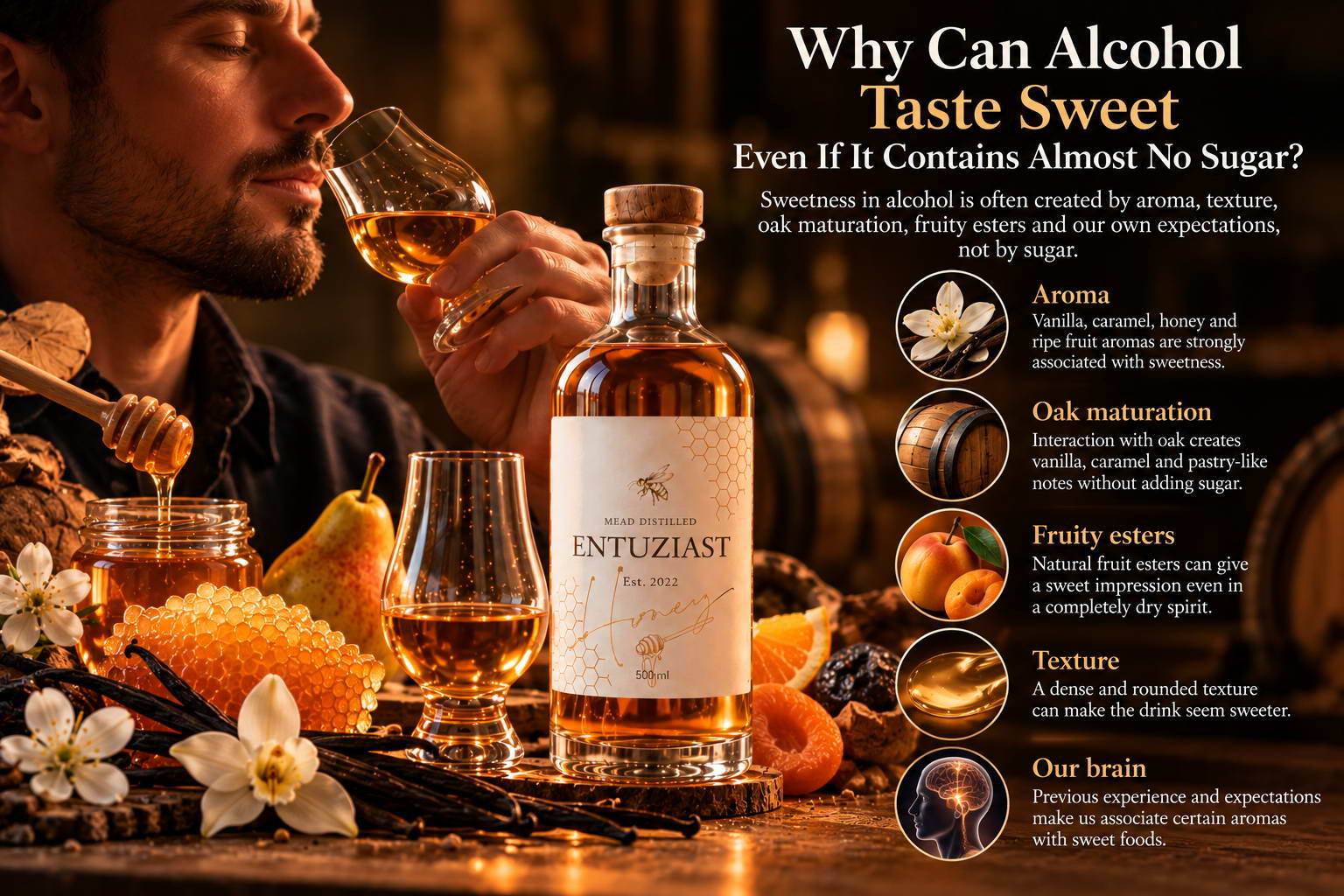
Alcohol can seem sweet because of aroma, texture, temperature, oak maturation, fruity esters and even our own expectations.
This is why a dry whisky, brandy or honey distillate may be described as “sweet,” “honeyed,” “vanilla-like” or “caramel-like” even when the actual amount of sugar is very low.
Let us look at where real sweetness ends and where aromatic illusion begins.
What Is Real Sweetness?
True sweet taste appears when certain substances activate sweet taste receptors on the tongue.
The most familiar examples are sugars:
- glucose;
- fructose;
- sucrose;
- maltose.
If a drink contains a significant amount of these substances, we genuinely perceive sweetness.
This is how liqueurs, sweet wines, syrups and sugar-containing cocktails work.
But distilled spirits are often very different.
Why Does Sugar Hardly Pass into the Distillate?
During distillation, volatile components evaporate, pass through the still and then condense.
Sugars are not volatile under normal spirit-distillation conditions.
They therefore remain mainly in the still rather than travelling with the alcohol vapour.
This means that the original sweetness of the raw material does not automatically make the final distillate sweet.
Honey is a particularly good example.
Honey Is Sweet — So Why Is Honey Distillate Not Necessarily Sweet?
The sweetness of honey comes mainly from its natural sugars.
During fermentation, yeast first converts a large part of these sugars into alcohol.
The fermented product is then distilled.
Any remaining sugars practically do not pass into the distillate with the vapour.
As a result, honey distillate may have:
- floral aromas;
- waxy nuances;
- honey-like associations;
- fruity notes;
- herbal nuances,
while still tasting dry.
ENTUZIAST has already explored this subject in the article “Why Are Honey Distillates Not Sweet?”.
So Why Does the Brain Still Say “Sweet”?
Because taste and aroma are almost never experienced separately in real life.
When we eat dessert, sweetness is usually accompanied by certain aromas.
For example:
- vanilla;
- caramel;
- honey;
- ripe fruit;
- coconut;
- cinnamon;
- biscuits and pastry.
Over many years, the brain learns to associate these aromas with sweet foods.
So when the same aromatic signals appear in a dry spirit, the brain expects sweetness.
Sometimes that expectation is so strong that the drink is described as sweet or slightly sweet even when the actual sugar content is minimal.
Vanilla Is One of the Best Examples
The smell of vanilla is almost automatically associated with sweetness.
Ice cream.
Custard.
Pastry.
Chocolate.
Desserts.
Yet the aromatic molecules responsible for vanilla aroma do not create the same sweetness on the tongue as sugar does.
In aged spirits, vanilla notes can develop naturally through interaction between the distillate and oak.
As a result, the drink smells “sweet,” and the brain partly transfers that association into the overall taste experience.
The Same Thing Happens with Caramel
Caramel aroma is strongly linked in our memory with sugar.
But caramel-like, toasted and pastry-like notes in aged distillates can arise from the heat treatment of oak and subsequent maturation.
So the aroma can resemble caramel even though nobody added a spoonful of caramel syrup to the finished drink.
The brain recognises a familiar smell — and the spirit begins to seem sweeter.
Why Do Fruity Notes Also Create a Sense of Sweetness?
Because ripe fruit is almost always associated with sugar.
If a distillate smells of:
- pear;
- peach;
- banana;
- pineapple;
- apricot;
- ripe apple,
the brain automatically recalls the taste of those fruits.
And that taste is usually sweet.
Yet the fruit itself may not have been used in the recipe at all.
Fruity esters can form naturally during fermentation and then pass into the distillate.
Can Alcohol Itself Have a Slightly Sweet Character?
Yes. The perception of ethanol is not limited to burning.
At certain concentrations, it can contribute a complex combination of:
- warmth;
- slight sweetness;
- bitterness;
- irritation.
In a real drink, however, this effect is always combined with many other aromatic and flavour compounds.
That is why people rarely identify “ethanol sweetness” as a separate sensation.
Why Can Texture Also Create an Illusion of Sweetness?
We unconsciously associate thick and rounded textures with sweet foods.
Syrup.
Honey.
Cream.
Liqueur.
So if a dry distillate feels dense, oily or rounded in the mouth, the brain may interpret it as sweeter.
Even though the amount of sugar has not changed.
This will be the subject of the next article in this series: what words such as “oily,” “dense” and “velvety” actually mean when tasting spirits.
Why Does Temperature Change the Perception of Sweetness?
Temperature affects both receptor activity and the volatility of aromatic compounds.
A very cold drink often seems:
- less aromatic;
- denser;
- softer;
- sometimes less expressive in flavour.
As the distillate warms in the glass, fruity, vanilla and honey-like notes may become more noticeable.
This can also change the subjective sense of sweetness.
Can Water Make a Dry Spirit Seem “Sweeter”?
Water obviously does not add sugar.
But it can change the balance of perception.
A small amount of water can:
- reduce alcoholic burn;
- change the behaviour of aromatic molecules;
- make fruity and floral notes easier to perceive;
- help reveal vanilla or honey-like nuances.
As a result, the drink may seem sweeter even though the actual amount of sugar remains exactly the same.
You can read more about this in the article “Should You Add Water to Strong Spirits?”.
Why Is Honey Aroma So Easy to Confuse with Sweetness?
Because almost all of our previous experience tells us:
if it smells like honey, it should taste sweet.
Distillation breaks that familiar connection.
Sugar barely passes into the distillate, while part of the aromatic character of the raw material can remain or be transformed during fermentation and distillation.
This is why a person can clearly recognise a honey-like association without experiencing the sweetness they expected.
An Example: Honey Spirit Pure ENTUZIAST
Honey Spirit Pure ENTUZIAST demonstrates the difference between the origin of a drink and its actual sweetness particularly well.
Its base is fermented honey, but the finished product is a distillate.
Its character should therefore be found not in syrup-like sweetness, but in the aromatic nuances created by the raw material, fermentation and distillation.
Honey acts as a source of character rather than as a spoonful of sugar added to the finished spirit.
What Happens After Oak Maturation?
After contact with oak, the effect can become even more interesting.
The original profile may gain aromatic associations with:
- vanilla;
- caramel;
- coconut;
- dried fruit;
- pastry;
- sweet spices.
All of these are psychologically associated with sweet foods.
This is why an aged dry distillate can sometimes seem sweeter than a young one even if the difference in actual sugar is small or nonexistent.
An Example: Honey Spirit Aged ENTUZIAST
In Honey Spirit Aged ENTUZIAST, the character of honey distillate is combined with the complex influence of oak maturation.
Woody, spicy, vanilla and wine-like nuances become part of the profile.
They can create a sense of aromatic roundness and a “sweet” character without turning the drink into something liqueur-like or syrupy.
This is why it is useful to clarify what exactly we mean when we call a spirit “sweet.”
Sweet Aroma and Sweet Taste Are Not the Same Thing
This distinction is worth remembering.
Sweet taste is created by taste receptors.
Sweet aroma comes from smells that the brain associates with sweet foods.
The two often work together, but they do not have to.
A completely dry spirit can therefore have a strongly “sweet” aroma of vanilla and fruit.
Why Can Sweetness Feel Stronger After the Sip?
After swallowing, retronasal perception becomes especially important.
Aromatic compounds travel from the mouth to the olfactory receptors.
At this point, fruity, vanilla, caramel or honey-like notes may become more noticeable.
The brain combines them with the tactile sensations of the drink, and the overall profile may seem sweeter.
Why Can the Finish Seem Sweeter Than the Sip Itself?
During the first contact, sensations such as these may dominate:
- alcohol strength;
- warmth;
- acidity;
- bitterness;
- tannins.
As alcoholic irritation gradually decreases, more delicate aromatic components can move into the foreground.
This is when vanilla, fruit or honey may suddenly become more obvious.
That can make the finish seem sweeter than the beginning of the sip.
Can Tannins Reduce the Perception of Sweetness?
They can.
Oak tannins create a dry, astringent sensation.
This works in the opposite sensory direction from rounded sweetness.
A well-balanced aged spirit can therefore contain all of the following at once:
- a sweet vanilla aroma;
- caramel-like associations;
- a dry tannic palate;
- a spicy finish.
It is precisely these contrasts that often create complexity.
Can You Determine Sugar Content Just by Tasting?
Not reliably.
A person can roughly distinguish between something very dry and something obviously sweet.
But aroma, alcohol, acidity, bitterness, temperature and texture influence perception so strongly that exact sugar content cannot be estimated by tasting alone.
For that, you need composition data or laboratory analysis.
Why Does a Fruity Spirit Often Seem Sweeter?
Associations with ripe fruit are especially powerful.
Think about the difference between:
green apple skin — and a ripe peach.
The first feels fresher, more acidic and drier.
The second feels softer and sweeter.
Different types of fruity aroma can therefore change the perceived sweetness of a drink in different ways.
Why Can MeadGIN Smell Bright and Still Remain Dry?
The same principle applies to gin.
Botanicals can create a very intense aromatic profile without adding sugar.
In MeadGIN ENTUZIAST, juniper, citrus and other botanical components create a vivid aroma, but that aroma should be considered separately from actual sweetness.
Citrus and floral notes in particular can create a sense of roundness without turning gin into a sweet drink.
Can the Name of a Drink Influence What You Taste?
Not the receptors themselves — but expectations can certainly influence the brain.
If someone is told that a drink is “honey-based,” they may expect sweetness before taking the first sip.
If a label mentions vanilla or caramel, attention is automatically directed toward those notes.
This is one reason blind tastings often produce surprising results.
Without the label, name or description, the same drink may be judged quite differently.
Can the Glass Affect Perceived Sweetness?
The glass does not add sugar.
But it changes the concentration of aromatic compounds near the nose.
If the glass shape concentrates vanilla, fruit or honey-like aromas more effectively, the overall profile may feel rounder and sweeter.
In a wide open glass, some of these aromas disperse more quickly.
So even glassware can slightly change the sensory impression.
Why Can a Spirit Seem Sweeter After a Few Minutes in the Glass?
Immediately after pouring, volatile alcohol vapours may be especially noticeable.
As some of the sharper vapours disperse, other aromas become easier to recognise:
- fruit;
- flowers;
- honey;
- vanilla;
- caramel;
- spices.
The drink has not gained extra sugar in five minutes.
The aromatic balance has simply changed.
This is one reason strong spirits can benefit from a little time in the glass.
Does “Sweet” Always Mean Something Negative?
No.
Just as “dry” does not automatically mean good.
Balance is what matters in tasting.
Aromatic sweetness can work beautifully with:
- oak dryness;
- citrus freshness;
- spice;
- juniper bitterness;
- tannic structure.
Contrast is often what makes a drink more interesting.
And Does Real Sugar Always Make a Drink More Pleasant?
No.
A small amount of sweetness can round out a composition.
But too much can mask:
- alcoholic harshness;
- faults;
- bitterness;
- a lack of aromatic complexity.
Sweetness by itself says nothing about quality.
What matters is the role it plays in the balance of the specific drink.
How Can You Tell What Exactly Feels Sweet During Tasting?
Try separating the experience into several parts.
First, the aroma.
Does it remind you of honey, vanilla, caramel or ripe fruit?
Then, the direct taste.
Is there genuine sweetness on the tongue?
Next, the texture.
Is the drink light, or rounded, oily and dense?
And finally, the finish.
What remains — sweetness, vanilla aroma, fruit, or simply warmth?
This makes it much easier to understand where the overall impression is coming from.
Why Is This Distinction Especially Important for Honey Distillates?
Because the word “honey” almost automatically creates an expectation of sweetness.
But honey distillate is not honey syrup and is not necessarily a liqueur.
Fermentation and distillation fundamentally transform the raw material.
The result can retain aromatic associations with honey, flowers and wax while remaining a dry strong spirit.
This contrast is often one of the biggest surprises for people tasting the category for the first time.
In Short: Why Can Dry Alcohol Seem Sweet?
- The brain associates vanilla, caramel, honey and ripe fruit with sweet foods.
- Fruity esters can create sweet-smelling associations without added sugar.
- Oak maturation can introduce vanilla, caramel and pastry-like aromas.
- A dense or oily texture can increase the sense of roundness.
- Temperature changes the balance between aroma and taste.
- A small amount of water can reduce alcoholic harshness and reveal “sweeter” aromas.
- Expectations and product names can also influence perception.
- Aromatic sweetness and actual sugar content are not the same thing.
Conclusion
If a dry distillate seems slightly sweet, that does not necessarily mean sugar was added.
Our perception of flavour is created by the tongue, nose, texture, temperature and brain working together.
Vanilla reminds us of desserts.
Caramel reminds us of sugar.
Ripe fruit suggests natural sweetness.
Honey aroma makes us think of a spoonful of honey.
When those notes appear in a dry distillate, the brain partly transfers familiar associations into the overall flavour experience.
This is why Honey Spirit Pure, aged Honey Spirit Aged and other aromatic distillates can have a warm, fruity, honeyed or vanilla-like character without becoming sweet liqueurs.
In tasting, sweetness is not always a question of sugar. Sometimes it is what the brain “adds” to flavour after recognising an aroma associated with something sweet.