





How to properly taste honey distillate
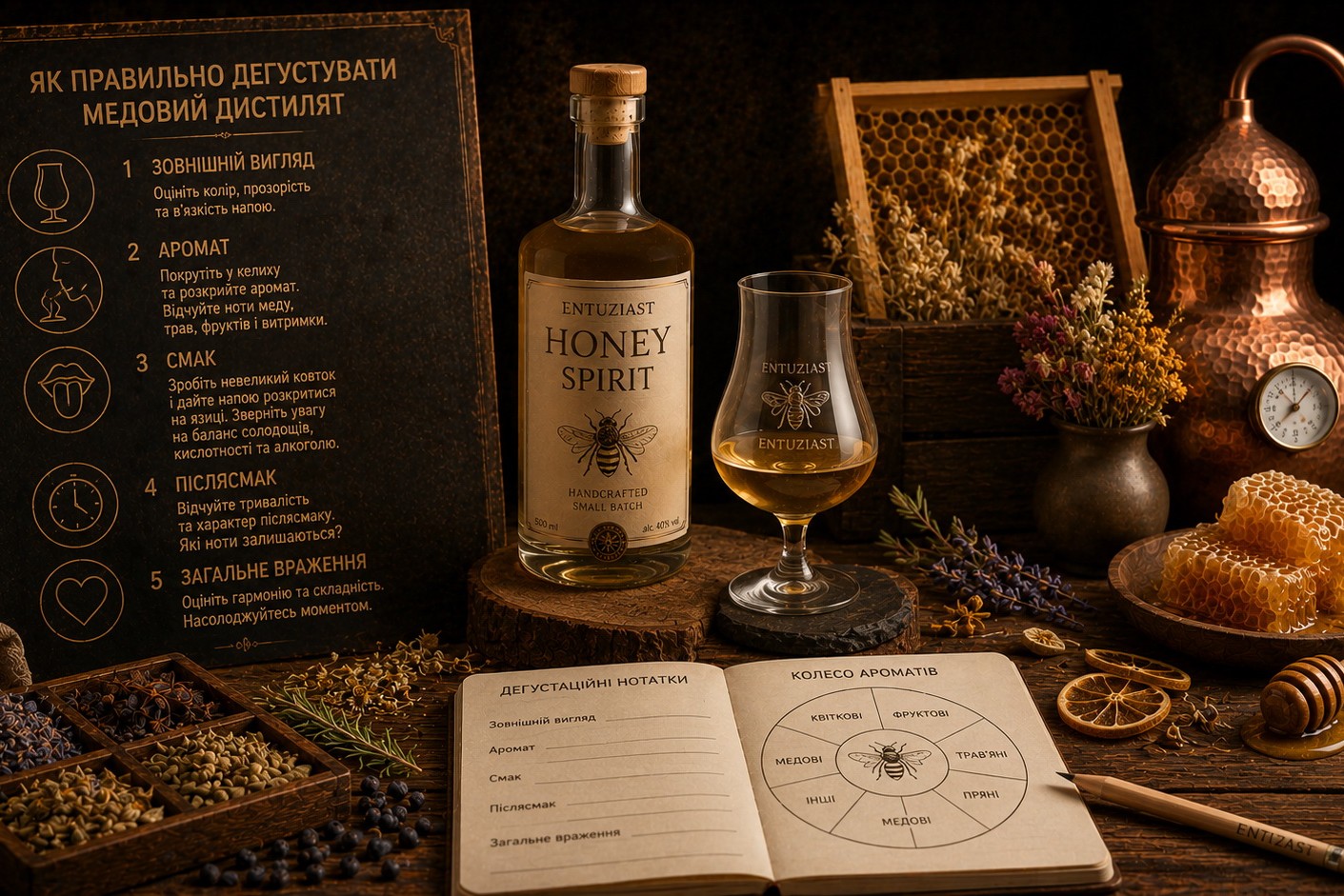
It’s best to take your time when trying honey distillate for the first time. It’s a strong drink whose character unfolds gradually: first through light, fleeting aromas, then through its texture and core flavor, with the aftertaste providing the final impression.
Honey distillate isn’t necessarily sweet. Rather than looking for the literal taste of honey, one should seek associations with wax, flowers, honeycombs, white bread, fruit, spices, wood, or creamy notes. The specific profile depends on the raw materials, fermentation, distillation, maceration, and aging.
Proper tasting helps distinguish the alcohol strength from the more subtle aromas and understand how the drink evolves in the glass. This doesn’t require complex equipment—all you need is the right glass, a comfortable temperature, and attention to your own sensations.
Tasting Is Not a Competition
During a tasting, there’s no need to try to identify every note listed in the producer’s description. Everyone has their own olfactory memory and may describe the same sensations differently.
What one taster describes as wax might remind another of honeycombs, pollen, or warm wood. A note of white bread might be perceived as baked goods, grain, or soft dough.
The main task is not to guess the correct answer, but to trace the sequence:
- what the initial aroma is;
- how the drink changes after a few minutes;
- what you sense in the first sip;
- how the mid-palate unfolds;
- what notes linger in the aftertaste.
Preparing for the Tasting
The surrounding environment affects the perception of aroma. Strong scents from perfume, food, smoke, or scented candles can mask the delicate notes of the drink.
For a tasting, it’s best to choose a quiet room free of outside scents. The glass should be clean, dry, and free of any detergent odor.
Before tasting, it’s best to avoid very spicy, sweet, or heavily spiced foods. These can temporarily alter the sensitivity of your taste buds and may make the distillate seem harsher or less distinct.
Keep a glass of clean, still water nearby. It will help refresh your palate between sips and, if needed, slightly dilute the strength of the drink in the glass.
Which Glass to Choose
A glass that tapers slightly toward the top is best suited for tasting. This shape helps trap the aroma above the surface of the drink and direct it toward the nose.
A glass that’s too wide quickly disperses the volatile components. A very narrow glass may concentrate mostly alcohol vapors, masking the more subtle notes.
The following may be suitable:
- a tulip-shaped tasting glass;
- a glass for aged spirits with a narrow top;
- a small wine glass, if no specialized glass is available;
- a stemmed glass, which prevents your palm from warming the drink.
It’s important that the glass allows you to swirl the drink easily and leaves enough space for the aroma to develop.
How Much to Pour
You don’t need a large pour for tasting. A volume that’s just enough to cover the bottom of the glass and allow you to swirl the liquid easily is sufficient.
If you pour too much, the aroma may become heavy, and the alcohol content may feel overly intense. A small portion comes into better contact with the air and gradually opens up.
Tasting involves taking small sips. The goal is to evaluate the drink, not to quickly down a standard serving.
At what temperature should honey distillate be served?
Excessive chilling dulls the aroma. The drink may seem smoother, but some of the floral, waxy, fruity, spicy, and woody notes will become less noticeable.
Conversely, a distillate that is too warm may release strong alcohol vapors that will mask the subtler flavor profile.
For a first tasting, it’s best to serve honey distillate at a moderate temperature, close to cool room temperature. The exact temperature depends on the style of the drink:
- a clear Honey Spirit may reveal its full character when served slightly cooler;
- aged distillate should be served not too chilled to preserve the oak and wine notes;
- berry and gin versions may taste fresher when moderately chilled;
- it’s best not to use ice for your first taste, as it quickly alters the temperature and alcohol content.
Why the drink needs to rest in the glass
Immediately after pouring, light alcohol vapors concentrate above the surface. If you bring the glass too close right away, they can create a sharp, harsh impression.
Let the drink sit in the glass for a few minutes. During this time, the most intense vapors will partially dissipate, and the more complex aromatic components will become more accessible.
A well-aged distillate can change particularly noticeably. At first, notes of alcohol, wood, and spices emerge; later, honey, wax, dried fruit, apples, vanilla, or wine-like nuances appear.
Letting it rest isn’t a strict rule with a set time. It’s enough to periodically return to the glass and observe how the aroma changes.
The first step: assessing the appearance
Before evaluating the aroma, examine the drink under natural or neutral lighting.
Pay attention to:
- clarity;
- color;
- intensity of the hue;
- the presence of natural sediment or cloudiness;
- how the liquid moves down the sides of the glass.
A clear distillate usually indicates an unaged style or a lack of prolonged contact with wood. A straw-colored or amber hue may indicate oak aging.
A berry-based drink can have a pink, pomegranate, or dark-fruit hue depending on the recipe and how the natural ingredients are processed.
What the “legs” on the glass can tell you
After gently swirling the glass, droplets and trails may form on the sides, slowly trickling down to the bottom. These are often called “legs” or “tears.”
The speed at which they flow down is influenced by the strength, viscosity, temperature, and cleanliness of the glass. However, this effect cannot be used to reliably determine the quality or exact age of the drink.
Slow trails may give the impression of a denser texture, but a final assessment should only be made after tasting the wine.
How to Properly Assess the Aroma
Don’t immediately plunge your nose deep into the glass. Start at a short distance and take a brief, cautious sniff.
Then gradually bring the glass closer and change the angle. Different aromatic components may be detected near different parts of the rim.
It’s helpful to evaluate the aroma in several stages:
- Without swirling—the lightest and freshest notes.
- After a light swirl—deeper aromatic components.
- After a few minutes—changes that occur upon contact with air.
- After the first sip—new notes that become more noticeable once your palate has adjusted to the alcohol content.
Inhalations should be brief. Prolonged inhalation of strong alcohol quickly fatigues the sense of smell and makes subsequent evaluations less accurate.
What aromas to look for in clear Honey Spirit
In a clear honey distillate, the main focus should be on the purity and character of the raw materials.
Possible associations:
- honey and a light floral note;
- wax or honeycombs;
- white wheat bread;
- flour or grain;
- butter;
- dry, clean alcohol notes;
- light spicy notes.
Don’t expect a bright, syrupy sweetness. The honey base may come through very subtly, especially in the finish.
What to Look for in an Aged Honey Distillate
Oak aging adds new layers to the honey profile. The aroma may unfold more slowly and evolve in the glass.
Pay attention to possible notes:
- vanilla;
- wood;
- warm spices;
- dried fruit;
- nuts;
- wax;
- honey;
- allspice;
- wine and berry notes;
- a light minerality.
It’s important to assess the balance: does the barrel support the honey-like base, or does the wood completely overpower it?
How to Take the First Sip
The first sip should be very small. It helps your taste buds adjust to the alcohol content and prepare for a more detailed evaluation.
Don’t rush to swallow. Let a small amount of the drink spread throughout your mouth. Pay attention to your first impression:
- dryness or sweetness;
- the warmth of the alcohol;
- mellow or sharp;
- lightness or density of texture;
- berry tartness;
- spiciness;
- woody astringency.
The first sip doesn’t always reveal the full character of the drink. After your palate adjusts, the second sip is often perceived as smoother and more nuanced.
How to Assess the Development of Flavor
The taste of a strong distillate can be roughly divided into several stages.
The beginning
First impression: alcoholic warmth, dryness, berry-like tartness, honeyed roundness, or fresh spiciness.
Middle
This is where the core character unfolds. In Honey Spirit, this might be honey, wax, bread, apple, spices, or wood. In MeadGIN—juniper, citrus, raspberry, or blackthorn.
Finish
Sensations after a sip: warmth, dryness, vanilla, pepper, honeycomb, berries, apples, or wine-like notes.
A high-quality, multi-layered drink doesn’t necessarily have to be as intense as possible. What’s more important is the consistency and harmony of the transitions.
What Is a Drink’s Texture
Texture is how the distillate feels in the mouth, regardless of specific aromas.
It can be:
- light;
- medium-bodied;
- full-bodied;
- oily;
- dry;
- creamy;
- warming;
- tannic.
Honey distillate is often perceived as rounded, even if it doesn’t have a sweet taste. Grainy and creamy notes can enhance this sensation.
Oak aging adds structure and dryness, while berry maceration adds acidity and astringency.
How to Assess Alcoholic Warmth
A strong drink naturally generates warmth. It can be felt in the mouth, throat, and after a sip.
It’s important to distinguish between a harmonious warmth and a sharp, burning sensation. Well-integrated strength supports the aroma and gradually transitions into the finish.
If the alcohol completely overpowers all other nuances, the drink may need more time in the glass or a few drops of water.
Personal sensitivity to alcohol strength varies, so it’s best to evaluate not the absolute strength, but the balance between alcohol and aroma.
What Is an Aftertaste
An aftertaste is the sensation that remains after a sip. It can be short, medium, or long.
It’s not just the duration that matters, but also how it develops. A long aftertaste isn’t always an advantage if it consists only of harsh wood or sharp alcohol.
In honey distillates, the aftertaste may include:
- honey and wax;
- honeycomb;
- creaminess;
- apple tartness;
- spices;
- allspice;
- vanilla;
- wood;
- berry tartness;
- juniper freshness.
It is often the finish that best reveals the influence of the honey base, oak barrels, or final aging.
Should You Add Water?
A few drops of pure, still water can alter the aroma and perception of strength. After dilution, some components come through differently, and the warmth of the alcohol becomes softer.
It’s best to add water gradually. First, taste the drink neat, then add a few drops and assess the aroma again.
Excessive dilution can make the taste watery and mask the structure. You should be especially careful with lower-proof drinks and delicate berry-flavored versions.
Adding water is not mandatory. It’s simply a way to explore how a particular distillate changes.
Should You Add Ice?
Ice cools the drink quickly and gradually dilutes it. This can reduce the sensation of alcohol strength but may also dull the aroma.
For your first tasting, it’s best to try the distillate without ice. This makes it easier to assess its original character.
Once you’re familiar with it, you can experiment with a large ice cube, which melts more slowly. This method is particularly interesting for rich, aged, or berry-based drinks.
The key is to understand that tasting with ice reveals a different version of the product, not its original profile.
Do You Need an Appetizer During Tasting?
For a detailed organoleptic evaluation, it’s best to try the drink without food first. Appetizers can alter sweetness, acidity, astringency, and the perception of alcohol.
After the main tasting, you can evaluate food pairings. The choice depends on the style:
- clear honey spirit — neutral appetizers without excessive spices;
- apple distillate — foods that complement the fruity acidity;
- aged Honey Spirit — appetizers that don’t overpower the oak, honey, and spices;
- MeadGIN—light ingredients that complement juniper, citrus, or berries.
Food that is too spicy, fatty, or sweet can make the subtle aromas almost imperceptible.
How to Taste Several Drinks in a Row
If you’re comparing several drinks, start with the lighter and less aromatic ones.
A suggested sequence might be as follows:
- clear Honey Spirit Pure;
- classic MeadGIN;
- MeadGIN Raspberry;
- Honey Spirit Apple;
- Honey Spirit Aged;
- Rich MeadGin Sloe Blackthorn.
This order isn’t a strict rule, but it helps prevent a situation where a bold berry-flavored or aged drink overpowers a more delicate one.
Drink water between samples and take short breaks. Avoid strongly flavored foods to cleanse your palate.
How to Take Tasting Notes
Brief notes help you better remember the drinks and compare them with one another.
You can use a simple structure:
- Color: clear, straw-colored, amber, pink, pomegranate.
- Initial aroma: what you notice right away.
- Aroma after resting: how the drink has changed.
- Taste: dry, sweet, spicy, berry, honey.
- Texture: light, round, creamy, full-bodied.
- Aftertaste: short, long, warming, fruity, or woody.
- Overall impression: how harmonious the composition seems.
There’s no need to use professional terms. The best notes are the ones that make sense to you.
How to Taste Honey Spirit Pure
Honey Spirit Pure should be evaluated as a clear honey distillate in which purity, the honey base, and grain notes play the leading roles.
In the aroma, look for a clean alcohol profile with a light hint of wheat dust. Give the drink a little time for the alcohol fumes to mellow.
On the palate, note the honey, white wheat bread, and butter. Appreciate how these notes harmonize with the 40% ABV.
How to Taste Honey Spirit Apple
Honey Spirit Apple has a more complex fruity and aged profile. It’s especially beneficial to let it sit in the glass for a few minutes.
The aroma may gradually reveal notes of baked apples, honey blossom, wax, and wood.
On the palate, note the freshness, spiciness, and apple tartness. After each sip, observe how long the apple and spice notes linger.
The 43% ABV supports its full-bodied character, so the first sip should be especially small.
How to Taste Honey Spirit Aged
Honey Spirit Aged combines honey distillate, three stages of distillation, and complex aging in oak and wine barrels.
Start with the aroma of wax, honey, and spices. After letting it breathe, vanilla and a light, fresh note—described in the drink’s profile as reminiscent of a sea breeze—may emerge.
The taste is mineral and warming, with honey and spicy pepper. Savor not only the first sip but also the gradual unfolding of the oak and wine nuances.
If desired, add a few drops of water to see how the aroma changes at 43% ABV.
How to Taste MeadGIN
In classic MeadGIN, start by noting the juniper. Then look for citrus notes of lemon, citron, and orange.
The taste should remain dry, spicy, and medium-bodied. The honey base may best come through in a light, creamy, and refreshing finish.
Taste it first without tonic. Later, you can add a little water or a neutral tonic to see how the juniper-citrus profile changes.
How to Taste MeadGIN Raspberry
With MeadGIN Raspberry, it’s important to assess the balance between raspberry and juniper.
In the aroma, look for spices, honey, juniper, and a fresh raspberry note. The berry should not completely mask the dry gin base.
On the palate, note the fresh raspberries, dryness, medium body, and a raspberry-honey finish.
The delicate pink color is also part of the overall experience, but the product should be evaluated primarily based on the naturalness of the aroma and its balance.
How to Taste MeadGin Sloe Blackthorn
MeadGin Sloe Blackthorn has a richer, berry-forward, and sweeter profile, so it’s best to taste it after drier foods.
First, assess the color—ranging from ripe pomegranate to dark black currants. In the aroma, look for berry jam, white pepper, and a honeyed undertone.
On the palate, note the balance between sweetness and the tartness of blackthorn. The finish may reveal notes of vanilla and honeycomb.
Its 32% alcohol content makes it milder than other products in the line, but its rich, berry-forward character calls for a leisurely tasting.
Common Mistakes During Tasting
- Pouring too much into the glass.
- Chilling the drink too much before the first assessment.
- Trying to inhale the aroma deeply right away.
- Taking large, quick sips.
- Tasting after eating spicy or very sweet food.
- Using a glass that smells like dish soap.
- Trying too hard to identify every note listed in the description.
- Comparing a delicate drink to a very rich one.
- Judging quality based solely on smoothness or color.
- Excessive consumption, which causes the taste buds to quickly lose sensitivity.
How to Tell if a Drink Is Balanced
A balanced spirit isn’t necessarily the smoothest one. It can be dry, spicy, tart, or warming, but the individual components must work together.
Signs of a harmonious composition:
- the alcohol does not mask the entire aroma;
- the honey base remains recognizable;
- the oak supports, rather than overpowers, the raw ingredients;
- the berry tartness does not become harsh;
- the sweetness does not make the taste heavy;
- the finish logically extends the main flavor profile;
- after a few minutes, the drink reveals new nuances.
Frequently Asked Questions About Tasting Honey Distillate
Should honey distillate be chilled?
It can be served slightly chilled, but excessive chilling dulls the aroma. Aged beverages are best served not too cold.
What is the best glass to use?
A glass that tapers toward the top: a tulip-shaped tasting glass or a small wine glass.
How long should the drink sit in the glass?
A few minutes is often enough for the sharp alcohol fumes to dissipate somewhat. An aged distillate may take longer to develop.
Can you add water?
Yes. A few drops can soften the strength and reveal new aromas. It’s best to add water gradually.
Should you use ice?
For your first tasting, it’s best to skip it. Ice cools and dilutes the drink, altering its original profile.
Why don’t I detect the notes mentioned in the description?
Aroma perception is subjective. Different people may describe the same nuance as wax, honeycomb, flowers, or baked goods.
Which ENTUZIAST product should I start with?
Honey Spirit Pure is a great choice for getting acquainted with a pure honey base. For a mature profile, try Honey Spirit Aged; for a fruity one, Honey Spirit Apple; and for a gin-style profile, MeadGIN.
Should you eat something while tasting?
It’s best to do your first tasting without food. After that, you can explore food pairings that don’t overpower the drink’s aroma.
The key is to give the drink time
Properly tasting honey distillate doesn’t require a complicated ritual. It’s important to choose a clean glass, avoid over-chilling the drink, pour a small portion, and take your time.
First, assess the color and subtle aromas; then let the distillate rest, take a small sip, and observe how the flavor develops. Pay attention not only to honey, but also to wax, bread, apples, berries, spices, juniper, vanilla, and wood.
In the ENTUZIAST collection, a single honey base unfolds in various styles: from the clear Honey Spirit Pure to the aged Honey Spirit Aged, an apple blend, and the signature MeadGIN.
Each of these drinks requires its own pace. Sometimes the most interesting note doesn’t appear in the initial aroma or even the first sip, but a few minutes later—when the drink has already begun to tell its story.