





From Alchemists to Distilleries: How the Alembic Came to Be
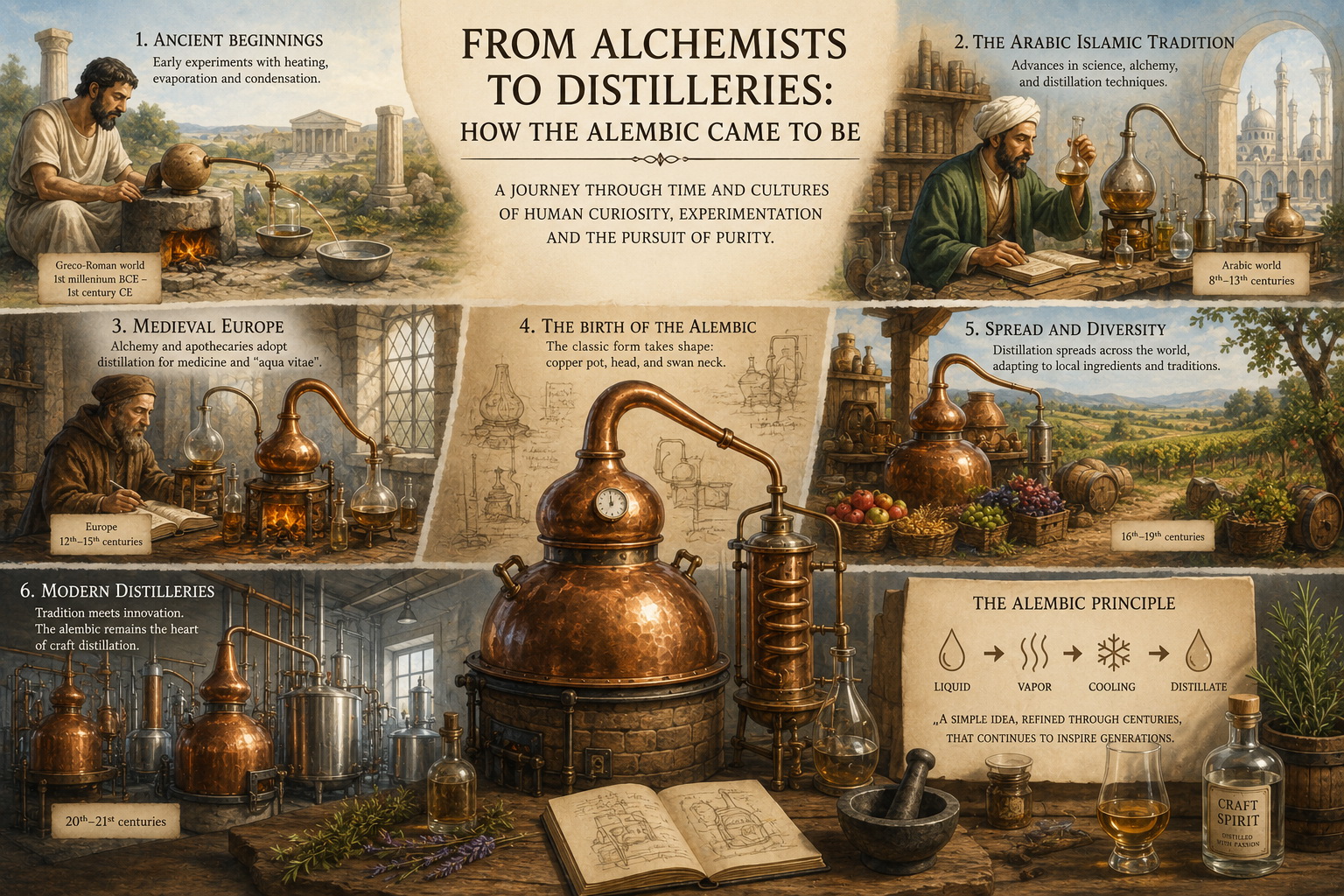
Today, the copper still with its rounded boiler, tall head, and curved pipe has become an almost universal symbol of traditional distillation.
You can see it in old engravings, museums, modern distilleries, and even on the labels of spirits.
This distinctive apparatus is commonly known as an alembic.
Its design seems so logical that it is easy to imagine someone inventing the complete apparatus in a single moment and the basic principle remaining unchanged ever since.
The real history of the alembic is much more interesting.
It was not the invention of one person or even one civilization. Its form developed gradually through centuries of experiments with heating, evaporation, cooling, and condensation.
Long before the alembic became the heart of a distillery, its ancestors were tools used by craftspeople, physicians, perfumers, and alchemists.
What Is an Alembic?
In its simplest sense, an alembic is an apparatus used for distillation.
Its purpose is to heat a liquid, collect the vapors that form, direct them toward a cooler area, and condense them back into liquid.
A classic alembic or pot still consists of several basic components:
- a boiler or pot in which the liquid is heated;
- an upper section where vapor collects;
- a vapor pipe or lyne arm;
- a cooling system or condenser;
- a vessel for collecting the resulting distillate.
The exact shape of these components can vary considerably.
But the fundamental principle remains the same: liquid → vapor → cooling → liquid again.
The Alembic Is Older Than the Culture of Drinking Spirits
Today, we almost automatically associate a still with alcoholic beverages.
Historically, however, the story was very different.
Techniques involving evaporation and condensation were used long before the widespread production of distilled alcoholic drinks.
They were applied to aromatic substances, plants, minerals, medicinal preparations, and other materials.
The ancestors of the modern alembic were therefore closer to laboratory and craft equipment than to machines designed specifically for making spirits.
Where Did the Idea of a Distillation Apparatus Begin?
One crucial observation had to be made before a practical distillation device could exist.
Vapor can become liquid again.
When hot vapor reaches a cooler surface, droplets form.
If those droplets are collected separately, the resulting liquid may have a different composition from the original mixture.
This simple observation lies at the heart of all distillation technology.
What Did the Ancient Greek Word “Ambix” Mean?
One of the linguistic ancestors of the modern word “alembic” is the Ancient Greek term ambix.
The word was associated with a vessel or component used in processes involving heating and the collection of substances produced through evaporation.
It is important not to imagine the ancient ambix as necessarily identical to the copper alembic we recognize today.
The apparatus evolved gradually.
Yet the linguistic connection helps us trace the remarkably long journey of the underlying technological idea.
What Did Early Distillation Devices Look Like?
A very simple arrangement could consist of a heated vessel and a cooler surface on which vapor condensed.
Later designs incorporated special upper sections that could collect condensate more efficiently or direct vapor toward another part of the apparatus.
The next logical step was to move the vapor away from the heat source.
Tubes or channels made this possible.
Gradually, the structure began to resemble something that can still be recognized in a modern still:
boiler → vapor chamber → pipe → cooling → distillate.
Why Is the Development of the Alembic Connected with Alchemy?
Alchemists experimented extensively with the transformation of substances.
They heated materials, dissolved them, evaporated liquids, collected condensates, and attempted to separate complex mixtures into different components.
Such work required specialized equipment.
Improving distillation apparatus therefore became a natural part of the development of alchemical practice.
The better an apparatus could contain and direct vapor, the more effectively an experiment could be controlled.
Did Jabir ibn Hayyan Invent the Alembic?
Popular accounts sometimes credit the medieval scholar Jabir ibn Hayyan, known in the Latin tradition as Geber, with inventing the alembic.
That claim oversimplifies the history.
Distillation principles and apparatus existed earlier, and their development resulted from contributions made across many cultures and generations.
At the same time, the body of writings associated with Jabir and the wider Arabic-Islamic alchemical tradition played an important role in the development of laboratory methods.
It is therefore more accurate to speak of a long evolution of distillation technology rather than a single inventor of the alembic.
Why Was the Medieval Islamic World Important to Distillation?
Medicine, pharmacy, perfumery, and experimental work with substances developed extensively in the medieval Islamic world.
The production of aromatic waters and essences from botanical materials was particularly important.
Distillation was extremely useful for this purpose.
The shapes of vessels, methods of sealing connections, ways of directing vapor, and techniques for cooling it were gradually improved.
This scientific and craft tradition became an important stage in the development of distillation technology.
How Did “Al-Anbiq” Become “Alembic”?
Words traveled between cultures together with scientific texts and technological knowledge.
The Greek ambix entered Arabic usage in the form al-anbiq.
Over time, the Arabic article al- was absorbed into the word as it passed into European languages.
Through Medieval Latin and other European languages, forms close to the modern word alembic developed.
Even the name of the apparatus therefore preserves traces of the journey the technology made between civilizations.
How Did the Alembic Reach Medieval Europe?
During the Middle Ages, European scholars translated many scientific and medical works circulating in the Arabic-speaking world into Latin.
Along with mathematics, astronomy, and medicine came descriptions of laboratory techniques and apparatus.
Distillation gradually became an important part of European alchemy and apothecary practice.
Within this environment, distillation equipment was increasingly used to process wine and produce concentrated alcohol.
Why Did Medieval Apothecaries Need Alembics?
Alcohol proved to be an exceptionally useful substance.
It could dissolve many compounds found in botanical materials and could be used to prepare tinctures and medicinal extracts.
For this reason, distilled alcohol remained closely connected with medicine for a long time.
A still might be found not in a distillery but in a laboratory or apothecary workshop.
Strong alcohol was only beginning its long transition from medicinal substance to a major category of beverages.
Why Was Distilled Alcohol Called the “Water of Life”?
In medieval Europe, distilled alcohol became known by the Latin expression aqua vitae — “water of life.”
The name reflects how extraordinary this concentrated liquid appeared to people at the time.
It was credited with medicinal properties and used as a base for numerous preparations.
The concept of a “water of life” later appeared in the naming traditions of spirits in several cultures.
When Did the Alembic Become a Tool for Making Drinks?
This happened gradually.
As distillation became better understood and the necessary equipment became more accessible, the technology moved beyond alchemists and apothecaries.
Craft producers began distilling whatever suitable fermented materials were readily available in their regions.
Wine-producing areas worked naturally with wine, grain-producing regions with fermented grain, and fruit-growing areas with fermented fruit.
The alembic was leaving the laboratory and becoming production equipment.
Why Did Copper Become the Traditional Material for Alembics?
Copper has several properties that make it exceptionally useful for distillation equipment.
It:
- conducts heat efficiently;
- can be shaped relatively easily;
- allows complex rounded components to be manufactured;
- can be repaired;
- interacts with certain undesirable sulfur-containing compounds.
The last property is especially important in the production of alcoholic distillates.
Copper is therefore more than simply a convenient construction material. It can actively influence the chemistry and aromatic character of the distillation process.
Why Does a Classic Alembic Have a Rounded Shape?
The rounded shape of a traditional copper still did not develop purely for aesthetic reasons.
Curved structures are practical for heating and handling internal pressure, while copper sheets can be formed effectively into rounded surfaces.
Over time, distillers also learned that the geometry of the apparatus influences the distillation itself.
Vapor rises inside the still, contacts the walls, partially condenses, and may return to the boiler.
The shape of the head and neck can therefore influence which components eventually reach the condenser.
What Is the Purpose of the Alembic Head?
The characteristic upper section of a pot still may be described as the head, helmet, or dome.
It collects the vapors produced as the liquid is heated.
But its function goes beyond simply collecting vapor.
Its shape and volume affect natural reflux — the partial condensation of vapor inside the apparatus.
Even relatively small changes in geometry can therefore influence the character of the resulting distillate.
Why Does an Alembic Have a Long Curved Pipe?
Once vapor leaves the upper section of the still, it must travel toward the cooling system.
The vapor pipe or lyne arm provides this path.
Different designs may use different lengths, diameters, and angles.
These dimensions are not necessarily neutral.
Some vapor can condense before reaching the main condenser and flow back toward the pot.
The path followed by the vapor can therefore contribute to the distinctive behavior of a particular still.
How Was Vapor Cooled Before Modern Condensers?
To collect a distillate, vapor must be converted back into liquid.
The simplest solution is to use a cooler environment or cold water.
Historical designs often directed a tube through a container filled with cold water.
Later, the tube could be formed into a coil, increasing the surface area exposed to the cooling medium.
This led to increasingly efficient condensation systems.
Why Did the Shape of the Alembic Become Part of the Recipe?
With experience, distillers noticed something important.
Two stills could process the same raw material and yet produce noticeably different spirits.
Neck height, head shape, copper surface area, the angle of the vapor pipe, and heating intensity all influence vapor movement and natural reflux.
The still therefore stopped being merely a “container in which liquid boils.”
Its design became part of the production method itself.
Why Do Old Distilleries Reproduce the Shape of Their Stills?
At some traditional distilleries, the shape of the stills is preserved for decades or even generations.
When an old copper still reaches the end of its working life, its replacement may be built to closely reproduce the original geometry.
This is not simply respect for tradition.
A significant change in the shape of the apparatus can alter reflux, copper contact, and ultimately the character of the spirit.
The geometry of a still can therefore become part of a distillery's technological signature.
How Did Double Distillation Develop?
A single run through an alembic does not necessarily produce a spirit with the desired strength, purity, or aromatic balance.
Redistillation makes it possible to concentrate alcohol further and work with the fractions more precisely.
Over time, traditions of double distillation developed in many regions.
Some styles adopted a third distillation as well.
The number of distillation cycles became another way of shaping the final character of a spirit.
How Did the Alembic Influence Different Spirit Traditions?
As distillation technology spread, people adapted it to locally available ingredients.
In one region, wine was distilled.
Elsewhere, fermented grain was used.
Other producers worked with apples, pears, plums, or other fruits.
In different parts of the world, sugar-rich materials or fermented honey bases could also be distilled.
One technological principle became the foundation for an enormous diversity of spirits.
How Is an Alembic Different from a Modern Rectification Column?
A traditional alembic or pot still normally operates as a batch system.
A defined amount of liquid is loaded into the boiler, the distillation is performed, and the cycle is then completed.
Column systems can create many successive stages of evaporation and condensation inside a single apparatus.
This provides much more efficient separation and makes it possible to produce alcohol with a very high degree of purity.
But maximum purity is not always the objective.
Why Didn't Column Stills Make the Alembic Obsolete?
If the only purpose of distillation were to produce the most neutral alcohol possible, traditional pot stills might have become far less important.
But many spirits are valued precisely because they retain the aromatic character of their raw materials.
Grapes, fruit, grain, honey, and botanicals contain enormous numbers of aromatic compounds.
Traditional pot distillation can be used in a way that allows part of this character to remain in the finished distillate.
This is why traditional and modern technologies continue to coexist.
Has the Alembic Changed in the 21st Century?
Yes and no.
A modern copper still may look remarkably similar to equipment used many generations ago.
What has changed dramatically is the technological infrastructure surrounding it.
Today, distillers can precisely monitor and control:
- temperature;
- heating rate;
- distillate collection rate;
- alcohol strength;
- cooling parameters;
- the duration of different stages of the process.
An old principle now works alongside modern systems of measurement and control.
Why Do Craft Distilleries Still Love Copper Alembics?
In small-scale production, maximum output is not always the main objective.
The character of the product may matter more.
A craft distiller may want to work closely with the raw material, observe changes throughout the run, and actively control the selection of fractions.
A copper alembic is particularly well suited to this approach.
It can be used for relatively small batches while preserving the aromatic individuality of the fermented base.
That is why equipment with roots in ancient laboratory practice still has a natural place in modern craft distilling.
Why Did the Alembic Become a Symbol of Distillation?
The reason is not simply its beautiful shape.
The alembic brings history, craftsmanship, and technology together in a single object.
Its copper surface recalls traditional workshops.
Its rounded boiler reflects the work of generations of coppersmiths.
The vapor moving through the apparatus connects it to the experiments of alchemists.
And the clear drops of distillate emerging from the condenser belong to a process that modern chemistry can explain in remarkable detail.
Few pieces of production equipment demonstrate the connection between past and present so visibly.
Is the Alembic Simply Romantic Old Technology?
No.
There is no doubt that a polished copper still is visually impressive and has become an important part of the imagery surrounding traditional spirits.
But there are practical reasons for its continued use.
Its geometry influences reflux, copper interacts with certain compounds, and batch operation gives the distiller considerable control over fraction selection.
The traditional form has survived not only because it is beautiful.
It has survived because it still works.
From the Alchemist's Laboratory to the Modern Distillery
Place an old engraving of an alchemical laboratory beside a photograph of a modern craft distillery and the resemblance can be surprising.
The buildings have changed.
Electronic controls have appeared.
Our understanding of physics and chemistry is incomparably greater.
Yet at the center of the scene there may still be a copper vessel from which vapor travels through a curved pipe toward a condenser.
Centuries of scientific progress did not eliminate the fundamental idea.
They taught us how to control it far more precisely.
The History of the Alembic: In Short
- The ancestors of the alembic existed long before distilled alcohol became widely consumed.
- Early distillation devices were used for aromatic substances, medicine, and alchemical experiments.
- The name is connected with the Greek ambix and Arabic al-anbiq.
- The medieval Arabic-Islamic scientific tradition made important contributions to the development of distillation techniques.
- In Europe, the alembic became an important tool for alchemists and apothecaries.
- It was gradually adopted for distilling fermented beverages.
- Copper became a major construction material because of its thermal, mechanical, and chemical properties.
- The geometry of the still affects distillation, making its shape part of the production method.
- The development of column stills did not eliminate traditional pot stills.
- Copper alembics remain important in the production of aromatic and craft distillates today.
Conclusion
The alembic did not appear as a finished invention.
It was shaped by generations of people exploring one deceptively simple question: what happens if a substance is heated, its vapor is captured, and that vapor is turned back into liquid?
Ancient observations, alchemical experiments, the scientific traditions of the medieval Islamic world, European apothecaries, skilled craftspeople, and generations of distillers gradually refined the idea.
The alembic evolved from a laboratory instrument into equipment for producing spirits.
Later, its shape itself became part of the distinctive style of individual distilleries.
And even after the arrival of industrial columns, automation, and laboratory analysis, it did not disappear.
Today, a copper alembic can stand inside a modern distillery surrounded by sensors, pumps, and computerized controls while still operating according to a principle that is centuries old.
Perhaps that is why the alembic remains such a powerful symbol of distillation: it is an ancient idea that humanity did not abandon, but learned to refine.