





What is blending of distillates and why is it needed
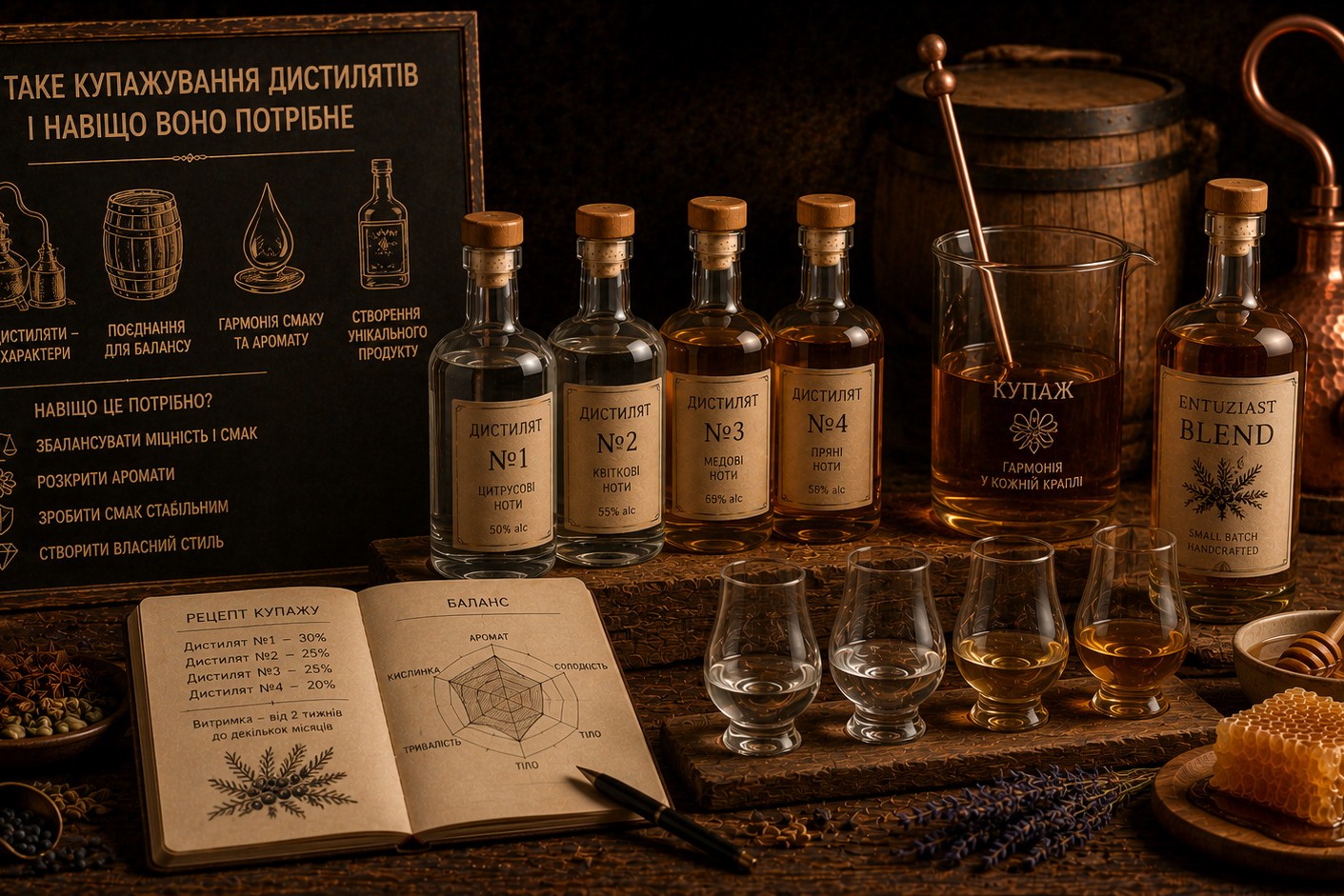
Even a high-quality distillate isn’t always ready to drink right away. One barrel might impart distinct notes of vanilla and wood, another might add fruity freshness, and a third might contribute spice, a waxy depth, or a wine-like character. Each individual spirit may be interesting, but it isn’t necessarily fully balanced.
This is where blending begins—the art of combining different distillates into a single composition. The master works not just with alcohol content or color, but with aroma, texture, taste, and finish. Their task is to determine the role of each component and find the proportions at which the individual spirits cease to be perceived as separate.
A blend can combine distillates from different barrels, batches, aging methods, or even different origins. In some beverages, it helps maintain a recognizable style; in others, it creates an entirely new character that none of the individual components possessed on their own.
In craft production, blending is not a way to hide the raw materials, but rather a continuation of the work with them. A honey base, apple spirits, French and Ukrainian oak, wine barrels, and final aging can all be combined to create a complex, signature beverage.
What Is Blending in Simple Terms
Blending is the combination of two or more spirits or distillates in specific proportions. The components may differ in age, aroma, alcohol content, production method, or type of barrel.
For example, one spirit might be smooth and honeyed but lack structure. Another might be spicy and woody but too dry. A third adds fruitiness and a long finish. When blended correctly, their strengths complement one another.
Blending is not limited to simply mixing. After combining, the components need time for their aromatic and flavor nuances to integrate. Therefore, the finished blend is often left to rest or sent for additional aging.
Why Blend Different Distillates
A single distillate may have a distinctive character but doesn’t always exhibit complete balance. Blending allows for more precise control over its structure.
Through blending, you can:
- combine smoothness and spiciness;
- add fruitiness to a dry, woody base;
- reduce the excessive influence of an active barrel;
- preserve the honeyed character after extended aging;
- create a longer, more complex finish;
- blend spirits of different ages;
- combine French and Ukrainian oak;
- add wine-like or berry-like notes;
- maintain a recognizable product style across batches.
The key is to avoid creating a bland, generic taste. A good blend should retain a distinct character while sounding more harmonious than its individual components.
Blending does not mean fixing a bad spirit
There is a misconception that blending allows you to hide any flaws. In reality, coarse, harsh, or defective components can negatively affect the entire composition, even in small quantities.
A high-quality blend is created from high-quality spirits, each of which serves a specific purpose. One may serve as the base, another as an aromatic accent, and a third as a source of texture or finish.
The master must understand not only a component’s strengths but also its limitations. An overly oaky spirit is added sparingly; a bright, wine-like spirit is added in such a way that it does not mask the honeyed base, and sweet, fruity notes are balanced with drier and spicier ones.
Which distillates can be blended?
The possibilities depend on the recipe and the beverage category. Spirits that differ in many ways can be blended.
Distillates from different barrels
One spirit is aged in French oak, the other in Ukrainian oak. The former can add delicate spice and a wine-like structure, while the latter can impart woody warmth or the berry character of the previous spirit.
Spirits of different ages
The younger component may retain more of the freshness and character of the original raw materials. The older one may have a deeper oak profile and a longer finish.
Distillates from different batches
Natural honey, apples, berries, and botanicals can vary from season to season. Blending helps maintain the product’s overall style.
Spirits with different aromatic bases
Honey distillate can be blended with apple spirits if the original recipe calls for it. In this case, one component provides a rounded honey base, while the other adds fruity freshness and tartness.
How Blending Differs from Mixing
Technically, any combination of liquids can be called a mixture. However, a blend involves a well-thought-out concept and sensory evaluation.
The master evaluates:
- the intensity of each spirit’s aroma;
- its texture;
- the level of dryness and sweet notes;
- the influence of oak;
- fruitiness and acidity;
- the warmth of the spirit;
- length of the finish;
- interaction with other components.
The proportions are not chosen at random. Even a change of just a few percent in a single component can make the aroma more woody, fruity, spicy, or mellow.
How a master creates a blend
The process begins with an evaluation of the individual spirits. Each sample is tasted separately, noting its strengths and distinctive characteristics.
Then, small test blends are created. The master adjusts the proportions and compares the results without using up the entire batch at once.
The general process might look like this:
- Tasting each component separately.
- Selecting the base spirit.
- Selecting components for aroma, texture, and aftertaste.
- Creating several trial proportions.
- Allowing the samples to rest after blending.
- Tasting again.
- Adjusting the proportions.
- Scaling the recipe to the main batch size.
- Stabilizing the finished blend.
Decisions are rarely made after the first blending. The beverage can change in just a few days as the components begin to blend together.
What Is the Base Component of a Blend?
In many blends, a single distillate serves as the base. It defines the drink’s primary character and makes up the largest portion of the volume.
Other spirits serve additional functions:
- they accentuate the honey aroma;
- add a hint of apple tartness;
- create a spicy note;
- increase the body;
- add notes of vanilla and oak;
- extend the finish;
- soften excessive dryness;
- enhance wine-like or berry notes.
An additional component does not necessarily have to be easily recognizable. Sometimes its role is only apparent through the overall balance.
How spirits of different proofs are blended
Distillates from different barrels or batches may have varying alcohol contents. This is always taken into account when creating a blend.
The master blender calculates not only the volume of each component but also the amount of pure alcohol. Otherwise, the final alcohol content may differ significantly from what was planned.
After blending, the beverage is gradually adjusted to the specified alcohol content using prepared water, if necessary. This step also affects the aroma and texture, so the product is given time to stabilize afterward.
Why the flavor isn’t final right after blending
Freshly blended spirits can taste disjointed. One component comes sharply to the forefront, another is perceived separately, and the overall composition seems unstable.
During the resting period, gradual integration occurs. The aromatic components distribute more evenly, the warmth of the spirits becomes more cohesive, and the transitions between honey, fruit, oak, and spices become smoother.
That is why professional blending does not end at the moment of mixing. The final result is evaluated only after a certain stabilization period.
What Is the “Marriage” of Spirits?
In both professional and informal discourse, the resting period of a blend is sometimes referred to as the “marriage” of the components.
This metaphor effectively captures the essence of the process: individual spirits cease to stand out as separate elements and gradually form a unified character.
Resting can take place in a neutral container or in an oak barrel. The latter option simultaneously integrates the blend and adds a new layer of aging.
Blending in a Neutral Vessel
After blending, the spirit can be left in a steel or other suitable neutral container. It does not impart a significant aroma of its own, so the focus remains on the interaction of the existing components.
This method is suitable when the master distiller does not want to emphasize the oak profile. It allows for the preservation of fruity, honeyed, or botanical freshness.
The duration of stabilization depends on the composition, alcohol content, and subsequent processing.
Blending followed by aging
Another approach is to transfer the blend to an oak barrel after blending. There, the components integrate while simultaneously acquiring new nuances from the wood and the original spirit.
This stage can serve two purposes at once:
- to blend different spirits;
- to complete the composition with a final aging period.
For example, honey distillates aged in French and Ukrainian oak can be blended and then transferred to an Oloroso cask. This will impart notes of dried fruit, nuts, spices, and wine to the blend.
What Is Finishing After Blending
Finishing is the additional aging of an already formed or nearly formed spirit in a different cask.
The goal is not to completely change the blend, but to add a final layer of aroma. These can be notes of Oloroso, Sauternes, red wine, or other previous contents of the barrel.
Finishing requires special care, as the blend already has its own complex profile. Excessive contact can disrupt the balance established in the previous stage.
Why Combine French and Ukrainian Oak
Different types of oak can serve distinct functions. A French barrel can add delicate structure, spice, and wine-like depth. A Ukrainian barrel contributes distinct woody warmth, density, or local berry character.
Blending allows you to avoid limiting yourself to just one style. A master distiller can combine spirits so that French oak contributes softness and complexity, while Ukrainian oak contributes character and structure.
It’s important that both components remain part of the honey distillate, rather than turning the drink into an overly oaky composition.
How Wine Barrels Affect Blending
Wine barrels retain part of their previous aromatic profile. After blending, they can add extra depth to the drink.
Oloroso
Can impart notes of dried fruit, nuts, spices, a wine-like dryness, and a warming finish.
Sauternes
Can add fruity, floral, honeyed, and citrus notes, particularly well-suited for blends with apple spirits.
Tempranillo and Garnacha
Barrels previously used for red wines made from these varieties can impart dark fruit, berry, winey, and spicy notes.
The name of the previous wine sets the direction, but the final result depends on the condition of the barrel and the duration of contact.
Blending Honey Distillate and Apple Spirits
Combining different raw materials is a more complex task than blending spirits of the same type. Honey distillate and apple spirits each have their own distinct character and should not mask one another.
The honey base can add:
- roundness;
- waxy and floral notes;
- a soft texture;
- a warm finish.
Apple spirits can contribute:
- fresh fruitiness;
- baked apples;
- natural tartness;
- a spicy, fruity finish.
In a well-balanced blend, the apple forms a recognizable core, while the honey base adds depth and roundness.
Blend and Flavor Consistency
Natural ingredients are not entirely uniform. Honey from one season may differ from the next, and individual barrels develop with varying intensity.
Blending helps maintain a recognizable product profile. If one batch has more spice, it can be balanced with a milder component. If another is more fruity, the master blender adjusts the proportions so that the overall style remains familiar.
This does not mean completely erasing natural differences. In craft production, slight variations are possible, but they should not undermine the brand’s character.
Can a blend be more complex than a single-cask spirit?
A single-barrel distillate showcases the character of a specific barrel. It can be very distinctive and unique, but it can also have a noticeable one-dimensionality.
Blending allows for the creation of more aromatic layers. One barrel contributes honey and vanilla, another brings apple and tartness, and a third adds spice, dried fruit, or a long finish.
Complexity doesn’t always mean better quality. What’s more important is how logically the composition is structured and whether it leaves a clear overall impression.
Why Proportions Are the Master’s Secret
Even knowing the list of barrels and distillates, it’s impossible to precisely replicate a blend without understanding the proportions.
A small amount of active alcohol from a new barrel can significantly intensify the vanilla and wood notes. A pronounced apple note, even in a small proportion, can alter the overall aroma. Spirit from Oloroso can add a spicy, wine-like accent, but in excess, it can make the blend drier.
That is why the blending formula is the result of numerous tastings, rather than simply dividing the components into equal parts.
How trial blends are evaluated
Test samples are tasted under identical conditions: in similar glasses, at a similar temperature, and after the same resting period.
The master evaluates:
- The initial aroma.
- Development after exposure to air.
- The balance of honey, fruit, oak, and wine.
- The intensity of the alcohol’s warmth.
- Texture.
- Mid-palate.
- The length and character of the finish.
- The overall integrity of the composition.
Sometimes the most striking sample is outshone by a more restrained but harmonious one. A blend should not simply be intense, but balanced.
Blending Honey Spirit Aged
Honey Spirit Aged by ENTUZIAST is crafted from fermented May honey and undergoes three stages of distillation.
Afterward, the spirits are aged for over two years in French oak barrels previously used for Tempranillo and Garnacha red wines. Part of the blend is aged in Ukrainian oak barrels previously used for blackthorn.
Blending allows for the combination of different characteristics:
- a honeyed and waxy base;
- the wine-like and fruity-spicy depth of French oak;
- the local character of Ukrainian wood;
- the berry notes from the blackthorn barrels;
- texture and a long finish.
After blending, the cuvée undergoes a six-month final aging in Oloroso casks. This round out the composition, adding spice and wine-like depth.
Blending Honey Spirit Apple
Honey Spirit Apple is an example of a blend that combines honey distillate with classic apple spirits produced using Calvados production technology.
The primary aging takes place in French oak barrels previously used for Tempranillo and Garnacha, while some of the spirits are aged in Ukrainian oak barrels previously used for blackthorn.
The blend combines:
- the smoothness of honey distillate;
- baked and fresh apple notes;
- natural fruity acidity;
- wax and honey blossom;
- spices and wood;
- the wine-like character of the barrels.
After blending, the spirit undergoes a six-month aging process in a former Sauternes barrel. This finishing touches reinforces the fruity and honey-floral profile.
How Blending Affects the Aroma
When blended correctly, the aroma becomes more complex. Instead of a single dominant note, there may be a series of transitions.
For example:
- first—honey, wax, or apple;
- then—vanilla, spices, and wood;
- after a brief pause—wine, dried fruit, or berries;
- finishing with a warm, honeyed, and spicy base.
A good blend shouldn’t smell like a random assortment of ingredients. The aroma should develop naturally.
How Blending Changes the Texture
One distillate may be light, while another is dense and oily. Blending allows you to create the desired body of the drink.
Honey spirit can add roundness, apple spirit can add freshness, and oak aging can add a dry structure. After blending, the texture becomes more balanced.
However, an excessive amount of heavy spirits can make the drink harsh, while too many light ones can rob it of depth.
How Blending Shapes the Aftertaste
The finish is often one of the key criteria for a successful blend. Individual spirits may fade quickly or leave only a single note.
Blending allows for a longer-lasting development:
- a fruity opening;
- a honey-like middle;
- a spicy or woody transition;
- a wine-like finish;
- a warm, waxy, or berry-like finish.
It is important that the aftertaste not be prolonged solely due to excessive woody astringency or alcoholic sharpness.
Can each component be detected separately?
In a young or freshly blended cuvée, individual spirits may be noticeable. Once the blend has stabilized, the boundaries between them become less obvious.
This does not mean that the components have disappeared. They continue to influence the overall character, but no longer come across as distinct layers.
The goal of good blending is not to let the taster break down the drink into exact percentages, but to create a cohesive aroma and flavor.
Blending and a Distillery’s Signature Style
It is precisely through blending that a producer can create their own recognizable signature. Two distilleries may use similar raw materials and barrels but achieve completely different results.
One master distiller emphasizes honeyed smoothness, another focuses on a dry, wine-like structure, and a third highlights apples, berries, or spices.
The distillery’s signature style is reflected in the selection of components, proportions, aging duration, and the method of final maturation.
How to Taste a Complex Blend
A blended, aged distillate should be allowed to breathe in a glass for a few minutes. Immediately after pouring, the alcohol content or the most dominant barrel may be the most noticeable.
Evaluate the drink step by step:
- Identify the primary aroma.
- Identify the secondary notes—fruit, spices, oak, or wine.
- Take a small sip.
- Assess the texture and balance.
- Notice how the finish evolves.
- Return to the aroma after a few minutes.
If needed, you can add a few drops of water. It sometimes helps reveal hidden fruity, honeyed, or wine-like notes.
Common Misconceptions About Blends
- Considering a blend less valuable than a single-barrel spirit.
- Expecting that each component will be easily identifiable on its own.
- Viewing blending as a way to hide poor quality.
- Evaluating the drink immediately after pouring, without letting it breathe.
- Assuming that the oldest component is automatically the best.
- Thinking that more types of barrels always mean a more complex flavor.
- Ignore the role of proportions.
- Evaluate a blend based solely on its smoothness.
Frequently Asked Questions About Blending Distillates
What is blending?
It is the combination of two or more distillates in specific proportions to create a balanced aroma, flavor, texture, and finish.
Why blend spirits from different barrels?
To combine their strengths: smoothness, fruitiness, spiciness, oak structure, wine-like notes, and a long finish.
Does blending mean lower quality?
No. A complex, high-quality blend requires careful selection of components and professional tasting.
Can spirits of different ages be blended?
Yes. Younger spirits can add freshness, while older ones contribute oak depth and a more complex finish.
Can honey and apple distillates be blended?
Yes, if the recipe calls for it. The honey base adds roundness, while the apple spirits add fruitiness and acidity.
Why does a blend need to rest?
So that the individual spirits can integrate, and the aroma, strength, and texture can form a cohesive composition.
What is the final aging of a blend?
It’s the additional aging of already blended spirits in a different barrel, such as one that previously held Oloroso or Sauternes.
How does a blend differ from a single-cask distillate?
A single-cask product reflects the character of one specific cask, while a blend combines the characteristics of several spirits.
Can you taste each barrel in a blend?
Not always. After stabilization, the components integrate, and the overall balance becomes the main focus, rather than the individual notes of each barrel.
When Multiple Characters Become One Drink
Blending is not a mechanical mixing process, nor is it an attempt to make all batches identical. It is a process that involves working with aromas, texture, strength, and time.
One distillate may add honeyed smoothness, another—apple-like freshness, a third—the spiciness of French oak, and a fourth—the berry character of a Ukrainian barrel. The master’s task is to ensure that each plays its part without disrupting the overall composition.
In Honey Spirit Aged, the blend combines honey spirits, French oak previously used for Tempranillo and Garnacha, Ukrainian oak previously used for blackthorn, and a finish in Oloroso. Honey Spirit Apple features a honey distillate, apple spirits, and a final aging in Sauternes.
It is precisely through this blending that individual barrels and distillates cease to be a mere collection of components. They become a single signature ENTUZIAST beverage—holistic, multi-layered, and crafted by the hand of a master.