





What Do “Oily,” “Dense” and “Velvety” Mean When Describing a Distillate?
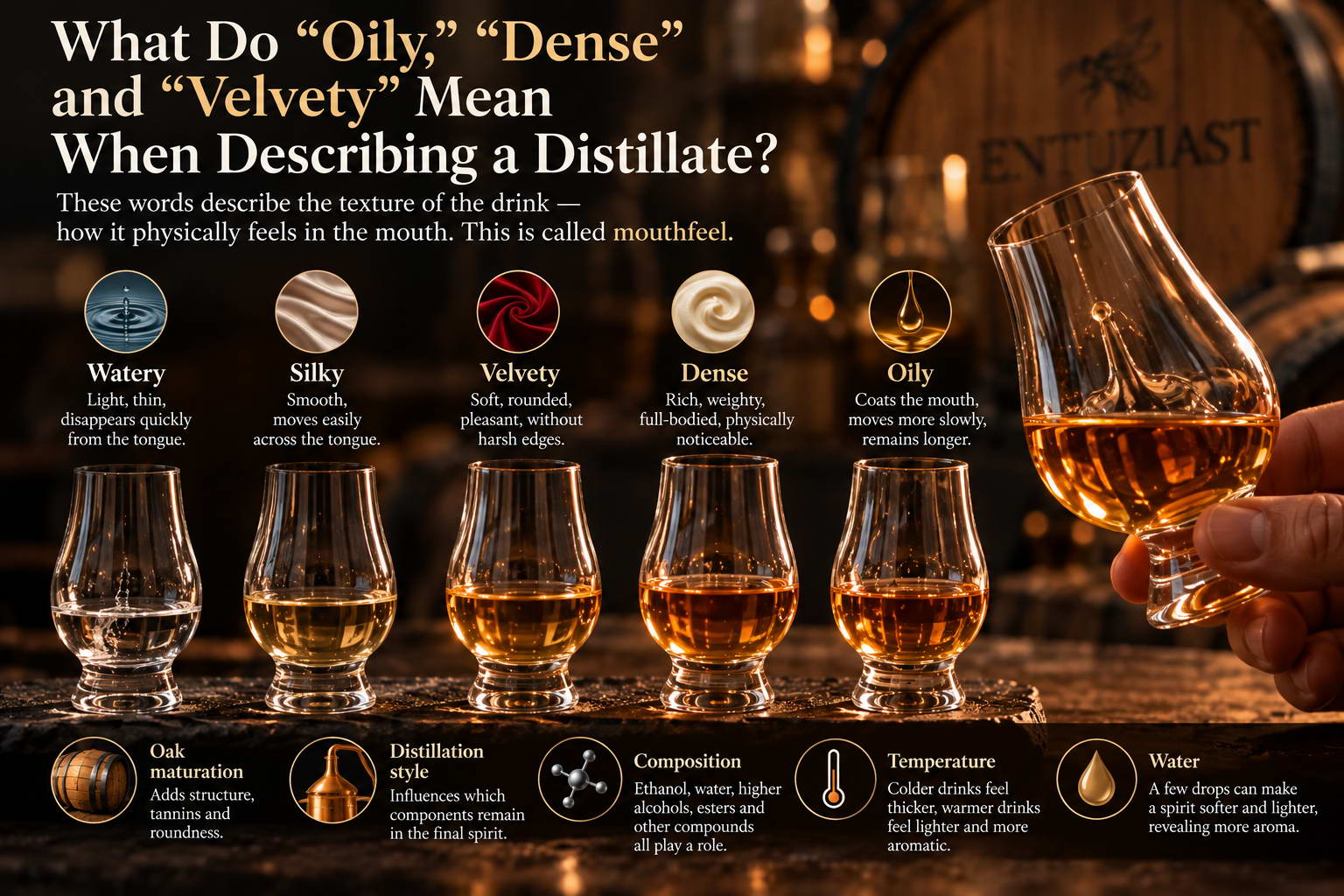
When tasting strong spirits, you may hear some strange-sounding words.
“Oily.”
“Dense.”
“Velvety.”
“Silky.”
“Watery.”
But there is no cooking oil, velvet or silk in the glass.
So what do tasters actually mean?
All of these words describe the texture of the drink — in other words, how it physically feels in the mouth.
In English tasting vocabulary, this is commonly described as mouthfeel.
And although texture can be harder to describe than vanilla aroma or citrus flavour, it has a major influence on the overall impression of a distillate.
What Is the Texture of a Spirit?
Texture is the combination of tactile sensations that appear when the drink comes into contact with the tongue, palate and the lining of the mouth.
A spirit may feel:
- light;
- watery;
- dense;
- rounded;
- oily;
- silky;
- velvety;
- dry;
- viscous;
- astringent.
These characteristics are not always directly related to flavour.
A drink may be very expressive aromatically but still feel light.
Or the opposite: it may have a restrained aroma but a very dense and oily texture.
How Is Texture Different from Taste?
Taste receptors mainly detect:
- sweetness;
- acidity;
- bitterness;
- saltiness;
- umami.
Texture is a different part of the sensory experience.
It answers the question:
how does the drink physically feel?
For example, two distillates may be equally dry and have similar alcohol strength, but one may feel thin and light while the other seems richer, softer and more rounded.
What Does “Oily” Mean in a Spirit?
When a taster describes a distillate as oily, it does not mean that the drink literally contains vegetable oil.
It means the spirit seems to:
- move more slowly across the tongue;
- coat the mouth;
- remain on the mucous membranes for longer;
- have a fuller body;
- avoid disappearing immediately after the sip.
The sensation is sometimes compared to a very light oily film.
But this is only a sensory analogy.
Why Does Oily Texture Appear?
The reason is usually complex.
The sensation can be influenced by:
- ethanol;
- water;
- higher alcohols;
- esters;
- other components of the distillate;
- temperature;
- alcohol strength;
- maturation;
- filtration;
- distillation style.
There is no single molecule that simply “switches on oiliness.”
It is the overall result of the drink’s composition and physical properties.
What Does “Dense” Mean?
The word “dense” usually describes the sense of body in a drink.
A dense distillate may feel:
- rich;
- weighty;
- full;
- concentrated;
- physically noticeable in the mouth.
The opposite would be a light or watery drink.
However, density does not automatically mean higher alcohol strength.
Two drinks with the same ABV can have completely different body.
Why Does “Dense” Not Mean “Strong”?
This distinction is important.
Alcohol strength tells us the concentration of alcohol.
Density in tasting is a sensory impression.
A high-ABV spirit may be dry and sharp but still quite light in texture.
And a lower-strength drink can feel rounded, rich and dense.
So the ABV number on the label cannot predict mouthfeel by itself.
What Does “Velvety” Mean?
“Velvety” is less about thickness and more about the quality of contact between the drink and the mouth.
A velvety distillate is usually described as:
- soft;
- smooth;
- rounded;
- free of harsh edges;
- pleasant as it moves across the tongue.
Alcoholic warmth may still be present.
But it should not dominate everything else.
What Does “Silky” Mean?
This is a closely related term.
A silky spirit usually moves over the tongue very smoothly.
It may be less dense than something described as oily, but it can still feel very refined and soft.
In simplified terms:
oily — more about coating and richness;
silky — more about smooth movement;
velvety — more about softness and roundness;
dense — more about the overall sense of body.
What Is the “Body” of a Spirit?
In tasting, “body” means the overall weight and richness of the drink in the mouth.
We can roughly describe it as:
- light-bodied;
- medium-bodied;
- full-bodied.
It is similar to the difference between skimmed milk and cream.
Both are liquids, but they feel completely different.
In spirits, the difference is subtler, but the principle is similar.
What Does “Watery” Mean in a Distillate?
Usually, it describes a drink that seems to lack body.
It may disappear quickly from the tongue and leave little tactile impression.
Sometimes this is perceived negatively.
But not always.
Some styles of alcohol are intentionally designed to be light and clean.
So “watery” should be used negatively only when the lightness feels inappropriate for the style.
Can a Light Distillate Still Be High Quality?
Absolutely.
Density alone is not a quality indicator.
A light drink can be:
- clean;
- aromatic;
- precise;
- balanced;
- very enjoyable.
And the opposite is also true: an extremely heavy or thick character does not automatically make a spirit better.
What matters is whether the texture suits the style and aromatic profile.
How Does Ethanol Affect Texture?
Ethanol has its own physical and sensory properties.
It contributes:
- warmth;
- slight viscosity;
- irritation;
- a sense of dryness or softness depending on concentration and composition.
Changing alcohol strength can therefore noticeably alter mouthfeel.
But the effect depends on more than just the amount of alcohol.
How Does Water Change Texture?
Water reduces ethanol concentration and changes the physical balance of the drink.
After adding a few drops, a distillate may:
- feel softer;
- burn less;
- seem lighter;
- lose some density;
- reveal more aroma.
If too much water is added, the drink can become thin or watery.
This is why water is usually added gradually during tasting.
We discuss this in more detail in the article “Should You Add Water to Strong Spirits?”.
Why Does Cold Alcohol Feel Thicker?
Lower temperature increases the viscosity of a liquid.
This is why a very cold distillate may feel:
- thicker;
- oilier;
- softer;
- slower in the mouth.
At the same time, cold suppresses aroma.
So a “denser” sensation does not necessarily mean a more interesting tasting experience.
Why Does a Warmer Spirit Feel Lighter?
As temperature rises, viscosity decreases.
The drink moves across the tongue more quickly.
At the same time, aromatic compounds and ethanol evaporate more actively.
A warmer distillate may therefore seem:
- less thick;
- more aromatic;
- sharper;
- more open.
This is one reason there is a difference between a pleasantly rich spirit and the same drink served excessively cold.
Does Fermentation Affect Texture?
Yes, although the influence is more complex than a simple formula.
Fermentation produces:
- ethanol;
- higher alcohols;
- esters;
- acids;
- other secondary compounds.
After distillation, some of these compounds remain in the final product.
They can influence not only aroma, but also the overall sense of richness and structure.
How Does Distillation Shape Mouthfeel?
During distillation, the producer determines which fractions and how much of them enter the final spirit.
Different distillation styles can create a distillate that is:
- lighter;
- cleaner;
- more neutral;
- more aromatic;
- denser;
- richer.
Texture is therefore partly the result of the producer’s technological style.
Does More “Heavy” Character Always Mean Better?
No.
If a distillate contains too many heavy components, it can become:
- rough;
- heavy;
- greasy in an unpleasant way;
- harsh;
- unbalanced.
Good texture does not mean maximum density.
It means balance.
Does Filtration Affect Texture?
Potentially, yes.
Filtration can remove some components that influence visual stability and the structure of the drink.
More intensive filtration can sometimes make a spirit feel cleaner or lighter.
But the result depends entirely on the specific production method.
Filtration by itself does not automatically make texture “better” or “worse.”
Why Do Some Craft Distillates Seem Oilier?
One possible reason is the producer’s decision to preserve more of the original raw-material and distillation character.
Such a spirit may retain a more expressive range of aromatic and structural compounds.
But the word “craft” guarantees nothing by itself.
An oily texture should feel clean and harmonious, not simply heavy.
How Does Oak Maturation Change Texture?
Oak maturation can significantly change mouthfeel.
During contact with wood, different compounds enter the spirit, including tannins.
They may contribute:
- dryness;
- astringency;
- structure;
- a greater sense of body.
At the same time, long maturation changes the overall balance of the drink.
This is why young and aged distillates can feel completely different even at similar alcohol strengths.
Why Are Aged Spirits Often Described as Rounded?
“Roundness” means that there are fewer sharp sensory transitions.
Alcohol, oak, raw-material character and finish feel more integrated.
No single component seems to stick out awkwardly from the others.
This is often described with words such as:
- rounded;
- balanced;
- soft;
- integrated.
An Example: Honey Spirit Aged ENTUZIAST
In Honey Spirit Aged ENTUZIAST, texture is shaped not only by alcohol strength but also by oak maturation.
Woody, vanilla and spicy components are added to the character of the honey distillate, together with additional structure from the barrel.
As a result, the drink may feel more rounded and fuller than a young distillate.
But the important thing is not simply how “heavy” it feels, but how well the texture works with the aroma and finish.
An Example: Honey Spirit Pure ENTUZIAST
Honey Spirit Pure ENTUZIAST offers a different type of texture.
There is no oak-derived layer, so the mouthfeel depends more directly on:
- the honey distillate base;
- fermentation;
- distillation;
- alcohol strength;
- serving temperature.
Comparing young and aged versions is a useful way to understand how strongly oak can change not only aroma, but also the physical sensation of a drink.
What About Texture in Gin?
Gin is often judged primarily through its botanical aroma.
But texture matters here too.
One gin may feel:
- very dry;
- light;
- sharp;
while another may feel:
- rounded;
- fuller;
- softer;
- more oily.
This strongly affects the way juniper, citrus and spices are perceived.
MeadGIN and Texture
In MeadGIN ENTUZIAST, botanical aroma works together with the honey-distillate base.
So during tasting, it is worth paying attention not only to juniper and citrus, but also to how the drink moves across the tongue.
Does it feel light?
Rounded?
Does a sense of density remain after the sip?
Questions like these help move from a simple “I like it / I don’t like it” reaction toward a more precise sensory description.
Why Are Sweetness and Texture So Easy to Confuse?
Because many thick and rounded foods in everyday life are sweet.
For example:
- honey;
- syrup;
- caramel;
- cream;
- liqueur.
The brain can therefore automatically associate a dense texture with sweetness.
This is why a dry but oily distillate can sometimes seem sweeter than it really is.
Why Can “Dry” Also Describe Texture?
The word “dry” can refer both to low sweetness and to a tactile sensation.
For example, oak tannins can create a tightening sensation in the mouth.
The drink may feel drier even though its sugar content has not changed.
So during tasting, it is useful to ask:
are we talking about dry taste or dry mouthfeel?
What Does “Astringent” Mean?
Astringency is not a classic taste either.
It is a tactile sensation of tightening and dryness in the mouth.
Tannins are a common cause.
A simple example is very strong black tea or dry red wine.
In aged spirits, a similar sensation can come from oak.
Why Can Too Many Tannins Make Texture Harsh?
A moderate amount of tannin can add structure.
But too much can make the drink:
- excessively dry;
- hard;
- astringent;
- bitter;
- overly woody.
This is why longer maturation does not automatically mean better texture.
How Is Finish Connected with Texture?
Very closely.
If a drink coats the mouth and remains on the mucous membranes longer, aromatic and tactile sensations may also last longer.
This is why an oily or dense distillate often seems to have a longer finish.
But this is not an absolute rule.
A light spirit can also have a very long aromatic finish.
Can You Judge Texture by the “Legs” on the Glass?
Only very roughly.
The so-called “legs” or “tears” on the glass depend on the physical properties of the water-and-alcohol mixture, surface tension, temperature and other factors.
They are not a direct or reliable indicator of quality.
Slow, attractive droplets on the glass do not automatically mean that the spirit is exceptional or truly oily.
Texture is better evaluated directly in the mouth.
How Should You Evaluate Texture?
Try a simple sequence.
- Pour a small amount.
- Let the drink rest for a moment.
- Take a small sip.
- Do not swallow immediately.
- Let the liquid move across the tongue.
- Notice how easily or slowly it moves.
- Pay attention to what remains after swallowing.
Ask yourself:
- Does the drink feel light or heavy?
- Watery or dense?
- Smooth or sharp?
- Dry or rounded?
- Does it coat the mouth or disappear quickly?
Why Should You Keep the Sip in Your Mouth for a Moment?
You do not need to hold strong alcohol in the mouth for a long time.
But if you swallow immediately, you may not have enough time to evaluate texture.
A few seconds are enough to notice:
- how the drink interacts with the tongue;
- how dense it feels;
- how alcoholic warmth develops;
- whether dryness or astringency appears.
Why Do Large Sips Make Texture Harder to Evaluate?
A large sip sharply increases alcoholic irritation.
The brain begins to focus on warmth and burning.
Against this background, subtle differences between:
- oiliness;
- roundness;
- dryness;
- silkiness
become harder to notice.
This is why tasting strong spirits usually means taking small sips.
Do All People Experience Texture in the Same Way?
No.
Like aroma, mouthfeel partly depends on individual sensitivity.
One person may immediately notice a slight astringency.
Another may pay more attention to oiliness.
Other factors include:
- tasting experience;
- drink temperature;
- saliva production;
- food consumed beforehand;
- the condition of the mouth;
- sip size.
Why Is Texture Harder to Describe Than Aroma?
Because we have many concrete words for aromas.
Apple.
Vanilla.
Juniper.
Honey.
Oak.
Texture is more abstract.
That is why we use analogies with materials and foods:
- oil;
- silk;
- velvet;
- water;
- cream.
These are not literal ingredients.
They are simply a way of translating physical sensation into words.
Is Oiliness a Sign of High Quality?
No.
It is simply a characteristic of style.
A good distillate can be:
- light;
- dense;
- oily;
- dry;
- silky.
The question is not which texture is “best.”
The question is whether it is:
- harmonious;
- clean;
- pleasant;
- appropriate for the style;
- working together with aroma and finish.
Can a Spirit Be Too Soft and Become Boring?
Yes, that can happen.
If too much character is removed in an attempt to make a drink extremely “easy,” the result may become neutral.
Softness alone is not the same thing as complexity.
A small amount of dryness, tannin, spice or alcoholic warmth can sometimes make the structure more interesting.
How Does Texture Affect Aroma Perception?
The brain experiences a drink as a whole.
If the texture is rounded and soft, fruity and vanilla aromas may seem warmer and sweeter.
If the texture is dry and astringent, the same aromas may feel more restrained and serious.
Aroma and mouthfeel constantly influence each other.
How Does Texture Affect the Perception of Alcohol Strength?
Very strongly.
A dense, rounded distillate can make alcoholic sharpness feel less dominant.
A light and dry drink at the same ABV may seem more intense.
This is why two spirits at the same 40–43% ABV can feel completely different.
This naturally leads to the next article in the series: why one drink can feel softer than another even at the same alcohol strength.
In Short: What Do the Main Texture Terms Mean?
- Light — moves quickly and does not feel heavy.
- Watery — feels too thin for the style.
- Dense — feels rich and weighty.
- Oily — coats the mouth and remains on the palate longer.
- Silky — moves very smoothly across the tongue.
- Velvety — soft, rounded and free of harsh sensory edges.
- Dry — can refer either to low sweetness or to tactile dryness.
- Astringent — creates a tightening sensation, often associated with tannins.
Conclusion
When a taster calls a spirit “oily,” “dense” or “velvety,” they are not describing the ingredients literally.
They are trying to put the physical behaviour of the drink into words.
An oily spirit coats the mouth.
A dense one feels weightier.
A silky one moves smoothly.
A velvety one combines softness with roundness.
These sensations are influenced by alcohol strength, temperature, water, fermentation, distillation, maturation, tannins and the overall chemical composition of the drink.
But no single texture is automatically a sign of high or low quality.
Balance matters most.
Does the body of the spirit match its aroma?
Does alcoholic warmth fit the texture?
Does the finish logically continue the sip?
When aroma, flavour, texture and finish work together, a distillate stops feeling like a collection of separate characteristics and becomes a complete sensory experience.