





Why Triple Distillation?
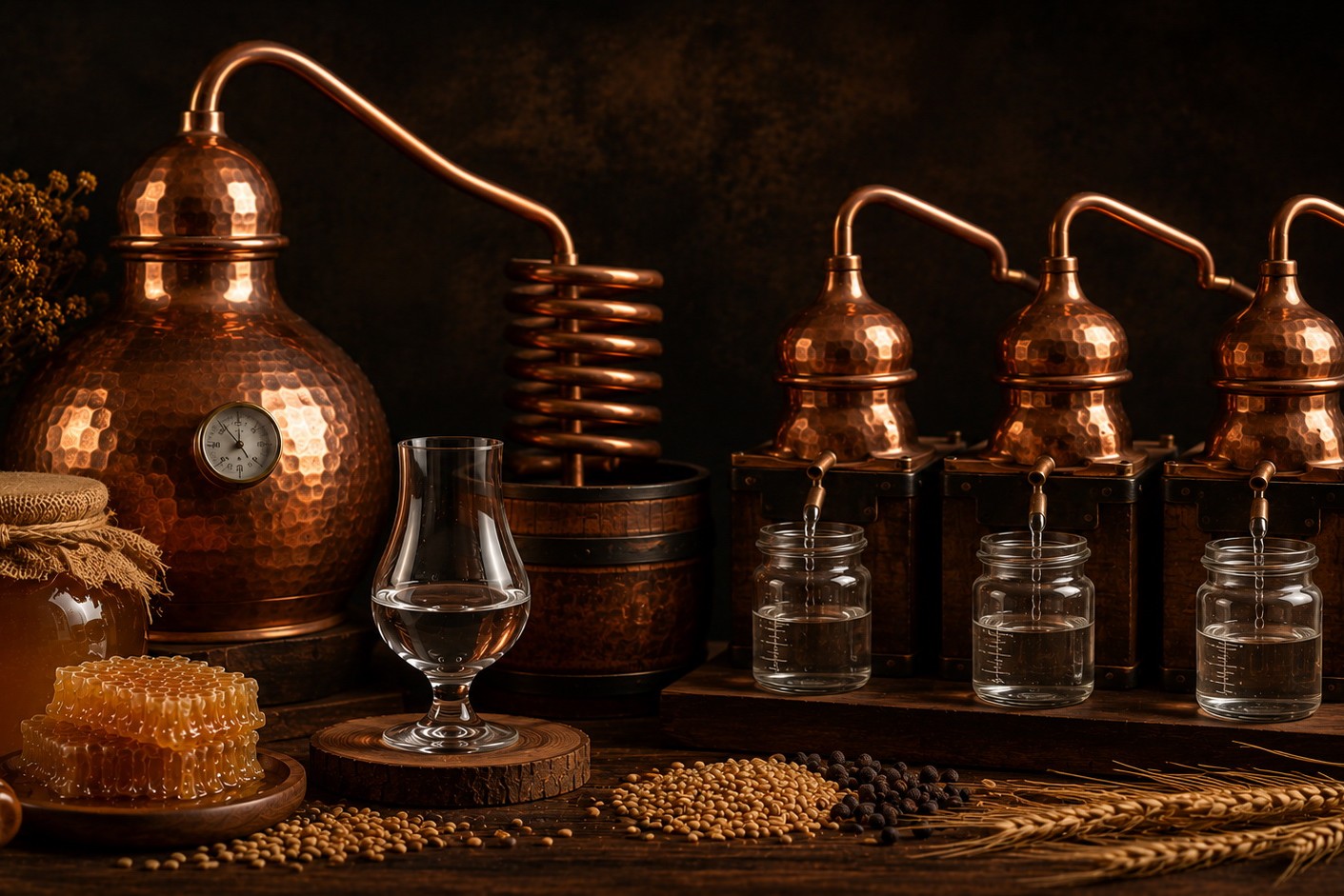
The number of distillations is often seen as a simple indicator of quality: the more times a spirit has been distilled, the purer, smoother, and better it is supposedly. In reality, it’s more complicated than that. Triple distillation is not a magic formula and does not guarantee a high-quality product on its own.
Its main advantage lies elsewhere—it gives the distiller more opportunities to control the process. Each stage can serve a specific purpose: concentrating the alcohol, purifying the base, separating the fractions more precisely, or shaping the final aromatic profile.
This approach is particularly interesting in the production of honey distillates. The honey base possesses its own aromatic potential, which must be purified of unwanted nuances without being transformed into a completely neutral spirit. That is precisely why multi-stage distillation is, above all, a quest for balance between purity and character.
What Does Triple Distillation Mean?
Triple distillation means that the fermented base or the intermediate spirit derived from it undergoes three separate distillation stages. However, these are not always three identical cycles using the same equipment.
In more complex processes, each stage may take place in a different type of still. For example, the first distillation concentrates the alcohol, the second ensures a more precise separation of fractions, and the third gives the distillate its final depth and roundness.
Thus, it is not only the number of distillations that matters, but also how they are organized. Three identical, rapid distillations and three carefully planned technological stages can yield completely different results.
Why a Single Distillation May Not Be Enough
After fermentation, the honey mash contains water, alcohol, and a large number of volatile aromatic compounds. Among them are both desirable components that shape the character of the beverage and those that can create harshness, heaviness, or unwanted odors.
During the first distillation, it is impossible to simultaneously purify the base perfectly, precisely separate all fractions, and establish the final flavor profile. Its primary purpose is often to initially concentrate the alcohol.
Subsequent stages allow for greater control. The distiller can then work not with a large volume of fermented mash, but with a more concentrated base, more precisely selecting the necessary fractions of the distillate.
The first stage: obtaining a pure base
The initial distillation removes a significant portion of the water and concentrates the alcohol. At this stage, it is important to consistently process the fermented base and obtain intermediate alcohol for further processing.
A continuous-flow column can be used for the first stage. It allows the fermented liquid to be fed continuously and maintains a stable operating mode.
The advantage of such equipment is its productivity and the ability to obtain a sufficiently pure base right from the start. However, the product after the first stage is not yet in its final form and requires further separation and refinement.
Conventionally, this stage can be compared to preparing a canvas. It is already suitable for use, but the true image will emerge later.
The second stage—precise fractionation
During the second distillation, the main task is to more precisely control the composition of the future beverage. For this purpose, a plate column can be used, inside which repeated evaporation and condensation take place.
Each level, or plate, of such a column effectively creates an additional mini-distillation cycle. The vapors rise upward, cool slightly, evaporate again, and are gradually separated based on their volatility.
This allows for better separation of the initial and final fractions, leaving a purer middle cut. As a result, harshness is reduced, and the distillate acquires a more predictable and balanced profile.
At the same time, it’s important not to overdo the purification. If too many aromatic components are removed, the individual character of the honey-based raw material may be lost along with the undesirable compounds.
Stage Three: Shaping the Character
The final distillation can take place in a copper still. After preliminary purification, the distiller is already working with a high-quality alcohol base and focuses on the aroma, texture, and overall harmony.
The contact of the vapors with copper helps reduce the impact of some of the undesirable sulfur-containing compounds. The shape of the alembic, the heating rate, and the fractionation mode influence how many light and heavy aromatic components end up in the finished distillate.
It is during this final stage that the spirit can acquire its roundness, fullness, and distinctive artisanal character. While the earlier stages are primarily responsible for purity, pot still distillation helps restore the product’s depth and individuality.
What Are Distillation Fractions
During distillation, the composition of the liquid gradually changes. The most volatile components are released first, followed by the main body, and finally the heavier substances.
Conventionally, these parts are called the heads, the heart, and the tails. To create a high-quality spirit, the heart fraction is primarily used, but the exact boundaries of its selection depend on the recipe and the desired style.
Initial Fractions
They may have a sharp, solvent-like, or overly volatile aroma. They are separated from the main body of the product.
The heart of the distillate
This is the purest and most balanced part, in which the main character of the future beverage is concentrated. It is this fraction that is used for aging, blending, or bottling.
Tail Fractions
They contain more heavy alcohols and other components. In small quantities, some of them can add body and depth, but an excess makes the distillate harsh, oily, or heavy.
Multiple distillation stages allow for more precise control over these transitions and result in a cleaner product.
Does triple distillation make the drink smoother?
In many cases, multi-stage distillation does indeed help produce a smoother distillate. During each stage, the distiller can reduce the concentration of components that create a harsh aroma or coarse texture.
However, smoothness depends not only on the number of distillations. The quality of fermentation, temperature, fraction selection, contact with copper, the strength of the finished product, and subsequent aging remain important factors.
A poorly executed triple distillation can yield a less harmonious result than one or two professionally performed distillations. Therefore, it is more accurate to say that the third stage provides additional opportunities for control, but does not replace craftsmanship.
Purity and neutrality are not the same thing
A distillate can be pure while still retaining the character of its raw materials. This is one of the main goals of craft production.
A completely neutral spirit reveals almost nothing about its origin. It’s difficult to detect notes of honey, grain, fruit, or berries in it. While this result may be necessary for certain categories, it doesn’t always align with the vision behind a signature distillate.
Triple distillation allows for selective processing. First, it removes coarse and undesirable components, and then it preserves or accentuates the notes that give the spirit its individuality.
For honey spirit, these might include hints of wax, honeycomb, white bread, flowers, butter, fruit, or spices. The master distiller’s task is not to erase these notes, but to make them purer and more harmonious.
How the Number of Distillations Affects the Aroma
Each distillation alters the ratio of volatile compounds. Some are removed, some are concentrated, and some settle into a new balance.
After the first distillation, the aroma may remain rough and broad. The second distillation helps separate out unwanted components and refine the profile. The third distillation allows for fine-tuning the result and shaping the final character.
At the same time, an excessive number of distillations can gradually strip the drink of its character. Therefore, triple distillation makes sense only when each stage has a clearly defined technical objective.
Why Different Equipment Is Used for Different Stages
A single piece of equipment rarely performs all possible tasks equally well. A continuous-action column is effective for initial concentration. A pot still is well-suited for precise fractional separation. A copper alembic helps to work with aroma and texture.
Combining different equipment allows you to leverage the strengths of each technology. In such a production chain, the first stage lays the foundation, the second purifies and structures, and the third shapes the character.
This is a more complex approach than multiple distillations in a single still, but it offers greater opportunities for creating a signature product.
Triple Distillation and Alcohol Content
After several distillation stages, the alcohol content of the intermediate spirit can be quite high. However, the finished product is usually bottled at a lower alcohol content, as specified by the recipe.
The distillate is gradually blended with prepared water, after which it is allowed time to stabilize. This is an important process, as changes in alcohol concentration affect the solubility of aromatic compounds, the texture, and the overall perception of flavor.
A higher alcohol content after distillation is not an end in itself. It is more important to obtain a pure, high-quality base that can be properly prepared for aging or bottling.
Is triple distillation necessary for an aged spirit?
An oak barrel cannot correct a rough or poorly made spirit. Aging can soften certain notes, but it can also highlight the flaws of the initial distillate.
That is precisely why it is important to prepare a clean and balanced base for long-term aging. Triple distillation reduces the amount of undesirable components even before contact with the wood.
Afterward, the oak gradually imparts vanilla, spice, wood, wine, or fruit notes to the spirit. A pure distillate integrates these notes better and maintains balance throughout the long aging process.
How Triple Distillation Works in Honey Spirit Aged
The creation of Honey Spirit Aged by ENTUZIAST involves three distinct distillation stages, each serving a specific purpose.
The first distillation takes place in a continuous-action column. It produces a pure base and prepares the spirit for further processing.
The second stage takes place in an eight-tray cap column. Here, fractional distillation is carried out with precise fraction selection, which helps create a smooth and clean profile.
The final distillation takes place in a traditional copper still. It is this stage that adds roundness, depth, and fullness to the distillate, while preserving the character of the fermented May honey.
After distillation, the spirit is aged for over two years in French oak barrels previously used for Tempranillo and Garnacha red wines. Some of the spirits mature in Ukrainian oak barrels previously used for blackthorn, and the final blend undergoes a six-month finishing period in an Oloroso cask.
In the finished spirit, the aroma of wax blends with honey, spices, vanilla, and a light freshness. The flavor unfolds with mineral, warming, honeyed, and peppery notes.
Is triple distillation always better than double distillation?
No. In distillation, there is no universal number of distillations that automatically makes a product better.
For some styles, it’s important to preserve a dense and rich aroma, so one or two distillations are sufficient. For others, exceptional purity and delicacy are required, and in those cases, a third stage may be justified.
Quality is determined not by the number on the label, but by how well the chosen technology matches the raw materials and the producer’s vision. Triple distillation is an advantage only when it truly improves the balance, rather than being used as a marketing term.
How to Evaluate the Result of Multi-Stage Distillation
Consumers do not need to know the design of every column to assess the quality of a beverage. It is enough to pay attention to the overall balance of aroma and flavor.
A well-made distillate should not have a sharp solvent-like odor, excessive harshness, or a heavy, unpleasant aftertaste. The alcohol content should support the aroma, not completely overwhelm it.
In honey distillate, one should look not for literal sweetness, but for subtle associations with wax, flowers, honeycombs, bread, fruit, or spices. If, after several distillations, these notes remain clear and recognizable, the process has succeeded.
Frequently Asked Questions About Triple Distillation
What does triple distillation mean?
It is a process in which a fermented base or intermediate spirit undergoes three consecutive distillation stages.
Why distill a spirit three times?
Multiple stages allow for the separate concentration of alcohol, more precise separation of fractions, purification of the distillate, and the development of its final aromatic character.
Does the third distillation make the spirit smoother?
It can contribute to a smoother and cleaner profile, but the result also depends on fermentation, equipment, heating conditions, and proper fraction selection.
Does the spirit become completely neutral?
Not necessarily. With the right technology, it is possible to achieve high purity while preserving the aromatic properties of honey or other raw materials.
How does triple distillation differ when performed on different equipment?
Each piece of equipment can perform a specific function. The column concentrates and purifies, the cap system separates the fractions more precisely, and the copper still imparts roundness and depth.
Are three distillations always better than two?
No. The number of stages should correspond to the style of the beverage. It’s not the three distillations themselves that matter, but their technological necessity and the quality of their execution.
Three stages—three different tasks
Triple distillation makes sense when each stage fulfills a specific role. The first stage creates the foundation, the second ensures precise purification and selection, and the third shapes the final character.
This isn’t a competition to see who can distill the most times, nor is it a way to completely erase the flavor of the raw materials. On the contrary, a properly designed process allows you to remove the excess and retain what matters most—a clean, harmonious, and recognizable aromatic profile.
At ENTUZIAST, the combination of a continuous-flow column, a pot still, and a copper alembic helps reveal the fermented May honey in a new light. This is how a distillate is born in which technological purity does not contradict its craft character, but rather complements it.