





Is there honey left in the finished distillate?
A question that almost everyone has
A person picks up a bottle of honey distillate and reads the label. It contains honey. But after the first sip, they are surprised: the drink does not look like liquid honey at all. It is not viscous, not sweet and does not at all resemble a dessert.
Then a logical question arises: if the distillate is made from natural honey, does this honey remain in the finished drink?
The short answer sounds unexpectedly: both yes and no.
Honey does not disappear instantly
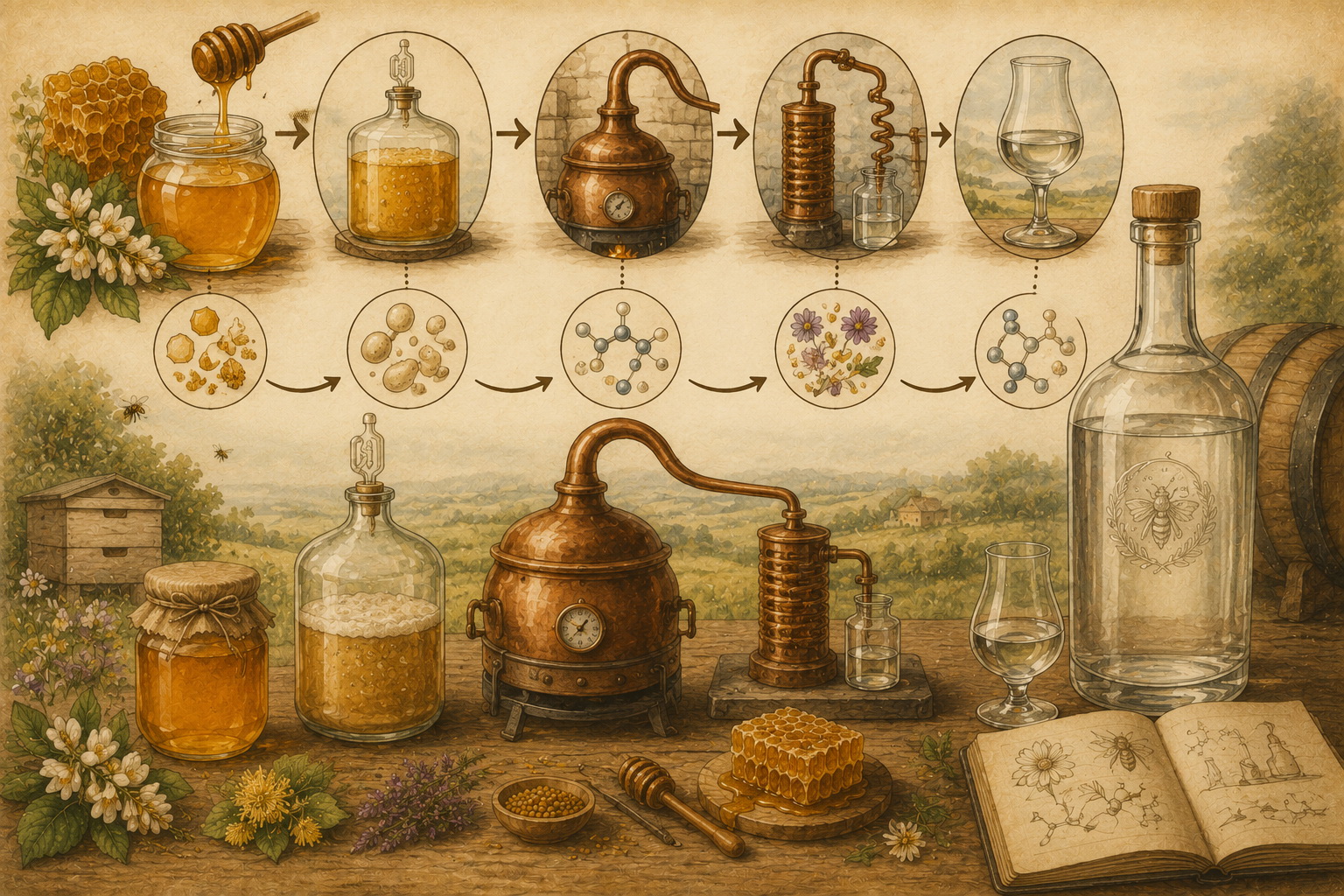
Before becoming a distillate, honey goes a long way. It is dissolved in water, creating an environment for fermentation. That is when the work of yeast begins - microscopic organisms that feed on natural sugars.
For yeast, honey is not a flavor or a color. For them, it is a source of energy. They consume glucose and fructose and gradually convert them into alcohol, carbon dioxide and dozens of new aromatic compounds.
Where does the sweetness disappear?
It is the sugars that make honey sweet. But during full fermentation, most of them are converted into alcohol.
Therefore, after fermentation is complete, the future distillate almost does not have the sweetness that we are used to feeling when tasting fresh honey with a spoon.
In fact, the yeast "eats" what we call the sweet taste.
So what is left then?
If honey consisted only of sugar, all honey distillates would be the same. But natural honey is much more complex.
It contains hundreds of natural aromatic substances, organic acids, trace elements and other compounds that are formed when bees collect nectar from flowers.
Some of these components change during fermentation, some are destroyed, and some are converted into new aromatic compounds. They are what create the character of the future drink.
Distillation separates not the honey, but its character
After fermentation is complete, distillation begins. This is where misunderstandings most often arise.
Distillation does not transfer all the honey to the bottle. It transfers only volatile substances that can evaporate with alcohol. They are responsible for the aroma, softness and versatility of the distillate.
Sugars do not evaporate. They remain in the distillation cube. That is why the finished distillate does not become sticky or sweet.
Why do different honeys still give different results?
The previous article was devoted to different varieties of honey. Now it becomes clear why this difference is so important.
Acacia honey contains one set of aromatic substances, linden honey - another, buckwheat - a third. Although the sugars in all cases are almost completely converted into alcohol, it is the aromatic profile of each honey that helps to shape the character of the future distillate.
In other words, it is not the sweetness of the honey that gets into the glass, but its individuality.
Why does it sometimes seem that the drink has a honey taste?
Our brain loves associations. If we know that a drink is made from honey, we often expect a familiar sweetness.
In fact, what we often experience is not the taste of honey, but subtle floral, waxy, fruity or spicy nuances that remind us of its origin. This is very similar to the situation with wine: a glass can smell of apples, peaches or honey, although none of these ingredients were added to it.
Can we say that honey remains?
Literally speaking, no. The finished distillate no longer contains the honey itself in the form in which it was before production began. Its natural sugars have turned into alcohol, and the heavy components have remained after distillation.
But if we talk about the nature of the drink, the answer will be completely different.
It is the honey that determines what the distillate will be like. It sets the direction of the aroma, creates the basis for fermentation and gives that natural character that cannot be obtained from any other raw material.
Conclusion
Honey distillate is not liquid honey and should not be. Its value lies not in its sweetness, but in the fact that it preserves the history of its origin. After fermentation and distillation, honey changes so much that a completely new drink is born.
And this is precisely the main miracle of distillation: it does not transfer honey to a glass. It transfers its soul.