





Why May honey became the basis of ENTUZIAST's honey distillates
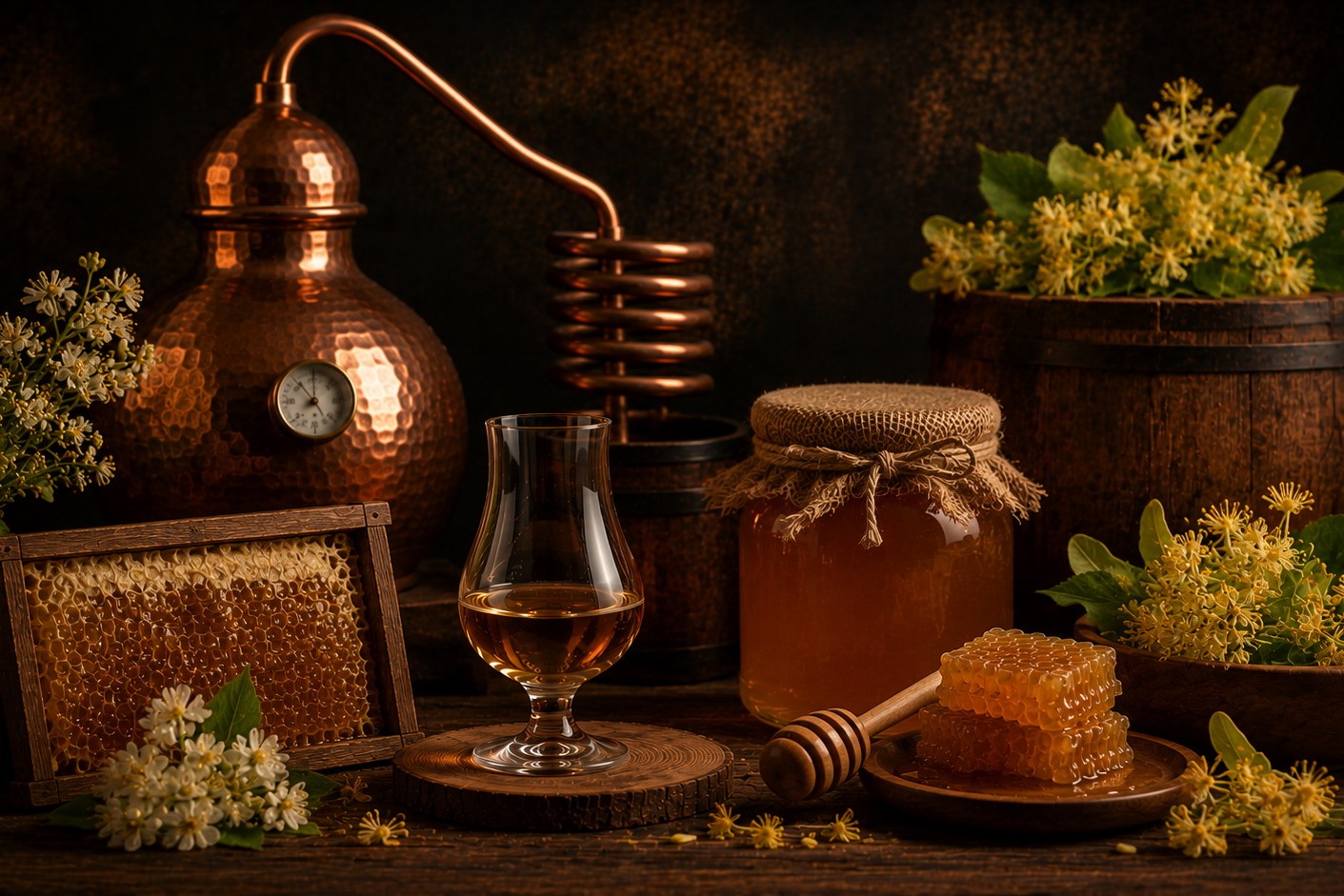
To create a spirit with its own unique character, it’s not enough to simply choose the right equipment or perform a precise distillation. It all starts with the raw materials. For ENTUZIAST honey spirits, fermented May honey serves as the foundation.
In the finished distillate, the honey doesn’t necessarily come through as direct sweetness. After fermentation and distillation, its character changes, evolving into notes of wax, flowers, honeycombs, white bread, spices, and a soft creaminess. It is precisely these nuances that make honey an intriguing base for craft production.
May honey in ENTUZIAST’s production process is not merely a flavoring additive to neutral alcohol. Its sugars undergo fermentation, the resulting alcohol is distilled, and the spirit obtained serves as the base for clear, aged, and signature spirits.
What Is May Honey?
May honey is a common name for honey harvested in early spring. Bees can produce it from the nectar of various plants that bloom at the start of the season. Therefore, it is not a single, strictly defined botanical variety with a consistent composition.
The specific aroma, color, and taste depend on the region, weather, harvest time, and the plants available to the bees. In one region, certain floral sources may predominate in the honey, while in another, entirely different ones may prevail.
That is precisely why every batch of natural honey requires evaluation. For a distiller, it is not only the honey’s taste properties in its natural state that matter, but also how the raw material behaves during mash preparation, fermentation, and subsequent distillation.
Honey as a Full-Fledged Raw Material for Alcohol
In the production of many spirits, the base raw material is rich in sugars or starch. In grain distillates, starch is first converted into sugars that yeast can utilize. In fruit spirits, the sugars are already present in the fruit.
Honey is naturally rich in sugars that can serve as the basis for alcoholic fermentation. However, due to its high concentration, it is not distilled directly nor left in its original form.
First, the honey is mixed with water to prepare a mash. Afterward, yeast converts the available sugars into alcohol, and the resulting fermented base is sent for distillation.
Thus, in honey distillate, the alcohol is derived directly from the honey itself and is not added later.
Why You Can’t Just Pour Honey Into a Still
Distillation does not create alcohol from sugar. It merely separates and concentrates the volatile components of an already fermented liquid.
Natural honey contains a lot of sugars, but not enough alcohol for distillation. Furthermore, its high density and low water content do not create the right conditions for stable fermentation.
That is why the production process begins with preparing honey wort. This stage creates an environment in which yeast can gradually do its job.
Only after fermentation is complete does the honey base become suitable for distillation.
How to Prepare Honey Wort
Preparing the wort involves mixing honey with water according to the recipe. The goal is to obtain a homogeneous liquid with a sugar concentration suitable for yeast activity.
An overly concentrated solution can hinder fermentation. If the wort is too diluted, the potential alcohol content and the overall structure of the future base will be altered.
At this stage, the temperature, cleanliness of the equipment, and condition of the raw materials are monitored. The honey must dissolve evenly, but the processing should not unnecessarily compromise its aromatic potential.
A properly prepared wort lays the foundation for clean and predictable fermentation.
Slow Fermentation of May Honey
ENTUZIAST’s honey spirit production process utilizes slow fermentation. Its purpose is not merely to convert the maximum amount of sugar into alcohol.
Aromatic compounds are also formed during fermentation, which can subsequently influence the character of the distillate. Temperature, the duration of the process, and the stability of the yeast activity are of great importance.
Fermentation that is too rapid or uncontrolled can create harsh and undesirable notes. A slow, controlled process allows for more careful work with the base and prepares it for the next stages.
The master distiller doesn’t simply wait for fermentation to finish. He monitors the condition of the mash, the temperature, and the dynamics of the process, because any mistake at this stage will carry over into the final distillate.
Where Does the Honey’s Sweetness Go?
One of the main misconceptions about honey distillate is the expectation of a very sweet taste. In reality, during fermentation, the yeast converts a significant portion of the sugars into alcohol.
During subsequent distillation, non-volatile sugars do not carry over into the finished spirit in the same way that alcohol and some aromatic components do. Therefore, a clear honey distillate can be dry.
The honey character is revealed not through syrupy sweetness, but through aromatic associations. The drink may evoke notes of flowers, wax, honeycombs, bread, and creamy or spicy undertones.
This is an important distinction between a drink sweetened with honey and a distillate in which honey serves as the fermented base.
How the aroma of honey changes after fermentation
The aroma of natural honey and that of the fermented base are not the same. As the yeast works, some of the original components change, and new compounds are formed along with them.
Therefore, the finished mash may develop fruity, floral, bready, spicy, or other notes that were not noticeable in the original honey.
Distillation alters this profile once again. It concentrates the volatile components, separates out unwanted fractions, and produces a cleaner aroma.
It is precisely because of this sequence of transformations that honey distillate is not simply a stronger version of honey. It is a new product with its own structure and character.
Why the result depends on more than just the honey
Even the best raw materials do not guarantee a high-quality finished spirit. Honey is the starting point of the process, but the final character is shaped at each subsequent stage.
The result is influenced by:
- the preparation of the honey mash;
- the selection and condition of the yeast;
- fermentation temperature;
- the duration of fermentation;
- the type of distillation equipment;
- heating mode;
- precision of fraction separation;
- contact with copper;
- further maceration;
- aging and blending.
Therefore, it is more accurate to speak not simply of a distillate made from May honey, but of the entire process of its transformation.
How Distillation Reveals the Honey Base
After fermentation is complete, the fermented mash undergoes distillation. The goal is to obtain a concentrated alcoholic base, properly separate the fractions, and preserve the desired aromatic character.
During distillation, different volatile components are released at different times. The most volatile compounds appear first, followed by the main “heart” fraction, and finally the heavier components.
The distiller’s decisions determine how pure, smooth, and distinctive the finished spirit will be. Too broad a selection can add harshness, while excessive purification can strip the drink of its individuality.
In the case of honey distillate, it is important to preserve the character of the raw material without leaving behind unwanted harsh notes.
Three Types of Distillation When Working with Honey
In the production of certain ENTUZIAST beverages, a combination of three types of distillation is used. This approach allows for the division of production tasks among different types of equipment.
The first stage may be responsible for obtaining a pure base. The next stage focuses on more precise fractional separation. The final distillation in a copper still helps develop roundness, depth, and an artisanal character.
These multiple stages are not intended to completely erase the honey aroma. On the contrary, their purpose is to remove unwanted components and preserve the most valuable part of the flavor profile.
What notes can a honey base produce?
Descriptions of honey distillates often include the words “honey,” “wax,” or “honeycomb,” but their aromatic range can be broader.
Depending on the raw materials and production methods, the following may emerge:
- floral notes;
- wax and honeycombs;
- white or freshly baked bread;
- grainy notes;
- butter;
- fruits and baked apples;
- vanilla and spices;
- a light minerality;
- spicy pepper;
- oak aging notes.
Not all of these nuances are necessarily present in a single drink. Each product has its own recipe and a distinct path after distillation.
Why Clear Honey Spirit Has a Honey-Like Character
After distillation, the spirit is clear unless it has been aged in a wooden barrel or undergone other color-altering treatments.
Transparency does not mean the absence of a honey aroma. Color and aroma are formed by different groups of components. During distillation, pigments and non-volatile substances mostly remain in the still, while some of the volatile aromatic compounds pass into the distillate.
Therefore, Honey Spirit Pure can remain completely clear yet still possess notes of honey, white wheat bread, and butter.
Why is the honey distillate macerated with wheat?
The Honey Spirit Pure production process involves maceration on sprouted wheat in steel vats at a controlled temperature.
This step helps to complement the honey base with grain-derived nuances. In the finished beverage, these can evoke notes of wheat flour, white bread, or a creamy texture.
The wheat is not intended to completely alter the spirit’s origin. Its role is to add another layer of aroma and flavor to the pure honey distillate.
How Oak Aging Transforms May Honey
After distillation, the honey spirit can remain clear or undergo extended aging in oak barrels.
Oak imparts vanilla, spice, woody, and toasty notes. Slow exposure to oxygen helps the individual components integrate, and sharp tones gradually soften.
In aged honey spirit, notes of wax, honey, and honeycomb can blend with vanilla, spices, dried fruit, wine, and wood.
The main purpose of aging is to complement the base without masking its origin.
May Honey in Honey Spirit Pure
Honey Spirit Pure is crafted from fermented May honey using a slow fermentation process. The production involves three types of distillation and maceration with sprouted wheat.
The drink remains clear. The aroma features a clean alcoholic profile with a subtle hint of wheat dust.
The flavor combines alcoholic, honey, and grain notes reminiscent of white wheat bread and butter.
In this product, the honey base is presented without oak aging, so the focus is on the purity of the distillation and the character of the raw materials.
May Honey in Honey Spirit Aged
Honey Spirit Aged is also made from fermented May honey and undergoes slow fermentation.
This is followed by three stages of distillation: a continuous-action column, an eight-story pot still, and a traditional copper alembic.
After distillation, the distillate is aged for over two years in French oak barrels previously used for Tempranillo and Garnacha. Some of the spirits are aged in Ukrainian oak previously used for blackthorn, and the final blend undergoes a six-month finish in an Oloroso cask.
The result is an aroma where notes of wax intertwine with honey, spices, and vanilla. The taste remains mineral and warming, with notes of honey and spicy pepper.
May Honey in Honey Spirit Apple
In Honey Spirit Apple, honey distillate is combined with classic apple spirits produced using Calvados production technology.
The honey base adds roundness to the composition, while the apple spirits contribute a fruity aroma and pleasant tartness.
Further aging in French and Ukrainian oak, as well as a finish in a Sauternes cask, blend notes of baked apples, honey blossom, wax, wood, and spices.
In this drink, May honey does not stand alone but is part of a complex, signature blend.
The honey base in MeadGIN
Honey distillate is also used as the base for the signature MeadGIN line.
In the classic MeadGIN, it is combined with juniper and citrus. In MeadGIN Raspberry, it is combined with macerated raspberries, fresh berries, and a basket of botanicals. In MeadGIN Sloe Blackthorn, it is combined with blackthorn berries and then aged in new barrels.
The honey base does not turn these drinks into sweet liqueurs. It adds roundness, smoothness, and its own aromatic profile, while preserving the dry or berry-spicy character of the recipe.
Why May honey became part of the ENTUZIAST style
For ENTUZIAST, honey is not merely a symbolic ingredient or a way to add sweetness to the finished drink. It forms the foundation of the entire production concept.
It is used to prepare a mash that undergoes slow fermentation. The resulting base is then distilled, macerated, aged, or blended with other spirits, depending on the specific recipe.
May honey unites various products into a single, recognizable line. Honey Spirit Pure showcases its pure character, Honey Spirit Aged demonstrates the possibilities of complex distillation and oak aging, Honey Spirit Apple features a blend with apple spirits, and MeadGIN highlights the use of juniper, berries, and botanicals.
In this way, a single raw material is expressed in several styles without losing its connection to honey distillation.
Does each batch of natural honey differ?
Natural raw materials are not entirely uniform. Honey from one season may differ from the next in color, aroma, moisture content, and the ratio of its components.
For craft production, this is both a distinctive feature and a challenge. The brewer must evaluate the raw material and take its properties into account during wort preparation and fermentation.
The goal is not to completely eliminate natural variations, but to achieve a consistent product style without losing its lively character.
It is precisely this careful handling of each batch that distinguishes craft brewing from simply using a standardized, neutral base.
How to Assess the Honey Character During Tasting
Don’t just look for pronounced sweetness. Start with the aroma and pay attention to associations with wax, honeycombs, flowers, bread, or fruit.
In a clear distillate, the honey character may be purer and more subdued. In an aged spirit, it blends with vanilla, spices, oak, wine, and dried fruit.
In gin, the honey base is often not immediately apparent but comes through in the texture and finish. Juniper, citrus, or berries remain the dominant notes, while the honey distillate rounds out the composition.
The most interesting part of tasting is observing how a single raw material changes depending on distillation, maceration, and aging.
Frequently Asked Questions About May Honey and Distillation
What is May honey?
It’s a common name for honey harvested in early spring. Its specific composition depends on the region, the season, and the plants from which the bees collected nectar.
Is natural honey distilled directly?
No. First, a mash is prepared from honey and water, which undergoes alcoholic fermentation. The fermented base is then distilled.
Why isn’t honey distillate always sweet?
During fermentation, yeast converts sugars into alcohol, and non-volatile sugars do not carry over into the distillate during distillation.
How does honey come through in the finished drink?
Through aromatic associations with wax, honeycombs, flowers, bread, and creamy, fruity, or spicy notes.
Why is Honey Spirit Pure clear?
After distillation, the spirit is colorless. Straw and amber hues usually appear after aging in an oak barrel.
Is honey used in MeadGIN?
Yes. MeadGIN beverages are based on a honey distillate, which is blended with juniper, citrus, berries, and other botanicals.
Is May honey the same every year?
No. Natural honey can vary depending on the season, weather, region, and available nectar-producing plants.
Honey that undergoes a transformation process
The May honey in ENTUZIAST beverages does not remain in its original form. It undergoes wort preparation, slow fermentation, distillation, and further processing according to the recipe.
In the clear Honey Spirit, it reveals itself through pure honey, grain, and creamy notes. After aging, it blends with oak, wine, and spices. In MeadGIN, it serves as the foundation for juniper, citrus, raspberry, and blackthorn.
It is precisely honey’s ability to transform while retaining its own aromatic signature that has made it the centerpiece of ENTUZIAST’s philosophy. It is not merely a raw material for alcohol, but the beginning of every story that culminates in a signature bottle from the honey distillery.