




Which glass to choose for honey distillate: tips and recommendations
Why does the glass matter?
When tasting a honey distillate, attention is usually paid to the drink itself: its origin, aging, strength, or production features. However, the glass plays an equally important role. Its shape determines how the aromatic substances will be revealed, how comfortable it will be to evaluate the taste, and whether it will be possible to feel all the nuances of the bouquet.
Professional tasters are well aware that the same drink can make a completely different impression depending on the vessel from which it is tasted. This is especially true for honey distillates, as they are distinguished by a rich aromatic profile with honey, floral, fruity, and spicy notes.
How the shape of the glass affects the aroma
After pouring, the distillate begins to actively interact with the air. Volatile aromatic compounds gradually rise above the surface of the drink. If the glass has a wide bowl and tapers towards the top, the aromas are concentrated near the rim, allowing them to be better experienced.
That is why professional tasting glasses have a tulip-shaped shape. It helps not only to reveal the aroma, but also to make it more multi-layered and expressive.
Tulip-shaped glass - a universal choice
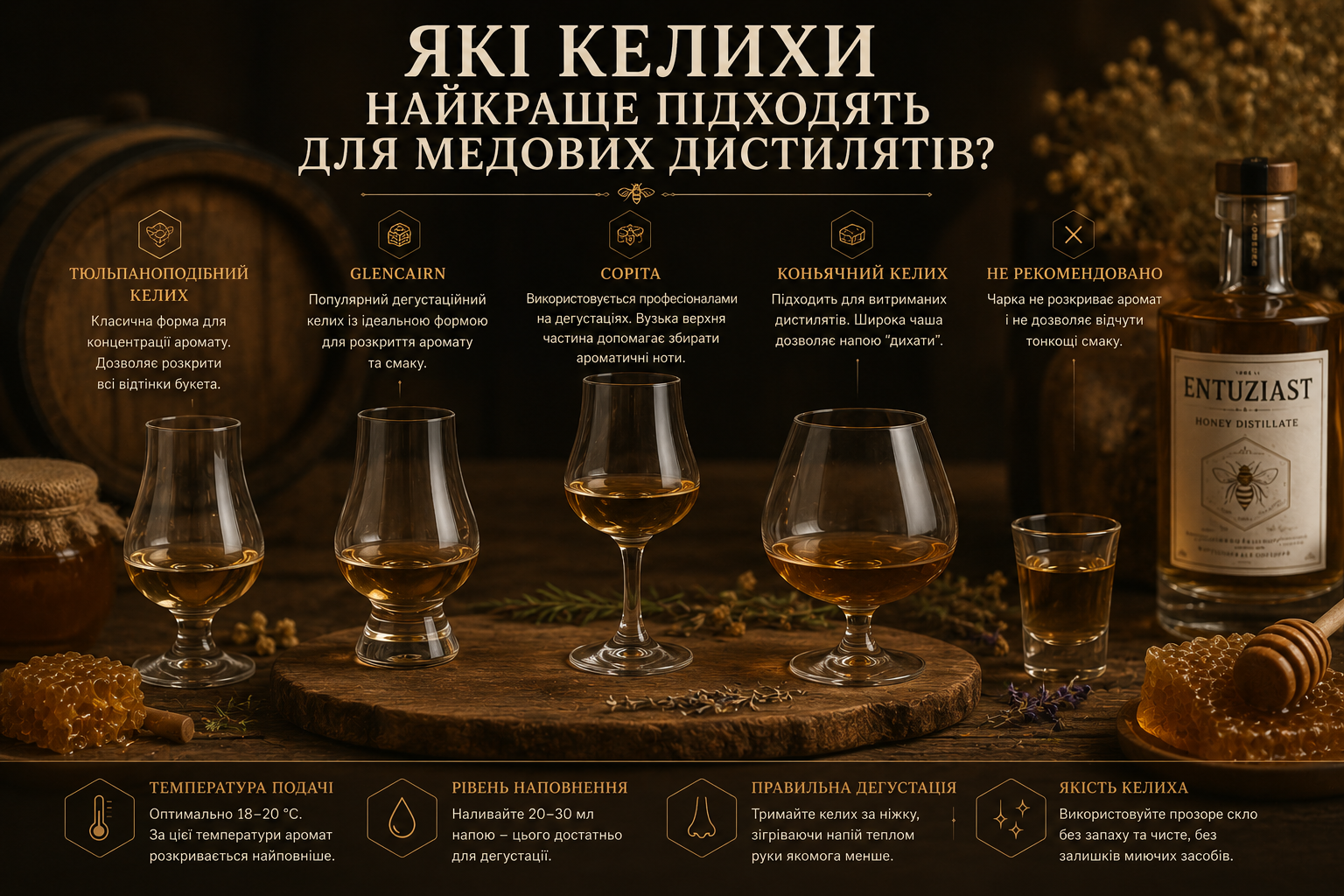
If you need to choose only one glass for honey distillate, the tulip-shaped shape will be the best solution.
Its advantages:
- concentrates the aroma well;
- allows you to appreciate all the shades of the bouquet;
- convenient for slow tasting;
- suitable for both young and aged distillates.
These are the glasses used at most international competitions and professional tastings.
Glencairn - the choice of professionals
One of the most famous tasting glasses in the world is Glencairn. It was originally created for whiskey, but today it is widely used for a variety of distillates.
The small wide base provides sufficient contact area for the drink with air, and the narrow upper part concentrates the aroma. This makes it easier to feel even the most subtle honey and floral shades.
For home tasting, this is one of the best options.
Copita - a classic for professional tastings
Another popular solution is the Copita glass. It is often used by master distillers, sommeliers and experts in the alcohol industry.
The high stem allows you to hold the glass without heating the drink with your hand, and the narrow upper part collects the aromatic bouquet well.
It is the Copita that is often used when evaluating new spirits and signature distillates.
Is a cognac glass suitable?
Many people believe that a large cognac glass is enough for any strong alcohol. In fact, this is not always the case.
A wide bowl contributes to the rapid evaporation of alcohols, which can make the aroma seem too sharp. This is especially noticeable in young distillates.
A cognac glass may be appropriate for aged honey distillates, but for careful tasting, tulip-shaped models are still the best choice.
Why a glass is not the best solution
A traditional glass practically does not allow you to evaluate the aroma of the drink. Due to the wide top, aromatic substances quickly disperse, and the tasting process itself is reduced only to assessing the taste.
If the goal is to feel the character of the honey distillate, its aromatic bouquet and aftertaste, it is worth using a specialized glass.
How much to pour?
For tasting, 20–30 ml of the drink is enough. This volume allows you to easily rotate the glass, saturating the distillate with oxygen, and at the same time leaves enough space for the aromas to accumulate.
It is not recommended to fill the glass more than a third.
Serving temperature
Honey distillates are best opened at a temperature of approximately 18–20 °C. A drink that is too cold hides aromatic notes, while an excessively warm one can make alcohol shades more noticeable.
Before tasting, it is advisable to let the bottle stand at room temperature for a few minutes if it has been stored in a cool place.
Common mistakes
To get the most out of the tasting, you should avoid several typical mistakes:
- using plastic utensils;
- too much drink in the glass;
- excessive cooling;
- hasty tasting without evaluating the aroma;
- using glasses with a strong smell of detergents.
A clean, transparent glass without foreign odors will help you evaluate the wine as objectively as possible. drink.
Conclusion
A properly chosen glass is not a trifle, but an important component of the culture of consuming honey distillates. It is it that helps to more fully reveal the aroma, feel the balance of taste and appreciate the aftertaste that master distillers create during production.
For most cases, the best choice will be a tulip-shaped tasting glass, in particular Glencairn or Copita. They allow you to maximally reveal the character of the drink and make each tasting more conscious.
ENTUZIAST honey distillates are created with great attention to detail, so they deserve to be served correctly. A good glass will help you fully experience their aromatic bouquet and get real pleasure from every sip.