





How to make honey distillate: from honey to bottle
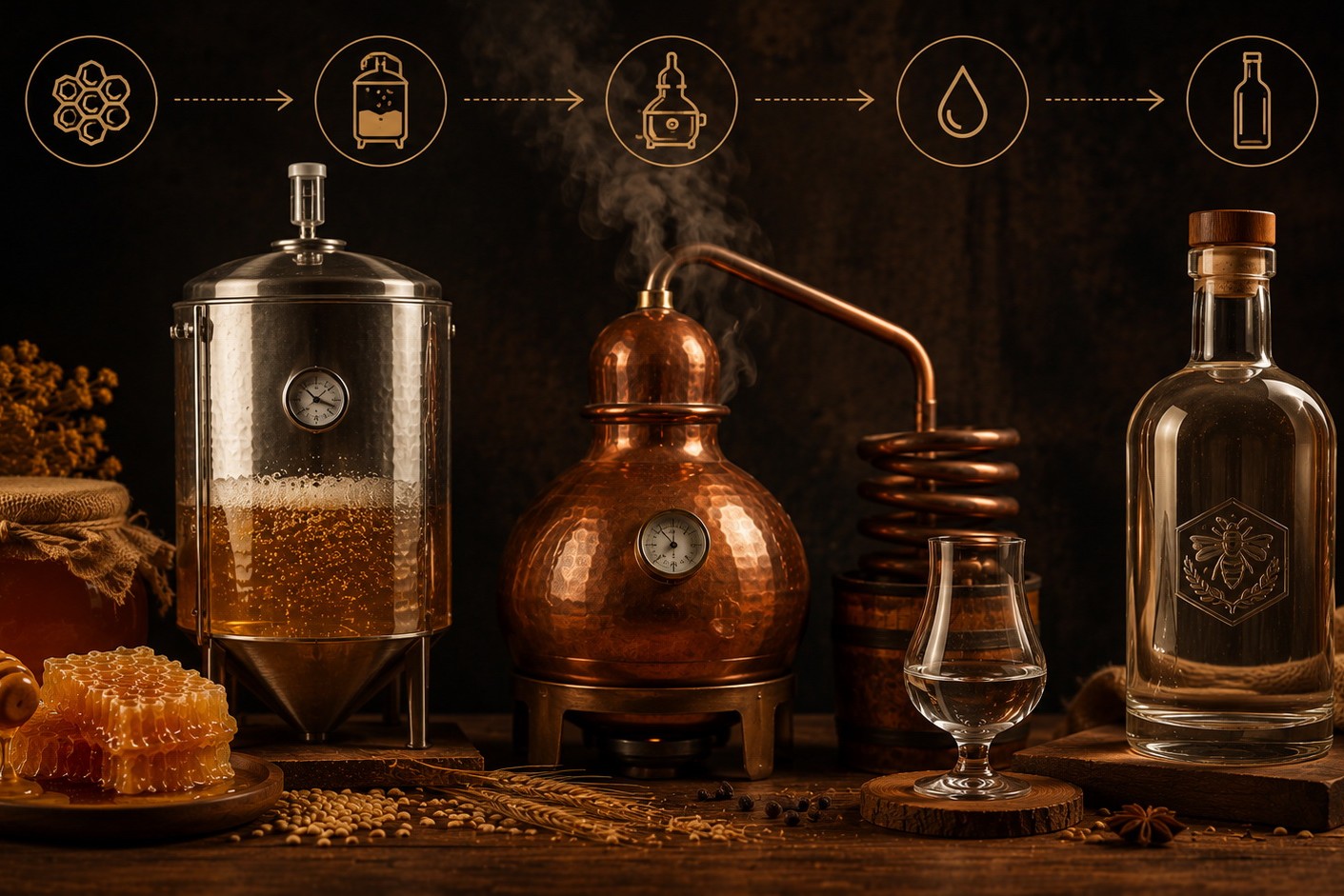
Every bottle of honey distillate begins long before the first distillation. Its story takes root in honey, water, the work of yeast, precise temperature control, and the distiller’s patience. There is no single magical step that creates the flavor. The character of the drink develops gradually—from the selection of raw materials to the moment the finished distillate is bottled.
Honey distillate is made from fermented honey wort. First, natural honey is prepared for fermentation; then, yeast converts its sugars into alcohol, and the resulting base is distilled. After that, the beverage can remain clear or undergo aging, maceration, blending, or final maturation in specially selected barrels.
In theory, the process seems simple. However, behind each stage lie dozens of decisions that determine the purity, aroma, smoothness, and future style of the product.
The first stage—selecting the honey
The foundation of a high-quality honey distillate is natural honey. It is not a decorative additive nor a way to sweeten the finished alcohol. Honey itself serves as the source of sugars for fermentation and forms the aromatic base of the future beverage.
The final result is influenced by the honey’s origin, harvest time, floral profile, and the overall condition of the raw material. Different types of honey can have floral, herbal, fruity, waxy, caramel, or spicy notes. After fermentation and distillation, these notes change, but the initial raw material still determines the direction in which the flavor will develop.
In production, it’s not just the intensity of the aroma that matters. The honey must be suitable for stable fermentation and meet the specifications of the specific product. The master distiller evaluates it not as an ordinary food product, but as the foundation of the future distillate.
Preparing the Honey Wort
Natural honey contains a large amount of sugars but very little water. Full-scale alcoholic fermentation cannot take place in such a concentrated medium. Therefore, honey is mixed with water to prepare the honey wort.
The ratio of ingredients depends on the recipe, the desired sugar content, and the production process. At this stage, it is important to achieve a homogeneous base in which the yeast can function predictably.
The preparation of the wort affects the entire subsequent production process. Excessive concentration can complicate fermentation, while insufficient concentration can alter the structure of the final beverage. That is why the recipe must take into account the properties of the specific honey, not just general proportions.
Equipment Preparation
Before starting work, fermentation tanks, piping, and heating, cooling, and temperature control systems are inspected. Equipment cleanliness is critical, as foreign microorganisms can alter the wort’s aroma or ruin the entire batch.
Craft brewing does not mean a lack of precision. On the contrary, small batches often require particularly careful monitoring. Every vessel, valve, and connection must be prepared for operation, and the process parameters must be set.
At this stage, the brewer essentially creates the conditions under which natural processes can work to the benefit of the future beverage.
Fermentation—the moment when honey becomes the basis of alcohol
After the wort is prepared, yeast is added. The yeast metabolizes the natural sugars in the honey, producing alcohol, carbon dioxide, and numerous aromatic compounds.
Fermentation isn’t just a matter of waiting for alcohol to form. It is during this period that the majority of the future flavor profile is formed. Temperature, duration, yeast activity, and the composition of the wort can all influence the intensity of fruity, floral, spicy, and other flavor notes.
Slow, controlled fermentation helps avoid sudden fluctuations and unwanted aromas. The master monitors the temperature, the condition of the wort, and the dynamics of the process. He does not try to speed up fermentation as much as possible, since speed does not always benefit quality.
Once fermentation is complete, the resulting base already contains alcohol but is not yet a honey distillate. Next comes distillation, during which only the most valuable portion is extracted from the large volume of fermented wort.
Preparation for Distillation
Before distillation, the fermented base is evaluated for aroma, alcohol content, and overall condition. At this stage, it is important to ensure that fermentation has completed properly and that the mash possesses the necessary characteristics.
The subsequent process depends on the style of the beverage. For some products, traditional pot still distillation is sufficient; for others, multiple stages and various types of equipment are used.
A combination of column and pot still distillation allows for high purity while preserving the distinctive character of the raw materials. Distillation columns help separate components more precisely, while a copper alembic can impart roundness, depth, and an artisanal character to the beverage.
First Distillation
During the first distillation, the fermented mash is heated, and the volatile components turn into vapor. They are then cooled and return to a liquid state.
The goal of this stage is not to produce the finished beverage, but to concentrate the alcohol and prepare the base for more precise separation in subsequent stages. The first distillation allows for the removal of a significant portion of the water and the formation of an intermediate distillate.
In complex processes, a continuous-action column may be used at this stage. It ensures stable operation and helps produce a pure base for further distillation.
Fractional Distillation and Fraction Separation
The next distillation requires particular precision. Different volatile components evaporate and condense at different rates, so the distillate is conventionally divided into initial, middle, and final fractions.
The initial fractions have a sharp aroma and do not contribute to the desired flavor profile of the beverage. The middle portion, often referred to as the “heart” of the distillation, contains the purest and most valuable aromatic components. Toward the end of the distillation, heavier notes emerge, and an excess of these can make the taste harsh.
The master distiller determines the cut-off points not only based on equipment readings. Aroma, taste, experience, and an understanding of what the finished product should be like remain crucial.
Cap columns allow for more precise control of the separation process. Multiple cycles of evaporation and condensation inside the column help achieve high purity while preserving the distillate’s essential character.
Final distillation in a copper alembic
The copper still is one of the most recognizable symbols of traditional distillation. It is used not only for its historical form. The contact of the vapors with copper influences the purity of the aromatic profile and helps to develop a more rounded character in the spirit.
The final distillation in the alembic can impart depth and expressiveness to the distillate that are difficult to achieve through a high degree of purification alone. It is important to find a balance here: the beverage must be pure, but not bland.
It is at this stage that technology gradually gives way to craftsmanship. Even with identical equipment, the result depends on the heating rate, the draw-off regime, and the distiller’s decisions.
Resting the Distillate
After distillation, the distillate needs time to stabilize. Immediately after distillation, its aroma and flavor can be harsh and disjointed.
During the resting period, the individual components gradually balance out, and the aromatic profile becomes more cohesive. The duration of this stage depends on the product’s style and the producer’s future plans.
Once stabilized, the clear honey distillate can be prepared for blending, adjusted to the desired strength, and bottled. Other batches are sent for aging or serve as the base for signature drinks.
Maceration of Berries, Fruits, and Botanicals
Honey distillate can be used as a standalone product or as a base for further work with natural ingredients. Berries, fruits, herbs, spices, and other botanicals are macerated in it.
During maceration, the raw materials impart their aromatic and flavor components to the distillate. The duration of the process depends on the type of material and the desired result. Delicate raspberries, tart blackthorn, and spicy botanicals each require a different approach.
After maceration, the spirit may be redistilled. This creates a cleaner and more refined profile, in which the natural ingredients do not stand out as separate additives but become part of the overall composition.
Aging in Oak Barrels
After distillation, some of the honey distillates are transferred to oak barrels. This marks the beginning of one of the longest stages of production.
The wood gradually imparts aromatic compounds to the spirit, and slow exposure to air alters its structure. The distillate develops color, becomes smoother, and takes on notes of vanilla, spices, wax, wood, dried fruit, or wine.
French and Ukrainian oak can affect the spirit in different ways. What was previously stored in the barrel is also significant. Barrels that previously held red wine, sherry, or sweet white wine can add new nuances to the honey-based spirit.
In some cases, the distillate undergoes its primary aging in one barrel and then its final aging in another. This approach allows for the addition of new nuances to the finished profile and makes the composition more complex.
Blending
Even high-quality individual distillates do not always become a finished product right away. The master distiller may blend batches of different ages, different aging styles, or spirits with distinct aromatic profiles.
Blending is not intended to mask flaws, but to create balance. One component may add honeyed smoothness, another—fruity freshness, and a third—spiciness or woody depth.
After blending, the drink needs more time to rest. The individual components must come together into a unified composition so that none of them seems out of place.
Adjusting to the Desired Alcohol Content
After distillation, the beverage’s alcohol content is usually higher than the level at which it reaches the consumer. Therefore, before bottling, the distillate is gradually diluted to the specified level.
This process should not be viewed as simply adding water. Changing the alcohol content affects the aroma, texture, and overall perception of the beverage. Sudden dilution can disrupt the balance, so water is added gradually, after which the distillate is allowed to stabilize.
The correct alcohol content helps bring out the aromatic profile without excessive harshness. It may vary for different products depending on their character and recipe.
Quality Control Before Bottling
Before the beverage is bottled, its color, clarity, aroma, taste, and alcohol content are evaluated. For aged products, it is also important to ensure that the influence of the barrel has not become excessive.
The master compares the finished batch with the original concept and determines whether the necessary balance has been achieved. If necessary, the beverage is given additional time to rest, or the blend is adjusted.
A craft product is valuable precisely because each batch undergoes careful evaluation, and decisions are made not only based on numbers but also on organoleptic properties.
Bottling
Bottling is the final stage of production, but it is not merely a technical operation. The bottle must protect the beverage, preserve its properties, and convey the brand’s character.
After filling, the bottles are sealed, labeled, and prepared for storage. It is important to avoid exposure to high temperatures, direct sunlight, and sudden changes in conditions.
This marks the end of the journey from honey to the finished product. For the consumer, however, the story of the beverage is just beginning—with that first encounter with its aroma and taste.
How ENTUZIAST Beverages Are Made
At the ENTUZIAST honey distillery, honey serves as the foundation for various styles of craft beverages. It undergoes fermentation, distillation, and subsequent stages depending on the specific product’s recipe.
In Honey Spirit Pure, the focus is on the purity of the honey distillate, slow fermentation, and the use of sprouted wheat. In Honey Spirit Aged, the process is enhanced by three stages of distillation, extended aging in French and Ukrainian oak, and a final maturation period.
Honey Spirit Apple combines honey distillate with classic apple spirits. The MeadGIN line takes a different approach: the honey base is blended with juniper, citrus, raspberries, blackthorn, and botanicals.
While each product follows a distinct path, they are united by a single philosophy: natural ingredients, meticulous production control, and a commitment to preserving the character of honey in a complex, high-proof spirit.
Frequently Asked Questions About Honey Distillate Production
Is pure honey distilled?
No. First, a mash is prepared from honey and water, which undergoes alcoholic fermentation. The fermented base is then distilled.
Why is slow fermentation necessary?
Controlled fermentation helps create a clean, aromatic base and reduces the risk of unwanted flavors.
Why are multiple distillation stages used?
Each stage serves a specific purpose: to concentrate the alcohol, purify the distillate, select fractions more precisely, or create a more rounded flavor.
Why is a copper still used for honey distillate?
Copper helps create a cleaner aromatic profile, while traditional pot still distillation adds depth and a distinct artisanal character to the distillate.
Why are some honey distillates clear, while others are amber?
After distillation, the spirit is clear. The straw-yellow or amber color develops during aging in oak barrels.
How long does it take to produce honey distillate?
An unaged product requires time for fermentation, several distillation stages, and stabilization. For aged beverages, the production cycle can last several years.
Honey, Technology, and Time
Creating honey distillate is a sequence of precise processes in which no stage can be skipped without compromising the result. The quality of the honey affects the mash; fermentation lays the foundation; distillation determines purity; and aging can completely transform the character of the beverage.
That is precisely why a true honey distillate is not created overnight. It requires knowledge, equipment, control, and patience. Every finished bottle combines the work of nature with the master’s artistry—from the first drop of honey to the final bottling.
ENTUZIAST works with honey as a full-fledged raw material for creating signature spirits. In this way, a traditional Ukrainian product is given a new interpretation within the modern culture of craft distillation.