





How Did People Learn to Distill Alcohol? The History of Distillation
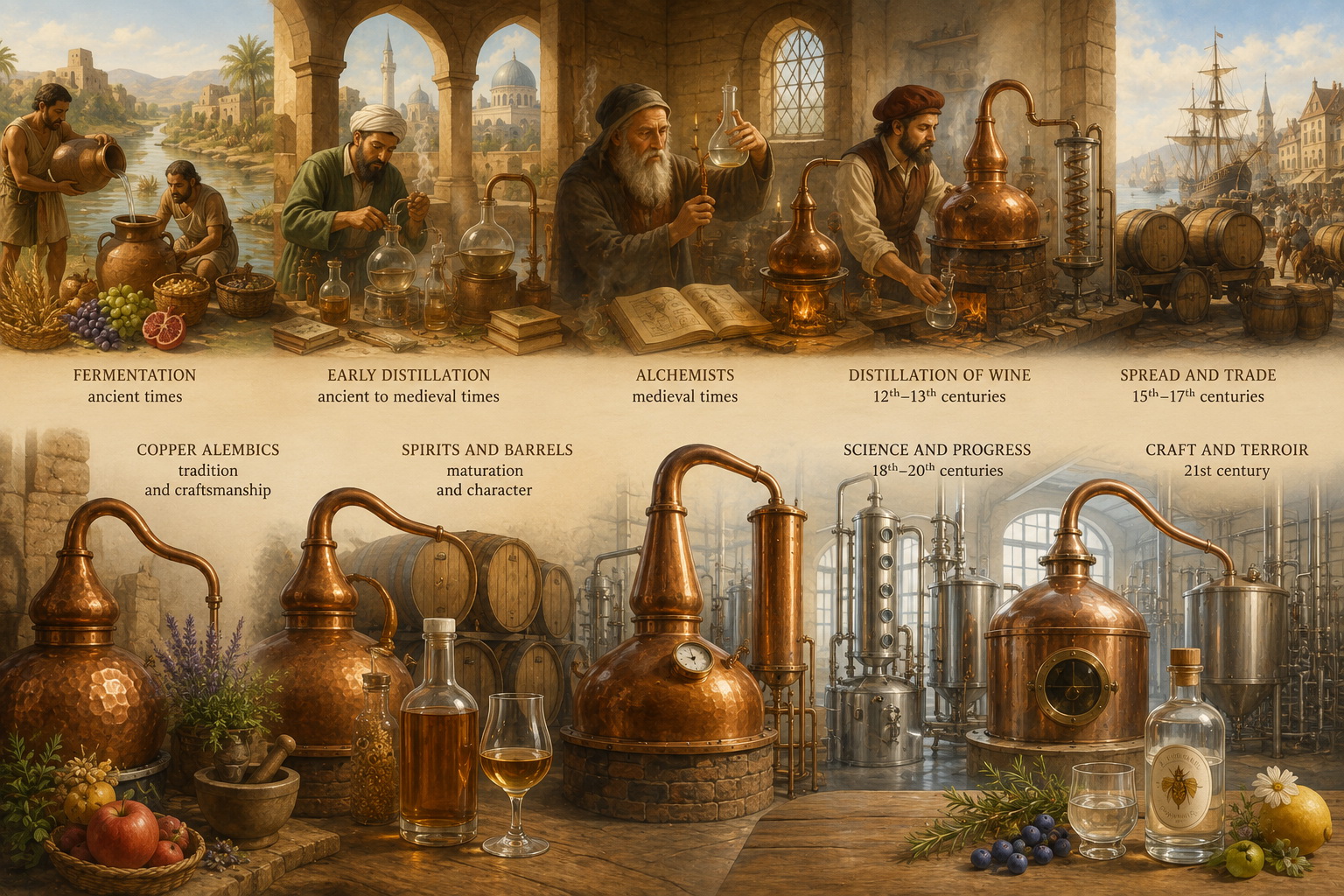
Today, distillation seems like a relatively straightforward technology. A fermented liquid is placed in a still, heated, part of it evaporates, the vapor is cooled and condensed, and a distillate is collected.
Yet behind this apparently simple sequence lies a history spanning thousands of years — a story of observation, experimentation, craftsmanship, and the gradual accumulation of knowledge.
People learned to make fermented drinks long before they understood the nature of alcohol. Wine, beer, and honey-based beverages existed in ancient civilizations at a time when nobody knew about yeast, ethanol, or the chemistry of fermentation.
Distillation came much later.
And perhaps the most interesting part of the story is that the technology was not originally developed simply to produce whisky, brandy, gin, or other strong spirits.
The history of alcohol distillation grew out of a much broader human desire to separate substances, capture vapors, and extract concentrated essences from complex materials.
First Came Fermentation
To understand the origins of alcohol distillation, we need to begin with a much older process: fermentation.
Humans were producing alcoholic beverages thousands of years before the emergence of modern science.
Archaeological evidence points to very early fermented drinks made from combinations of grains, fruits, and honey.
Their discovery was probably connected to observations of processes that occur naturally.
Sweet fruit juices or honey diluted with water can begin to ferment under suitable conditions when wild yeasts are present.
To ancient people, the transformation must have seemed almost mysterious: a sweet liquid changed its aroma and flavor and began to affect the human body in an entirely different way.
Over time, people learned how to reproduce and control this process more reliably.
A culture of fermented beverages was born.
Why Were Ancient Alcoholic Drinks Relatively Weak?
Fermentation has natural limits.
Yeast converts sugars into ethanol and carbon dioxide, but as the concentration of alcohol rises, the environment becomes increasingly difficult for the yeast itself.
For that reason, ordinary fermentation cannot increase alcohol strength indefinitely.
To obtain alcohol at a much higher concentration, another process is required.
That process is distillation.
What Did People Know About Evaporation Before Alcohol Distillation?
Humans could observe evaporation long before laboratories existed.
Water disappears under the heat of the sun. Steam rises from a boiling vessel. When that vapor reaches a cooler surface, droplets of liquid form again.
These phenomena may seem obvious to us today, but they contain the fundamental principle behind distillation.
The crucial step is not simply allowing a liquid to evaporate, but capturing the vapor and turning it back into liquid.
Once this becomes possible, substances can be separated and concentrated in new ways.
Distillation Was Not Invented for Drinking Alcohol
One common misconception is to imagine the first distillers as people trying to make stronger alcoholic drinks.
In reality, early forms of distillation had a much wider range of purposes.
People were interested in producing or studying:
- aromatic waters;
- perfume ingredients;
- plant extracts;
- medicinal preparations;
- mineral and chemical substances;
- materials used in alchemical experiments.
Distillation techniques developed gradually, and only over time were they increasingly applied to fermented liquids.
Who Invented Distillation?
There is no simple answer.
It is unlikely that there was a single inventor who one day created the distillation apparatus in the form we recognize today.
Different forms of evaporation, condensation, and primitive distillation appeared in different cultures and were applied to different materials.
What we now call distillation emerged gradually over a very long period.
Claims that “distillation was invented by one particular person in one particular year” therefore tend to oversimplify a much more complicated history.
What Existed Before the Classic Alembic?
The basic principle of distillation can be demonstrated without highly sophisticated equipment.
If a liquid is heated in an enclosed or partially enclosed vessel, its vapor is directed toward a cooler surface, and the resulting condensate is collected, a basic form of distillation has already taken place.
Early devices were far more primitive than the copper stills used by many distilleries today.
But their design gradually improved.
Separate vessels for heating appeared, along with components for collecting vapor and systems for cooling it.
Step by step, these developments moved closer to the apparatus that would eventually become known as the alembic.
What Role Did Alchemy Play in the Development of Distillation?
An enormous one.
Today, the word “alchemy” is often associated primarily with legendary attempts to turn base metals into gold.
Historical alchemy, however, was a much broader field of experimentation.
Alchemists heated substances, evaporated them, condensed vapors, dissolved materials, mixed compounds, and observed the resulting transformations.
Through these experiments, laboratory equipment gradually became more sophisticated.
Distillation apparatus became one of the most important tools of this early chemical practice.
Why Was Distillation So Important to Alchemists?
Alchemists were fascinated by the idea of separating matter into its components and extracting what they sometimes understood as its essential qualities.
Distillation fitted this worldview remarkably well.
A liquid disappeared inside a vessel, became invisible vapor, traveled through the apparatus, and then returned to liquid form.
To a medieval observer, this was more than a physical process.
It could easily become a symbol of purification and transformation.
Yet alongside philosophical interpretations, very practical knowledge was being accumulated.
What Role Did the Medieval Islamic World Play?
Scholars and craftspeople of the medieval Islamic world made major contributions to laboratory techniques and the development of distillation methods.
Medicine, pharmacy, perfumery, and chemical practices flourished across the region.
Distillation was particularly valuable for producing aromatic waters and concentrated substances from botanical materials.
Apparatus designs became more sophisticated, while knowledge of distillation was recorded, refined, and transmitted.
Through the translation and circulation of scientific works, these traditions later had a significant influence on European practice as well.
Where Does the Word “Alembic” Come From?
The history of the word itself reflects the movement of technology between cultures.
The European word alembic derives through the Arabic al-anbiq from the older Greek term ambix, associated with a vessel or component used in distillation.
The word changed as it traveled between languages, while the technological tradition evolved alongside it.
Eventually, “alembic” came to describe the characteristic distillation apparatus consisting of a heated vessel, an upper section that collects vapor, and a tube directing that vapor toward a cooling system.
When Did People Begin Distilling Alcohol?
This is where the history becomes more complicated.
Experiments involving fermented liquids took place over a long period, but reliable written evidence for systematic wine distillation and the production of concentrated alcohol becomes particularly important in the medieval tradition.
In Europe, knowledge of wine distillation developed significantly around the 12th and 13th centuries.
At first, the resulting spirit was not necessarily viewed as an everyday drink.
Instead, it was regarded as an unusual concentrated substance with potentially valuable medicinal properties.
What Was Aqua Vitae?
One of the best-known historical names for distilled alcohol was the Latin aqua vitae — “water of life.”
Similar ideas later appeared in the names of strong alcoholic drinks across different languages and cultures.
Distilled alcohol seemed like an extraordinary substance.
It was far stronger than wine, acted as an effective solvent for many compounds, could be stored for long periods, and was useful for extracting substances from herbs and other botanicals.
It is therefore hardly surprising that people attributed an extraordinary range of medicinal properties to it.
First a Medicine, Then a Drink
For a considerable period, distilled alcohol was closely connected with medicine and apothecary practice.
Herbs and other botanicals were infused in alcohol.
Spirit proved to be an excellent solvent for many aromatic compounds.
As a result, the historical boundary between medicine, herbal tincture, and alcoholic beverage was much less distinct than it is today.
Some modern categories of spirits have roots in precisely this tradition.
When Did Spirits Move Beyond the Apothecary?
As distillation technology became more accessible and reliable, it gradually moved beyond laboratories and apothecaries.
People began distilling whatever suitable raw materials were abundant in their region.
Where grapes were widely grown, wine was the natural starting point.
In grain-producing regions, fermented grain became the base.
Fruit-growing areas used apples, pears, plums, cherries, and other fruits.
And in regions with strong beekeeping traditions, fermented honey beverages could also provide raw material for distillation.
A universal technology began to produce a remarkable variety of local traditions.
Why Did Distillation Spread So Widely?
Strong spirits offered several practical advantages.
They contained more alcohol in a smaller volume than fermented beverages, could generally withstand extended storage and transportation more effectively, and offered a concentrated product that was useful for trade.
This became especially important as commercial networks expanded.
Wine and beer could be relatively unstable products under historical storage conditions.
Distilled alcohol opened new possibilities for transporting and storing alcoholic beverages over greater distances.
How Did Local Ingredients Create Different Types of Spirits?
The fundamental principle of distillation is broadly similar wherever it is practiced.
The raw materials, however, can be completely different.
And that difference became the foundation for the extraordinary diversity of spirits.
Fermented grape wine became the basis for many styles of grape brandy.
Fermented grain gave rise to numerous grain spirits.
Apples, plums, pears, cherries, and other fruits created their own regional distilling traditions.
Sugar cane gave the world another major family of spirits.
In this sense, distillation became a kind of language through which different regions could express the character of their local raw materials.
Why Were Traditional Stills Often Made from Copper?
Copper proved to be an exceptionally useful material for distillation equipment.
It conducts heat efficiently, is relatively easy to shape, and can be formed into complex rounded structures.
Over time, another important property became clear: contact between vapor and copper can improve the aromatic profile of a distillate by interacting with certain undesirable sulfur-containing compounds.
The copper alembic therefore became more than a historical symbol of distillation.
It became a technological tool that remains relevant in modern spirit production.
Were Early Distilled Spirits Similar to Modern Ones?
Probably not always.
Modern distilling relies on precise control of fermentation, temperature, fractions, alcohol strength, and equipment hygiene.
Early distillers had neither modern measuring instruments nor a scientific understanding of vapor composition.
They learned through observation.
Aroma, flavor, the behavior of the still, and accumulated experience were their primary tools.
From this practical knowledge, the craft of distillation gradually emerged.
When Did Distillers Begin Separating Heads, Hearts, and Tails?
It is difficult to assign an exact date to the development of this practice.
It evolved alongside the practical understanding that the composition of a distillate changes throughout a run.
Distillers noticed that the first portions smelled and tasted different from the middle, while the character changed again toward the end.
Even without modern chemistry, experience revealed an important lesson: not everything leaving the still should simply be mixed together.
This observation gradually developed into the craft of making distillation cuts.
How Did Distillation Become a Craft?
Eventually, producers stopped thinking only about obtaining stronger alcohol.
They began to notice that the shape of the still, heating rate, timing of the cuts, and number of distillation runs could all change the final flavor.
Distillation evolved from a method of concentrating alcohol into a method of shaping its character.
This is where what we might now call the art of the distiller truly began to emerge.
How Did Barrel Aging Become Part of the Story?
This is another important chapter in the history of spirits.
Originally, wooden barrels were primarily practical containers.
They were used to store and transport wine, beer, and many other products.
As distilled spirits began to be stored and transported in barrels, producers and merchants gradually observed that prolonged contact with wood changed the alcohol.
It developed color, acquired new aromas, and often became smoother.
A practical shipping container gradually evolved into one of the most important tools for developing the flavor of spirits.
How Did Science Change Distillation?
For centuries, distillation developed largely through empirical knowledge.
Distillers knew that certain actions produced certain results even when they could not explain the chemistry behind them.
The development of modern chemistry gradually changed this.
Scientists gained a better understanding of ethanol, liquid mixtures, vapor-liquid behavior, and the roles played by different volatile compounds.
Craft began to receive a scientific explanation.
How Did Distillation Columns Appear?
Traditional pot stills are well suited to producing aromatic distillates, but each distillation is a separate batch process.
As industrial production expanded, more efficient systems became desirable.
Column stills made it possible to create repeated cycles of evaporation and condensation within a single system.
This greatly increased separation efficiency and made it possible to produce alcohol at much higher levels of purification.
Distillation had entered the industrial age.
Did Column Stills Replace Traditional Copper Pot Stills?
No.
They can serve different production goals.
When highly neutral alcohol is required, the efficiency of a column can be a major advantage.
But when a producer wants to retain the character of fruit, grain, grapes, honey, or another raw material, traditional pot distillation can be extremely valuable.
That is why enormous industrial columns and relatively small copper alembics still exist side by side in the 21st century.
What Has Changed in Modern Distillation?
A modern distiller has tools that historical alchemists could hardly have imagined.
Temperature can be monitored with great precision.
Alcohol strength can be measured accurately.
Chemical composition can be analyzed in a laboratory.
Fermentation can be controlled using carefully selected yeast cultures.
Yet the fundamental principle remains remarkably familiar.
We still heat a liquid, create vapor, direct that vapor elsewhere in the system, and turn it back into liquid.
Why Are Craft Distilleries Returning to Traditional Methods?
Interestingly, the rise of highly technological industrial production has not eliminated interest in traditional distilling.
Quite the opposite: small distilleries around the world increasingly work with local ingredients and aim to preserve their individual character.
In this context, a copper alembic is not merely a decorative symbol of the past.
It can be a practical way to create aromatic distillates in which technology does not erase the origin of the raw material but helps reveal it.
What Does an Alchemist Have in Common with a Modern Distiller?
Centuries of scientific development separate a medieval laboratory from a modern distillery.
Yet if we look at the process itself, there is a remarkable continuity.
Both the alchemist and the modern distiller observe a liquid becoming vapor and that vapor returning to liquid form.
The difference lies in understanding and control.
Where there were once intuition, symbolism, and experimentation, there are now chemistry, measurement, and process control.
But the fascination with transformation remains.
Why Does the History of Distillation Matter Today?
Because most modern categories of spirits cannot truly be understood without understanding the history of the technology behind them.
Still shapes, the use of copper, double or triple distillation, fraction selection, botanical distillation, and barrel maturation did not appear all at once.
Each is the result of generations of accumulated experience.
A modern bottle of distillate therefore carries traces of technological decisions that may be centuries old.
The History of Distillation: In Short
- Fermented alcoholic beverages appeared long before distillation.
- Early distillation methods were not developed exclusively for alcohol production.
- Evaporation and condensation were used in perfumery, medicine, botanical processing, and alchemical experiments.
- The scientific traditions of the medieval Islamic world made major contributions to the development of distillation techniques and apparatus.
- In medieval Europe, wine distillation became important in alchemical and apothecary practice.
- Distilled alcohol became known as aqua vitae — the “water of life.”
- Distillation gradually moved beyond medicine and became a method for producing many different types of spirits.
- Local raw materials helped create distinct regional distilling traditions.
- The development of chemistry and industrial technology made distillation increasingly precise and controllable.
- Despite modern equipment, the basic principle remains the same: evaporation, separation, and condensation.
Conclusion
The history of distillation is not the story of a single invention.
There was no one day when somebody assembled the first still and instantly created the world of spirits as we know it.
It was a long journey.
First, people learned to work with fermentation. Then they experimented with evaporation and condensation. Alchemists and apothecaries improved the equipment. Scholars and craftspeople across different cultures developed and transmitted knowledge. Distillers adapted the technology to the raw materials available in their own regions.
Gradually, grape, grain, fruit, honey-based, and many other distilling traditions emerged.
Then came increasingly sophisticated copper stills, fraction selection, repeated distillation, oak barrels, columns, laboratory analysis, and the modern distillery.
Yet at the center of this entire history remains an extraordinarily simple and beautiful idea.
Humans learned how to capture vapor, turn it back into liquid, and transform that principle into one of the most sophisticated crafts in the world of drinks.