





Sloe MeadGIN Negroni — A Berry Interpretation of the Classic Negroni
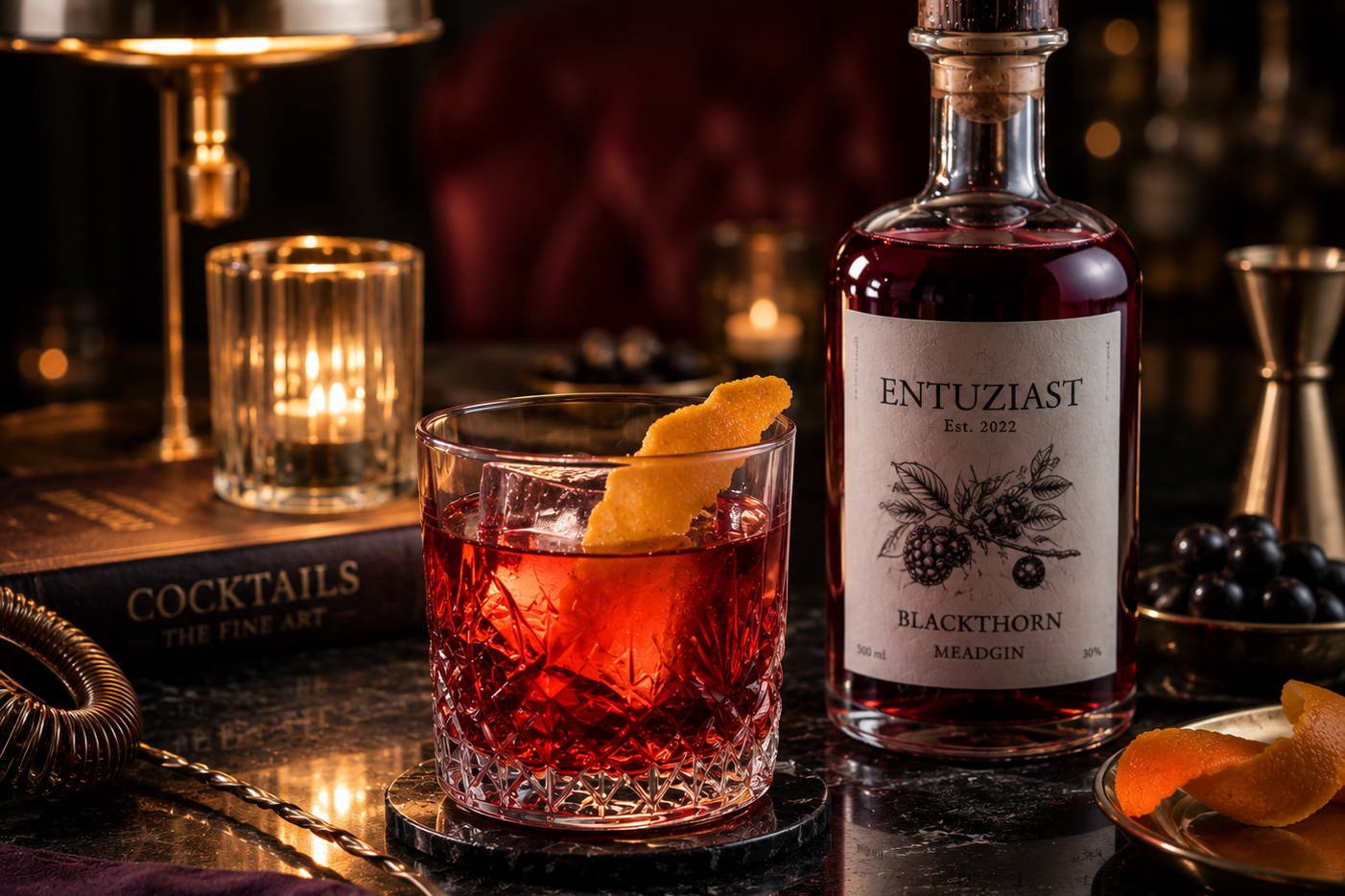
Negroni is one of those cocktails where there is almost no room for unnecessary ingredients.
The classic formula is built around three components in equal proportions: gin, sweet red vermouth, and a bitter Italian aperitif.
This structure is so simple and yet so beautifully balanced that it has become the foundation for dozens of modern variations.
But what happens when traditional gin is replaced with a spirit carrying the deep, dark-fruit character of blackthorn?
This is where Sloe MeadGIN Negroni begins — an Entuziast interpretation of the classic in which the familiar bittersweet structure of Negroni acquires a darker berry dimension.
How Is Sloe MeadGIN Negroni Different from a Classic Negroni?
In a traditional Negroni, gin primarily provides a dry botanical character. Juniper, citrus, herbs, and spices create a contrast with the sweetness of the vermouth and the bitterness of the aperitif.
In our version, the balance shifts.
The blackthorn component introduces dark berry notes, subtle tartness, fruit depth, and a softer character.
The result remains clearly recognizable as a relative of Negroni, but becomes rounder, more fruit-driven, and distinctly different from the classic.
Why Does Blackthorn Work So Well in a Negroni?
Blackthorn has a particularly interesting flavor profile.
It combines dark berry fruitiness with natural acidity and characteristic tartness.
These qualities interact beautifully with the other two elements of a Negroni.
Sweet vermouth emphasizes the fruit notes, while the bitter aperitif creates contrast and prevents the cocktail from becoming simply a sweet berry drink.
The character of Sloe MeadGIN Negroni emerges precisely at the intersection of sweetness, bitterness, fruit, and tartness.
Sloe MeadGIN Negroni Recipe
- 30 ml Entuziast Blackthorn;
- 30 ml sweet red vermouth;
- 30 ml bitter red aperitif;
- one large ice cube;
- orange peel for garnish.
This is the basic version, built around the classic Negroni ratio of 1:1:1.
However, because Blackthorn has its own distinctive character, the proportions can be adjusted slightly. We will return to this later.
How to Make a Sloe MeadGIN Negroni
- Fill a mixing glass with ice.
- Add 30 ml of Entuziast Blackthorn.
- Pour in 30 ml of sweet red vermouth.
- Add 30 ml of bitter aperitif.
- Stir gently with a bar spoon for approximately 15–20 seconds.
- Strain into a rocks glass over one large ice cube.
- Express the essential oils from a strip of orange peel over the surface of the cocktail.
- Place the peel in the glass or use it only to perfume the drink.
Why Is a Negroni Stirred Rather Than Shaken?
There is no citrus juice, egg white, cream, or other ingredient that requires vigorous mixing.
All three components already have a uniform liquid structure.
Our goal is therefore simply to chill the cocktail and introduce the right amount of dilution from the melting ice.
Gentle stirring allows this to happen in a controlled way.
Shaking would introduce more tiny air bubbles, increase dilution, and create a different texture that this particular cocktail does not need.
Why Does the Cocktail Need Water?
Dilution is an important part of almost every spirit-forward cocktail.
As the drink is stirred, the ice slowly melts, and a small amount of water becomes an invisible fourth ingredient.
It reduces the concentration of alcohol and helps the aromas open up.
This is why simply pouring three chilled ingredients into a glass is not quite the same as properly stirring a Negroni with ice.
What Kind of Vermouth Should You Use?
This cocktail calls for sweet red vermouth.
Its wine base, herbs, spices, and moderate sweetness create a bridge between the dark-fruit character of Blackthorn and the bitterness of the aperitif.
An excessively sweet or strongly vanilla-driven vermouth can make the cocktail feel heavy.
A more herbal and spicy vermouth, on the other hand, helps preserve the recognizable character of Negroni.
What Kind of Bitter Aperitif Works Best?
The most obvious choice is a classic red Italian bitter aperitivo.
It provides the characteristic citrus and herbal bitterness associated with Negroni.
However, different bitter aperitifs can significantly change the final result.
Some are more orange-driven, while others emphasize herbs, spices, or a more intense bitterness.
This gives you another opportunity to experiment with the cocktail.
Do You Have to Follow the 1:1:1 Ratio?
No.
Equal parts are an excellent starting point, but they are not an unbreakable rule.
Blackthorn has a more expressive fruit character than a classic dry gin, so the balance can be adjusted according to personal preference.
For example:
- 30/30/30 ml — closest to the classic Negroni structure;
- 40/25/25 ml — more emphasis on Blackthorn;
- 30/35/25 ml — softer and more wine-driven;
- 30/25/35 ml — drier and more bitter.
In this way, the cocktail can literally be tuned to your taste.
Does It Need Additional Simple Syrup?
No.
Sweetness is already present in the vermouth, the bitter aperitif, and the berry character of the base spirit.
Additional syrup would almost certainly make the cocktail too sweet and disrupt its greatest strength — the balance between sweetness and bitterness.
What Kind of Ice Should You Use?
For serving, one large cube or another large piece of clear ice works best.
It melts more slowly and allows the cocktail to evolve gradually in the glass.
The first sips will be more concentrated, while the drink becomes slightly softer over time.
This slow evolution is part of the Negroni experience.
Why Use Orange Peel?
Orange is almost a natural partner for Negroni.
Its essential oils emphasize the citrus notes of the bitter aperitif while creating a fresh contrast with the dark berry character of Blackthorn.
The important part is to perfume the surface of the cocktail with the peel rather than simply placing a piece of orange in the glass.
Squeeze the peel gently over the drink and you may even see tiny droplets of aromatic oil settle on the surface.
Can You Garnish It with Berries?
You can, but we would not make berries an essential part of the presentation.
Sloe MeadGIN Negroni is not intended to be a fruity dessert cocktail.
Its berry character should be discovered in the flavor rather than explained by covering the glass with fruit.
A simple strip of orange peel is more than enough.
What Should Sloe MeadGIN Negroni Taste Like?
The first sip should feel rich and concentrated.
The familiar bittersweet character of Negroni appears first, followed gradually by darker berry notes.
Blackthorn contributes fruit, acidity, and subtle tartness.
Vermouth brings vinous and spicy notes, while the bitter aperitif creates a long, pleasantly bitter finish.
This is not a light cocktail designed to be consumed in large sips.
It benefits from time.
Is Sloe MeadGIN Negroni Sweeter Than a Classic Negroni?
It may feel somewhat softer and more fruit-driven.
However, a properly balanced version should not become noticeably sweet.
The bitterness of the aperitif and the herbal character of the vermouth keep the berry component under control.
If the cocktail feels too sweet, slightly reduce the amount of vermouth or increase the proportion of bitter aperitif.
When Should You Serve Sloe MeadGIN Negroni?
Unlike a light Spritz or Highball, this is more of an evening cocktail.
It works beautifully before dinner as a rich aperitif, but it can be equally interesting when sipped slowly after a meal.
Its darker character feels particularly natural during autumn and winter, although there is no reason to limit it to a particular season.
What Food Goes Well with Sloe MeadGIN Negroni?
Its rich bittersweet structure allows it to stand alongside more flavorful foods.
Aged cheeses, cured meats, prosciutto, nuts, olives, and dishes with caramelized or smoky notes are all good choices.
Dark chocolate can also make an interesting pairing, especially when it has a high cocoa content and restrained sweetness.
How Is Sloe MeadGIN Negroni Different from Sloe MeadGIN Sour?
The difference is fundamental.
Sloe MeadGIN Sour is built around lemon acidity, a sweet component, and a softer texture.
It is brighter, fresher, and more overtly fruit-driven.
Sloe MeadGIN Negroni contains no citrus juice.
Instead, bitterness, vermouth, berry tartness, and slow dilution over ice define its character.
They are two completely different ways of exploring the blackthorn character of Entuziast .
Why Is Sloe MeadGIN Negroni Important to the Entuziast Signature Cocktail Collection?
Because signature cocktails should differ by more than a garnish or a new name.
We are interested in placing Entuziast spirits into fundamentally different cocktail structures.
A Fizz reveals one side of a spirit. A Sour reveals another. A Spritz shows something different again.
Negroni allows us to explore Blackthorn within one of the world's most recognizable bittersweet cocktail structures.
Conclusion
Sloe MeadGIN Negroni is not an attempt to make a classic Negroni “more berry-flavored” by adding syrup.
The berry character is already built into the alcoholic base itself.
Blackthorn brings dark fruit and tartness, vermouth contributes vinous and spicy depth, while the bitter aperitif provides the characteristic long bitterness.
As a result, the familiar 1:1:1 formula takes on an entirely different personality.
It is still Negroni in its logic. But unmistakably Entuziast in its character.