





How many years should distillate be aged?
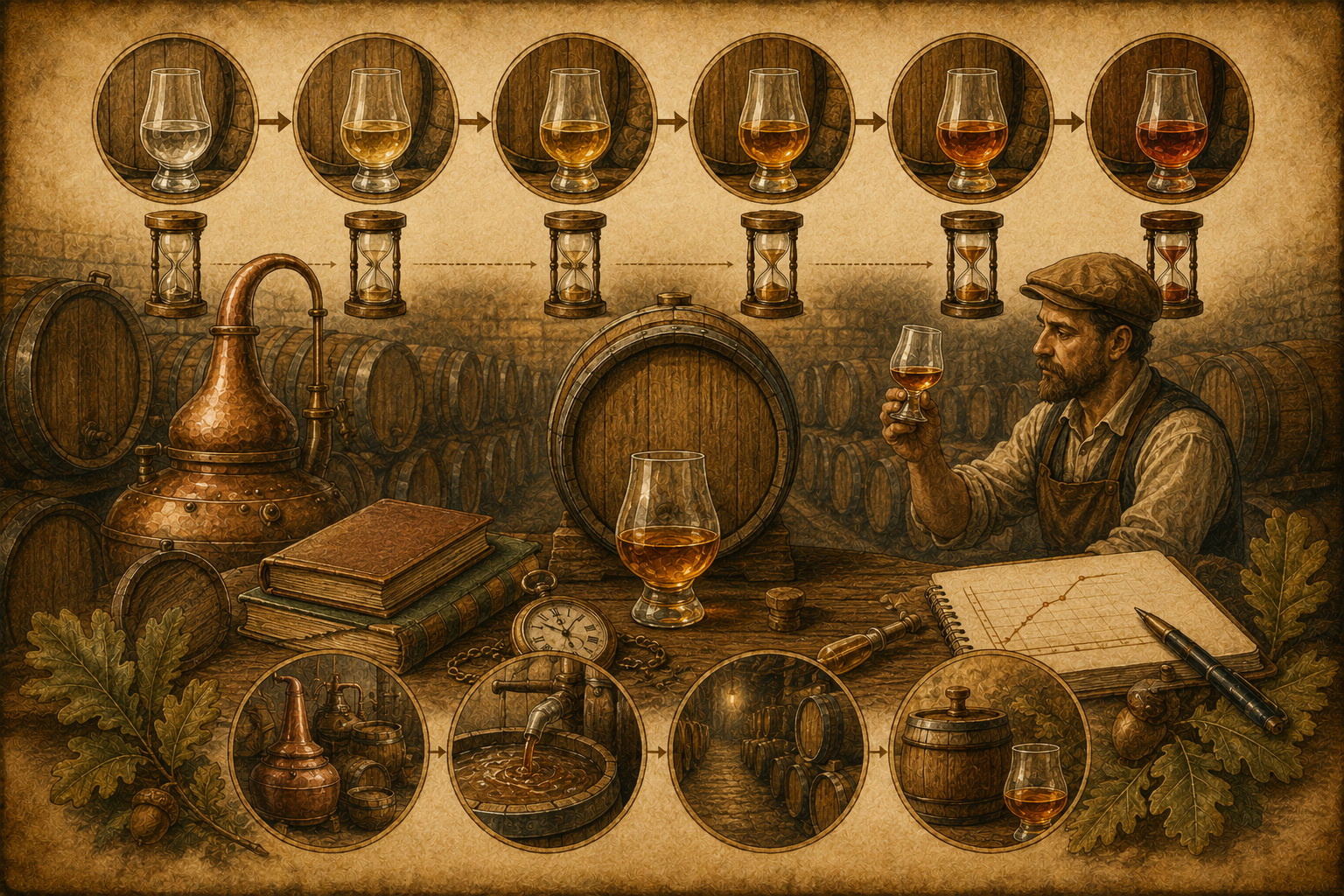
Why does this question sound simple, but it doesn't have a simple answer?
If you ask people which distillate is better - three-year-old or twelve-year-old, most will choose the second option without thinking.
We are used to perceiving the years of aging as an indicator of quality. The higher the number on the label, the more expensive and prestigious the drink seems.
But master distillers know one thing that may sound strange at first glance.
Time itself does nothing.
If you poured the distillate into a glass bottle and put it in a cellar for twenty years, it would hardly change. It would not become softer, would not acquire a golden color, would not acquire a vanilla or caramel aroma.
All this is not done by the calendar.
All this is done by the oak barrel.
Time only allows it to work.
What happens on the day the distillate enters the barrel?
Many people imagine aging as calm storage. As if the drink is just standing and slowly aging.
In fact, it all starts in the first hours.
Fresh distillate penetrates the pores of the wood. Part of the alcohol dissolves natural substances that have accumulated in the oak for decades. Then, when the temperature changes, the liquid returns to the middle of the barrel, carrying with it new aromatic compounds.
This process is repeated thousands of times.
In fact, the distillate is constantly "breathing", entering the wood and returning back. That is why aging is sometimes called a continuous dialogue between alcohol and oak.
The first months: getting to know the wood
At the beginning of aging, changes occur very quickly.
The oak begins to give off light aromatic compounds: vanilla notes, shades of fresh wood, light sweetness, spice. The color gradually changes from completely transparent to light straw.
During this period, the drink can still remain quite sharp. Young alcohol is felt distinctly, and all the components seem to exist separately from each other.
It's like an orchestra that has already assembled, but has not yet begun to sound as a single whole.
The most interesting thing begins after a year
Gradually, the wood stops simply giving away its substances. It begins to change the distillate itself.
Oxygen slowly enters the barrel through microscopic pores. It is so small that the drink does not oxidize sharply, like open wine. Instead, very slow chemical processes occur.
Individual aromatic molecules interact with each other, forming new compounds. The sharp alcohol notes gradually smooth out, and the aroma becomes more complex.
That is why masters often say that aging does not add flavor. It helps them learn to sound together.
Why is there no “perfect” time?
In cooking, there are recipes where you can say: bake for exactly forty minutes. And then the result will be correct.
With aging, everything is different.
There is no universal number of years after which any distillate becomes perfect.
One barrel can achieve excellent balance after just three years. Another will need eight. And a third after ten years will begin to lose its fruity aromas and gradually become too woody.
That is why experienced distillers do not wait for a specific date on the calendar. They regularly taste the contents of each barrel.
Not because it's more interesting.
But because no two barrels are the same.
Why does the same number mean different things?
We often see labels saying: 5 years, 10 years, 18 years. But these numbers don't say anything without context.
Let's imagine two identical oak barrels.
One was left to mature in cool Scotland.
The other was left in the warm climate of Southern Europe or Ukraine.
In the first, the reactions will occur more slowly. The drink will develop very delicately over the years.
In the second, seasonal temperature changes will more actively force the distillate to penetrate the wood and return. The aging process will be much faster.
That's why you can't directly compare just the number of years. The climate is as important a participant in the process as the barrel itself.
Does longer aging mean better taste?
Not always.
And this is one of the biggest surprises for those who are just getting acquainted with the world of distillates.
Wood not only gives off aroma. It also contains tannins and other substances that gradually accumulate in the drink.
In the right amount, they create structure, depth and noble astringency.
But if you wait too long, the wood begins to speak louder than the distillate itself.
Then instead of a complex bouquet, only oak, dryness and bitter nuances remain.
Masters sometimes call it simply:
“The barrel ate the distillate.”
That is why age is not a competition. It is a search for the moment when the drink has reached its best balance.
How does a distiller know when the time has come?
There is no device that will show: "127 more days and it will be perfect."
There is only experience, attentiveness and regular tasting.
The master opens the barrel, evaluates the aroma, taste, aftertaste, texture, and development of the drink in the glass. He is not looking for maximum aging, but for the moment when all the elements are in balance.
That is why two barrels filled on the same day can be bottled at different times.
Each of them has its own character and its own pace of maturation.
So how many years does it really take?
The correct answer may seem unusual.
Exactly as long as this particular distillate needs.
No more.
And no less.
Sometimes it is several years. Sometimes it is decades. But in each case, the decision is made not by the calendar, but by the master who sees how the drink changes day by day.
Conclusion
Aging is not an expectation, but the constant work of nature, wood and time. The oak barrel imparts aroma, lets in oxygen, changes the structure of the drink and gradually shapes its character. That is why a single number on the label will never tell the whole story.
A truly great distillate is defined not by how many years it has spent in the barrel, but by whether that time has been used correctly. And this is precisely the art of aging - not to wait as long as possible, but to stop exactly when the drink has become the best version of itself.