





What is honey distillate?
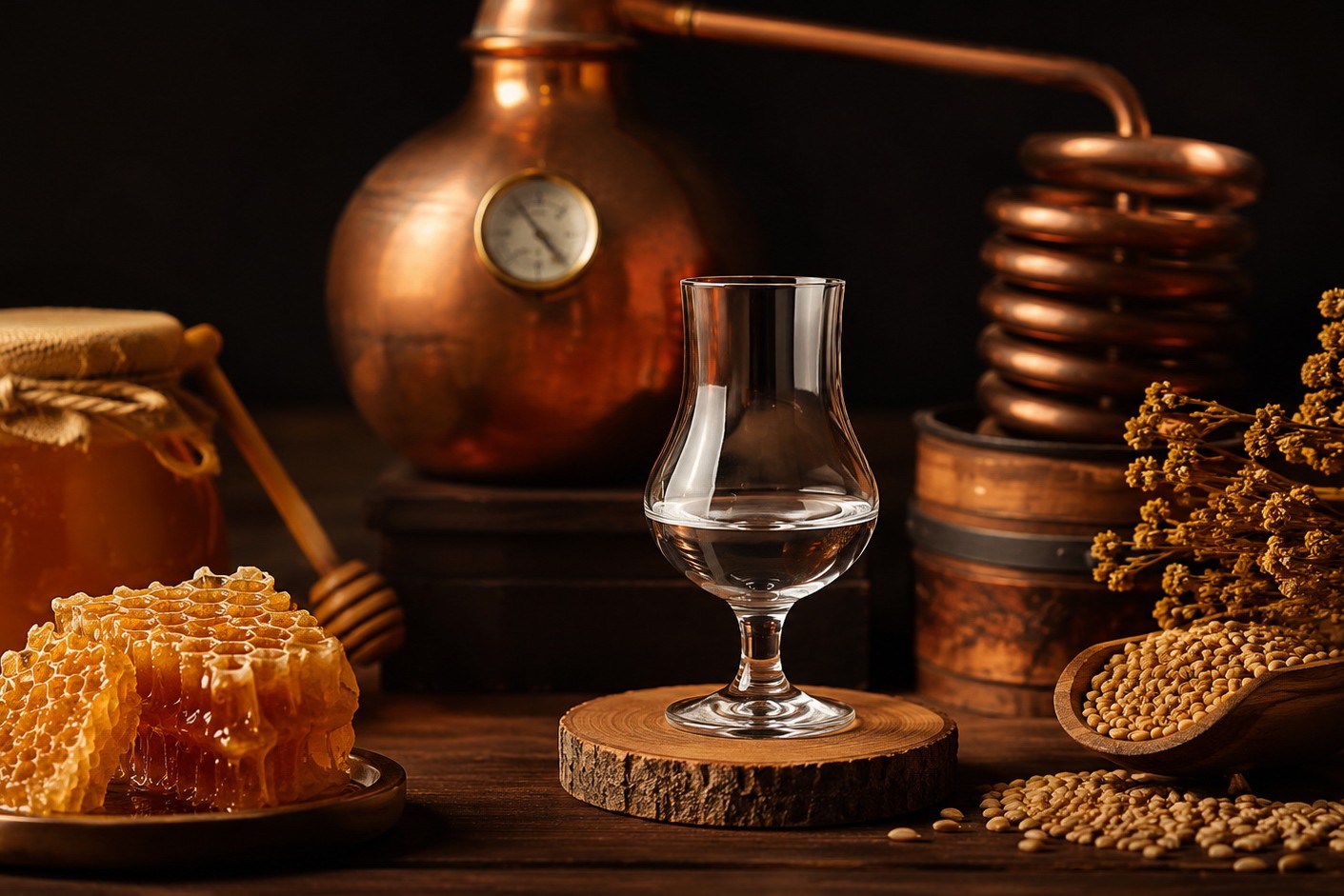
Honey has accompanied humanity for millennia. It is valued for its natural sweetness, rich aroma and ability to acquire different shades depending on the plants, area and time of collection. However, honey can be not only a product of beekeeping or the basis of fermented drinks. After fermentation and distillation, it can turn into a unique strong drink with its own character.
Honey distillate is a strong alcoholic beverage that is created from fermented honey wort and obtained through further distillation. In simple terms, honey is first dissolved and prepared for fermentation, yeast converts natural sugars into alcohol, and the resulting base is distilled on distillation equipment.
The result is not a sweet honey syrup or an ordinary neutral alcohol, but a complex craft distillate, in which tones of honey, wax, flowers, white bread, fruits, spices and wood can appear. Its final character depends on the raw materials, fermentation technology, distillation method, equipment and further aging.
How to make a strong drink from honey
Natural honey contains a significant amount of sugars, but in its usual form it is too concentrated for the intended alcoholic fermentation. Therefore, at the first stage, honey wort is prepared: honey is combined with water in a proportion determined by the manufacturer's recipe.
After the wort is prepared, fermentation begins. Yeast processes the available sugars, forming alcohol and aromatic compounds. It is at this stage that the basis of the future drink is laid. The temperature, duration of the process, the characteristics of the honey and the work of the yeast can affect the purity, aroma and overall style of the fermented base.
Next, the resulting drink is distilled. During heating, volatile components evaporate, then cool and return to a liquid state. The task of the master is not simply to increase the strength. It is necessary to select the necessary fractions and preserve those aromatic shades that form the character of the honey distillate.
Depending on the author's recipe, distillation can take place in several stages and on different types of equipment. Some technologies help to achieve high purity, others - to preserve more of the taste and aroma of the initial raw material. The combination of these approaches allows you to create both transparent and clean honey distillates and rich drinks for further aging.
Honey distillate and mead are not the same thing
Honey distillate is often mistakenly called mead. Both drinks do indeed start with honey, water and fermentation, but technologically they are different products.
Mead is a fermented drink. After fermentation, it can be clarified, stabilized, aged, or supplemented with berries, fruits, and spices. It usually has a moderate strength and retains the character of the drink obtained directly from fermentation.
Honey distillate must be distilled after fermentation. This gives it a higher strength, a different structure, and a more concentrated aromatic profile. Distillation removes some of the unwanted components while allowing the master to select the core of the drink—the part that will become the basis of the finished product.
Therefore, the difference is not only in the amount of alcohol. Mead and honey distillate belong to different styles of drinks and reveal the natural properties of honey in different ways.
Should honey distillate be sweet?
The word “honey” often creates expectations of a distinctly sweet taste. However, a quality distillate from honey wort is not necessarily sweet. During fermentation, a significant part of the sugars is converted into alcohol, and during distillation, non-volatile sugars do not pass into the finished product in the same way as aromatic components.
Honey in such a drink manifests itself differently: through the aroma of flowers, wax, honeycombs, herbs, ripe fruits or light creaminess. The taste may evoke associations with honey, although the drink itself remains dry.
It is this feature that makes honey distillate interesting for tasting. It does not try to recreate the taste of a spoonful of honey, but demonstrates how natural honey raw materials can reveal themselves after fermentation and professional distillation.
What is the taste of honey distillate
There is no single universal taste. Honey distillate can be clean and restrained, floral, spicy, fruity, mineral or rich with woody shades. The result is influenced by several factors at once.
Origin of honey
Honey from different plants has its own aromatic profile. Even before the start of production, it can contain floral, herbal, fruity or caramel shades. Not all of them are preserved after fermentation and distillation in their original form, but the raw material directly affects the basis of the future drink.
Fermentation technology
Slow controlled fermentation gives the master the opportunity to control the process and form a clean base for distillation. Too fast or unstable fermentation can change the aromatic profile and create undesirable shades.
Distillation equipment
Columns and traditional stills perform different tasks. Column equipment allows you to achieve a high degree of purification and accurately separate fractions. A copper alembic helps to form a rounded, expressive and rich character of the distillate.
The work of the master
Even high-quality raw materials do not guarantee a good result without the correct selection of fractions. The master determines the moment when the initial components of the distillation are separated, the main part of the drink is taken and the process is completed. It is the accuracy of these decisions that affects the purity and balance of the finished distillate.
Why is honey distillate aged in oak?
Honey distillate can be clear and unaged or undergo prolonged contact with wood. Aging in an oak barrel does not just change the color of the drink. It gradually rebuilds its aroma, taste, and texture.
During contact with oak, the distillate can acquire shades of vanilla, spices, wood, dried fruits, and other nuances that depend on the type of barrel and its previous use. Some of the harsh tones gradually soften, and individual aromatic components combine into a more holistic composition.
Barrels that have previously aged wine or other beverages give a particularly interesting result. They can add new shades without hiding the honey base. That is why craftsmen work not only with different types of oak, but also with different origins of barrels.
However, the duration of aging itself is not the only sign of quality. The size and condition of the barrel, the storage temperature, the properties of the initial distillate and the master's decision regarding the moment of completion of aging remain important.
How does honey distillate differ from other spirits
The main difference lies in the raw materials. For whiskey, the basis is cereals, for fruit brandies - fermented fruits or fruit raw materials, while the character of honey distillate begins with honey wort.
At the same time, honey distillate is not necessarily opposed to other categories. It can be used as a standalone drink or become the basis for signature products, in which it is combined with berries, apple spirits, botanicals or aged in various barrels.
This is how modern craft drinks appear, which are difficult to describe only through familiar categories. They use classic distillation principles, but have their own recipe, local raw materials and the individual style of the producer.
ENTUZIAST Honey Distillates
At the ENTUZIAST honey distillery, honey is considered not as an additional flavoring, but as a full-fledged basis for creating strong drinks. It is from the preparation of honey wort, controlled fermentation and professional distillation that the character of the line begins.
The collection presents transparent honey distillates, aged drinks, signature combinations with apple spirits and honey-based gins. Each product demonstrates a different way of working with the raw materials.
Honey Spirit Pure reveals the pure character of the honey distillate with light grain and creamy shades. Honey Spirit Aged combines a honey base, several distillation stages and long work with oak barrels. Honey Spirit Apple complements the honey distillate with apple spirits and a complex aging system.
The MeadGIN line shows another side of the honey base. Juniper, citrus, berries and botanicals create signature gins that combine a traditional dry character with the roundness of honey spirit.
Getting to Know Honey Spirits volume
It is better to start the first acquaintance without haste. Pour a small amount of the drink into a clean glass and give it some time. You should not immediately evaluate the aroma too close to the edge of the glass: strong alcohol can cover up the subtler shades.
First, pay attention to the general character of the aroma. It can resemble wax, flowers, fruits, spices, wood or fresh bread. After a small sip, you should evaluate not only the first impression, but also how the taste changes and what notes remain in the aftertaste.
Aged and unaged honey distillates open differently. A clear drink better demonstrates the purity of the raw materials and distillation, while an aged one adds to the honey base the character of oak, wine, spices and other shades formed by the barrel.
Honey distillate as part of modern craft culture
Interest in craft drinks is not only related to the search for unusual flavors. It is important for the buyer to understand what the product is made of, what technologies were used and why the drink has such a character.
Honey distillate fits well with this philosophy. It combines the work of bees, the properties of natural honey, fermentation control, distillation accuracy and the experience of the master. If the drink is aged in oak, another important component is added to this list - time.
That is why honey distillate should be perceived not just as alcohol from honey. This is a separate production culture in which traditional raw materials are given a modern interpretation. From clear pure spirits to aged blends and signature gins, honey allows you to create drinks of different styles while maintaining a recognizable base.
Frequently asked questions about honey distillate
What is honey distillate made from?
It is made from honey wort. Honey is combined with water, alcoholic fermentation is carried out, and the resulting base is distilled.
Is honey distillate mead?
No. Mead is a fermented drink, and honey distillate is distilled after fermentation and has a different strength, structure, and aromatic profile.
Is honey distillate sweet?
Not necessarily. It can be completely dry, but retain aromatic associations with honey, wax, flowers or honeycombs.
Why can a honey drink be clear?
After distillation, honey spirit is clear. Straw and amber shades usually appear during further aging in wooden barrels.
What affects the taste of honey distillate?
The characteristics of honey, wort preparation, fermentation mode, type of equipment, number of distillation stages, selection of fractions and possible maturation in oak are important.
What makes honey distillate special?
It is distinguished by its honey raw material, which after fermentation and distillation can reveal floral, waxy, grain, fruity, creamy and spicy shades.
From honey to a signature drink
Honey distillate is born at the intersection of nature, technology and craftsmanship. Honey forms the base, fermentation creates the future aromatic profile, distillation purifies and concentrates the character, and aging can add depth and new shades.
ENTUZIAST continues to explore the possibilities of honey raw materials, combining them with classic and original production methods. This creates drinks in which honey is not hidden behind sweetness, but is revealed in a new, complex and unexpected form.