




What Is a Distillate and How Is It Different from Alcohol?
The words “alcohol” and “distillate” are often used almost interchangeably. This is understandable: both concepts are related to alcoholic beverages, both can refer to products with a high alcohol content, and ethanol is indeed the main alcohol found in distilled spirits.
However, from the perspective of spirit production, there is an important difference between them.
Put very simply, a distillate is not merely alcohol at a certain strength. It is a product of distillation that can retain part of the character of the raw material from which it was made.
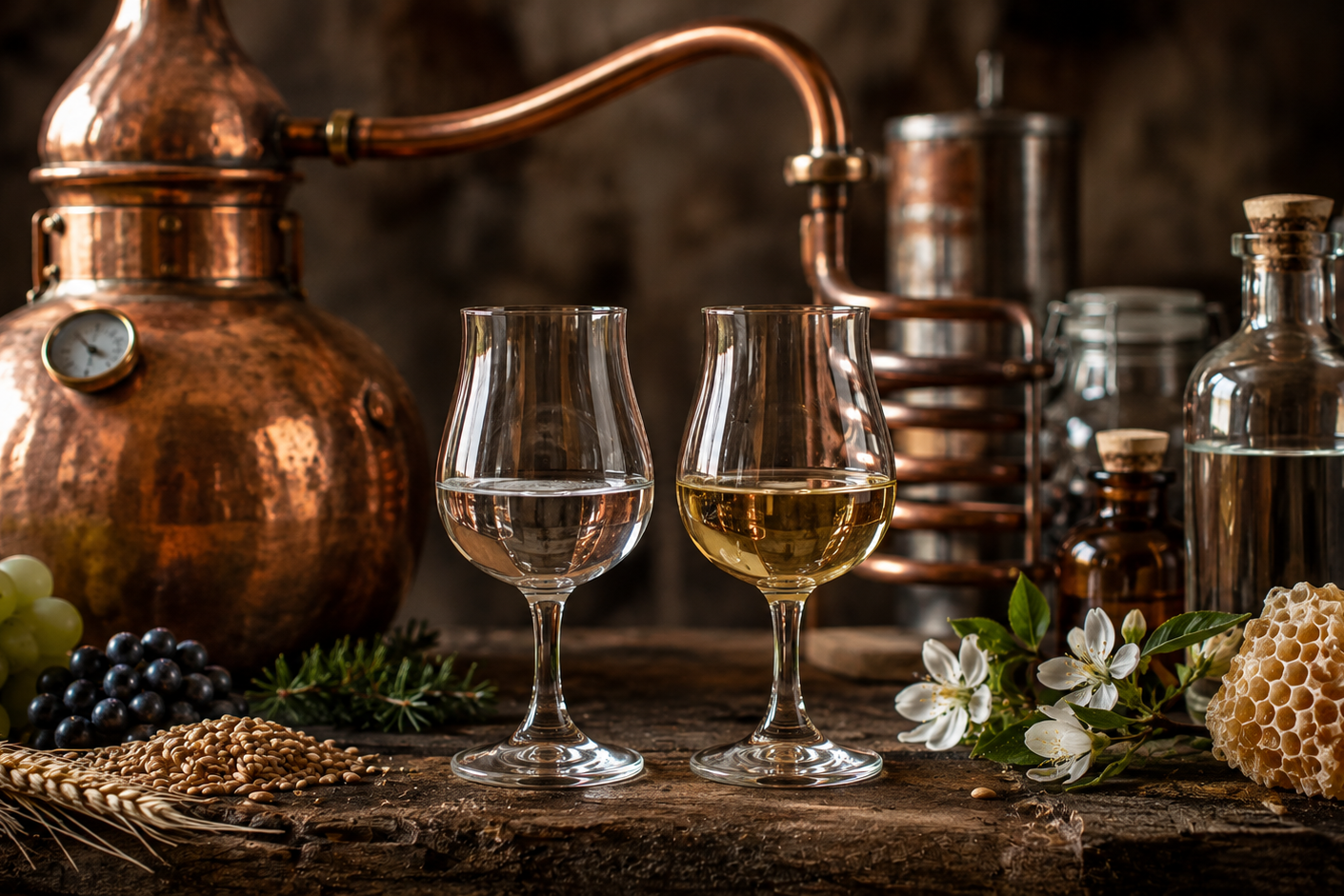
Grapes may contribute fruity and floral notes. Grain can bring bread, malt, cereal, or nutty nuances. Fruit may leave recognizable aromas of apples, plums, pears, or apricots. Fermented honey can create its own complex aromatic profile with floral, herbal, fruity, waxy, and spicy notes.
This is one of the reasons the world of distilled spirits is so diverse. Two clear spirits with exactly the same alcohol strength may look almost identical while having completely different aromas, flavors, textures, and finishes.
What Is a Distillate in Simple Terms?
A distillate is a product obtained through the distillation of fermented raw material.
Before distillation can begin, the raw material must normally undergo fermentation. Yeast converts fermentable sugars into ethanol while also producing a wide range of other compounds that can influence aroma and flavor.
The result is a relatively low-alcohol fermented liquid that serves as the starting point for the future distillate.
This liquid is then heated in a still. The components of the mixture evaporate with different degrees of volatility. The vapors are directed away from the still, cooled in a condenser, and converted back into liquid.
That collected liquid forms the basis of the distillate.
But there is an important detail: distillation is not simply a method of “extracting alcohol” from a fermented liquid. Along with ethanol, many volatile compounds can pass into the distillate and contribute to its aroma and flavor.
These compounds play a major role in creating the individual character of a spirit.
Where Does the Alcohol Come From?
Before fermentation begins, there is no significant ethanol naturally present in honey, grapes, apples, or grain. Instead, these raw materials contain water, sugars, organic acids, aromatic compounds, and many other substances.
Alcohol appears as a result of yeast activity.
In very simplified terms, fermentation can be described as:
sugar → yeast → ethanol + carbon dioxide + numerous flavor and aroma compounds.
In reality, fermentation is much more complex. Alongside ethanol, yeast metabolism and other biochemical reactions can create esters, higher alcohols, organic acids, aldehydes, and many other compounds.
Some of these are desirable, while others may be undesirable in excessive concentrations.
One of the distiller's tasks is therefore to manage fermentation and subsequent distillation in a way that produces a clean, balanced, and expressive spirit.
What Actually Happens During Distillation?
A common explanation says that ethanol boils at approximately 78°C while water boils at 100°C, so the alcohol simply evaporates first.
This is an oversimplification.
A fermented liquid is a complex mixture of water, ethanol, and many other compounds. When heated, these substances interact and enter the vapor phase simultaneously, although in different proportions.
Distillation is therefore considerably more complicated than simply separating alcohol from water.
Temperature, still design, heating rate, number of distillation runs, copper contact, reflux, and the way different fractions are selected can all influence which aromatic compounds remain in the final distillate.
A Distillate Is Not Necessarily a Finished Spirit
Another important point is that a freshly produced distillate does not always go directly into a bottle.
It may undergo additional stages such as:
- further distillation;
- a period of resting;
- maturation in oak barrels;
- maceration with botanicals;
- blending with other distillates;
- dilution with water to reach the desired bottling strength;
- filtration;
- other processes depending on the style of spirit being produced.
In other words, a distillate is often not the final destination. It is the foundation upon which the producer builds the character of the finished drink.
So What Is Alcohol?
This is where much of the confusion begins.
From a chemical perspective, ethyl alcohol, or ethanol, is a specific substance with the chemical formula C₂H₅OH.
Ethanol is present in gin, whisky, brandy, wine, honey spirits, and countless other alcoholic beverages. It is the main compound responsible for their alcoholic strength.
Therefore, saying that “a distillate does not contain alcohol” would be incorrect. Ethanol is, in fact, one of its major components.
The important question is not whether ethanol is present, but what exists alongside it.
A characterful distillate can contain numerous volatile compounds originating from the raw material, fermentation, and distillation process.
Together, these substances help create the organoleptic character of the spirit.
What Do We Mean by “Rectified Alcohol”?
When people contrast a distillate with “alcohol” in the context of spirits production, they often mean highly purified rectified ethyl alcohol or neutral spirit.
Rectification has a different technological objective.
When producing an aromatic distillate, the distiller may deliberately try to preserve desirable characteristics of the original raw material. With intensive rectification, the objective is generally to separate components much more thoroughly and obtain highly purified ethanol.
As a result, much of the original aromatic character of the raw material is removed.
The resulting spirit becomes considerably more neutral in aroma and flavor.
Distillation and Rectification Are Not the Same Thing
Both processes rely on differences in the volatility of components, but their technological goals can be very different.
In simplified terms:
Distillation can be used to remove unwanted components while preserving desirable character.
Intensive rectification is used to achieve a much higher degree of separation and a more neutral spirit.
This is why an aromatic distillate may retain recognizable characteristics of its raw material, while highly rectified alcohol is expected to be much more neutral.
This does not mean that one method is inherently “better” than the other. They are simply designed to accomplish different things.
Some beverages require a neutral alcoholic base. In others, the character of the raw material is a fundamental part of the style.
Why Can a Distillate Retain the Aroma of Its Raw Material?
This is perhaps the most fascinating part of the process.
During fermentation and distillation, numerous volatile aromatic compounds are created, transformed, and transferred. Some of these compounds become part of the fraction that the distiller chooses to keep.
That is why an apple distillate may remind you of ripe apples, a grape distillate may reveal fruity, floral, or dried-fruit notes, and a grain distillate may suggest malt, bread, cereal, or nuts.
Yet there are obviously no pieces of apple, grain, grapes, or honey floating in the finished distillate.
What we perceive are volatile aromatic molecules associated with the raw material and transformed throughout fermentation and distillation.
Why Can Two Distillates Made from the Same Raw Material Taste Different?
Even when two producers begin with the same general type of raw material, the finished spirits can be dramatically different.
The character of a distillate can be influenced by:
- the variety and quality of the raw material;
- its geographical origin;
- the type and concentration of fermentable sugars;
- the yeast strain;
- fermentation temperature;
- fermentation time;
- the design of the still;
- the materials used in the distillation equipment;
- distillation speed;
- the number of distillation runs;
- the points at which different fractions are separated;
- the experience and decisions of the distiller.
This is why distillation is much more than a mechanical process. It gives the producer considerable freedom to shape the style and personality of the spirit.
What Are the “Heads,” “Hearts,” and “Tails”?
During distillation, the composition of the collected spirit changes continuously. Distillers traditionally divide the run into several broad fractions known as the “heads,” “hearts,” and “tails.”
The early part of the run contains higher concentrations of certain more volatile compounds. The middle portion contains much of the spirit that may be selected for the final product. Toward the end of the run, the proportion of heavier and less volatile compounds increases.
However, these fractions are not separated by perfectly sharp boundaries.
They gradually flow into one another.
Deciding where one fraction should end and another should begin is therefore one of the most important decisions a distiller makes.
We explore this subject separately because it demonstrates particularly well the difference between simply operating a still and deliberately shaping the aroma and flavor of a spirit.
Can You Identify the Raw Material by Smelling a Distillate?
In many cases, yes — although the connection is not always obvious.
Fruit distillates often have recognizable aromatic profiles. Apple, pear, plum, or apricot notes may be relatively easy to identify.
With grain distillates, the connection may appear as malt, cereal, bread, nuts, or even chocolate-like associations.
Honey distillates can be even more intriguing.
After fermentation and distillation, honey no longer presents itself in the same way as a spoonful of fresh honey. Its character is transformed. Instead of obvious sweetness, the spirit may reveal floral, herbal, fruity, waxy, spicy, or other subtle aromatic notes.
This is why a honey distillate can taste completely dry while still maintaining an aromatic connection to the honey from which it originated.
Why Isn't a Honey Distillate Necessarily Sweet?
This is one of the most common questions surrounding honey-based spirits.
We naturally associate honey with sweetness, so it seems logical to expect alcohol made from honey to taste sweet as well.
But during fermentation, yeast consumes a substantial portion of the available fermentable sugars and converts them into alcohol. The fermented liquid is then distilled.
Sugar is essentially non-volatile under normal distillation conditions, so it does not travel through the still with ethanol and volatile aromatic compounds.
As a result, honey can provide the fermentable material and contribute to the aromatic identity of a spirit without making the resulting distillate sweet.
This is why the relationship between honey and honey distillate is much more interesting than simply “honey equals sweetness.”
What Spirits Are Made from Distillates?
A large part of the world of strong alcoholic beverages is built around different types of distillates.
Depending on the specific production method and legal definition, this broad family includes or may include:
- whisky;
- brandy;
- Cognac;
- Calvados;
- rum;
- tequila;
- mezcal;
- grappa;
- slivovitz;
- kirsch;
- many types of fruit distillates;
- grain distillates;
- honey distillates.
Gin is also closely connected to the world of distillation, although its production methods can vary significantly depending on the style and producer. Its defining aromatic character comes primarily from juniper and other botanicals.
Does a Distillate Always Have to Be Aged in a Barrel?
No.
A distillate can be excellent without ever touching wood.
In unaged spirits, the character of the raw material, fermentation, and distillation itself often takes center stage. This is why a clear distillate can be remarkably aromatic and complex.
A barrel is another tool available to the producer.
During maturation, wood introduces new compounds and gradually changes the structure and aroma of the spirit. Notes associated with vanilla, caramel, wood, nuts, spices, and fruit may develop over time.
However, aging cannot automatically turn a poor distillate into a great one.
Much of the potential quality of an aged spirit is established before it ever enters the barrel.
Why Can a Clear Distillate Have Such a Strong Aroma?
Color and aroma are completely different characteristics.
Most freshly distilled spirits are clear when they leave the still. Color often develops later through contact with oak or other production processes.
Many aromatic compounds, however, are colorless.
That is why a transparent fruit, grain, or honey distillate can have an exceptionally intense and complex aroma.
Judging the complexity or quality of a spirit solely by its color is therefore a common mistake.
Are Distillate and Vodka the Same Thing?
No, although the answer requires a little nuance.
Modern vodka is generally produced using highly purified ethyl alcohol combined with prepared water. Its traditional stylistic goal is relative aromatic neutrality.
A characterful distillate, on the other hand, may deliberately retain organoleptic characteristics associated with its original raw material.
As a result, two spirits with exactly the same ABV can provide completely different tasting experiences.
Is a Distillate the Same as Moonshine?
The term “moonshine” generally refers to spirits produced outside regulated commercial channels, historically often through home or illicit distillation. Because of this, people sometimes assume that any distillate is simply a more expensive version of moonshine.
That comparison is misleading.
“Distillate” describes a product and a technological principle, while “moonshine” primarily describes the informal or illicit context in which a spirit is produced.
Professional distillation involves control over raw materials, fermentation, equipment, production parameters, fraction selection, consistency, safety, and numerous other factors.
The same basic physical principle of distillation can be found in both a simple still and the production of sophisticated whisky, Cognac, Calvados, or craft honey spirits.
The result depends not merely on whether something has been distilled, but how the distillation was carried out.
Why Is Copper So Important in Distillation?
Copper became a traditional material for many stills for more than historical or aesthetic reasons.
During distillation, copper can interact with certain sulfur-containing compounds that might otherwise contribute undesirable aromas to the spirit.
In addition, the shape and construction of a copper pot still influence vapor movement, reflux, copper contact, and ultimately the aromatic profile of the distillate.
This is why details such as the shape of the pot, the height and shape of the neck, the angle of the lyne arm, and other apparently technical features can influence the character of the finished spirit.
Why Are Some Spirits Distilled Two or Three Times?
Each additional distillation allows the producer to work more precisely with the composition of the spirit, increase its alcohol concentration, and alter the balance of aromatic compounds.
But the rule “more distillations mean better quality” is not true.
Excessive purification can make a distillate increasingly neutral and remove some of the character that the producer may want to preserve.
The number of distillations is therefore a stylistic decision.
One spirit may be designed to retain a rich, raw-material-driven aromatic profile, while another may aim for greater lightness and purity. The producer's job is to find the appropriate balance.
What Matters More: Raw Material or Distillation?
It is almost impossible to choose one over the other.
Poor raw materials limit the potential of the future spirit. But even exceptional ingredients can be compromised by poorly managed fermentation or inappropriate distillation.
The character of a distillate develops as a sequence:
raw material → fermentation → distillation → resting or maturation → blending → finished spirit.
Every stage can preserve, enhance, transform, or lose what was created during the previous one.
Why Is Distillate So Interesting as a Craft Product?
Producing a characterful distillate involves a remarkable number of decisions.
Which raw material should be used? How should it be fermented? Where should the heart cut begin and end? How many times should the spirit be distilled? Should it remain unaged? Should it mature in oak? Which type of oak should be used? How long should it mature? Should different distillates or barrels eventually be blended?
Every decision leaves its mark on the finished product.
For this reason, a craft distillate can be compared not simply to purified alcohol but to products in which the producer's individual approach matters — wine, coffee, cheese, or chocolate.
The raw material creates possibilities, technology provides the structure, and the producer shapes the style.
Honey Distillate as a Distinctive Style
In a honey distillate, honey provides the fermentable raw material and is involved from the beginning of the production process.
This distinction is important. Honey is not simply added to finished neutral alcohol to provide sweetness or flavor. Instead, it participates in creating the alcoholic base itself.
The honey is prepared for fermentation, yeast transforms its fermentable sugars, and the resulting fermented liquid is distilled. The distiller then selects the desired fractions and shapes the character of the future spirit.
This creates an interesting paradox: honey may be the fundamental raw material, yet the finished distillate can be completely dry and taste nothing like a sweet honey drink.
Its connection to honey is expressed more subtly through its aromatic profile, texture, and nuances that may suggest flowers, herbs, wax, fruit, or spices.
Distillate vs Alcohol: The Main Difference in Simple Terms
To summarize the distinction as simply as possible:
- ethyl alcohol is the chemical substance ethanol;
- rectified alcohol is highly purified ethanol-based spirit, generally intended to be relatively neutral;
- a distillate is a product of distillation in which ethanol may be accompanied by aromatic compounds derived from the raw material and fermentation;
- a finished alcoholic beverage is the result of further production steps using a distillate or another alcoholic base according to the desired style.
This is why asking “Which is better, distillate or alcohol?” is not really the right question.
A better question is: what kind of product is the producer trying to create?
If the goal is an extremely neutral alcoholic base, that requires one technological approach. If the goal is to preserve and express the character of honey, grapes, fruit, or grain, the task is entirely different.
Conclusion
A distillate is much more than simply a strong alcohol-containing liquid.
Its character begins with the choice of raw material, continues through fermentation, and is profoundly influenced by the decisions made during distillation.
Ethanol is present in every alcoholic distillate, but ethanol alone does not explain its aroma or flavor. Its individuality comes from the many other compounds that the producer seeks to create, select, balance, and preserve.
That is why a grape distillate may suggest grapes and dried fruit, an apple distillate may evoke ripe apples, a grain distillate can reveal malt and bread, and a honey distillate may offer floral, herbal, fruity, waxy, and spicy nuances.
And that is one of the central ideas behind distillation: not simply to produce alcohol, but to preserve the character of the raw material and transform it into the character of a spirit.