





What Are the “Heads,” “Hearts,” and “Tails” in Distillation?
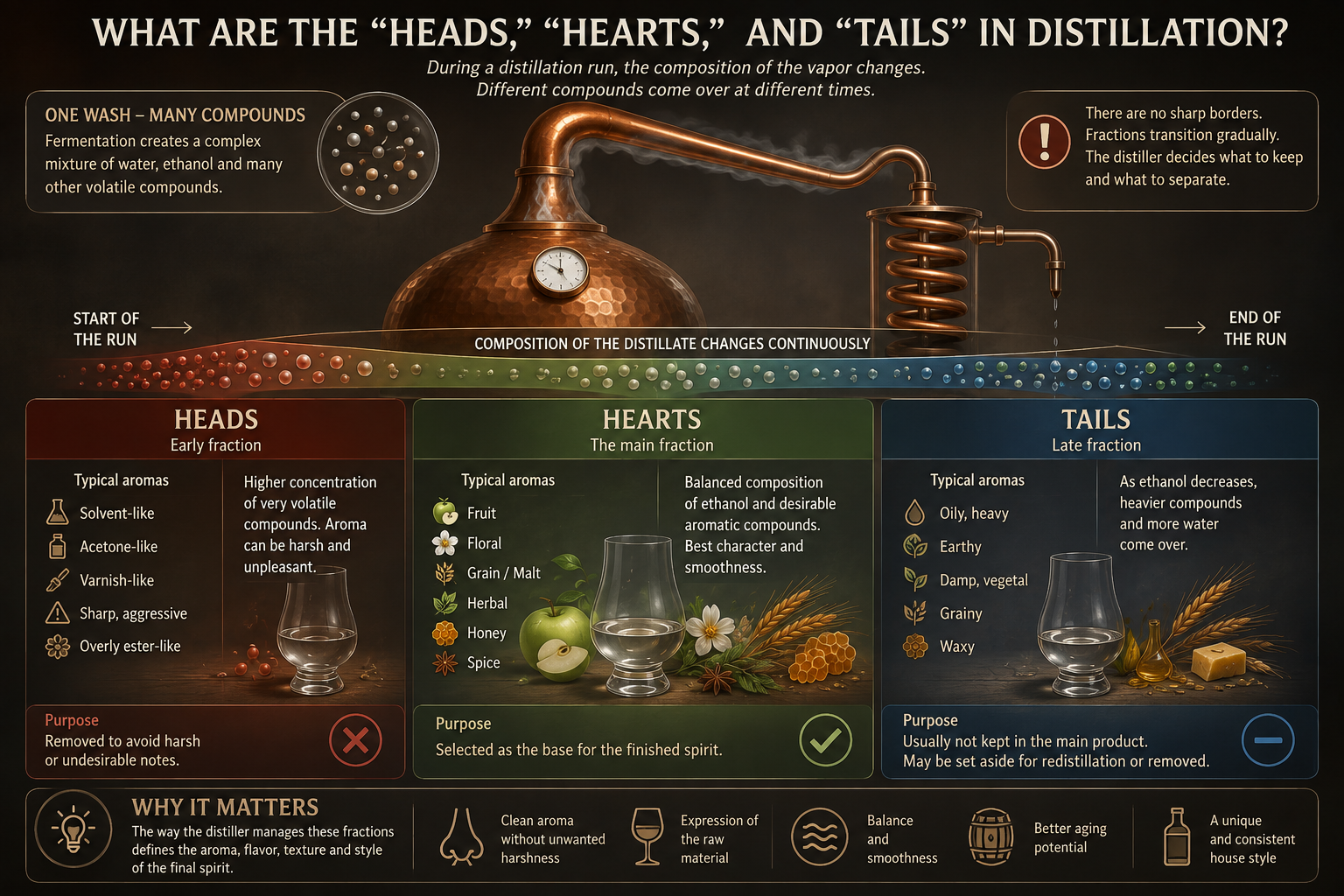
When people talk about distillation, they often use three unusual terms: “heads,” “hearts,” and “tails.” To someone unfamiliar with spirit production, these words can sound like insider jargon.
In reality, they describe one of the most important ideas in producing a well-balanced distillate.
During a distillation run, the composition of the liquid coming from the still changes continuously. Different volatile compounds appear in different proportions as the process develops.
For this reason, distillers divide the run conceptually into three broad sections: the beginning, the middle, and the end. These are traditionally called the “heads,” “hearts,” and “tails.”
The most important point is that there are no perfectly sharp physical boundaries between them. One fraction gradually transitions into another, and the decision about which portion to keep has a major influence on the final character of the spirit.
Why Is a Distillation Run Divided into Fractions?
Fermented liquid is much more complex than a mixture of water and ethanol.
During fermentation, many different compounds are formed, including:
- ethyl alcohol;
- esters;
- aldehydes;
- organic acids;
- higher alcohols;
- sulfur-containing compounds;
- other volatile aromatic substances.
Some of these compounds contribute desirable aromas. Others, especially in excessive concentrations, may create harsh, heavy, solvent-like, or otherwise undesirable notes.
Distillation changes the balance between them.
Working with fractions allows the producer to decide which components should become part of the future spirit and which should be separated from the main product.
Why Do Different Compounds Appear at Different Stages?
The components of fermented liquid have different physical and chemical properties, including different levels of volatility.
But it is important to avoid a common oversimplification.
A distillation run should not be imagined as a sequence in which one compound evaporates completely, then another, then a third.
In a real mixture, many substances enter the vapor phase at the same time.
What changes throughout the run is their relative concentration.
At the beginning, certain highly volatile compounds are more prominent. In the middle, the balance shifts. Toward the end, heavier compounds become increasingly noticeable.
These gradual changes create the broad fractions that distillers refer to as heads, hearts, and tails.
What Are the “Heads”?
The “heads” are the early part of the distillation run.
At this stage, the spirit generally contains higher concentrations of certain more volatile compounds.
Their aroma may be perceived as:
- very sharp;
- solvent-like;
- acetone-like;
- varnish-like;
- strongly ester-like;
- chemical or aggressive.
However, the situation is more complex than simply saying that everything in the heads is undesirable.
Some light esters can contribute attractive fruity or floral notes and may be important to the character of the finished distillate when present in small amounts.
The producer’s task is therefore not to remove everything that appears early in the run, but to determine where undesirable harshness ends and desirable aroma begins.
Why Do the Heads Smell So Sharp?
At the beginning of a run, some highly volatile compounds are present at especially high concentrations.
The human nose can detect many of them at extremely low levels.
As a result, the earliest part of the distillation may have a very intense aroma that is noticeably different from what appears later.
As the run continues, the relative concentration of these compounds decreases. Aggressive notes fade and the aroma may become softer, cleaner, and more representative of the original raw material.
That transition often signals the approach of the central portion of the run.
What Are the “Hearts”?
The “hearts” are the central portion of the distillation that the producer selects as the main basis for the future spirit.
The term is well chosen.
This is generally the point where ethanol and desirable aromatic compounds reach the balance the distiller wants for a particular style.
The hearts may reveal characteristics of the raw material, including:
- fruity notes;
- floral notes;
- grain and malt character;
- herbal nuances;
- honeyed aromas;
- spicy notes;
- other characteristics created during fermentation.
This portion often becomes the basis for resting, maturation, blending, or further production steps.
Are the Hearts Made of Pure Ethanol?
No.
If the goal were simply to obtain the purest possible ethanol, much of the aromatic identity of the distillate would disappear.
The heart fraction contains water, ethanol, and many other compounds at much lower concentrations.
These accompanying substances are responsible for much of the complexity of aroma and flavor.
A good heart cut is therefore not simply “clean alcohol.”
It is a balanced aromatic composition.
What Are the “Tails”?
The “tails” are the later part of the distillation run.
As the concentration of ethanol in the boiler decreases, the collected distillate contains more water and a greater proportion of certain less volatile compounds.
The aroma begins to change again.
It may develop:
- heavier oily notes;
- earthy aromas;
- damp or vegetal associations;
- grain and malt nuances;
- waxy characteristics;
- other heavier aromas.
Some of these may be undesirable in excessive amounts.
But once again, not every “tail” compound is automatically bad.
Some can contribute body, texture, depth, and complexity.
Why Not Keep Only the Exact Middle of the Run?
In theory, a producer could keep an extremely narrow central portion.
That might result in a very clean and light spirit.
At the same time, it could remove a large part of the character that makes the distillate interesting.
Some attractive fruity esters may appear closer to the transition from the heads, while certain heavier aroma compounds may be found closer to the beginning of the tails.
The width of the heart cut is therefore a stylistic decision.
A narrow cut may produce a lighter and cleaner profile.
A broader cut may produce a more aromatic, textured, and robust spirit.
Neither approach is automatically better.
Where Exactly Do the Heads End and the Hearts Begin?
There is no universal point.
This is one of the most important things to understand about distillation.
The fractions do not sit inside the still as separate layers, and they do not emerge as three completely different liquids.
Their composition changes gradually.
The boundary between heads and hearts is therefore a production decision.
The same applies to the transition from hearts to tails.
How Does a Distiller Know When the Fraction Changes?
In professional production, decisions are based on a combination of factors.
These may include:
- the aroma of the distillate;
- taste and mouthfeel;
- the alcohol strength of the output;
- temperature readings;
- the stability of the process;
- the character of the raw material;
- the design of the still;
- experience from previous runs.
This is why distiller experience matters so much.
Instruments help monitor the process, but the aromatic character of the future spirit cannot be fully described by a single number.
Can Fractions Be Defined by Temperature Alone?
This is another common misconception.
Temperature is an important parameter and helps the operator understand what is happening inside the system.
But a rule such as “heads end at one exact temperature and tails begin at another” oversimplifies the process.
Temperature readings depend on:
- the composition of the mixture;
- pressure;
- where the sensor is located;
- the design of the still;
- the operating mode.
Aromatic compounds also do not suddenly disappear at one precise temperature.
Professional fraction selection therefore relies on several indicators together.
Can Fractions Be Defined by Alcohol Strength Alone?
Alcohol strength is also useful, but it does not tell the entire story.
Two distillates with the same ABV can have very different aromatic compositions.
Different raw materials also behave differently during distillation.
An alcoholmeter helps track the process, but it does not replace knowledge of the specific raw material or sensory evaluation.
Why Is Aroma So Important?
The human sense of smell is extremely sensitive to many volatile compounds.
Some substances can be detected at remarkably low concentrations.
During a distillation run, the aroma may shift gradually from sharp ester-like notes to cleaner fruit, floral, grain, or honey aromas, and later toward heavier and more oily characteristics.
For an experienced distiller, these changes are an important source of information.
Are the Fractions the Same for Every Raw Material?
No.
Grapes, grain, apples, plums, honey, and other raw materials produce different combinations of aromatic compounds during fermentation.
Even two varieties of the same fruit may behave differently.
The final composition is also influenced by:
- the yeast strain;
- fermentation temperature;
- fermentation time;
- acidity;
- raw-material quality;
- the way the raw material was prepared.
There is therefore no universal fraction-selection formula that works for every spirit.
How Do Fractions Influence the Style of a Distillate?
Very strongly.
Imagine two producers using the same fermented wash and similar stills.
The first producer makes a very narrow heart cut.
The second includes more material from the transition zones.
The first distillate may be lighter, cleaner, and more restrained.
The second may be richer, more aromatic, more textured, and more expressive.
In this sense, the way fractions are selected becomes part of the producer’s signature style.
Does Still Design Affect the Fractions?
Yes.
The design of the equipment determines how vapor moves through the system and how much partial condensation and re-evaporation takes place.
Important factors include:
- the shape of the boiler;
- the height of the neck;
- the angle of the vapor path;
- the amount of reflux;
- the amount of copper contact;
- the speed of the run.
As a result, the same fermented raw material may require a different approach to fraction selection on different equipment.
How Does Distillation Speed Affect Separation?
The operating rate of the still influences how effectively components are separated.
An overly aggressive run can make the transitions between fractions less distinct.
A more controlled process gives the producer more opportunity to observe gradual changes in the composition of the distillate.
The ideal operating rate, however, depends on the design of the still and the intended style of the spirit.
What Happens to the Heads and Tails?
In professional production, separated fractions are not necessarily treated simply as waste.
What happens next depends on the production system.
In some processes, selected fractions may be incorporated into a future distillation run, where their components are separated again.
In other systems, they are removed from the main production stream.
The key principle is that they should not be added indiscriminately to the finished product simply to increase volume.
Why Does Redistillation Change the Way Fractions Are Managed?
During a second or third distillation, the producer has another opportunity to separate and rebalance the volatile compounds.
Each additional run changes their concentration and relative proportion.
This is why double or triple distillation can offer more precise control over the aromatic profile.
At the same time, every additional distillation can also make the spirit cleaner and more neutral.
The number of distillation runs is therefore another stylistic choice.
Does More Purification Always Mean Higher Quality?
Not necessarily.
If absolute purity were the only definition of quality, the best spirit would always be the most neutral rectified alcohol possible.
But aromatic distillates are valued for something different: character.
A fruit distillate should remind us of fruit. A grain spirit may show malt and bread. A honey distillate can reveal floral, herbal, fruity, waxy, and spicy nuances.
The distiller’s job is therefore not maximum purification, but the right degree of purification.
How Does This Work in Honey Distillates?
Honey is an especially interesting raw material for fermentation and distillation.
Different varieties of honey have their own aromatic profiles, which change significantly during fermentation.
During distillation, the goal is to remove undesirable compounds without making the spirit completely anonymous.
The heart portion may retain nuances associated with:
- flowers;
- meadow herbs;
- ripe fruit;
- beeswax;
- spices;
- other characteristics linked to the raw material and fermentation.
The balance between fractions helps transform fermented honey into more than simply strong alcohol. It creates a distillate with its own identity.
What Matters More: Equipment or Distiller Skill?
Good equipment is extremely important.
But equipment alone does not guarantee an interesting spirit.
Two producers can work with similar stills and obtain very different results.
The difference lies in the decisions.
When should the main cut begin? When should it end? How wide should the heart cut be? Which aromatic characteristics should remain? What style is the producer trying to create?
The still cannot answer those questions on its own.
This is why fraction selection is one of the clearest examples of where technology meets craftsmanship.
Why Can Two Batches Be Slightly Different?
Natural raw materials are never perfectly identical.
Honey from different seasons, grapes from different harvests, or fruit from different orchards can vary in composition.
Even two similar fermentation batches may develop in slightly different ways.
For that reason, producers cannot simply set one fixed rule and repeat it mechanically forever.
The process has to be monitored continuously and adjusted to the characteristics of the actual raw material.
Can the Consumer Taste the Difference Made by Fraction Selection?
Not directly.
A consumer is unlikely to taste a spirit and say, “The transition from heads to hearts was moved here.”
But the result of those decisions is still present in the glass.
It can be experienced through:
- clarity of aroma;
- lack of excessive harshness;
- expression of the raw material;
- texture;
- balance;
- length of finish.
In other words, technical production choices become part of the tasting experience even when the drinker does not know the details.
Heads, Hearts, and Tails: In Short
- Heads — the early part of the run, where certain highly volatile compounds are especially noticeable.
- Hearts — the central portion selected by the producer as the main basis for the finished spirit.
- Tails — the later part of the run, where water and heavier compounds become increasingly prominent.
- There are no perfectly sharp physical boundaries between these fractions.
- Some aromatic compounds from the transition zones may be desirable in the final style.
- The way the cuts are defined has a major influence on the character of the distillate.
Conclusion
“Heads,” “hearts,” and “tails” are more than just traditional names for three parts of a distillation run.
They help explain the philosophy of distillation itself.
During the process, the producer is not simply separating alcohol from water. The still is handling a complex mixture of volatile compounds, each of which can influence the aroma, flavor, and texture of the future spirit.
The early part may contain overly sharp components. The middle forms the core of the spirit. The later part brings heavier compounds, some of which can add depth while too much may disturb the balance.
And there is no universal switch or exact number that automatically defines where one fraction ends and another begins.
There is a gradual evolution of aroma, composition, and character.
That is why one of the most important skills in distillation is not simply knowing how to operate the equipment, but understanding what should be removed, what should be preserved, and where the balance lies that will eventually become the character of the finished spirit.